At a glance
| Where | Saxony, Germany, 155 km north of Prague |
| Cost (DIY) | around €25–45 per person |
| Time needed | a full day (9 a.m.–7:30 p.m.) |
| Getting there | direct EC/RE train from Prague hlavní nádraží, around 2h 10–30min |
| Best time | May–October; December for the Striezelmarkt Christmas market |
From “Florence on the Elbe” to rubble and back
Dresden was built by the Wettin dynasty — specifically by Augustus the Strong (August der Starke, Elector of Saxony 1694–1733), who transformed the small medieval town into a Baroque showcase of extraordinary ambition.
Augustus collected art obsessively (the Green Vault treasury, still open, is one of the densest accumulations of luxury objects in Europe), commissioned the Zwinger palace complex as a festival arena for court celebrations, and built the Hofkirche Catholic cathedral — in a predominantly Protestant city — to demonstrate his conversion to Catholicism as a political calculation to secure the Polish crown. The result was a city of Baroque excess, earning the nickname “Florence on the Elbe” from the 18th-century writer Johann Gottfried Herder.
By February 1945, Dresden had absorbed roughly 300,000 refugees fleeing the Soviet advance from the east. The city was the administrative capital of the Nazi Gau Sachsen and had significant industrial and military infrastructure, though less concentrated than in cities previously targeted. On the night of 13 February, 796 RAF Lancaster bombers dropped incendiaries and high explosives on the city centre in two waves. 311 USAAF bombers followed the next morning. A firestorm consumed the historic centre. The 25,000 deaths (the current scholarly consensus) made it one of the deadliest single Allied bombing raids of the war.
The East German state rebuilt the city, but deliberately left the Frauenkirche as a ruin — a memorial and a reminder. After German reunification, a citizens’ initiative and international fundraising campaign raised approximately €180 million to rebuild it stone by stone between 1994 and 2005. The original stones were catalogued, their positions in the original structure mapped, and 3,800 original pieces were incorporated into the rebuilt structure. The result is visible on the exterior: the original darker sandstone pieces stand out against the lighter new stone, creating a kind of mosaic record of destruction and reconstruction across the facade.
Why Dresden is the best cross-border day trip from Prague
Dresden sits 2.5 hours north of Prague by train and 155 km by road. The Elbe river connects both cities — the same river that flows through central Prague, past Bohemian Switzerland, and into Germany. Dresden was the capital of the Saxon Electorate and one of the finest Baroque cities in Europe.
Then came the night of 13–14 February 1945, when Allied bombers reduced the historic centre to rubble in what remains one of the most contested military operations of the Second World War. The casualty estimates and the military necessity have been debated ever since. What is beyond dispute is that a city of extraordinary beauty was largely destroyed in two nights.
What makes Dresden unusual among bombed European cities is what happened next. The East German government and, after reunification, the unified German state undertook one of the most ambitious architectural restoration programmes in history. The Frauenkirche, Dresden’s most beloved church, was deliberately left as a ruin and memorial from 1945 to 1994, then rebuilt stone by stone from 1994 to 2005, incorporating original pieces wherever possible. It reopened on the 60th anniversary of the firebombing. The reconstruction is not perfect — you can see the darker original stones amid the brighter new ones like a mosaic — but it is deeply moving.
This combination — pre-war Baroque grandeur, total destruction, methodical reconstruction, and honest memorial — gives Dresden a weight and emotional texture that few European cities match. Add the Zwinger palace, the Semperoper opera house, the Elbe waterfront, and the Old Masters Picture Gallery, and you have one of the most compelling cross-border day trips available from Prague.
How to get there
By train
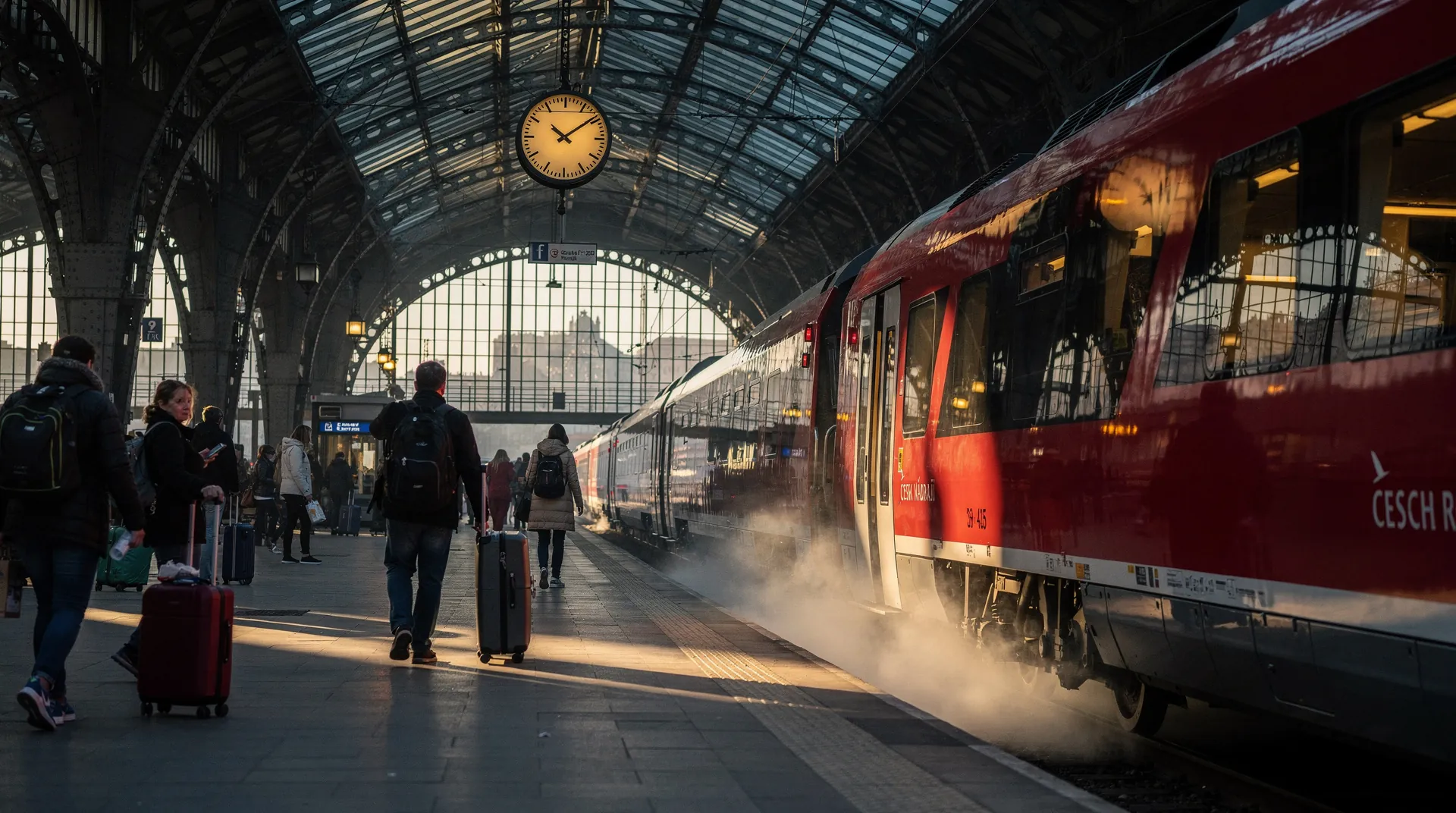
EC (EuroCity) and RE trains run directly from Prague hlavní nádraží to Dresden Hauptbahnhof. Journey time: 2h 10min to 2h 30min. Price: approximately 20–40 EUR one way depending on booking time and ticket type. Book in advance for the cheapest fares at bahn.de or cd.cz.
The train journey through the Elbe valley between Děčín and Dresden is scenic — the river gorge, sandstone formations, and the approach into Saxony are worth looking out the window for.
From Dresden Hauptbahnhof, the historic centre (Altstadt) is 15 minutes on foot or a few minutes by tram.
By bus
FlixBus runs from Prague Florenc to Dresden. Journey time: 2h 30min–3h. Cheaper than the train (from around €8 one way), but bus arrival is often at Dresden’s peripheral bus station rather than the central Hauptbahnhof. The train is more convenient and the time saving rarely justifies the comparison.
By car
Prague to Dresden via D8 and A17 motorways: about 1h 50min to 2h in light traffic. The drive through the Elbe valley in Germany is particularly attractive. Parking in central Dresden — use the large car parks near the Altmarkt or Prager Strasse. Note: daily parking near the Altstadt costs approximately €8–15.
Czech motorway vignette required on D8 (already covered if you have a standard Czech vignette). No special German road fees.
By organised tour
Several guided day trips run from Prague to Dresden. The advantage: a guide who covers the bombing and reconstruction history, the pre-war Dresden, the political history of Saxony, and the specific story of each monument. The combined Bohemian Switzerland and Dresden tours (Bastei Bridge + Dresden in one long day) are popular and work well with the itinerary geography.
Guided day tours from Prague to Dresden, including combo options with Bohemian Switzerland:
Hour-by-hour day plan (9 a.m. to 6:30 p.m.)
9:00 a.m. — Depart Prague hlavní nádraží by EC (EuroCity) or RE train. The 2h 10–30min journey through the Elbe valley passes through Děčín, then through the Saxon Switzerland gorge (keep to the right side of the train for the views). Book at bahn.de or cd.cz at least 2 weeks ahead — early-booking fares can halve the walk-up price.
11:15 a.m. — Arrive Dresden Hauptbahnhof. Walk 15 minutes through Prager Strasse to the Altstadt, or take tram 8 or 9 (two stops, €2.30).
11:30 a.m.–1:00 p.m. — Frauenkirche (1–1.5 hours). Enter the church and take your time with the interior — the rebuilt Baroque dome (91 metres), the painted vault, the altar. Read the small museum about the reconstruction in the church undercroft. Then stand outside and look carefully at the facade: the darker stones are the originals, incorporated wherever possible. This act of looking — noticing the scar tissue — is the most important thing you can do at the Frauenkirche.
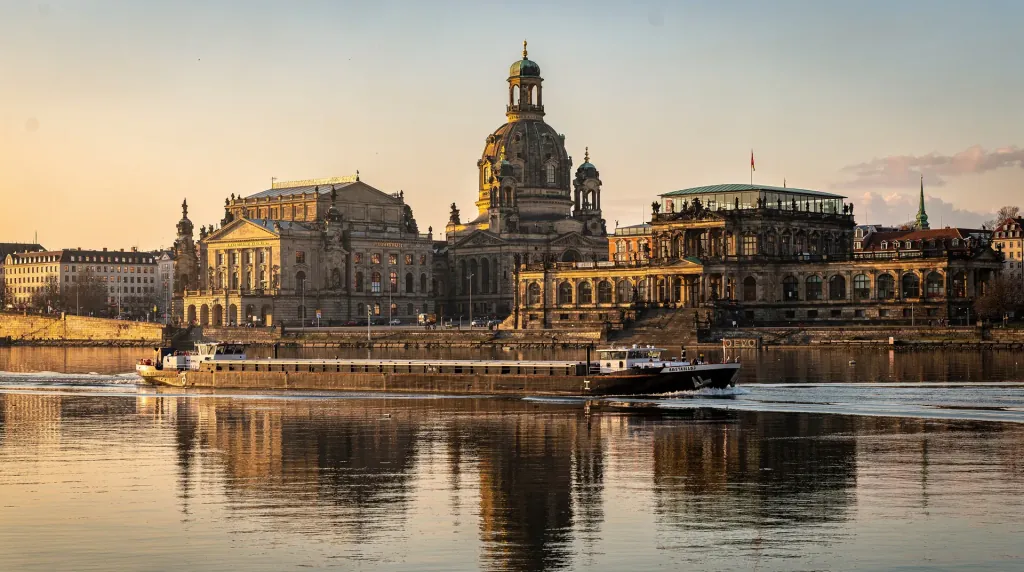
1:00–1:45 p.m. — Brühlsche Terrasse and Elbe waterfront. Walk east from the Frauenkirche along the terrace above the river. The panoramic view encompasses Frauenkirche, Hofkirche, Semperoper, Residenzschloss — the classic Dresden skyline. This is Canaletto’s view, essentially unchanged in 280 years. The Augustus Bridge (Augustusbrücke) below provides the best angles looking back toward the Altstadt.
1:45–3:00 p.m. — Lunch at Sophienkeller (Taschenberg 3, next to the Zwinger). Saxon cooking in medieval cellar vaulting. Roast pork knuckle, venison goulash, Saxon wine. Around €14–20 per main. Reserve ahead in summer.
3:00–4:30 p.m. — Zwinger palace complex (1.5 hours). Enter the courtyard through the Kronentor (free). Walk all four gallery wings. The Gemäldegalerie Alte Meister (Raphael’s Sistine Madonna is the centrepiece) requires a separate entry fee of €14 — worth it if you have time. The courtyard and Wallpavillon fountain alone are magnificent without paying.
4:45 p.m. — Walk to the Semperoper exterior and Theaterplatz. The opera house, rebuilt in 1985 after 1945 destruction, is one of the most beautiful 19th-century theatres in Europe. No entry required for the exterior.
5:30 p.m. — Return train from Dresden Hauptbahnhof to Prague. Late afternoon trains run approximately every 2 hours — check bahn.de for the last practical service. Arrive Prague approximately 7:30–8 p.m.
Photography notes
Frauenkirche exterior detail (overcast day is best): Overcast light reveals the tonal contrast between dark original stones and light new stone without the harsh shadows of direct sun. Use a 50–85mm equivalent to isolate sections of the facade.
Dresden Altstadt panorama from the Augustus Bridge (late afternoon, 4–6 p.m.): The classic western view of the skyline with the Frauenkirche, Hofkirche, and Semperoper reflected in the Elbe. Golden hour in summer (8–9 p.m.) is extraordinary; for a day trip, arrive at the bridge around 4–5 p.m. for warm light.
Zwinger courtyard (morning, 9–11 a.m.): No crowd photography is possible later in the day. The courtyard fountains and the Wallpavillon arch make strong architectural compositions. Wide-angle from the north gate.
Elbe from the steamboat pier: Dresden’s fleet of historic paddle steamers on the Elbe — if one is moored, the combination of historic vessel and Baroque skyline is excellent.
What to see, realistically, in a day
Frauenkirche (1 hour minimum). The centrepiece of the Altstadt and the most important site to understand. The church’s exterior shows the restoration — darker sandstones (original 18th-century pieces) next to lighter modern replacements. Inside, the rebuilt Baroque interior is extraordinary, with a dome that ascends 91 metres. There’s a small museum documenting the destruction and reconstruction. Entry to the church: free. Tower access: €8. The story of the reconstruction alone justifies the visit.
Zwinger (1.5 hours). The 18th-century Baroque palace complex built for Augustus the Strong. Its courtyard — surrounded by pavilions, galleries, and the famous Wallpavillon — is the most purely beautiful piece of Baroque architecture in Germany east of the Rhine. The Gemäldegalerie Alte Meister (Old Masters Picture Gallery) inside the Zwinger holds an extraordinary collection including Raphael’s Sistine Madonna, Giorgione’s Sleeping Venus, and rooms of Canaletto’s Dresden views. Gallery entry: €14 (€350 CZK). Worth it if you have time; the courtyard alone is free.
Semperoper (exterior, or opera performance if booked). The opera house on Theaterplatz, rebuilt twice (the current building dates from 1878, destroyed 1945, rebuilt 1985). The exterior is Baroque grandeur at its most theatrical. If you want to attend a performance, book well in advance at semperoper.de — the Dresden State Orchestra and Dresden Staatskapelle are among the finest in Europe.
Elbe waterfront and Brühlsche Terrasse (45 minutes). The terrace above the Elbe offers the classic Dresden panorama: Frauenkirche, Hofkirche (Catholic cathedral), Semperoper, and the Elbe. This is the view that appeared on 18th-century Canaletto canvases and looks almost identical today. Walk east toward the Augustus Bridge for the best angles.
Neustadt (30–45 minutes, optional). Cross the Augustus Bridge to the Neustadt (New Town — ironically the older of the two districts). The Kunsthofpassage is a series of courtyard art installations that’s popular and genuinely charming. The Neustadt is also where the better restaurants and bars are.
What to skip: the Military History Museum (excellent but requires half a day) and the Residenzschloss (worth it but adds 2 hours — better saved for an overnight visit).
Where to eat
Sophienkeller (Taschenberg 3, near the Zwinger): A large, theatrical Saxon restaurant in medieval vaulted cellars. Game dishes, roast pork, Saxon wine. Touristy in presentation but the food is genuine and the setting is atmospheric. Around €14–20 (€350–500 CZK equivalent).
Dresdner Feldschlösschen (Blasewitzer Strasse, 15 min from Altstadt): Local brewery pub with proper Saxon cooking at honest prices. Around €10–15. Better value than the Altstadt tourist restaurants.
Café Pattis (Prager Strasse): A Dresden institution for coffee and cake — Bienenstich, Streuselkuchen, Black Forest cake. Good for a mid-afternoon stop.
Common mistakes and what we’d do differently
Treating Dresden purely as a tourist spectacle. The Frauenkirche and Zwinger are beautiful, but the real weight of Dresden comes from engaging with the 1945 bombing and the reconstruction story. Take 20 minutes to read about the Frauenkirche’s history before you arrive.
Not booking the train in advance. EC train tickets from Prague to Dresden are significantly cheaper bought 2–4 weeks ahead at bahn.de. Day-of tickets can be twice the price.
Trying to do the Dresden Art Gallery and everything else in one day. The Alte Meister gallery is worth a dedicated visit; trying to rush through it in an hour while also doing the Frauenkirche and the Zwinger courtyard means doing none of them justice. Prioritise.
Skipping the Elbe banks. The riverside walkway and the Brühlsche Terrasse are free and give the best architectural views. Don’t miss them in favour of indoor museums.
Tour vs DIY — which to choose for Dresden
Book a guided tour if:
- You want the bombing/reconstruction history explained well
- You’re combining Dresden with Bastei Bridge (Bohemian Switzerland) in one day
- You prefer transport handled from Prague
Go on your own if:
- You’re comfortable with train travel internationally (it’s simple — same ticket system as Czech trains, booked at bahn.de)
- You want to spend more time in the Alte Meister gallery or at the Semperoper
- You’re staying overnight in Dresden (strongly recommended if you can manage it)
Our recommendation: The train from Prague to Dresden is one of the most pleasant train journeys in Central Europe. Take it independently, book in advance, and plan your day around the Frauenkirche and Zwinger. If you want both Dresden and Bohemian Switzerland in one day, the Bastei and Dresden small-group day trip is the logical option.
For a private experience, the full-day private trip from Prague to Dresden offers the most flexibility.
The Prague to Königstein and Dresden day trip adds the Königstein fortress — a vast Saxon hilltop stronghold 30 km from Dresden — for visitors who want both military history and Baroque culture in one day.
Season-specific notes
January–March: Dresden is worth visiting in winter — all major museums open, crowds minimal, and the city’s Baroque architecture has a particular quality under grey winter skies. The Frauenkirche’s interior is best appreciated without summer tourist volume.
May–September: Good conditions. June–August brings significant tourist numbers to the Altstadt. The Elbe terrace and Neustadt are more pleasant in summer heat. Restaurant terraces along the river open in April.
December: The Striezelmarkt Christmas market (Altmarkt) is one of Germany’s oldest, running from late November to 24 December. Dresden in December is genuinely atmospheric — mulled wine, the illuminated Baroque buildings, the market traditions. Worth a specific visit.
Insider note on trains: The EC trains from Prague are the most comfortable; they have a dining car. The RE (Regional Express) trains are cheaper but have no food service. For a comfortable day-trip experience, book EC.
Dresden versus other Prague day trips
Dresden is unusual among Prague’s day trips for crossing an international border, and it’s worth weighing against the alternatives before committing a full day to it. The day-trip comparison page ranks it alongside Český Krumlov, České Budějovice, and the rest — useful if history and architecture matter more to you than the cross-border novelty. For the transport decision specifically, the train vs bus vs tour guide covers how this route compares to Prague’s other options in comfort and price.
Families deciding whether Dresden suits younger children should note that the Zwinger courtyard and Frauenkirche are genuinely family-friendly (see the FAQ below), but the emotional weight of the 1945 bombing history is better suited to visitors 10 and up — similar in that respect to Terezín, the other Prague day trip with serious WWII content. If you’re planning a longer Bohemia-and-Saxony trip, the 5-day Prague itinerary has room to combine Dresden with a South Bohemia day without over-scheduling.
Is one day in Dresden enough?
For the core sights — Frauenkirche, Zwinger courtyard, Brühlsche Terrasse, Semperoper exterior — a single day from Prague is genuinely sufficient, and the hour-by-hour plan above covers it comfortably. Where a day trip falls short is the Alte Meister gallery (worth a dedicated half-day on its own), the Residenzschloss, and the Neustadt’s bar and restaurant scene, which rewards an evening you won’t have if you’re catching a train back to Prague. If Dresden’s art and history genuinely interest you, an overnight — even just one — lets you see the Zwinger galleries properly and experience the Neustadt after dark, which has a different character entirely from the tourist-oriented Altstadt.
Frequently asked questions about Dresden from Prague
Do I need a visa or special documents to travel from Czech Republic to Germany?
No. Both countries are in the Schengen Area. EU/EEA citizens and most international visitors with valid Schengen access can cross freely. No border checks at the Czech-German border.
Is Dresden expensive compared to Czech cities?
More expensive than Prague, but still cheaper than Munich or Berlin. Restaurant meals: €12–20 for a main course in a sit-down restaurant. Museum entry: €8–14. Coffee: €3–5. Budget approximately €40–60 per person for a day (excluding transport and major museum entry).
What currency is used in Dresden?
Euros (€). Czech koruny are not accepted — exchange or use a card before crossing the border. Most major establishments in Dresden accept credit cards.
When is Dresden’s famous Christmas market (Striezelmarkt)?
The Striezelmarkt runs from late November to 24 December on the Altmarkt. It’s one of Germany’s oldest Christmas markets and genuinely worth the trip — Dresden in December is atmospheric and the mulled wine is excellent.
What happened to Dresden in February 1945?
Between 13–15 February 1945, British Royal Air Force and American USAAF bombers conducted multiple raids on Dresden. Firestorms destroyed most of the historic city centre. Casualty estimates range widely; contemporary scholarship suggests 22,700–25,000 deaths. The raids remain controversial due to the timing (late in the war, with Dresden not a primary military target) and the scale of destruction. The rebuilt city is partly a memorial to this history.
Can I combine Dresden with Schloss Moritzburg?
Yes — Schloss Moritzburg is a Baroque hunting palace on a lake 15 km northwest of Dresden. Some tours include it as a stop; the Dresden and Schloss Moritzburg day trip from Prague covers both. Best by car or organised tour.
Is there a private tour option with Litoměřice en route?
Yes — the private day trip from Prague to Dresden and Litoměřice adds the beautiful North Bohemian town of Litoměřice as a stop on the return journey — a wine-growing town with a lovely main square that few Prague tourists ever see.
Do I need to carry any identification for the border crossing?
Yes — although the Czech Republic and Germany are both Schengen Area members, you should carry your passport or national ID card. Police checks at the Czech-German border are technically possible under Schengen rules and occur periodically. In practice most journeys see no check.
Are children welcome on the Zwinger and Frauenkirche visits?
Both are entirely family-friendly. The Zwinger courtyard is free and has open spaces where children can move around. The Alte Meister gallery has family guided tours available. The Frauenkirche has a children’s audio guide. Dresden is manageable for families with children of any age.
Can I combine Dresden with Bohemian Switzerland in one day using public transport?
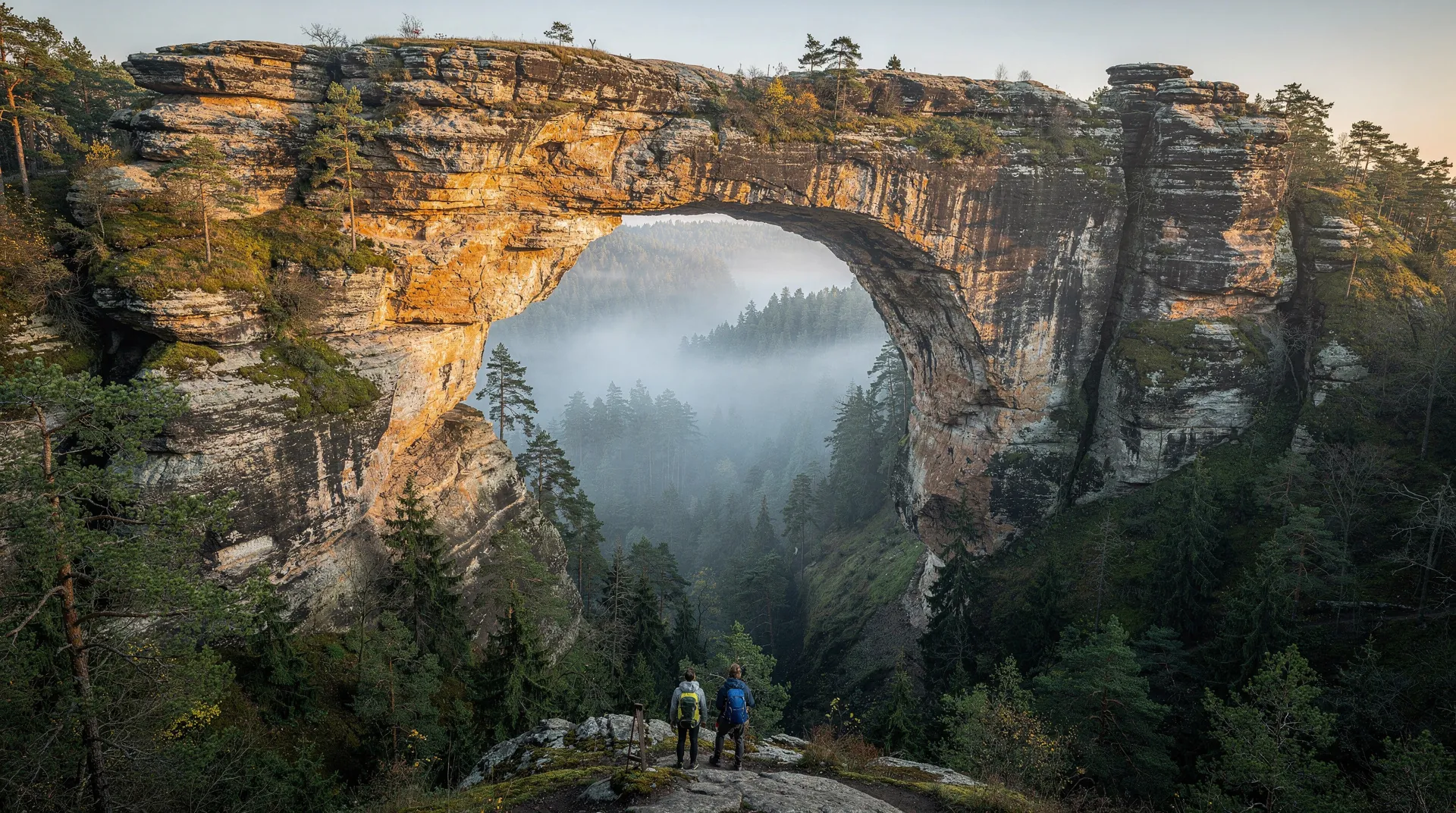
It’s tight but possible on a long day, since both are on the same Elbe-valley rail corridor through Bad Schandau. Most travellers find a guided combo tour — see the Bohemian Switzerland guide — handles the connections more reliably than self-arranged trains and buses, especially if you also want time at the Pravčická Brána arch.
Practical info
- Distance from Prague: 155 km north (into Germany)
- Travel time: 2h 10–30min by direct train from Prague hlavní nádraží
- Train booking: bahn.de or cd.cz
- Zwinger + Alte Meister Gallery entry: €14
- Frauenkirche: free (tower €8)
- Best time: May–October; December for Christmas market
- Currency: Euro (€); no Czech koruny accepted