How Josefov survived — and why it almost didn’t
Prague’s Jewish community is documented from at least the 10th century, when Arab traveller Ibrahim ibn Ya’qub wrote of a Jewish trading settlement in Prague in 965 or 966. By the 12th century, a walled Jewish town — the name Josefov came much later, after Emperor Joseph II’s 1781 Edict of Tolerance — occupied the area north of Old Town Square, governed by its own laws and leadership.
The community endured repeated pogroms, forced conversions, and expulsions. The most catastrophic was the 1389 Easter pogrom, when approximately 3,000 Jews were killed in a single day after being accused of desecrating the Host. Rabbi Avigdor Kara, who survived, wrote a lamentation poem that is still recited in the Old-New Synagogue on Yom Kippur. The community recovered, rebuilt, and continued.
Emperor Rudolph II (reigned 1576–1611) gave Prague’s Jewish community unusual protections; his court physician was Jewish, and the community under Rabbi Löw (the Maharal, 1520–1609) reached one of its medieval highpoints. The Maharal’s reputation as a scholar and legal authority spread across European Jewry; the Golem legend, associating him with a clay creature animated to protect the community, came much later but attached itself firmly to his historical figure.
Joseph II’s 1781 reforms granted Jews rights of residence outside the ghetto and opened most professions to them. The area was officially renamed Josefov in 1850, the year it was incorporated into Prague’s municipal structure as the fifth quarter. By this time the ghetto was severely overcrowded, lacking sanitation, and the subject of urban reform debate. The 1893–1913 demolition cleared almost the entire medieval district — the wide boulevard Pařížská was built across the site, along with new Art Nouveau apartment buildings — and the six monuments survived through a combination of historical consciousness, community lobbying, and what retrospective irony reveals was a Nazi plan to preserve them as evidence of Jewish life.
The Jewish Museum’s records, documents, Torah scrolls, and ceremonial objects were centralized in Prague during the occupation from Jewish communities across Bohemia and Moravia. The Nazis called it a “Central Jewish Museum” — the museum now uses this history as part of its own curatorial framing.
| Where | Josefov, north of Old Town Square, within Staré Město |
| Cost | Single ticket around €24 / 600 CZK adult, Old-New Synagogue included — see the Jewish Quarter ticket page |
| Time needed | 2–2.5 hours minimum; 3 hours if you read the Pinkas Synagogue wall of names in full |
| Getting there | Metro Staroměstská (Line A), then 5 minutes north on Pařížská; also an easy walk from the Astronomical Clock |
| Best time to visit | Opening time (9:00) for the cemetery and Pinkas Synagogue at their quietest |
Why Josefov is essential, not optional
Prague’s Jewish Quarter — Josefov — is one of the best-preserved medieval and early modern Jewish heritage sites in Europe, and its current state is paradoxical. The district was almost entirely demolished between 1893 and 1913 in a city-wide slum clearance programme. The six surviving monuments — five synagogues, a cemetery, and a ceremonial hall — were preserved partly because local Jewish community members fought for them, and partly because the Nazis, during the occupation, intended them as a future “exotic museum to an extinct race.”
The result is a concentrated, emotionally heavy, architecturally extraordinary set of sites that rewards at least half a day. It is not comfortable tourism — the Pinkas Synagogue, where the names of nearly 80,000 Czech and Slovak Jewish Holocaust victims are inscribed on the walls, is one of the most affecting spaces in Central Europe — but it is important.
The six sites on the combined ticket
Starý židovský hřbitov — Old Jewish Cemetery
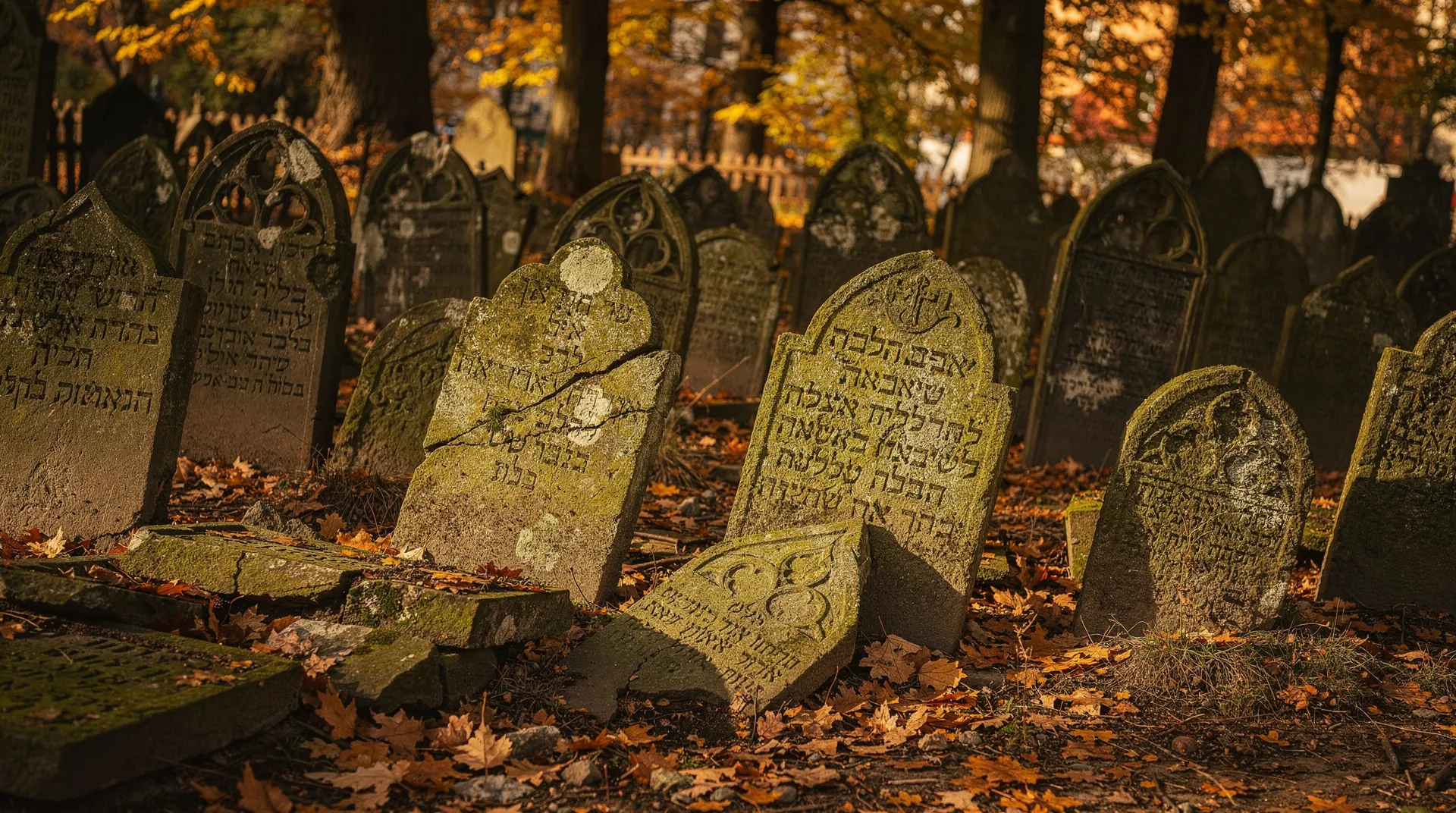
The Old Jewish Cemetery is the most visually striking and sobering of the sites. Active from the early 15th century until 1787, it contains an estimated 12,000 tombstones stacked in multiple layers — Jewish law prohibits disinterring the dead, so when the small plot filled, new earth was added and burials continued above older graves. In some places the ground is layered 12 bodies deep.
The stones themselves, many tilted at dramatic angles and covered with moss, create an extraordinary landscape. Many are inscribed with symbols indicating the buried person’s family name or profession: grape clusters for vintners, scissors for tailors, hands in blessing for descendants of the priestly Kohanim tribe. The grave of Rabbi Loew (Maharal), the 16th-century scholar associated with the legend of the Golem, is in the eastern section and still receives small stones and folded notes from visitors.
Pinkasova synagoga — Pinkas Synagogue
The Pinkas Synagogue (16th century) is now a memorial. Its walls are covered with the names of 77,297 Bohemian and Moravian Jewish victims of the Shoah, inscribed by hand over many years by painter Václav Boštík and his team after 1945. The names are organized by community and family. Walking through the two floors of the interior, reading names that go on and on — grandparents, parents, children, family clusters — is genuinely difficult. Upstairs, drawings made by children in the Theresienstadt concentration camp are on permanent display. This is the most emotionally intense site in the quarter.
Španělská synagoga — Spanish Synagogue
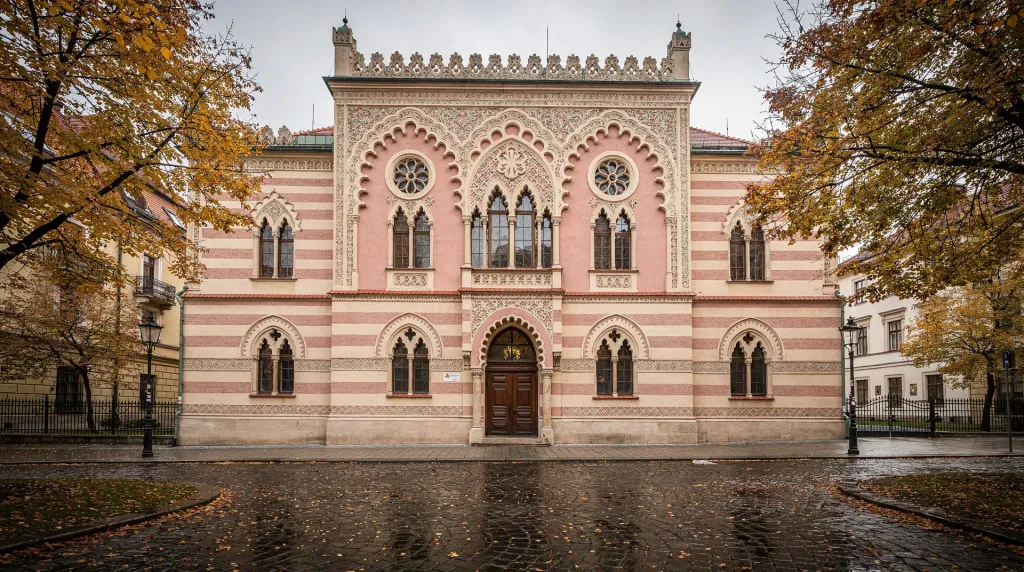
Built in 1868 in a Moorish Revival style inspired by the Alhambra in Granada, the Spanish Synagogue is architecturally the most spectacular of the five. The interior — tiled walls, geometric stucco, a stunning gilded dome — feels almost hallucinatory after the sobriety of the cemetery and Pinkas. The upper galleries contain permanent exhibitions on the history of Czech Jewry from the emancipation era through the Second World War.
Maiselova synagoga — Maisel Synagogue
The Maisel Synagogue (16th century, heavily rebuilt in Neo-Gothic style in the 1890s) houses a permanent collection of silver Judaica, Torah crowns, and ceremonial objects from the Jewish Museum’s collection. One of the most extensive collections of its kind in Europe. If you have serious interest in Jewish religious art and material culture, this is the richest site in the quarter; if you’re moving quickly, it can be abbreviated.
Starý-Nová synagoga — Old-New Synagogue
The Staronová synagoga (built around 1270) is the oldest surviving synagogue in Central Europe and one of the earliest examples of Gothic architecture in Prague. It is still an active place of worship for the Prague Jewish community. The interior is spare, functional, and very old: brick walls, a simple bimah (raised reading platform), the red flag with the Star of David given to the community by Emperor Ferdinand III in the 17th century.
Entry is included in the single ticket (since 1 January 2024). It’s worth it for the authenticity of the space.
Obřadní síň — Ceremonial Hall
The Ceremonial Hall (1908) is a small Romanesque Revival building adjacent to the cemetery that served as a preparation hall for the dead. It now houses an exhibition on Jewish funeral rites and death customs. Informative and not overly long.
Tickets and timings
Single ticket (all five synagogues including the Old-New Synagogue, plus cemetery and ceremonial hall; valid 3 opening days):
- Adult: ~€24 / 600 CZK
- Child (7–15): ~€8 / 200 CZK; under 7 free
- Student (under 26): ~€16 / 400 CZK
- Free with the Prague Visitor Pass and Prague CoolPass (one visit per site)
Opening hours:
- Daily except Saturday (Shabbat) and Jewish holidays
- April and September–17 October: 9:00–18:00
- May–August: 9:00–19:00
- 18 October–March: 9:00–16:30 (24 December until 14:00; 1 January from 11:00)
- Tickets are sold until 30 minutes before closing
The sites can be busy from mid-morning. Arriving at 9:00 gives you the cemetery and Pinkas Synagogue at a quieter moment.
Note: Photography is permitted in most spaces except the Old-New Synagogue interior. Modest dress is expected at all sites.
Different ways to experience the Jewish Quarter
Self-guided with combined ticket
The combined ticket comes with an information map and the exhibitions are well-labelled in English. You can move at your own pace and spend as long as you need in each space. Allow a minimum of 2.5 hours; the Pinkas Synagogue alone typically takes 30–45 minutes if you read the names.
Guided Old Town and Jewish Quarter tour
For context on the whole northern Old Town as well as Josefov, a combined tour covers more ground:
Prague Old Town and Jewish Quarter guided walking tourCastle and Jewish Quarter combined tour
An unusual but efficient combination — both sites in one day with a guide:
Prague Castle and Jewish Quarter combined tourCombined admission with Old Town highlights
For visitors who want to pair the Jewish Quarter with the Clock Tower and Prague Castle in a single ticket:
Prague Castle, Jewish Quarter, and Clock Tower combined admissionClassical concert in the Spanish Synagogue
The Spanish Synagogue hosts regular classical music concerts in the evening — chamber music in a Moorish Revival space with exceptional acoustics. A very different way to experience the building:
Classical concert in the Spanish SynagogueSeasonal notes
Shabbat and Jewish holidays: All Jewish Museum sites are closed on Saturdays and on Jewish holidays. The holidays include Rosh Hashanah (September–October), Yom Kippur (ten days after Rosh Hashanah), Sukkot, Passover, and Shavuot — exact dates shift annually with the Jewish calendar. Check jewishmuseum.cz before your visit.
Summer (June–August): The quarter is at maximum capacity. The Old Jewish Cemetery is a controlled entry space — visitor numbers are capped per session. Arriving at 9:00 gives you the cemetery and Pinkas Synagogue in relative quiet. By 11:00, group tours fill the narrow cemetery paths.
Winter (November–March): Closing hours shift to 16:30, and the reduced natural light in the cemetery and Pinkas Synagogue changes the atmosphere. The winter quiet is appropriate for these spaces — it’s easier to spend time reading the Pinkas walls without the pressure of a moving crowd.
Pařížská at any season: The luxury boulevard that replaced most of the demolished ghetto runs north from Old Town Square to Čechův most. The Art Nouveau facades from 1900–1910 are exceptional regardless of what’s in the ground-floor windows. Worth a slow walk in any weather.
Insider details
The Pinkas wall — take your time: Many visitors walk the ground floor and leave. The upper floor contains the children’s drawings from Theresienstadt — small watercolours and pencil drawings of butterflies, flowers, houses, and animals made by children who mostly did not survive. They are displayed with each child’s name and dates. The wall names below and the drawings above form a complete and devastating testimony. Allow at least 20 minutes on each floor.
The 9:00 entry: The Old Jewish Cemetery and Pinkas Synagogue at 9:00 in the morning have perhaps a dozen visitors rather than the hundreds of midday. The layered tombstones in morning light are quieter and more affecting without the crowd.
Červená street: The exterior of the Old-New Synagogue on Červená street — the small alley on the north side — is one of the most intact stretches of medieval-scale urban fabric in Prague. The contrast between the low, ancient synagogue and the Art Nouveau apartment building across the street is sharp and telling.
The Franz Kafka angle: Kafka’s connection to Josefov is personal and biographical. His birthplace (Náměstí Franze Kafky, one minute north of the Old-New Synagogue) is marked with a bust by sculptor Jaroslav Róna. Kafka described the Josefov of his childhood as a labyrinthine place of dark memories — “the dark corner” — and the 1893 demolition happened when he was ten years old. The Franz Kafka Museum is in Malá Strana (opposite bank), not in Josefov, but tickets are available:
Franz Kafka Museum entry ticketWhich tour to book
A guided tour adds context that you won’t get from reading labels — particularly around the cemetery, where the layering system, the symbolism of the tombstones, and the community history benefit greatly from a knowledgeable guide:
Prague Jewish Quarter walking tour with admission ticketsFor a premium small-group experience with deeper historical framing:
Prague Jewish Quarter premium tour with admissionFor a private tour, ideal for families or those who want to set their own pace:
Jewish Quarter private walking tour with synagoguesFor a combined Old Town and Jewish Quarter tour in one session:
Prague Jewish Quarter and museum guided tourGetting there
Metro: Staroměstská (Line A, green) — exit and walk north along Pařížská street. The first synagogue entrance (Maisel, or the cemetery) is about 5 minutes’ walk.
Tram: Lines 17 or 18 to Staroměstská, same walking directions.
On foot from Old Town Square: Walk north on Pařížská or Maiselova — 5–7 minutes.
Josefov is bounded by Pařížská (west), Dlouhá (north), Náměstí Republiky area (east), and Old Town Square (south). All sites are within a compact 500-metre radius.
Photographer’s note
The Spanish Synagogue interior — gold, geometric, and vaulted — is visually extraordinary. The building allows photography (no flash). Best light is midday when the main dome windows illuminate the interior. The Old Jewish Cemetery is best early morning or on a slightly overcast day when the stacked tombstones and layered shadows are visible without harsh sunlight.
The exterior of the Old-New Synagogue, on Červená street, photographs well from the north. It is one of the few surviving Gothic buildings of this scale in the city outside the castle complex.
Frequently asked questions about the Jewish Quarter
How long do you need for the Jewish Quarter?
Budget 2–2.5 hours minimum for the combined ticket sites. If you enter every space carefully and read the Pinkas wall names, 3 hours is more appropriate.
Is the Jewish Quarter open on Saturdays?
No. All Jewish Museum sites are closed on Saturdays (Shabbat) and on Jewish holidays. Check the Jewish Museum website (jewishmuseum.cz) for specific holiday closures before visiting.
Do I need the combined ticket or can I choose individual sites?
Individual site tickets are available but cost more per site. The combined ticket is better value if you plan to see more than two sites. Most visitors who come to Josefov should buy the combined ticket.
Is the Jewish Quarter family-friendly?
The Pinkas Synagogue is heavy content for young children. The Spanish Synagogue and the cemetery are more visually engaging for families. Use judgement based on your children’s age and maturity.
What is the connection between the Jewish Quarter and the Golem legend?
Rabbi Loew (Maharal of Prague, 1520–1609) is the figure most associated with the Golem legend — a creature fashioned from clay of the Vltava riverbed and animated by placing a shem (written name of God) in its mouth. The legend appears in 16th-century Jewish folklore and was heavily elaborated in 19th-century Czech and German literature. Rabbi Loew is buried in the Old Jewish Cemetery.
Is Pařížská worth walking even for non-shoppers?
Pařížská (the wide boulevard running north from Old Town Square through the heart of Josefov) is one of the finest examples of Art Nouveau urban planning in Europe. The facades from 1900–1914 are exceptional. Worth a slow walk regardless of your interest in its current luxury retail occupants.
Is photography allowed in the Jewish Museum sites?
Photography is permitted in most outdoor areas and in the Spanish Synagogue. Inside the Pinkas Synagogue (the wall of names), photography is generally discouraged out of respect, though it is not strictly prohibited. Photography inside the Old-New Synagogue is prohibited. Modest dress is expected at all sites.
Can I visit only the Old Jewish Cemetery without buying the combined ticket?
The cemetery is part of the Jewish Museum complex and requires the combined ticket for entry. There is no standalone cemetery ticket available. The combined ticket is the only way in.
Are the sites accessible for visitors with mobility limitations?
The Old Jewish Cemetery has uneven, tilted pathways — not ideal for wheelchairs or those with limited mobility. The Spanish Synagogue and Maisel Synagogue are accessible. The Pinkas Synagogue has stairs to the upper floor. The Old-New Synagogue has a step at the entrance. Check jewishmuseum.cz for specific accessibility information per site.
What is the significance of leaving small stones on graves in the Old Jewish Cemetery?
Placing a stone on a grave (rather than flowers) is a Jewish mourning tradition — stones are permanent, unlike flowers, and their placement signals that someone has visited and remembered. On the grave of Rabbi Löw (Maharal), visitors also leave folded notes and prayers, a practice that developed in the early modern period and continues today.
Beyond Josefov: following the wider story
The Jewish Quarter is the physical centre of this history, but it isn’t the whole story. The Jewish heritage theme trail links Josefov to other sites across the city connected to Prague’s Jewish history, and the Kafka trail traces Franz Kafka’s Josefov childhood and adult life through the surrounding streets. Both are worth combining with a Josefov visit if you have more than a single afternoon for this part of the city’s history.
Practical info at a glance
- Address: Josefov, 110 00 Praha 1 (bounded by Pařížská, Náměstí Republiky, Old Town Square)
- Opening hours: Daily 9:00–18:00 (Apr, Sep–17 Oct), 9:00–19:00 (May–Aug), 9:00–16:30 (18 Oct–Mar); closed Saturdays and Jewish holidays
- Combined ticket price: ~€24 / 600 CZK adult, Old-New Synagogue included
- Nearest metro: Staroměstská (Line A, green)
- Official website: jewishmuseum.cz