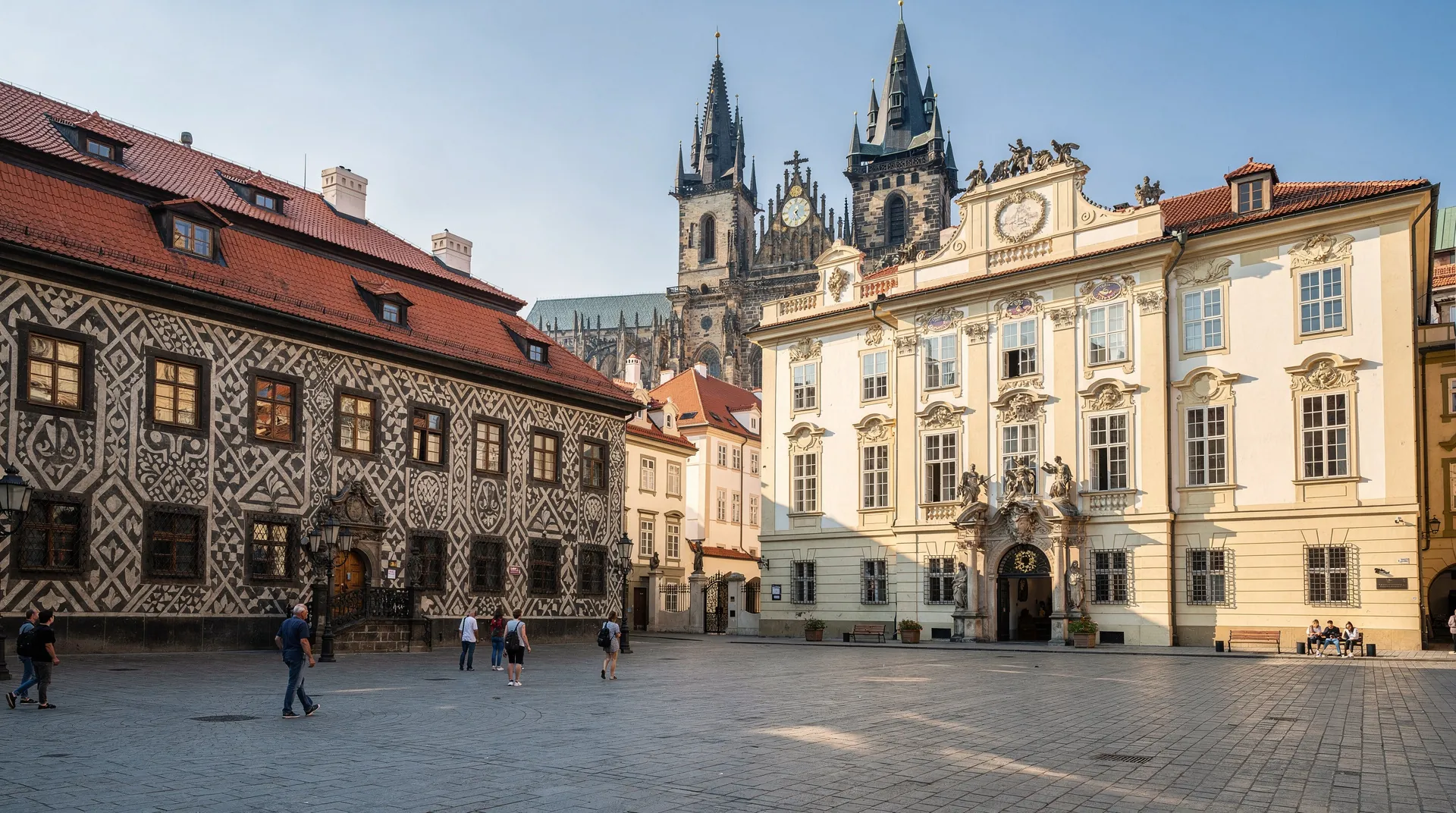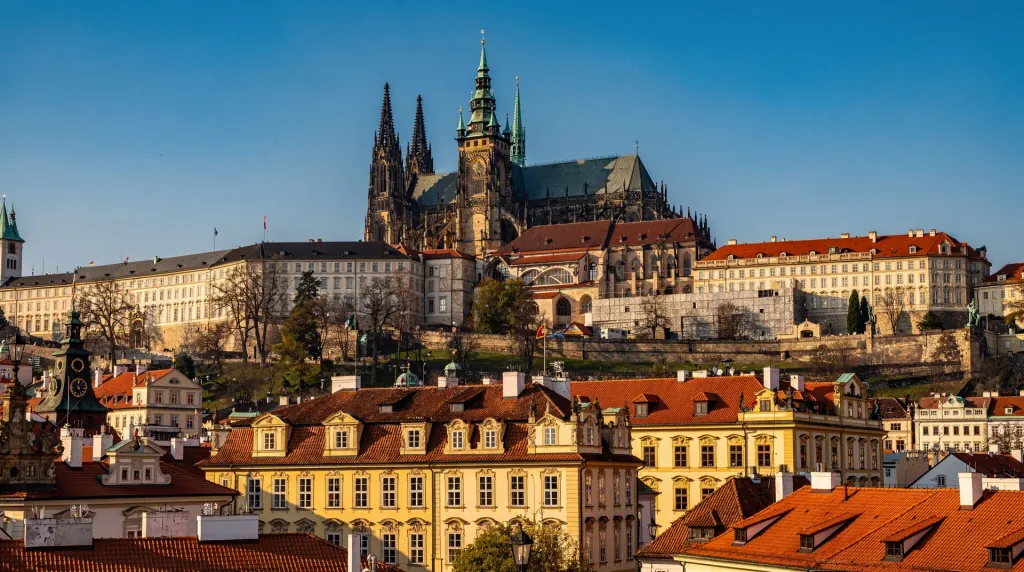
At a glance
| Where | Hradčany, on the ridge above the west bank of the Vltava |
| Cost | Grounds free; Circuit B around €14; Circuit A around €18 |
| Time needed | Around 2.5–3 hours for Circuit B; a full morning if adding Lobkowicz Palace or the Royal Garden |
| Getting there | Tram 22 or 23 to Pražský hrad, or 15-minute uphill walk from Malostranská metro (Line A) |
| Best time | Opening (9:00) before the tour buses, or 16:00–17:00 in summer for quieter light |
A thousand years of Bohemian history on a single ridge
Pražský hrad began as a wooden palisade in the 870s under Prince Bořivoj, the first Přemyslid ruler to convert to Christianity. The stone fortifications came gradually, layer upon layer, over the next 11 centuries. By the time Charles IV — King of Bohemia and Holy Roman Emperor — began transforming Prague into the de facto capital of the empire in the 1340s, the castle already contained Romanesque basilicas, a Přemyslid palace, and defensive walls.
Charles commissioned the Gothic cathedral in 1344, appointing the French architect Matthias of Arras as its first builder. Matthias died in 1352, and the project passed to a young German architect named Peter Parler, who worked on St Vitus until 1399. The nave remained unfinished for almost 500 years.
The Habsburgs arrived in 1526, when Ferdinand I took the Bohemian throne after the last Jagiellonian king died childless. Rudolf II (reigned 1576–1611) turned the castle into the epicentre of European intellectual and artistic life — he collected compulsively (Dürer, Arcimboldo, Brueghel), patronised astronomers Tycho Brahe and Johannes Kepler, and filled the castle galleries with one of the most extraordinary collections in history. Most of that collection was looted by Swedish forces in 1648, the final act of the Thirty Years’ War.
The 1618 Defenestration of Prague — when Protestant Bohemian lords threw two Catholic royal governors and their secretary out of the castle’s Bohemian Chancellery window — ignited that same Thirty Years’ War. (All three survived; the Catholics credited the angels, the Protestants credited the dung heap 17 metres below.) The window is on the first floor of the Old Royal Palace, clearly labelled.
The 20th century brought its own dramas. In 1918, Tomáš Garrigue Masaryk became the first president of an independent Czechoslovakia from these walls. In 1939 and 1942, Hitler made the castle his Bohemian seat. In 1989, Václav Havel — playwright, dissident, revolutionary — was elected president and moved in. The castle has been the seat of Czech heads of state continuously since.
Why Prague Castle is worth a half-day of your life
Pražský hrad is not a single building. It’s a walled city within a city — 70,000 square metres spread across interconnected courtyards, palaces, gardens, churches, a basilica, a lane of tiny houses, and a gallery. The Guinness World Records lists it as the largest coherent castle complex in the world, and walking through it confirms that claim viscerally.
The castle anchors the left bank of the Vltava and has been the seat of Bohemian kings, Holy Roman Emperors, Czechoslovak presidents, and now Czech heads of state for more than 1,100 years. That layering of history — Romanesque crypt beneath Gothic cathedral beneath Baroque interiors beneath 20th-century renovations — is what makes it genuinely fascinating rather than merely impressive.
That said: the castle is crowded between June and September, certain sections have real queues, and the four ticket circuits can be confusing enough that plenty of visitors end up paying for things they won’t see or skipping things they wished they hadn’t. This guide is designed to prevent that.
The four ticket circuits
Circuit A — the widest sweep
Circuit A (around €18 / 450 CZK for adults) covers everything in Circuit B plus the Story of Prague Castle permanent exhibition and the Powder Tower. It’s the most complete option but adds considerable time and walking. Recommended only for history enthusiasts with a full morning free.
Circuit B — the one most visitors actually need
Circuit B (around €14 / 350 CZK) covers:
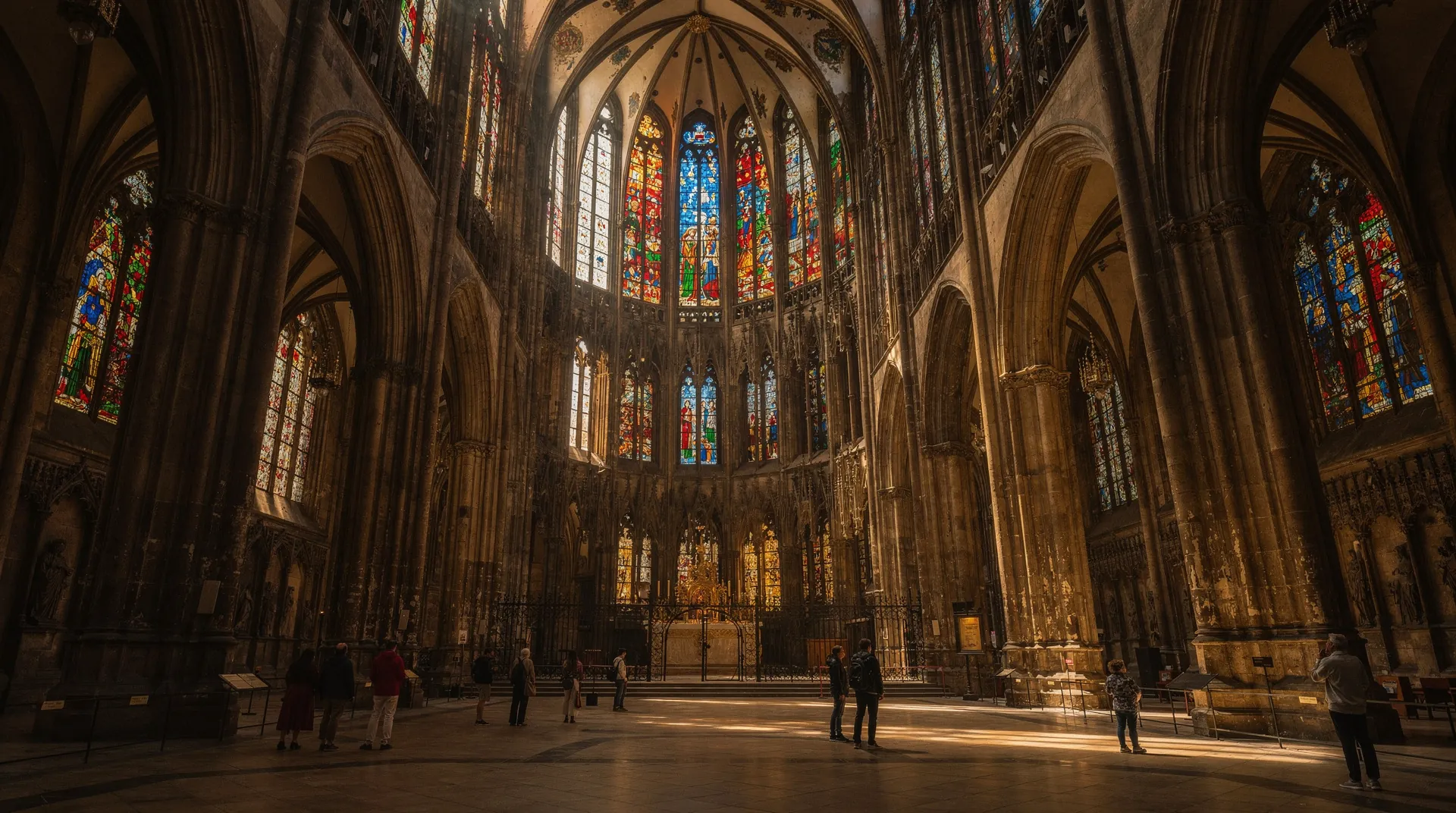
- Katedrála sv. Víta (St Vitus Cathedral) — the centrepiece. Gothic construction began in 1344 and finished — after a 600-year pause — only in 1929. The stained glass windows designed by Alfons Mucha on the north nave are worth slowing down for.
- Starý Královský Palác (Old Royal Palace) — the vast Vladislav Hall once hosted jousting tournaments indoors. The Bohemian Chancellery room is where the 1618 Defenestration of Prague (the spark that ignited the Thirty Years’ War) took place.
- Bazilika sv. Jiří (St George’s Basilica) — Prague’s best-preserved Romanesque interior. Cool, quiet, and overlooked by many visitors rushing past.
- Zlatá ulička (Golden Lane) — the row of colourful miniature houses built against the castle wall in the 16th century. Franz Kafka stayed briefly at no. 22 in 1916–17. The houses double as tiny exhibit spaces.
Circuit B is the correct choice for virtually all first-time visitors.
Circuit C — the exhibitions
Circuit C focuses on the Story of Prague Castle permanent exhibition only. Worth it if you have a specific interest in the archeological layers of the site, otherwise Circuit B is better value.
Circuit D — St Vitus Cathedral only
Circuit D (around €10 / 250 CZK) is the cheapest option and gives access only to the cathedral and its towers. A reasonable fallback if your time is limited to 90 minutes.
What you can see for free
The castle grounds — the first, second, and third courtyards, the exterior of St Vitus, the lane between the Basilica and Golden Lane — are accessible without any ticket, from 6:00 to 22:00 daily. You can watch the hourly Changing of the Guard at the main gate on Hradčanské náměstí for free. Many visitors spend two hours at the castle without paying anything, which is a perfectly valid approach if your interest is primarily the views and the architecture rather than the interiors.
Inside St Vitus Cathedral — what to slow down for
Most visitors rush through the cathedral nave in 15 minutes. They miss the things that reward patience.
The Mucha window (north aisle, third bay from the west): Alfons Mucha designed this window in 1931, at the end of his life, as a gift to the Czechoslovak nation. Unlike his commercial Art Nouveau poster work, this is austere and deeply felt — the colours are deep blue and gold, and the subject is Slavic saints and Přemyslid royalty. It is the most beautiful piece of glass in the cathedral.
The Wenceslas Chapel (south transept): Built by Peter Parler between 1362 and 1367 over the grave of Wenceslas I (the “Good King Wenceslas” of the Christmas carol — actually a 10th-century Bohemian duke). The lower walls are encrusted with semi-precious stones — amethyst, jasper, chrysoprase — set into gilt plaster. Murals above show the Passion and scenes from the life of Wenceslas. The door to the crown jewels chamber is in this chapel. The jewels themselves are not on display; they are kept in a room accessible only with seven keys held by seven different constitutional officers.
The Royal Mausoleum (central nave, before the choir screen): An ornate marble tomb by sculptor Alexander Collin (completed 1589) holds Ferdinand I, his wife Anne of Bohemia and Hungary, and Maximilian II. The white marble against the dark Gothic choir is dramatic.
The crypt: Below the nave, accessible by stairs, contains sarcophagi of Bohemian kings including Charles IV, Wenceslas IV, Rudolf II, and George of Poděbrady. Not included in all circuit tickets — check before you descend.
The Cathedral towers: The main south tower (96 metres) can be climbed for views over the castle complex. Entry is separate from the circuit ticket (~€5 / 120 CZK). The clock on the tower face is 16th century.
Different ways to experience the castle
Self-guided with audio guide
The castle’s own app (downloadable before you arrive) covers the main monuments adequately. GetYourGuide’s skip-the-line ticket with optional audio guide is the best value for independent visitors:
Prague Castle skip-the-line ticket with optional audio guideSmall-group guided tour
With a local guide, the experience is qualitatively different. Guides can take you to the specific spot where the Defenestration window is, explain the iconography of the Mucha window, and give context to the Wenceslas Chapel gems that panels can’t convey in two sentences. Best for first-time visitors who want to understand what they’re looking at:
Prague Castle small-group tour with local guide and admission2-hour castle district tour
Covers the castle complex and the surrounding Hradčany neighbourhood — useful if you want to combine the castle with a walk through the district:
Prague Castle and Castle District 2-hour guided tourPrivate city highlights tour
For families, couples, or anyone who wants a fully personalised itinerary covering the castle alongside other Prague highlights:
Prague city highlights private walking tourAfter-dark experience
The castle grounds remain accessible until 22:00. The night tour combining the castle, Charles Bridge, and Old Town covers a very different atmosphere — illuminated monuments, far fewer people:
Prague after dark — private night experience (Castle, Charles Bridge, Old Town)For the focused night walk through the castle specifically, with its illuminated Gothic cathedral and the city lights below:
Alchemy and mysteries of Prague Castle — walking tour after darkSeasonal notes
Spring (April–May): The Royal Garden (Královská zahrada) north of the castle opens in April. Cherry trees bloom in the garden and along the moat paths. The garden holds the Ball Game Hall (Míčovna) and the Belvedere summer palace. Peak crowds arrive from mid-April. Mornings are cool and quieter than summer.
Summer (June–August): The castle is at maximum capacity. Queues at ticket windows can be 30–40 minutes. The guard change at noon (full ceremony with the castle band) is worth seeing once. The late afternoon (16:00–17:00) is the best time to arrive — tour buses have left, the light is excellent, and the gardens are at their summer best.
Autumn (September–October): September is arguably the best month: warm light, smaller crowds than summer, and the wine harvest in the Strahov vineyards below the castle walls. Opening hours shift to 16:00 close from November.
Winter (November–March): The castle is atmospheric but reduced. The Royal Garden is closed. The Riding School (Jízdárna) sometimes hosts winter exhibitions. Crowds are minimal at midday. Snow on the cathedral’s Gothic pinnacles is one of Prague’s great photographs.
Insider details
Avoid the main gate queue: The tourist queue at the main gate on Hradčanské náměstí can be long. The north gate (on U Prašného mostu, accessible from the Prašný most tram stop or from the Royal Garden) is significantly quieter and deposits you directly into the second courtyard.
Midday concert at Lobkowicz Palace: If you’re combining Lobkowicz with Circuit B, the daily midday concert (12:00, about 50 minutes) is one of the more civilised ways to spend a lunch break in Prague. Chamber music in a room hung with Canalettos.
Prague Castle midday classical concert at Lobkowicz PalaceThe Powder Tower (Prašná věž / Mihulka): Included in Circuit A, overlooked by most Circuit B visitors. This cylindrical tower at the north end of the second courtyard served as an alchemical laboratory under Rudolf II. The exhibitions are modest but the tower itself has atmosphere.
The café at the back of the castle: The café behind the Basilica of St George, near the exit toward Golden Lane, has tables in a quiet corner of the third courtyard and is far less crowded than the main courtyard options. Coffee is decent; the terrace faces away from the main tourist flow.
The free afternoon window: The changing of the guard happens at the main gate on the hour, every hour, from 7:00 to 23:00. The ceremonial full change with castle band takes place at noon. Watching from the Hradčanské náměstí side (outside the gate) is entirely free.
Lobkowicz Palace — the private detour
Not included in any circuit ticket, Lobkowicz Palace (entry around €12 / 300 CZK) is a private family museum housing original Beethoven and Mozart manuscripts, a Pieter Bruegel the Elder painting, and Canaletto views of London. The audio guide is narrated by members of the Lobkowicz family, which gives it unusual warmth. The café terrace has one of the best views of the castle district. If your budget allows, combine it with Circuit B.
Prague Castle and Lobkowicz Palace combo ticketTickets and timings
Opening hours (2026):
- Castle grounds: 6:00–22:00 all year
- Monuments (Circuits): 9:00–17:00 (1 April – 31 October); 9:00–16:00 (1 November – 31 March)
- Last entry to the Cathedral: 30 minutes before closing
Adult prices (2026 estimates):
- Circuit A: ~€18 (450 CZK)
- Circuit B: ~€14 (350 CZK)
- Circuit C: ~€10 (250 CZK)
- Circuit D: ~€10 (250 CZK)
- Children under 6: free
- Students and seniors: reduced rates apply (show valid ID)
Tickets are available at castle box offices, but during peak season (May–September) queues at the ticket windows can be 20–40 minutes. Buying online or through a tour eliminates this.
Which tour or ticket to book
For skip-the-line entry with an included audio guide, the easiest option is the fast-track entry ticket:
Prague Castle skip-the-line ticket with optional audio guideIf you prefer a guided experience with a local expert who can explain the history of each space as you walk through it, a small-group tour is worth the extra cost:
Prague Castle small-group tour with local guide and admissionFor the most comprehensive guided tour combining St Vitus, Old Royal Palace, and Golden Lane:
Prague Royal Castle, St Vitus, and Golden Lane tour with ticketsIf you want the castle at night, this after-dark walking experience takes you through the illuminated grounds with far fewer crowds:
Prague night walk through Prague Castle with city viewsGetting there
Tram (easiest): Trams 22 and 23 stop at Pražský hrad, just below the second courtyard — a short uphill walk to the entrance. From Náměstí Republiky or the centre, this takes about 20 minutes.
Metro + walk: Metro A (green line) to Malostranská, then a 15-minute walk up Zámecké schody stairs or through Malá Strana streets. The walk is steep but scenic.
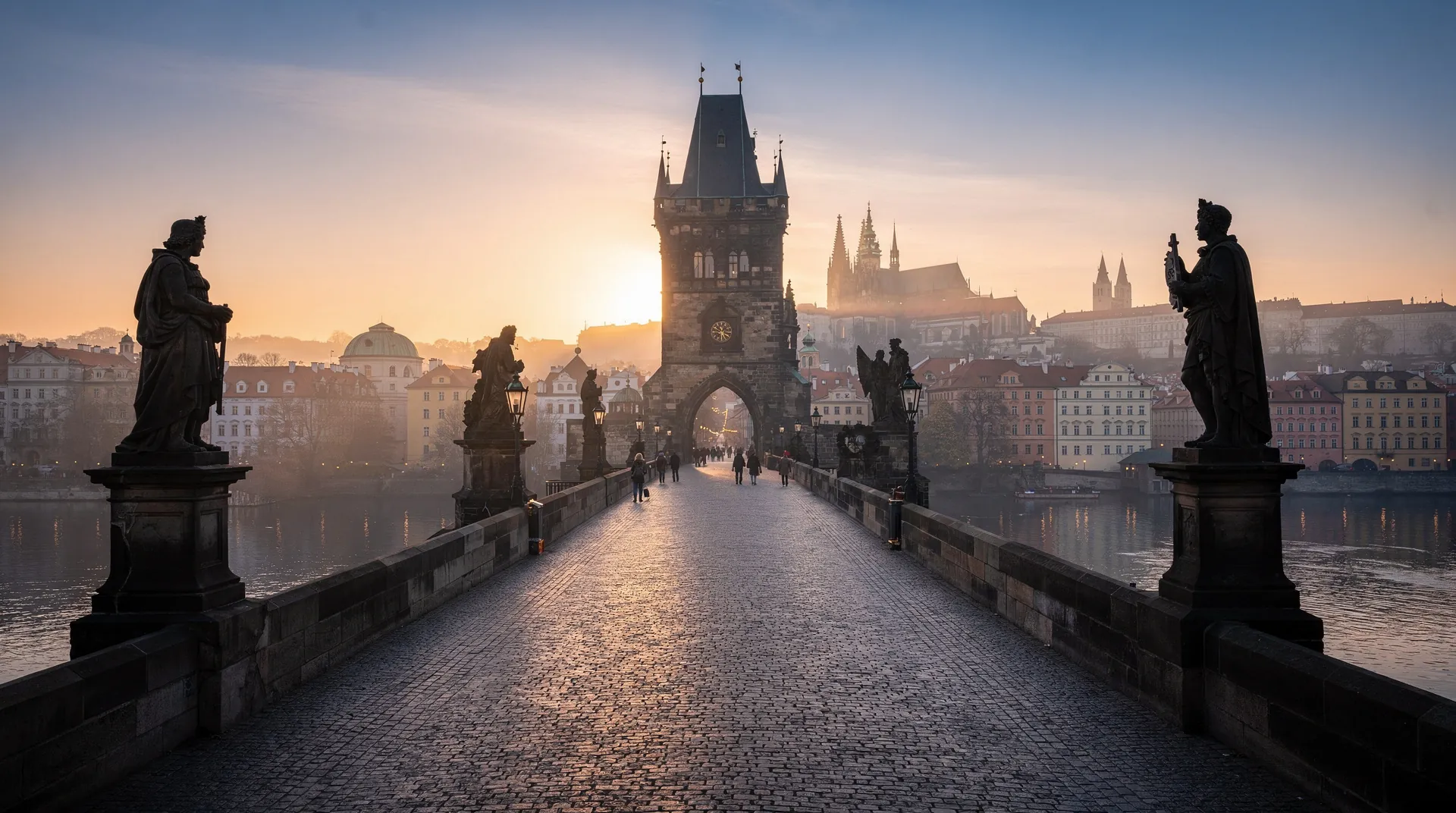
From Charles Bridge: Cross the bridge, turn left along Mostecká, then uphill through Malá Strana. Budget 25–30 minutes on foot from the bridge.
Taxi/Uber/Bolt: Drop-off at Hradčanské náměstí (the main square in front of the castle gate) is practical and avoids the climb. Roughly €6–9 from the Old Town.
Photographer’s note
The famous postcard shot — castle and cathedral skyline over the river — is taken from the Old Town side of Charles Bridge or from Čechův most (Čech Bridge) further north. The golden hour before sunset, when the west façade of the cathedral catches the light, is optimal.
For a less-photographed angle: climb to the Belvedere (Letohrádek královny Anny) at the far north end of the Royal Garden. From there, at around 7:00–8:00 in summer, the low morning light hits the castle from the northeast and you have the view almost entirely to yourself.
Inside, the best light in St Vitus Cathedral hits the Mucha stained-glass window on the north wall in the morning (roughly 10:00–11:00 in summer). Tripods are not permitted inside the monuments.
Circuit comparison at a glance
| Circuit | Covers | Price | Time | Best for |
|---|---|---|---|---|
| A | Everything in B + Story of Prague Castle exhibition + Powder Tower | ~€18 / 450 CZK | 3.5–4 hours | History enthusiasts with a full morning |
| B | St Vitus Cathedral, Old Royal Palace, St George’s Basilica, Golden Lane | ~€14 / 350 CZK | 2.5–3 hours | Almost all first-time visitors |
| C | Story of Prague Castle exhibition only | ~€10 / 250 CZK | 45–60 minutes | Archaeology-focused visitors already holding a B ticket |
| D | St Vitus Cathedral only | ~€10 / 250 CZK | 45–60 minutes | Time-limited visitors (under 90 minutes available) |
Combining the castle with the rest of Hradčany
The castle sits inside a larger district worth building around it. Strahov Monastery is a 15–20 minute walk west, connected by a hilltop path that also passes near Petřín Hill — a natural combination if you want views plus history in one outing. The Hradčany neighbourhood guide covers the district’s quieter streets, cafés, and viewpoints beyond the castle walls.
Coming from the Old Town side, most visitors cross Charles Bridge and climb through Malá Strana — budget 25–30 minutes for that walk alone. For ticket logistics across the whole trip, the Prague Castle tickets guide and the broader pass comparison page are worth checking before you commit to a circuit.
Frequently asked questions about Prague Castle
Is Prague Castle worth it for first-time visitors?
Yes, almost unconditionally. The combination of scale, history, and genuine beauty makes it the single most compelling site in the city. Even visitors who find castle tourism predictable tend to find Pražský hrad surprising in its variety.
How long do you need at Prague Castle?
Allow a minimum of 2.5 hours for Circuit B. Add 30 minutes for Lobkowicz Palace and another 30 for the Royal Garden if it’s open (April–October). A full morning — arriving at 9:00 and leaving around 12:30 — is the comfortable option.
Can you visit Prague Castle for free?
The castle grounds, courtyards, and exterior of all monuments are free to enter. The interiors (cathedral nave and towers, Old Royal Palace, Golden Lane, St George’s Basilica) require a paid ticket. Most of the best views — including the panorama over the red rooftops of Malá Strana — are free.
Is Prague Castle open year-round?
Yes. The grounds are open every day. Monument interiors close earlier in winter (16:00 instead of 17:00) and some ancillary buildings (the Riding School, Royal Garden) are seasonal.
Is Prague Castle accessible for visitors with reduced mobility?
Partially. The third courtyard and St Vitus Cathedral nave are largely accessible. Golden Lane is challenging (narrow, uneven cobblestones). The castle website lists accessibility details for each monument. The tram approach (stop Pražský hrad) is flatter than the Malostranská metro approach.
What’s the best time of day to visit Prague Castle?
Opening time (9:00) to avoid the tour buses that arrive from 10:00 onwards. Alternatively, visit at 16:00–17:00 in summer: you’ll have a quieter Golden Lane but the cathedral is still open, and the late-afternoon light on the city below is exceptional.
Are dogs allowed in Prague Castle?
Dogs on leads are permitted in the castle grounds and gardens. They are not allowed inside the monuments or the cathedral.
Can I take photographs inside the monuments?
Photography is permitted in most spaces without flash. Inside St Vitus Cathedral, photography is allowed in the nave and side chapels. The Wenceslas Chapel prohibits photography entirely. Tripods are not permitted inside any monument. No drone photography is permitted over the castle complex.
Is there a left-luggage facility at the castle?
There is a cloakroom (šatna) at the main ticket office in the third courtyard. Large bags and luggage can be checked for a small fee. Carrying a large suitcase through the monuments is impractical — stow it before entering.
What’s the difference between a guided tour and the audio guide?
The audio guide covers facts efficiently but can’t adapt to your questions or deviate from its script. A live guide can take you to the specific Defenestration window, point out the Rudolf II astronomical ceiling, explain why the Wenceslas Chapel walls are embedded with gems (some 1,345 polished stones of 29 types), and skip areas that don’t interest your group. For a first visit with children or serious history interest, a live guide is measurably better value.
Can you skip the ticket queue?
The ticket queue at the main gate box offices during peak season (May–September) can run 20–40 minutes. Online tickets bought through the castle website or GetYourGuide typically come with priority entry. For the smoothest arrival: buy online, arrive at opening time (9:00), and enter through the north gate off U Prašného mostu.
Is Prague Castle bigger than other European castles?
Yes — Guinness World Records lists it as the largest coherent castle complex in the world at approximately 70,000 square metres. For comparison, most European castle sites are a fraction of the size once you account for the churches, palaces, and gardens contained within the Prague Castle walls.
Should I visit Prague Castle or Petřín Hill first if I only have one day?
If it’s your only day in Prague, do the castle first — it’s the more essential single site and benefits from morning light and lower crowds. Petřín Hill works well as a lower-key afternoon follow-on, reachable on foot via Strahov in 30–40 minutes.
Practical info at a glance
- Address: Hradčany, 119 08 Praha 1
- Opening hours: Grounds 6:00–22:00; monuments 9:00–17:00 (Apr–Oct), 9:00–16:00 (Nov–Mar)
- Price: Circuit B ~€14 / 350 CZK; Circuit A ~€18 / 450 CZK
- Nearest tram: Pražský hrad (tram 22, 23) or Pohořelec (tram 22)
- Nearest metro: Malostranská (Line A, green) — 15 min walk uphill
- Official website: hrad.cz