At a glance
| Where | 60 km north of Prague, North Bohemia |
| Cost (DIY) | around €15–25 per person including combined ticket, bus, and food |
| Cost (tour) | around €35–60 for a guided day trip with transport |
| Time needed | a full day (6–7 hours) to visit both main sites without rushing |
| Getting there | direct bus from Prague Florenc, roughly 50–65 minutes |
| Best time | year-round; spring and autumn are quieter |
The history behind the memorial
The fortress town of Terezín was built between 1780 and 1790 by Emperor Joseph II (the son of Empress Maria Theresa, for whom it is named) as a military garrison to defend against Prussian invasion from the north. The town was designed on a grid plan within a star-shaped fortification — a model Enlightenment garrison city. It never saw serious military action in its original purpose.
The Small Fortress (Malá pevnost), a separate structure 1.5 km east, served as a political prison for the Habsburg empire. Gavrilo Princip, the assassin of Archduke Franz Ferdinand, died there in April 1918. This Habsburg imprisonment context is important: when the Nazi SS took over the facility in June 1940 as a Gestapo prison, they were using an already-established institutional structure.
The Jewish ghetto operation began in November 1941 under SS-Standartenführer Siegfried Seidl. Terezín’s role was deliberately constructed as a propaganda device: the Nazis used it as a “model Jewish settlement” to show the International Red Cross in June 1944 that Jews were being treated humanely. The Red Cross inspection — which the prisoners were forced to stage with a “beautification” programme — took place while deportations to Auschwitz were ongoing. A German propaganda film, “Der Führer schenkt den Juden eine Stadt” (“The Führer Gives a City to the Jews”), was shot in the camp in 1944; most of those who appeared in it were deported and killed within months of filming.
The cultural life of the ghetto — the musicians, writers, and artists who created under impossible conditions — was itself partly a product of this propaganda function. But it was also genuine. The musicians were real musicians. Viktor Ullmann, Pavel Haas, Hans Krása, and Gideon Klein composed here; all four died in Auschwitz. Their music survives.
Visiting Terezín — what you need to know first
This guide handles a subject that requires honesty about what you’re going to see.
Terezín (German: Theresienstadt) was an 18th-century garrison town that the Nazi regime converted in November 1941 into a Jewish ghetto and transit camp. Between 1941 and 1945, more than 155,000 people were imprisoned there. Approximately 33,000 died in Terezín itself — from disease, starvation, and overcrowding. The vast majority of the survivors were deported further east, primarily to Auschwitz-Birkenau. Only around 23,000 survived the war.
The site is now operated as the Terezín Memorial (Památník Terezín), one of the most significant Holocaust memorials in Central Europe. It encompasses the Small Fortress (Malá pevnost), which served as a Gestapo prison; the Ghetto Museum in the town of Terezín itself; and several additional structures including a crematorium, a hidden prayer room, the Magdeburg Barracks, and the Columbarium.
This is not a difficult visit to navigate logistically — it’s an hour by bus from Prague, entry is inexpensive, and the sites are clearly signposted in English. It is, however, emotionally demanding in the way that honest Holocaust memorials are. Give it the full day it deserves.
Hour-by-hour day plan (8:30 a.m. to 4:30 p.m.)
8:30 a.m. — Depart Prague Florenc by bus. The journey to Terezín is 50–65 minutes. Check iDOS (idos.cz) for the first morning bus — services run from approximately 7:30 a.m. Book a guided tour departure from Prague if you prefer transport handled.
9:30 a.m. — Arrive at Terezín town bus stop (near the Ghetto Museum). Purchase the combined ticket (220 CZK / €9) at the Ghetto Museum entrance (Komenskeho 411). This covers all memorial sites.
9:45–11:15 a.m. — Ghetto Museum (Muzeum ghetta). Plan 60–90 minutes. The ground-floor exhibition covers the full history: the decision to use Terezín as a ghetto, the population statistics, the living conditions. The upper floors cover the cultural life — the music, theatre, and art, with original artworks and scores on display. The children’s drawings section is the most affecting part of the museum; allow yourself time here.
11:30 a.m. — Magdeburg Barracks (5-minute walk from the Ghetto Museum). The reconstruction of the Jewish Council offices and the exhibition on cultural life. 30–45 minutes.
12:15 p.m. — Walk or take the local bus 1.5 km east to the Small Fortress.
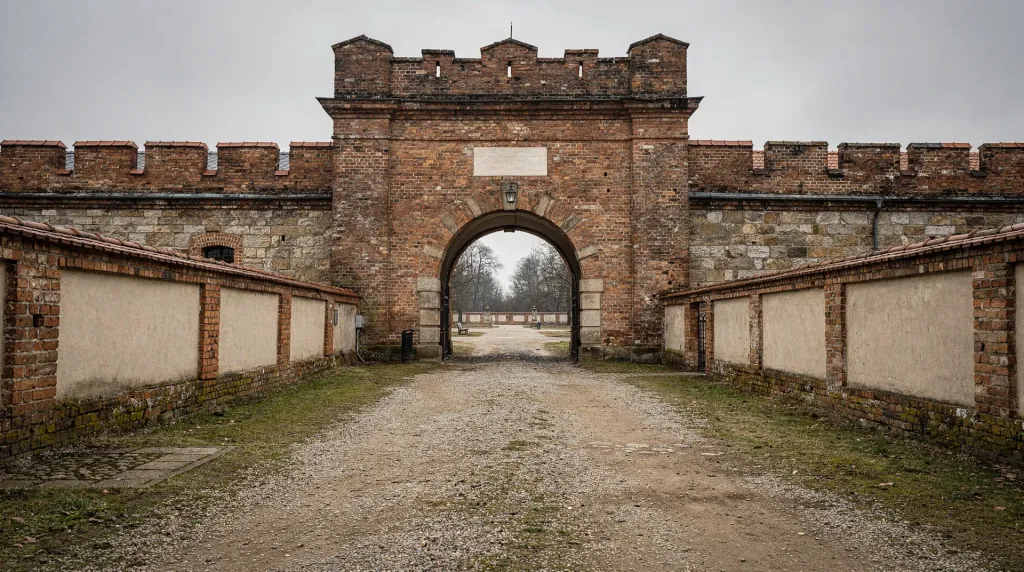
12:30–2:30 p.m. — Small Fortress (Malá pevnost). Two hours minimum. Enter through the original gate with its “Arbeit macht frei” inscription. Follow the self-guided route through the prison cells, isolation cells, execution yard, and mass graves. The SS commandant’s villa (at the far end of the complex) now contains an exhibition on the commandant’s household — a chilling contrast to the cells 50 metres away. The National Cemetery at the entrance to the fortress complex contains the graves of approximately 10,000 people.
2:30 p.m. — The Crematorium (500 metres south of the Small Fortress): A 15-minute walk. The crematorium building and the Memorial Cemetery outside the town walls are quiet, minimal, and sobering. Usually visited by only a handful of people at a time.
3:30 p.m. — Return bus from Terezín to Prague. Check the last afternoon buses on idos.cz — services thin out after 4–5 p.m. The private day trip from Prague to Terezín removes all transport concerns and allows the guide to pace the visit.
Photography notes
Photography is permitted at Terezín, with some restrictions. The following guidance applies:
Outdoor areas: Fully open to photography — the fortress walls, the National Cemetery, the town streets, the Small Fortress courtyard.
Exhibition areas: Many exhibition rooms prohibit flash photography. Some areas request no photography at all (follow the posted signs). This applies primarily to certain displays in the Ghetto Museum.
Cell blocks and isolation cells: Photography is permitted but should be done quietly and respectfully. Do not photograph other visitors in distress.
Key images: The “Arbeit macht frei” gate at the Small Fortress entrance is the most recognisable. The isolation cell blocks with their series of individual metal doors are distinctive. The mass grave markers in the National Cemetery are dignified and worth documenting.
How to get there
By bus
The most practical independent option. Buses run from Prague Florenc (or Nádraží Holešovice) to Terezín/Litoměřice. Journey time: 50–65 minutes. Price: approximately 120–160 CZK one way (€5–6). Check iDOS (idos.cz) for timetables — bus frequency varies by day of week.
Buses stop in Terezín town near the Ghetto Museum. The Small Fortress is about 1.5 km east; there’s a footpath or a local bus.
By train
No direct service. The nearest station (Litoměřice) requires a bus connection. Not recommended compared to the direct bus.
By car
Prague to Terezín via Route 8 north: about 55 minutes. Parking is available near the Small Fortress and in Terezín town. Useful if you want to see both main sites (Small Fortress + Ghetto Museum) without managing the local bus connection between them.
By organised tour
A guided tour is genuinely the better choice here for most visitors. The reason: context matters enormously at Terezín. The physical sites — barrack rooms, transit halls, the Gestapo prison cells — are stark. A guide with expertise in the history of the camp, the Nazi “model ghetto” propaganda, the children’s art and theatre produced here, and the deportations east transforms the visit from a tour of an old fortress into something that actually registers what happened.
Most Prague tours include transport both ways, entry tickets to all sites, and a guide who can answer questions throughout.
Guided day trips from Prague with expert guides and entry to the Small Fortress and Ghetto Museum:
What to see at Terezín
The memorial is divided into two main sites about 1.5 km apart. Budget a full day for both.
Small Fortress (Malá pevnost) — 1.5–2 hours
The Small Fortress was used as a Gestapo political prison. It predates the war — it was originally built as a defensive fortification in the 18th century and later used as a Habsburg prison (Gavrilo Princip, the assassin of Archduke Franz Ferdinand, died here in 1918). Under the Nazis, it held political prisoners, resistance fighters, and Jews caught in hiding. The conditions were brutal.
Today the fortress is preserved largely as it was: cell blocks, interrogation rooms, the isolation cells, the mass graves, the SS commandant’s villa. There is a permanent exhibition in English. Entry is included in the combined ticket.
The memorial inscription over the main gate — “Arbeit macht frei” — is identical to the gate at Auschwitz and was placed here in the same period. It is a jarring thing to walk under.
Ghetto Museum (Muzeum ghetta) — 1–1.5 hours
In Terezín town itself. The Ghetto Museum is the primary exhibition on the history of the camp: who was sent here, how the ghetto was administered, the Nazi propaganda use of Terezín as a “model Jewish town” for an International Red Cross inspection in 1944 (which the prisoners were forced to stage while conditions remained lethal), and the documented cultural life of the prisoners — the musicians, writers, theatre directors, and artists who continued to create under impossible circumstances.
The children’s art is among the most affecting things in the museum. Approximately 15,000 children passed through Terezín; fewer than 100 survived. The drawings and poems they left were preserved by a teacher named Friedl Dicker-Brandeis, who was herself deported to Auschwitz.
Magdeburg Barracks (within Terezín town): Houses a reconstruction of the Jewish council offices and an exhibition on the cultural life of the ghetto — the clandestine concerts, operas, and theatrical performances. Worth visiting if you have time; particularly relevant for the Brundibár children’s opera history.
Columbarium and Crematorium: The Terezín crematorium (outside the town walls) and the Memorial Cemetery contain the remains of many who died in the ghetto. Quiet, sobering, appropriately minimal.
Practical and emotional guidance
This is not a half-day visit. You can physically see the Small Fortress in 90 minutes. But doing it properly — reading, reflecting, engaging with the exhibitions — takes a full day. Don’t rush it.
Photography: Photography is permitted in the outdoor areas and some interior spaces. Some cell blocks and exhibition areas ask that you refrain. Use common sense and follow the posted guidance.
Dress and conduct: There is no dress code, but visitors are asked to conduct themselves appropriately in all areas of the memorial. This is common sense for a site of this nature.
Children: The memorial is open to all ages. Parents should consider their children’s maturity and understanding of the subject matter. The Ghetto Museum has an exhibition specifically on children’s experience. Most educators consider age 10–11 as an appropriate minimum for a substantive visit.
Language: All major exhibitions have English text. Guided tours in English are available on-site and through the Prague tour operators listed above.
Tour vs DIY — which to choose for Terezín
Book a guided tour if:
- You want an expert guide who can contextualise the history, answer questions, and pace the visit appropriately
- You prefer not to manage bus logistics independently
- You’re visiting as part of a group or educational programme
Go on your own if:
- You’re comfortable navigating the bus from Prague and the local connection between the two sites
- You’ve read extensively on the subject and want to spend time independently
- You want to control your own pacing — particularly if you need more time in certain areas
Our recommendation: For most visitors, a guided tour is worth the additional cost. The all-inclusive bus tour to Terezín Memorial or the Terezín day tour with expert guide provide context that makes the visit more meaningful and easier to process.
That said, independent visitors with preparation will have a full and appropriate experience.
The private day trip from Prague to Terezín offers a flexible schedule and a dedicated guide — the most appropriate format for educational groups or visitors who want to spend extra time at specific parts of the memorial without group pacing.
Season-specific notes
Winter (November–March): The memorial is open year-round. Winter visits are notably quiet — you may have the Small Fortress largely to yourself. The stark architecture and leafless trees give the site a particular gravity in winter light. Check pamatnik-terezin.cz for any reduced December holiday hours.
Spring and Autumn: These are the most appropriate times for a visit that involves extended walking between sites. The 1.5 km walk from the Ghetto Museum to the Small Fortress and then the 500m to the Crematorium is more comfortable in mild weather.
Summer: Terezín sees increased visitors in July–August, but it never becomes crowded in the way tourist-focused sites do. The emotional weight of the memorial tends to regulate visitor behaviour — there is no queue culture or impatience here. The outdoor areas can be hot in August; carry water.
Terezín by season, at a glance
| Season | Weather | Crowds | Notes |
|---|---|---|---|
| Nov–Mar | cold, often bare trees | quietest, notably subdued atmosphere | shorter hours (8 a.m.–4:30 p.m.); check holiday closures |
| Apr–May, Sep–Oct | mild | comfortable for the walking between sites | most appropriate season for a first visit |
| Jun–Aug | warm, can be hot | busier than winter, never crowded like tourist sites | carry water for the outdoor walking sections |
Frequently asked questions about Terezín
What is the difference between Terezín and Auschwitz?
Terezín was a transit camp and ghetto, not an extermination camp. People were imprisoned and many died there, but the mass killings took place at Auschwitz-Birkenau and other extermination camps in occupied Poland. The majority of Terezín’s Jewish prisoners were deported east to those camps. Terezín is significant both as a site of suffering in its own right and as a transit point for the deportations.
Was there really an opera performed in Terezín?
Yes. The children’s opera Brundibár, composed by Hans Krása, was performed over 50 times in Terezín by child prisoners. The Nazis allowed and even filmed one performance for propaganda purposes — presenting the ghetto as a cultural community. Krása was deported to Auschwitz in 1944. Brundibár has since been performed worldwide as a memorial to the Terezín children.
How long should I spend at Terezín?
A minimum of 4–5 hours to cover both the Small Fortress and the Ghetto Museum meaningfully. A full day (6–7 hours) allows you to also visit the Magdeburg Barracks and the Crematorium without rushing.
Is the memorial open year-round?
Yes. The Small Fortress and Ghetto Museum are open daily. Hours: approximately 8 a.m.–6 p.m. April–October, 8 a.m.–4:30 p.m. November–March. Closed 1 January and 24 December. Check pamatnik-terezin.cz for current seasonal hours.
How much does entry cost?
A combined ticket for the Small Fortress and Ghetto Museum costs approximately 220 CZK (€9) for adults; reduced prices for students and children. Some sites (Columbarium, exterior areas) are free.
Is Terezín still an inhabited town?
Yes. Roughly 2,500 people live in Terezín today. The memorial occupies specific sites within and around the town, but it is a functioning community. This duality — ordinary Czech town life continuing in and around a Holocaust memorial — is part of what makes the experience distinctive.
Can I visit Terezín on a half-day trip?
Technically possible, but not recommended. You can cover the Small Fortress in 90 minutes, but doing so without the Ghetto Museum omits the most important explanatory exhibition. Allow a full day.
Are there lockers or facilities at Terezín?
The Ghetto Museum has a cloakroom for bags. There are toilets at the museum entrance and at the Small Fortress visitor centre. No lockers are available — leave large bags at your accommodation in Prague. The memorial grounds have no café or food facilities; bring water and snacks, particularly if visiting in summer.
Is there public transport between the Small Fortress and the Ghetto Museum?
There is a local bus that runs between the town and the Small Fortress area, but the schedule is infrequent. Most visitors walk the 1.5 km on a well-marked path. Independent visitors with mobility limitations should consider a private tour with a vehicle that can move between sites. Contact pamatnik-terezin.cz for accessibility-specific advice.
How does Terezín compare to other Holocaust memorial sites?
Terezín is not Auschwitz in scale or function — it was a transit and imprisonment camp, not an extermination facility. Its particular value is in the documented cultural resistance (the music, art, and theatre), the detailed exhibition on the Nazi propaganda manipulation, and its proximity to Prague. Visitors who have been to Auschwitz-Birkenau will find Terezín complementary rather than comparable.
Practical info
- Distance from Prague: 60 km north
- Travel time: ~55 min by bus from Prague Florenc or Nádraží Holešovice
- Combined ticket (Small Fortress + Ghetto Museum): ~220 CZK (€9)
- Opening hours: Daily; Apr–Oct 8 a.m.–6 p.m., Nov–Mar 8 a.m.–4:30 p.m.
- Official site: pamatnik-terezin.cz
- Bus timetable: idos.cz
- Best time: Any; spring and autumn are less crowded