At a glance
| Where | 70 km east of Prague, in Central Bohemia |
| Cost (DIY) | around €20–35 per person including combined ticket and lunch |
| Cost (tour) | around €35–65 for a half-day guided option |
| Time needed | half a day minimum; a full day (9 a.m.–5 p.m.) does it justice |
| Getting there | direct train from Prague hlavní nádraží, roughly 55–65 minutes |
| Best time | April–June or September–October; year-round otherwise |
Silver, kings, and the economy of medieval Bohemia
Kutná Hora’s story begins in the 1260s when Cistercian monks discovered silver ore in the hills east of Prague. By the early 14th century, the Kutná Hora silver mines were producing approximately one-third of all silver mined in Europe. This was not a peripheral boom town — the Bohemian kings moved their royal mint here in 1300, and the Prague Groschen (Pražský groš) struck at the Vlašský dvůr became the dominant currency of Central European trade for 150 years.
The wealth produced here paid for the Prague construction projects of Charles IV (1316–1378): the Charles Bridge, St. Vitus Cathedral, the New Town of Prague, and the Charles University. Kutná Hora was, in economic terms, the engine of the Czech High Gothic. The Cathedral of St. Barbara, begun in 1388, was an explicit act of civic pride — funded by the mine owners themselves, built to rival Prague’s royal cathedral, and dedicated to the patron saint of miners.
The silver ran out in the late 16th century. The town entered a slow decline interrupted by plague and then the Thirty Years’ War (1618–1648), which devastated the region. By the 18th century, Kutná Hora was a provincial backwater. The bones in the Sedlec Ossuary — from plague victims, from soldiers killed in the Hussite Wars — had accumulated over centuries while the town shrank around them.
Why Kutná Hora deserves its own day
There are two reasons people visit Kutná Hora, and they are very different in tone.
The first is the Sedlec Ossuary — the Bone Church — where the bones of approximately 40,000 people have been arranged into chandeliers, coat-of-arms decorations, and garlands. It’s genuinely extraordinary, and depending on your disposition, either deeply moving or profoundly strange. Probably both. It’s 2 km outside the centre, in the suburb of Sedlec, and takes about 45 minutes.
The second is Kutná Hora itself: a medieval silver-mining town that was once the second wealthiest city in the Kingdom of Bohemia. Its Cathedral of St. Barbara — built to rival Prague’s St. Vitus — is a Gothic masterpiece with flying buttresses you can photograph from every angle without another tour bus in the frame. The Italian Court (Vlašský dvůr), the medieval town centre, and the underground silver mines round out a genuinely rich destination.
The combination of macabre ossuary and outstanding medieval architecture in a town just 70 km from Prague makes this arguably the most logistically easy and content-dense day trip on the list. If you can only do one day trip from Prague, Kutná Hora is a serious contender.
Hour-by-hour day plan (9 a.m. to 5 p.m.)
9:00 a.m. — Arrive at Kutná Hora hlavní nádraží (main station). Walk five minutes to the Sedlec Ossuary — it is literally visible from the station exit. Buy the combined ticket (500 CZK / €20 for all four sites) at the ticket desk of the Cemetery Church of All Saints above the ossuary.
9:15–10:15 a.m. — Sedlec Ossuary (45–60 min). The bones of 40,000 people. Take your time in the lower chapel — read the explanation panels in English, understand the 1870 commission, look carefully at the Schwarzenberg coat-of-arms made from bones in the corner. Photography is permitted.
10:15–10:45 a.m. — Cemetery Church of All Saints (upstairs). Frequently bypassed. The Baroque church above the ossuary has a remarkable interior and is almost always empty — you may have it to yourself.
10:45 a.m. — Walk or taxi to the old town (3 km uphill). The walk takes 35–45 minutes via the main road; a taxi costs about 100–150 CZK (€4–6) and is worth it with limited time.
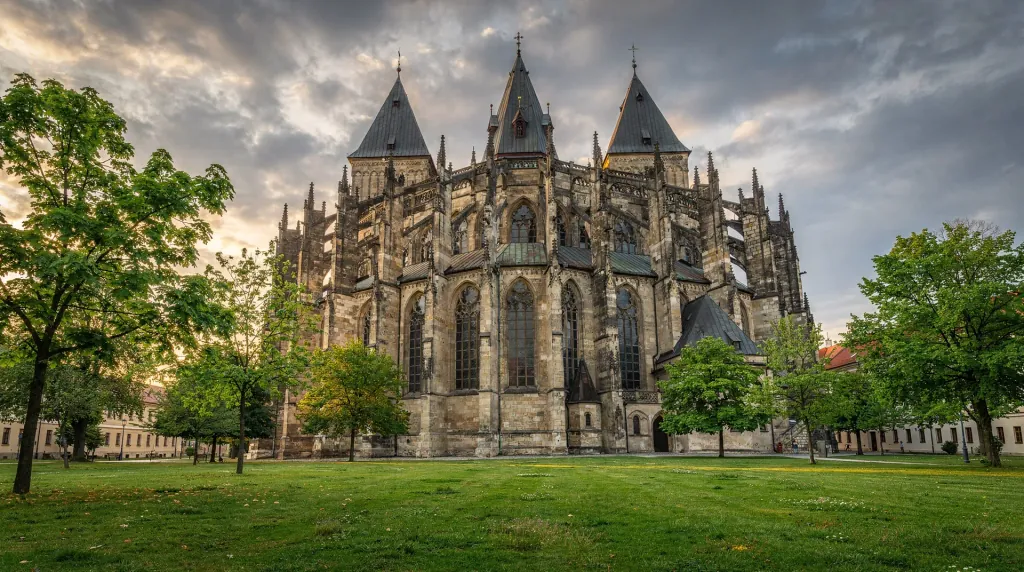
11:15 a.m.–12:45 p.m. — St. Barbara’s Cathedral. Allow 60–90 minutes. Walk the exterior first: the flying buttresses on the south side, the three Gothic spires, the view from the Jesuit college terrace (Jezuitská kolej) looking back at the cathedral over the valley. Go inside for the vaulted ceiling with miner motifs, the medieval frescoes in the chapels, and the sense of scale that a silver-funded Gothic cathedral achieves.
1:00–2:00 p.m. — Lunch. Kavárna a restaurace Harmonie (Husova 106) is the most reliable local choice. Czech classics at €7–11 (175–275 CZK) per main.
2:00–3:00 p.m. — Vlašský dvůr (Italian Court). The 13th-century royal mint. The guided tour covers the audience hall with its medieval painted ceiling and the coin-striking workshop. Entry included in the combined ticket.
3:00–4:00 p.m. — Old town walk. Palacký Square, the Stone House (Kamenný dům), the Church of St. James with its Gothic spire, the Plague Column. The town has a quiet, understated quality that is a genuine respite from Český Krumlov’s tourist intensity.
4:00 p.m. — Optional: underground silver mine at Hrádek (if pre-booked). Otherwise, coffee at Cukrárna Pukl on Palacký Square and the last train back to Prague (~17:10 from Kutná Hora město station, check cd.cz for exact times).
Photography notes
St. Barbara’s Cathedral, exterior south side (best 10 a.m.–noon): The flying buttresses and three spires from the Jesuit college terrace. Shoot with a 24–35mm equivalent for the full facade. Morning light from the east catches the stonework.
Sedlec Ossuary interior (natural light only): The light comes through small windows — arrive early when it is brightest. The bone chandelier in the centre of the lower chapel is the signature shot; use a wide aperture (f/2.8 or equivalent) for the dim interior.
Palacký Square from the corner (any time): The plague column at centre with Gothic church spires behind. Late afternoon light from the west.
Town approach from the Jesuit terrace: Looking back over the Vrchlice valley towards Sedlec with the cathedral at the right edge — an underused angle.
How to get there
By train
This is one of the few Prague day trips where the train is the clear best option. Direct trains run from Prague hlavní nádraží (main station) to Kutná Hora hlavní nádraží roughly every 1–2 hours. Journey time: 55–65 minutes. Price: around €5–9 return (125–225 CZK) depending on ticket type.
Important note: Kutná Hora has two stations. Kutná Hora hlavní nádraží is the main station, near Sedlec — the Bone Church is a 5-minute walk from here. The town centre is another 3 km (€2 taxi or 20-minute walk uphill). Alternatively, some trains continue to Kutná Hora město station, which is closer to the old town centre. Check which trains stop at město before you go.
By bus
Buses run from Prague Florenc to Kutná Hora, but the journey takes 1h 30min–2h and connections are less convenient than the train. Not recommended when the train is this straightforward.
By car
Prague to Kutná Hora via D11 motorway: about 1 hour. Parking is available near the town centre and at the Sedlec Ossuary. Useful if you want to drive between Sedlec and the town centre rather than walking the 3 km.
By organised tour
Half-day and full-day tours from Prague are well-established and good value if you want a guide. The main advantage: a guide who explains the history of the silver mines, the Hussite Wars, and the context behind the ossuary makes the visit significantly more meaningful than reading panels in English. Many tours include entry to the ossuary and St. Barbara’s.
The most popular guided options from Prague, combining the Bone Church and St. Barbara’s Cathedral:
What to see, realistically, in a day
Sedlec Ossuary (45–60 minutes). Start here if you’re arriving by train at Kutná Hora hlavní nádraží — you’re already in Sedlec. The ossuary is beneath the Cemetery Church of All Saints. Entry: 120 CZK (€5). No pre-booking needed for independent visitors; queues move quickly. Photography is permitted. The story behind the bone arrangements — a half-blind monk commissioned in 1870 to “tidy up” the accumulated remains of plague victims — is so Czech it hurts.
The All Saints Church above the ossuary is also beautiful and undervisited.
Cathedral of St. Barbara (1–1.5 hours). Walk or take a taxi from Sedlec to the town centre (3 km). St. Barbara is patron saint of miners, and the cathedral built in her honour is extraordinary — Gothic construction started in 1388, interrupted by the Hussite Wars, finished 500 years later. The interior has vaulted ceilings with miner and heraldic motifs, and the flying buttresses outside are probably the best-preserved Gothic architectural feature in Bohemia outside Prague.
Entry: 120 CZK (€5). No need to book ahead.
Vlašský dvůr — Italian Court (45 minutes). This was the Bohemian royal mint in the medieval period, where the Prague Groschen was struck. Today it’s a museum with a royal audience hall and guided mint tour. Entry: around 120 CZK (€5). Worth it for the scale of the building if you’re already in the town centre.
The town centre (30–45 minutes free walking). Kutná Hora’s Palacký Square and the streets around it are understated but genuinely pleasant. The town lacks the touristy gloss of Český Krumlov, which is either a positive or negative depending on your preferences. There are good cafes and no queue for anything.
Alchemy and silver mines (optional, 45 minutes). If you have a full day rather than a half day, the underground silver mine tour at Hrádek castle gives a vivid sense of medieval mining conditions. Only available in organised groups with advance booking.
What to skip: the Tobacco Museum (eccentric, minor) and the Stone House (fine, not essential if time is limited).
Where to eat
Kavárna a restaurace Harmonie (Husova 106): A solid local restaurant in the town centre. Czech classics — svíčková, goulash, fried cheese — at non-tourist prices. Around €7–11 (175–275 CZK) for a main course. Unpretentious and reliable.
Pizzeria Venezia (Šultysova 154): Sounds wrong for a Czech UNESCO town, but the pizza is genuinely good and the prices are honest — about €7–10 (175–250 CZK). Popular with locals.
Cukrárna Pukl (Palacký Square): Old-school Czech cake shop for coffee and something sweet. Good for a late morning stop between Sedlec and St. Barbara’s.
Common mistakes and what we’d do differently
Starting at the town centre instead of Sedlec. If you arrive by train at the main station, the ossuary is right there. Starting in the town centre means backtracking. Start at Sedlec, then walk or taxi to the old town.
Underestimating St. Barbara’s Cathedral. Most people give it 20 minutes. Give it 60 minimum, including walking the exterior with the buttresses and the Jesuit college terrace view.
Not understanding the context. Kutná Hora without any context is a pretty medieval town. Knowing that this was the engine of the entire Bohemian economy — silver mined here funded the Bohemian kings’ armies and architectural projects across the Kingdom — makes everything more interesting. A guided tour helps; reading even 10 minutes about the silver trade before you go helps more.
Going on a Monday. Several sites have limited Monday hours or closures. Check individual opening times before booking trains.
Tour vs DIY — which to choose for Kutná Hora
Book a guided tour if:
- You want context for the ossuary, the silver economy, and the Hussite history
- You’re doing a half-day (there are good half-day Prague options that get you back by afternoon)
- You don’t want to manage the Sedlec-to-town-centre logistics independently
Go on your own if:
- You’re comfortable with train travel and enjoy independent exploration
- You want to spend more time at St. Barbara’s than a group allows
- You want to combine it with another stop (e.g., drive via Kutná Hora on the way to Brno)
Our recommendation: Kutná Hora is the one destination on this list where the DIY option is almost as good as the tour, purely because the train connection from Prague is so simple. Take the train from Prague hlavní nádraží, start at the ossuary, walk or taxi to the town centre, allow a full day. If you’d rather have a guide, the Sedlec Ossuary skip-the-line ticket with audioguide is a useful middle ground — guided audio, no group pacing.
Or book the full guided day trip from Prague including both sites if you want all logistics handled.
For visitors who want private transport and a tailored schedule, the Kutná Hora private tour day trip from Prague provides a dedicated vehicle and guide. The private format is particularly useful for families, as it allows you to spend more or less time at each site without group pacing constraints.
Season-specific notes
January–March: All main sites open year-round (ossuary, St. Barbara’s, Italian Court). Kutná Hora in winter is remarkably quiet — you may have St. Barbara’s interior almost to yourself. The underground mine closes in winter; check hrady.cz for Hrádek seasonal hours.
April–June: Best overall conditions. The town starts to fill from May but never reaches the intensity of Český Krumlov. Late May brings pleasant weather and manageable visitor numbers.
July–August: The ossuary sees significant weekend queues (20–40 minute waits on summer Saturdays). Arrive before 9:30 a.m. The town centre is still manageable compared to other Czech UNESCO sites.
September–October: Excellent. Crowds thin noticeably after school starts. October sees some reduced hours at minor sites — verify before visiting.
Kutná Hora by season, at a glance
| Season | Weather | Crowds | Notes |
|---|---|---|---|
| Jan–Mar | cold, sometimes snow | quiet, best for having St. Barbara’s near-empty | mine tours mostly closed for winter |
| Apr–Jun | mild, warming | growing from May | best overall balance of weather and space |
| Jul–Aug | warm to hot | ossuary queues 20–40 min on summer Saturday mornings | arrive before 9:30 a.m. |
| Sep–Oct | mild, crisp | thins noticeably after school starts | some minor sites reduce hours in October |
Multi-stop variant: Kutná Hora and Sedlec as a full combined day
The ossuary and St. Barbara’s are usually described as a single day trip, but they are actually 3 km apart with distinct neighbourhood characters. Sedlec is a flat suburb near the station; the old town is uphill and more architecturally cohesive. The Kutná Hora historical centre and Sedlec Ossuary guided tour treats them as complementary halves of a coherent day — which is correct.
The Kutná Hora and Bone Church excursion with lunch from Prague adds a Czech lunch stop to make it a fully catered day.
Frequently asked questions about Kutná Hora
How far is Kutná Hora from Prague?
70 km east of Prague — about 55 minutes by direct train from Prague hlavní nádraží. It’s the closest major day trip on this list, which makes it ideal for people with limited time.
Do I need to book the Sedlec Ossuary in advance?
For individual visitors, no — tickets are sold at the door and queues move quickly outside peak summer. In July and August weekend mornings, a short wait is possible. Pre-booking is only necessary if you’re going with a tour group.
How many sites can I realistically visit in a half day?
Two: the ossuary (45–60 min) and St. Barbara’s Cathedral (1 hour). That’s a solid half-day itinerary. Add the Italian Court if you want a full day or are particularly interested in medieval monetary history.
Is there a combination ticket for all Kutná Hora sites?
Yes — a combined ticket covering the ossuary, the Cathedral of the Assumption (Sedlec), St. Barbara’s, and the Italian Court is available for around 500 CZK (€20). Worth it if you’re spending a full day.
Is the Kingdom Come: Deliverance game connection real?
Yes, very much so. The 2018 open-world RPG (and its 2024 sequel) was set in medieval Bohemia, with Kutná Hora as the primary inspiration for the city of Kuttenberg. For fans of the game, the Kingdom Come Deliverance real-world tour of Kutná Hora is a specific guided experience walking the game’s actual locations.
Can children visit the Sedlec Ossuary?
The ossuary is open to all ages and children are admitted with parents. The display is unusual but not gory — bones are arranged decoratively, not graphically. Parents of younger children (under 8) should use their own judgement; it’s unusual enough to be unsettling for some small children. Most older children find it fascinating rather than frightening.
What’s the best season to visit Kutná Hora?
Any month with the ossuary and St. Barbara’s open (year-round) works. Spring and autumn are pleasantest weather-wise and avoid the July–August school holiday crowds. Even at peak season, Kutná Hora is noticeably less busy than Český Krumlov.
Is the walk from the train station to the ossuary manageable?
Yes — Kutná Hora hlavní nádraží is approximately 400 metres from the ossuary entrance. It’s flat, signposted, and takes about 5 minutes on foot. The walk from the ossuary to the town centre (St. Barbara’s, Italian Court) is 3 km uphill — most visitors take a taxi (100–150 CZK / €4–6) or check if any trains continue to Kutná Hora město station, which is closer to the centre.
Are there luggage lockers in Kutná Hora?
The main station has a left-luggage office (úschovna) for approximately 50 CZK (€2) per bag per day. Check hours before leaving bags — the office may close during part of the day.
Is Kutná Hora accessible for visitors with disabilities?
St. Barbara’s Cathedral is partially accessible — the main nave is flat, but the crypt and some side chapels involve steps. The Italian Court has ramp access in parts. The Sedlec Ossuary lower chapel involves stairs with no ramp alternative; the upper Cemetery Church is ground-floor accessible. Contact the individual sites for current accessibility details.
Practical info
- Distance from Prague: 70 km east
- Travel time: 55–65 min by direct train
- Train booking: cd.cz
- Sedlec Ossuary entry: 120 CZK (€5); open year-round Mon–Sat 9 a.m.–6 p.m. (shorter hours Nov–March)
- St. Barbara’s Cathedral entry: 120 CZK (€5); open year-round (check seasonal hours)
- Combined ticket: ~500 CZK (€20) covering four sites
- Italian Court (Vlašský dvůr): ~120 CZK (€5)
- Best time: April–June, September–October