Czech koruna is the currency — euros are not your friend here
| Currency | Czech koruna (CZK) — the Czech Republic does not use the euro |
| Where to get it | Bank ATM (Česká spořitelna, ČSOB, Komerční banka) on arrival |
| Daily cash to carry | Around 500–1 000 CZK (~€20–40) |
| Golden rule | Always choose “CZK” when a terminal or ATM offers DCC |
| Cards | Widely accepted, but keep cash for markets, trams, small kiosks |
The Czech Republic is an EU member but has not adopted the euro. The currency is the česká koruna (CZK), divided into 100 haléřů (hellers, though coins below 1 CZK no longer exist in practice).
2026 rate: 1 EUR ≈ 25 CZK. 1 USD ≈ 23 CZK. These fluctuate — use Google or your banking app for real-time rates before you travel.
Prices in this guide show CZK first, then euros in parentheses: a beer in a local pub costs 55–70 CZK (€2.20–2.80). In a tourist trap near Old Town Square, the same beer is 130–180 CZK (€5–7).
ATMs — the best source of CZK
Local ATMs connected to your home bank are usually your best source of Czech crowns. The process:
- Find a bank ATM (Česká spořitelna, ČSOB, Raiffeisenbank, UniCredit, Komerční banka) — these are standalone machines or inside bank branches.
- Withdraw CZK.
- Always decline DCC (see below — this is critical).
- Pay any foreign transaction fee your home bank charges (typically 1–3%).
Machines to avoid: Euronet machines (bright yellow and orange, found everywhere in tourist areas) charge higher fees and aggressively push DCC. They are technically functional but more expensive than bank ATMs. Recognize them by the Euronet branding.
Withdrawal limits: Most Prague bank ATMs allow 10 000–15 000 CZK per transaction. If you need more, two withdrawals is fine. Plan your cash needs: many restaurants and smaller shops are still cash-first.
ATM locations: Every major metro station area has at least one bank branch with an ATM. Václavské náměstí (Wenceslas Square) has several. Old Town Square area: multiple Česká spořitelna and ČSOB machines on the surrounding streets (avoid the Euronet ones).
The DCC scam — the most expensive mistake tourists make
DCC (Dynamic Currency Conversion) is a system that lets an ATM or card terminal convert your transaction to your home currency (dollars, pounds, euros) instead of leaving it in Czech crowns. It sounds convenient. It is not.
When it happens:
- At an ATM: the screen asks “Would you like to be charged in CZK or [your home currency]?” — always choose CZK.
- At a hotel, shop, or restaurant terminal: the machine says “Do you want to pay 180 CZK or €7.40?” — always choose CZK.
- At a restaurant: the waiter says “I can put it through in euros” — politely say no and ask for CZK.
Why it’s a scam: When you let the merchant or ATM do the conversion, they apply their own exchange rate, which is typically 3–8% worse than your bank’s rate. On a 4-night trip with 2 000 CZK of daily spending, this costs €15–30 extra — for nothing. Your bank converts the CZK charge at the interbank rate anyway.
The rule: Always, without exception, pay in the local currency (CZK). If a terminal defaults to your home currency, tap “change currency” or tell the cashier to re-run it in CZK.
Exchange offices — good ones exist, many do not
Cash exchange (směnárna) in Prague is a minefield. The headline rate displayed on the board outside often bears no relation to what you’ll actually get, because of hidden commissions, minimum transaction fees, or simply deceptive display practices.
How to spot a bad exchange office:
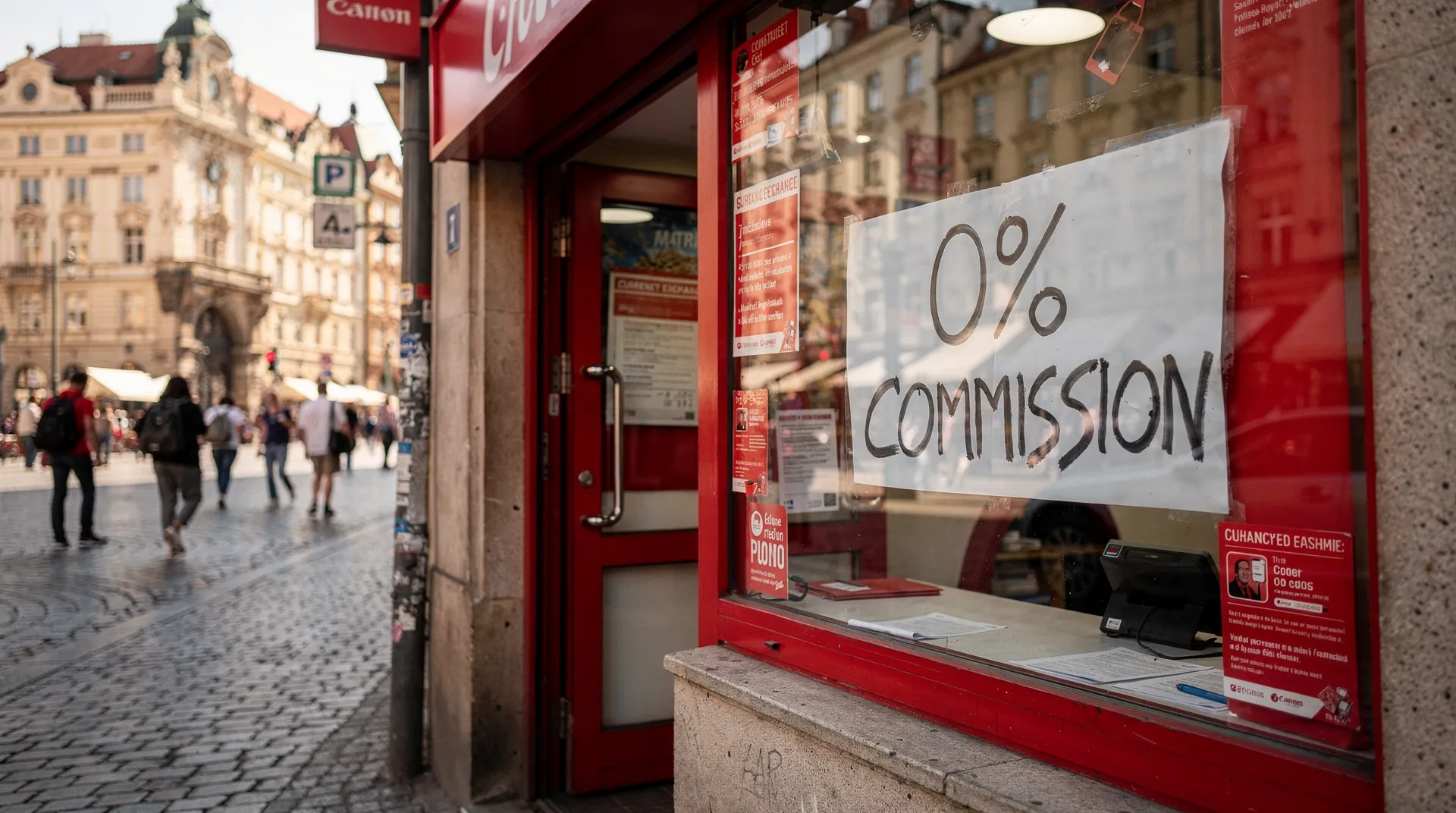
- “0% commission” signs (they build the fee into the rate instead)
- Rate boards showing buy/sell with a 10+ CZK spread (e.g., buying at 20 CZK/EUR, selling at 30 CZK/EUR)
- Offices on Old Town Square, near the Astronomical Clock, or on Wenceslas Square tourist strip
- Any office that doesn’t display the final amount you’ll receive before you hand over cash
The handful of genuinely good exchange offices in Prague:
- Interchange Prague (Mánesova 28, Vinohrady) — consistently good rates, transparent, frequented by expats. Not in a tourist area.
- Exchange offices inside Česká spořitelna or Komerční banka branches — bank exchange rates are transparent and close to interbank.
- Prague airport: The exchange counters in arrivals are not terrible (better than the worst Old Town tourist traps) but an ATM withdrawal at the airport is still better.
Practical tip: If you arrive in Prague with €100 in cash and need to exchange it, don’t do it in Old Town. Take the metro to Náměstí Míru or Náměstí Republiky and find a bank branch. Or just use an ATM.
Can you pay with cards in Prague?
Prague is increasingly card-friendly, but cash is still necessary in 2026. Rules of thumb:
- Hotels, major restaurants, department stores, supermarkets: Card accepted almost always.
- Local cafés, mid-range restaurants, pubs: Card accepted at most, but have 200–300 CZK cash as backup.
- Street food stalls, market vendors, small tabák kiosks: Often cash only.
- DPP public transport ticket machines: Card accepted (contactless works fine).
- Trams and buses: Cash not accepted on board. Use ticket machines or app.
Contactless: Widely accepted where cards are accepted. Apple Pay and Google Pay work at most card terminals. Amex is less widely accepted than Visa/Mastercard.
How much cash to carry
For a typical tourist, carrying 500–1 000 CZK (~€20–40) in cash daily is comfortable. You’ll use it at markets, for small purchases, tips, and the odd cash-only spot. Restaurants and larger purchases are easily card-paid.
Avoid carrying more than 2 000–3 000 CZK (€80–120) at a time — not because Prague is unsafe, but because losing your wallet or being pickpocketed is easier when you’re a tourist with a lot of cash.
Tipping and cash for small purchases
Cash matters most for tipping — Czech tipping culture rounds up or adds 10%, and rounding is much easier with a few coins on hand than fumbling for a card top-up. It’s also the norm at small stalls in the food/street food scene and at some Christmas market stalls, where card terminals can be slow or absent during the busiest evenings.
Money and getting around
The metro, trams, and buses run on the same DPP ticketing whether you pay by card at the machine or (rarely) in cash — see the metro guide for how the ticket system works. If you’re arriving from the airport, the airport to city guide covers exactly which payment methods each transport option accepts, since bus 119 in particular does not take cash on board.
What we’d actually do
Get CZK from a Česká spořitelna or ČSOB ATM on arrival (there are several at the airport, look for the bank-branded ones, not Euronet). Withdraw 3 000–4 000 CZK for a few days. Always choose CZK on the terminal. Never visit an exchange office in Old Town. That’s it — no complexity required.
Common mistakes
Paying in euros at restaurants: Some tourist restaurants near Old Town Square display prices in EUR and CZK and accept both. If you pay in EUR, the rate they use is typically 22–23 CZK/EUR (vs 25 CZK/EUR real rate) — that’s a 10% loss. Always pay in CZK.
Using airport exchange counters before checking ATMs: The airport has both exchange offices (bad rates) and bank ATMs (good rates). Use the ATM.
Not having any cash: Even in 2026, a completely cashless day in Prague can leave you stuck. Local markets, small pharmacies, some transport ticket situations, tip rounding — always have some crowns.
Accepting DCC at the hotel checkout: Hotels are particularly aggressive about DCC at checkout. The terminal will often default to your home currency. Ask them explicitly to charge in CZK.
Questions people actually ask
Do restaurants and shops in Prague accept euros?
Some do, especially in very tourist-heavy zones. But the rate they use is always unfavourable for you — typically 3–8% worse than the real exchange rate. Pay in CZK whenever possible. The Czech koruna is a stable, freely convertible currency; there’s no reason to use euros except convenience, and that convenience costs you money.
Is it safe to use ATMs in Prague?
Yes, Prague is generally safe for ATM use. Card skimming does happen occasionally, primarily on standalone ATMs in poorly-lit or unsupervised locations. Use ATMs inside bank branches or in well-lit lobbies. Cover the keypad when entering your PIN. Avoid ATMs that look physically altered (loose card slot, unusual attachment).
How much should I budget per day in Prague?
Budget traveller (hostel, local food, public transport): 1 200–1 800 CZK/day (€50–70). Mid-range (3-star hotel, restaurant meals, a couple of paid attractions): 3 000–5 000 CZK/day (€120–200). Comfort/luxury: 6 000–10 000+ CZK/day (~€240–400). These are rough guides — accommodation is the biggest variable.
What coins and notes are in circulation?
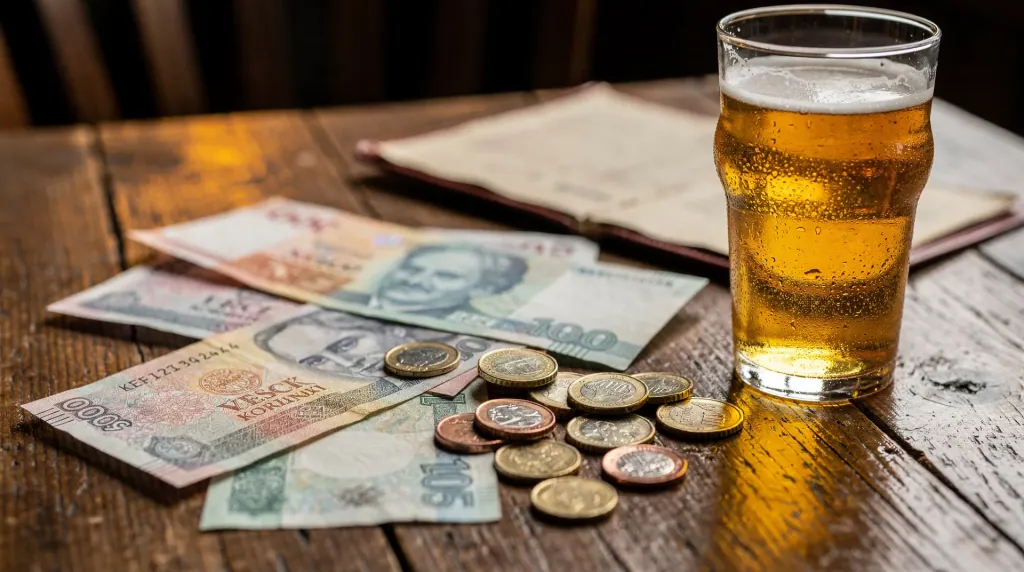
Coins: 1, 2, 5, 10, 20, 50 CZK. Notes: 100, 200, 500, 1 000, 2 000, 5 000 CZK. The 100 CZK note (~€4) is the most useful denomination for everyday transactions. Large notes (2 000+ CZK) can be hard to break at small shops.
Should I order a currency exchange via my bank before travelling?
It’s rarely necessary. Bank and Revolut/Wise ATM withdrawals in Prague give you the best rates without pre-ordering. If your home bank charges high foreign ATM fees, consider opening a Wise or Revolut account before your trip — both offer fee-free or low-fee withdrawals in Czech crowns.
Is Revolut or Wise useful in Prague?
Very useful. Both offer near-interbank exchange rates when you withdraw CZK or pay by card. With Revolut or Wise, the DCC issue becomes less painful (they still convert correctly), and ATM withdrawal fees are minimal or zero within your monthly free allowance. Set up your preferred account before leaving home.
Do I need cash for tipping in Prague?
Cash makes tipping simpler but isn’t strictly required — many card terminals let you add a tip or round up the total. See the tipping guide for exact norms by venue type.
Can I use my home country’s coins or notes anywhere in Prague?
No — only CZK is legal tender, and shops that display EUR prices are simply offering a (poor) conversion, not genuinely accepting euro cash everywhere. Treat any EUR pricing as a courtesy conversion, not proof that euros are usable at face value.