At a glance
| Where | Staroměstské náměstí, Staré Město |
| Cost | Square free; Clock Tower ~€6 / 150 CZK; Týn Cathedral free |
| Time needed | 30–45 minutes; half a morning with the clock tower and cathedral |
| Getting there | Metro A to Staroměstská, 4 minutes on foot |
| Best time | Before 8:30 or after 21:00 in summer to avoid the worst crowds |
Eight centuries of history compressed into one square
Staroměstské náměstí has been the commercial and civic centre of Prague since the 12th century, when a market was established at the confluence of the trade routes from Germany, Silesia, and Hungary. The square’s unusual shape — wide and irregular, not the neat rectangle of a planned city — reflects its organic growth around the original market.
The Old Town Hall (Staroměstská radnice) was established in 1338, when John of Luxembourg granted the burghers the right to their own seat of government. The tower was built through the 14th and 15th centuries; the famous clock was added in 1410 under Master Mikuláš of Kadaň. By the time the Gothic hall reached its current form in the 15th century, the square was already a site of major political events: it was here that Jan Hus was summoned before leaving for the Council of Constance in 1414, knowing he would not return.
The darkest chapter: on 21 June 1621, 27 Bohemian Protestant leaders were executed in the square following the Battle of White Mountain. The Habsburg authorities staged the execution as a public spectacle — several of the condemned were beheaded, others hanged. The 27 white crosses embedded in the pavement in front of the Old Town Hall mark the exact positions of the scaffolds. Many visitors walk over them without noticing; they deserve a moment.
The 20th century brought the destruction of the north wing of the Town Hall by retreating German forces on 8 May 1945, the last day of the war in Europe. A bomb-gutted section of the town hall stood open until the 1980s; the current glass-and-steel covering replaced the temporary solution. The deliberate decision not to rebuild the destroyed wing in a matching historical style remains debated.
What makes Staroměstské náměstí genuinely impressive
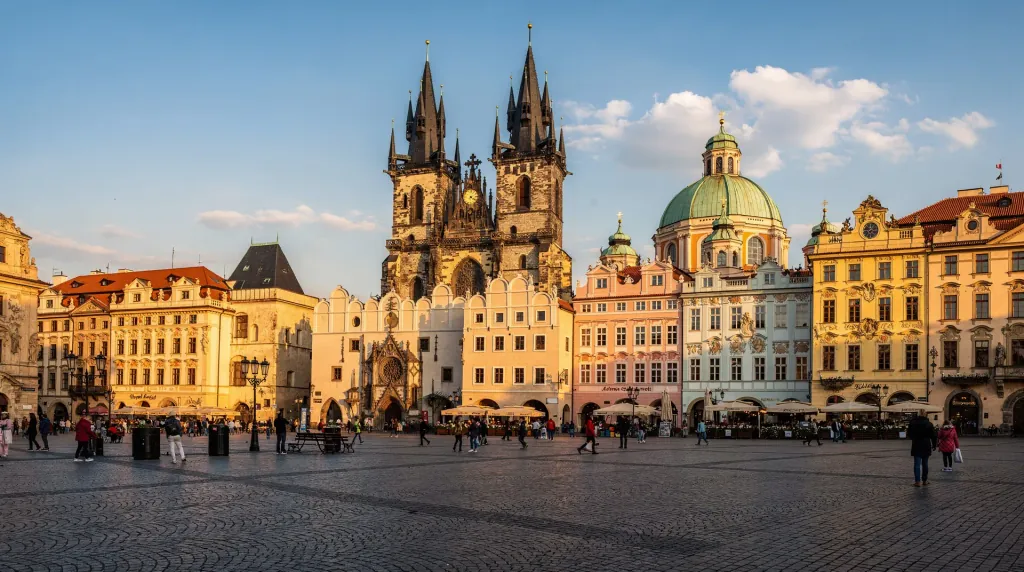
Prague’s Old Town Square is one of those places that manages to be both the most tourist-photographed spot in the city and still, under the right conditions, entirely worth the visit. The square is flanked on three sides by buildings from the 11th to 18th centuries: a Gothic church, a Baroque church, a Renaissance palace, town houses in every style, and the medieval town hall with its famous astronomical clock. This variety of period and style, packed into a single public space, is unusual even by Central European standards.
The problem is the middle: between 10:00 and 18:00 in summer, the square is packed to near-capacity with tour groups, selfie-stick vendors, horse-drawn carriages, and overpriced restaurants charging three times the city average. Navigating it comfortably requires either timing or lowered expectations.
Timing fix: visit before 8:30 in summer, or after 21:00. At both windows the square is transformed — you can actually see the buildings.
What’s in the square and around it
The Astronomical Clock — Orloj
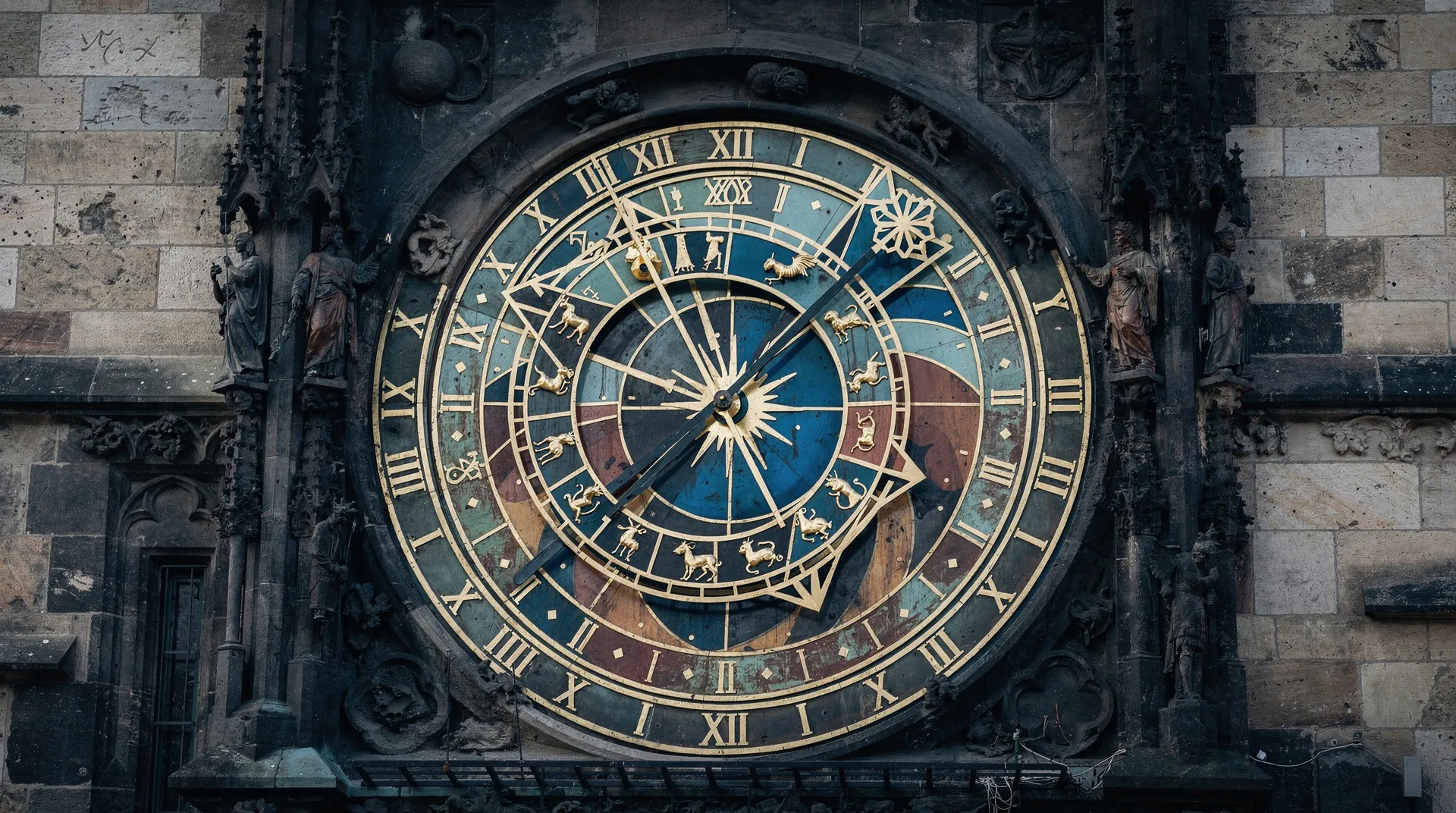
The astronomical clock on the south façade of the Old Town Hall is the square’s main attraction and warrants its own deep-dive page. In brief: it’s a 15th-century marvel of medieval technology that simultaneously shows solar time, sidereal time, Bohemian time, the position of the sun and moon, and the sign of the zodiac. On the hour (every hour, 9:00–23:00), a set of moving figures — the Apostles, Death, a Vain Man, a Miser, a Turk — emerge from windows above the clock face. The show lasts about a minute. Whether it’s worth the crowds is entirely personal.
The tower interior and panoramic gallery can be accessed with a ticket (~€6 / 150 CZK). For more on the clock itself, see the dedicated page at Prague Astronomical Clock.
Kostel Matky Boží před Týnem — Týn Cathedral
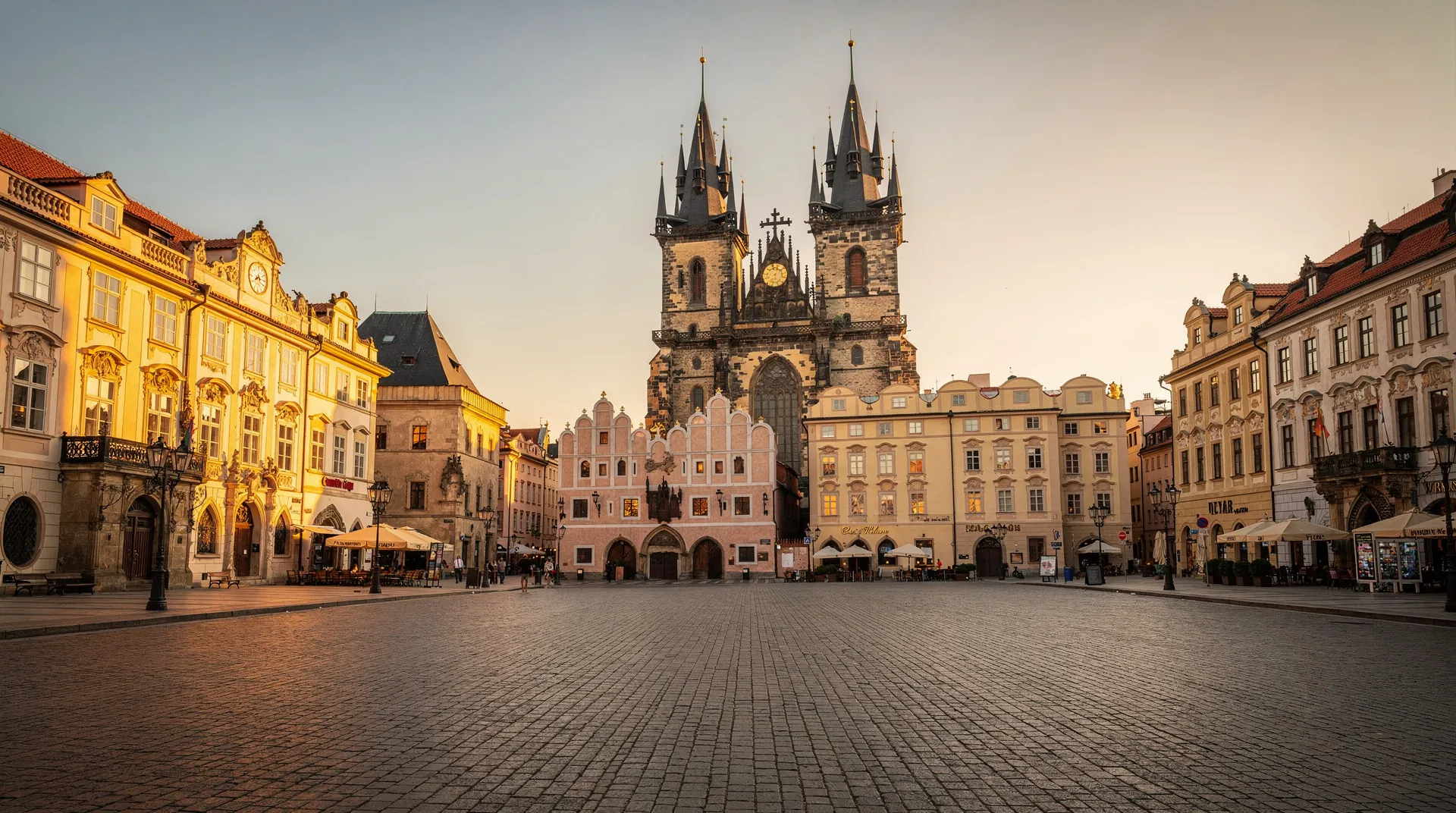
The twin Gothic spires of Týn Cathedral (completed around 1511) dominate the eastern side of the square, though the church façade is actually hidden behind the row of houses fronting the square — a quirk that means many visitors photograph it for 20 minutes without finding the entrance. The entrance is through the arch passage under the house called the Týn School, to the left of the tall houses.
Inside: a beautiful Baroque interior (heavily remodelled in the 17th century, as was most of Prague after the Counter-Reformation), the tomb of Danish astronomer Tycho Brahe (who died in Prague in 1601 and is buried here), and a Gothic portal on the north door that is one of the finest in the city. Entry is free. Hours are irregular and the church closes during services — check in advance.
Tip: The spires are best photographed from Celetná street, which runs east from the square, in the morning light.
Kostel sv. Mikuláše — St Nicholas Church
The white Baroque St Nicholas Church at the north end of the square (not to be confused with the larger St Nicholas in Malá Strana) was completed in 1735 and has excellent acoustics. Classical music concerts are held here regularly in the evenings — a well-rated option for a cultural evening:
Old Town classical concert tourThe Jan Hus Memorial
The large bronze monument in the centre of the square commemorates Jan Hus, the Czech theologian and reformer burned at the stake in 1415. The monument (1915) was controversial at the time and remains a focal point for Czech national memory. Worth a closer look for the inscription and the quality of the sculptural work.
Kinský Palace
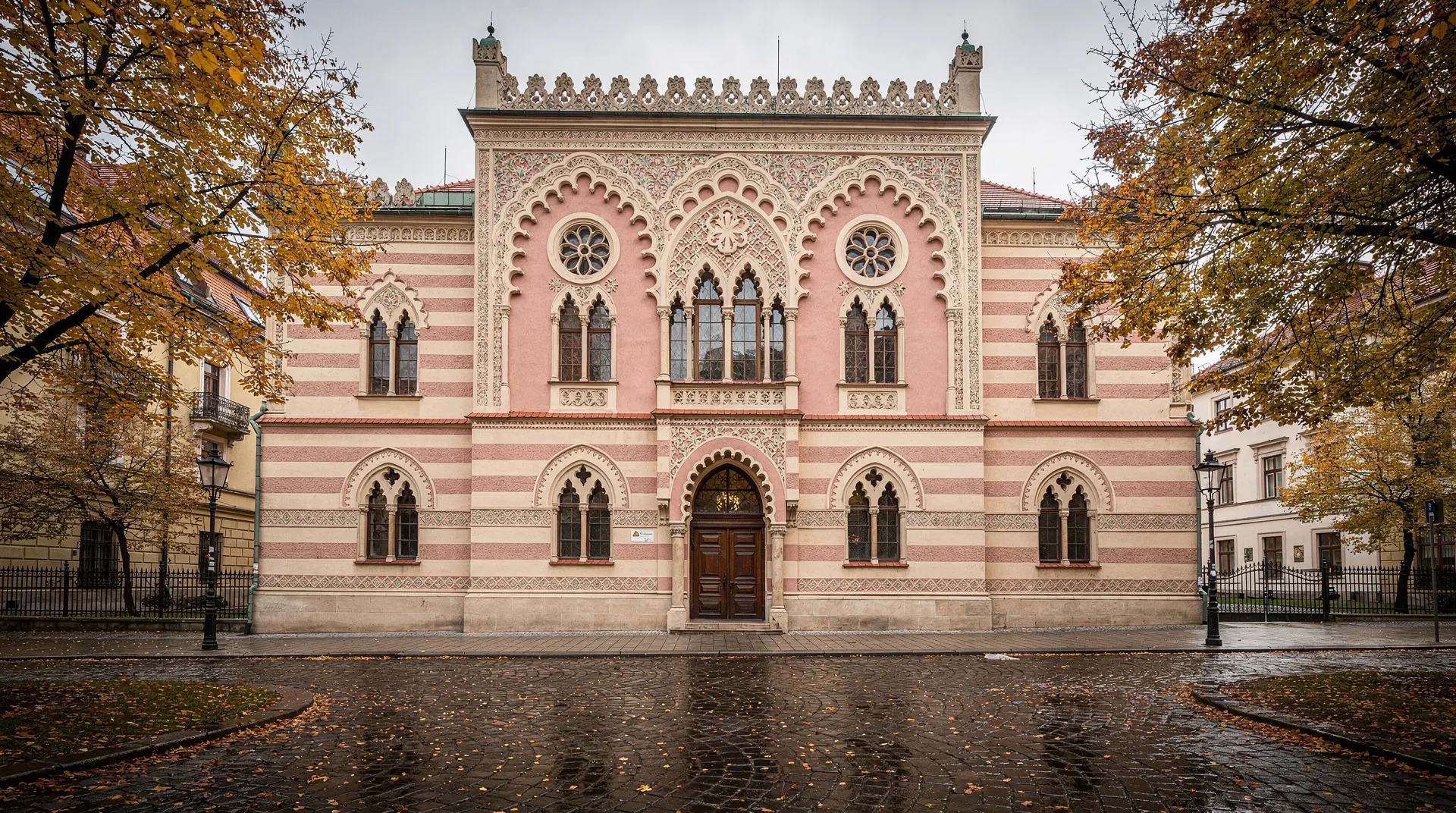
The pink Rococo palace on the east side of the square (Palác Kinských) is now a branch of the National Gallery, with changing exhibitions. Franz Kafka went to secondary school in the building.
Beyond the clock: what the square’s other buildings actually are
The east side of the square — the dramatic face framed by the Týn Cathedral spires — is actually a row of Gothic and Baroque merchant houses, not a single building. The houses are called the “Stone Bell House” (U Kamenného zvonu), a Gothic tower house with a restored 14th-century interior now used as an art gallery; and the Týn School houses, which screen the cathedral façade. This layering of centuries is characteristic of the whole square.
The most photographed corner, on the northwest edge, is the Palác Kinských (Kinský Palace) — a pink late Baroque façade from 1765, designed by Kilián Ignác Dientzenhofer. Franz Kafka was a student at the German-language gymnasium housed in this building. His father Hermann ran a haberdashery shop on the ground floor. The palace is now the National Gallery’s collection of prints and drawings.
The Stone Bell House (Dům U Kamenného zvonu, no. 13) is worth entering for the gothic stone interior. The 14th-century carved stone bell on the corner that gives the house its name is original; the house was a royal palace in the time of John of Luxembourg.
A note on the Týn Church interior
Visitors who find the entrance through the Týn School passage discover an interior that surprises after the Gothic exterior’s severity: the nave is filled with ornate Baroque altarpieces, gilt reliquaries, and ceiling paintings added after 1620 as part of the Counter-Reformation recatholicisation of Bohemia. The earliest elements — the Gothic north portal (c. 1390), the tin baldachin over the high altar (15th century), and the tomb of Tycho Brahe (who died in Prague of kidney failure in 1601, reportedly refusing to leave a royal banquet to relieve himself) — are worth finding individually.
Different ways to experience Old Town Square
Private walking tour
For a deeper read of the square’s buildings and history, a private guide covers the stories that panels skip:
Prague Old Town private walking tour with hotel pickup Prague Old Town highlights private guided walking tourIntroduction tour for first-time visitors
A compact overview of the key sights in the historic centre — good for orienting yourself on day one:
Prague top sights and historic centre introduction tourCombined castle, Jewish Quarter, and clock tower ticket
For those who want to cover the big three in a single day with combined admission:
Prague Castle, Jewish Quarter, and Clock Tower combined admissionEvening concert in Týn Church
Classical concerts are held regularly inside Týn Cathedral — an opportunity to hear the space as it was intended to be experienced:
Prague classical music concert at Týn ChurchSeasonal notes
Christmas (late November to 23 December): The Old Town Square Christmas markets are among the most photogenic in Europe. Two large wooden market villages fill the square with craft vendors, roasted chestnut stands, and svařák (mulled wine). The Astronomical Clock is decorated with lights. Crowds are enormous — 10:00–18:00 is essentially immovable. The square at 7:00–8:00 on a December morning, with frost on the cobblestones and the market just setting up, is one of the best private moments in Prague. Book hotels months in advance and expect prices 30–40% above normal.
Easter (March–April): The Easter markets (Velikonoční trhy) fill the square for about two weeks. Smaller and quieter than Christmas, with traditional crafts and food. The flower stalls are particularly good.
Summer evenings: Open-air classical concerts and occasional city events are held in the square. The setting — Gothic, Baroque, and Romanesque facades lit under a warm evening sky — is hard to beat for atmosphere.
Winter outside market season: January and February are the quietest months. The square in fresh snow, before the tourist day begins, is the version that locals rarely share but that justifies early rising.
Insider details
The 27 execution crosses: The white crosses embedded in the pavement in front of the Town Hall mark where 27 Protestant leaders were executed on 21 June 1621 after the defeat at White Mountain. Easy to miss underfoot; worth looking for deliberately.
Celetná street at dawn: The Gothic and Baroque facades on Celetná, running east from the square toward the Powder Gate, photograph best in morning light with almost no foot traffic. The Cubist House of the Black Madonna (Dům U Černé Matky Boží, 2 minutes’ walk) is the only significant Cubist commercial building in Prague.
The Town Hall observation platform: The tower climb (~€6 / 150 CZK, by lift) gives a directly overhead view of the Jan Hus monument, the square’s irregular shape, and — facing north — the top of Týn Cathedral’s spires. Most visitors photograph from the square; very few photograph the square from above.
The astronomical clock mechanism room: Included in the tower entry ticket, this room shows the iron clockwork driving the Orloj — weights, escapements, and gearing. More interesting than it sounds, and almost nobody lingers here.
Food and drink: what to avoid, what to seek
The restaurants with outdoor seating directly on the square are among the most expensive in Prague, with quality frequently underwhelming. Budget €25–35 per person for a meal here; the food is rarely worth it relative to what you’d pay two streets away.
Better alternatives one block away:
- V zátiší (Liliová 1) — proper Czech-international food without the tourist markup
- Lokál (Dlouhá 33) — the canonical place for tank-fresh Pilsner Urquell and well-made Czech food
- Kavárna Nová Scéna (on Bartolomějská) — reliable coffee without the square surcharge
Trdelník (the chimney cake sold everywhere around the square) is not a Czech tradition despite its ubiquity. It was introduced commercially in the 2000s. It’s not offensive — it’s just dough, butter, and cinnamon — but it’s not an authentic Prague food experience.
Tickets and timings
- Square: Always open, free
- Astronomical Clock Tower interior and gallery: ~€6 / 150 CZK; open daily 9:00–22:00 (Monday from 11:00)
- Týn Cathedral: Free; open daily except during services (10:00–13:00 and 15:00–17:00, variable)
- St Nicholas Church: Entry varies (free or small donation); regular concert events in the evenings
Which tour to book
For a guided walk covering the square and its history, including the clock and the surrounding architecture:
Old Town, Jewish Quarter, and Astronomical Clock walking tourFor a focused tour of the square and the clock with an audio guide:
Old Town Square and Astronomical Clock audio guideFor a broader orientation to Old Town and the Jewish Quarter together:
Old Town and Jewish Quarter 2-hour walking tourFor the underground layer of Old Town — the medieval cellars beneath the square:
Old Town, Astronomical Clock, and underground tourGetting there
Metro: Staroměstská (Line A, green) — 4-minute walk south along Kaprova.
Tram: Lines 17 and 18 to Staroměstská, then a short walk. Alternatively, tram 2 or 14 to Náměstí Republiky for the east side of Old Town, 5 minutes’ walk.
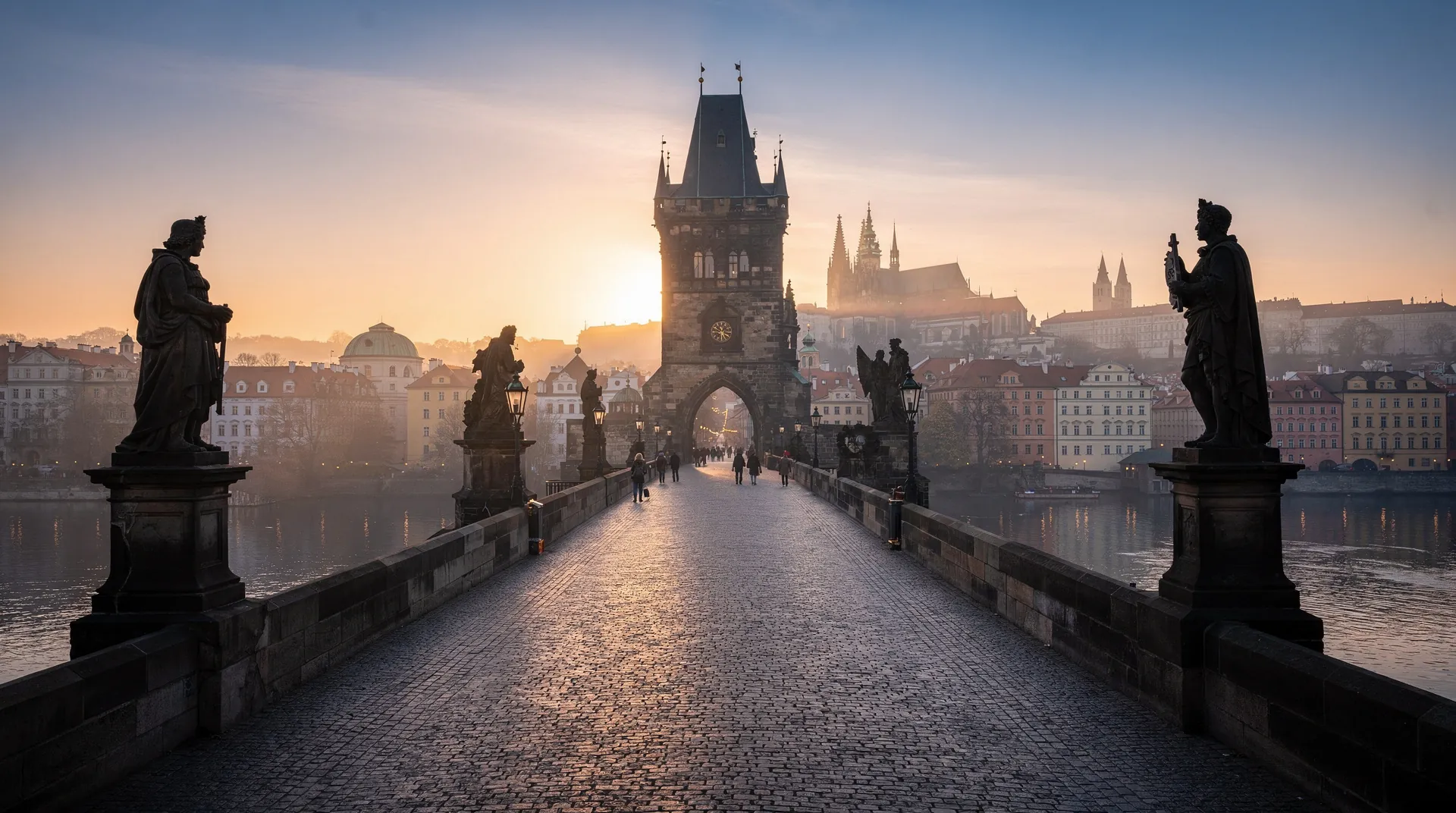
On foot from Charles Bridge: Walk east on Karlova street — about 6 minutes.
On foot from Wenceslas Square: Walk north via Na Příkopě and Celetná — about 10–12 minutes.
Photographer’s note
The cathedral spires photograph best from Celetná street in morning light. The clock tower at night (the building is lit until midnight) gives a bluer, less orange tone than midday shots. For the full square panorama with the Jan Hus monument, stand near the northwest corner of the square (by the corner of Pařížská street) and shoot southeast — you get the Town Hall, the church, and depth of field from the houses behind Hus.
Old Town Square vs Prague’s other historic squares
Old Town Square is the most famous, but not the only, historic square in Prague — and knowing how it compares helps decide how much time to allocate.
| Square | Character | Crowds | Best for |
|---|---|---|---|
| Old Town Square | Gothic/Baroque mix, Astronomical Clock, Týn Cathedral | Very high 10:00–18:00 | First-time visitors, the clock show |
| Wenceslas Square | Wide 19th/20th-century boulevard, National Museum | Moderate, spread out | Shopping, modern history (1968, 1989) |
| Vysehrad area | Fortified hilltop, cemetery, river views | Low | Quiet atmosphere and panoramic views |
Old Town Square earns its reputation but is also the most crowded square in the city by a wide margin. If the crowds at Old Town Square feel overwhelming, Wenceslas Square (10–12 minutes on foot) offers a completely different, far less congested atmosphere, and Vysehrad offers genuine quiet with comparable historic weight.
Is Old Town Square worth visiting more than once?
Yes, if your schedule allows it. The square looks and feels different at each of its distinct time windows: the pre-8:30 version with almost nobody present, the mid-morning-to-evening tourist peak, and the after-dark version when the facades are lit and the day-trippers have mostly left. Visitors who only see the square once, at midday, get the least interesting version of it. Pairing an early-morning visit here with an evening walk across Charles Bridge gives a much fuller sense of central Prague than a single midday pass through both.
Frequently asked questions about Old Town Square
Is Old Town Square free to visit?
The square itself is free and permanently accessible. The clock tower interior has a small admission fee. Týn Cathedral is free to enter during opening hours.
What time does the Astronomical Clock perform?
Every hour from 9:00 to 23:00. The hourly show lasts about 60 seconds. There is no need to arrive more than 2–3 minutes early.
Where is the entrance to Týn Cathedral?
Through the arch passage (Týnská škola) to the right of the Týn School houses on the east side of the square — not directly from the square. Follow the signs through the archway.
Are there Christmas markets on Old Town Square?
Yes — among the most famous in Central Europe. The markets run from late November through 23 December and attract enormous crowds. Beautiful but extremely busy; book accommodation well in advance and expect premium prices everywhere.
How long do you need at Old Town Square?
30–45 minutes to absorb the square and watch the clock. Add another hour if you enter the clock tower and Týn Cathedral. Half a morning if you combine it with the Jewish Quarter.
Is Old Town Square safe?
Generally yes, though pickpockets are active in the crowd around the Astronomical Clock at peak hours. Standard urban precautions apply: don’t leave a bag unattended, keep wallets in front pockets.
What are the 27 white crosses in front of the Town Hall?
They mark the positions of the scaffolds where 27 Bohemian Protestant leaders were executed on 21 June 1621, following the Habsburg victory at the Battle of White Mountain. The execution was staged as a public spectacle and remained a defining trauma in Czech national memory for centuries.
Is Týn Cathedral free to visit?
Entry is free during opening hours (roughly 10:00–13:00 and 15:00–17:00 Tuesday to Saturday, and Sunday after Mass). The cathedral closes during services. Donations are appreciated. The entrance is through the arch passage in the Týn School building — not directly from the square.
Where exactly is the Tycho Brahe tomb?
In the north aisle of Týn Cathedral, near the north transept. It’s marked with an engraved stone slab and a small bronze portrait relief. Brahe died in Prague in October 1601, aged 54, while serving as court astronomer to Rudolf II.
What’s the best way to photograph the Týn Cathedral spires?
From Celetná street, looking west, in morning light. The spires appear above the row of houses at a distance that gives them proper scale. From inside the square, you’re too close and get foreshortening. The view from the Old Town Bridge Tower also gives a good elevated angle on the cathedral.
How does Old Town Square compare to Wenceslas Square?
They’re very different: Old Town Square is a compact medieval and Baroque space centred on the Astronomical Clock, while Wenceslas Square is a wide 19th/20th-century boulevard associated with modern Czech history, including the 1989 Velvet Revolution. Both are worth seeing; Old Town Square is the more visually dense of the two.
Is it worth visiting Old Town Square twice in one trip?
Yes, if your schedule allows it. The early-morning version (before 8:30) and the evening version (after 21:00) feel like different places compared to the crowded midday hours, and each rewards a separate visit.
Practical info at a glance
- Address: Staroměstské náměstí, 110 00 Praha 1
- Opening hours: Square always open; Clock Tower 9:00–22:00 (Mon from 11:00)
- Price: Square free; Clock Tower ~€6 / 150 CZK
- Nearest metro: Staroměstská (Line A, green)
- Nearest tram: Staroměstská (trams 17, 18)
- Official website: staromestskenamesti.cz (tourist info); muzeumpraha.cz (clock tower tickets)