At a glance
| Where | Karlův most, spanning Staré Město and Malá Strana |
| Cost | Free to cross; tower climbs cost around €8 / 200 CZK each |
| Time needed | 10 minutes to cross when empty; 45–60 minutes with a stop at the towers |
| Getting there | Metro A to Staroměstská (Old Town side) or Malostranská (castle side); a 6–8 minute walk from Old Town Square |
| Best time | Sunrise in summer (around 5:30–7:00) or after 21:00; avoid 10:00–18:00 in peak season |
How Charles IV built the most important bridge in Central Europe
The decision to build Karlův most was not merely practical. When Charles IV (Karel IV) laid the foundation stone on 9 July 1357 at 5:31 in the morning, he chose the moment deliberately: the sequence 1-3-5-7-9-7-5-3-1 (year, day, month, hour, minute) formed a magic palindrome that medieval numerology considered particularly powerful. Whether Charles genuinely believed in the protective numerology or was simply performing political theatre is uncertain; the bridge has withstood 660 years of floods and war regardless.
Charles IV commissioned the bridge following the catastrophic flooding of 1342 that destroyed the Judith Bridge, which had been the only Vltava crossing in Prague for nearly 200 years. He appointed Master Otto, a pupil of the great German Gothic builder Peter Parler, as the primary architect. The construction required enormous quantities of Bohemian sandstone quarried upriver at Braník and Zbraslav, and the mortar binding the stones was allegedly mixed with eggs for extra strength — a claim that modern analysis has partially confirmed, finding traces of organic material in the original mortar.
By 1402, the basic bridge structure was complete, though the towers were finished later. For the next three centuries, Karlův most was not just the main crossing but the commercial artery between the Old Town and the castle district — merchants, market stalls, and craftsmen occupied its length. The Baroque statues did not arrive until 1683, when the Jesuits placed the first figure of St John of Nepomuk and the city’s Catholic establishment followed with the remaining sculptures over the next 30 years.
The 1890 flood — the most severe since the bridge’s construction — nearly destroyed several piers and forced a major engineering intervention that reinforced the foundations. The current stone surface dates largely from early 20th-century repairs. The 2002 flood, the worst in 500 years, rose to within centimetres of the bridge deck but did not damage it structurally.
Why Charles Bridge is still worth seeing — and when to skip the midday rush
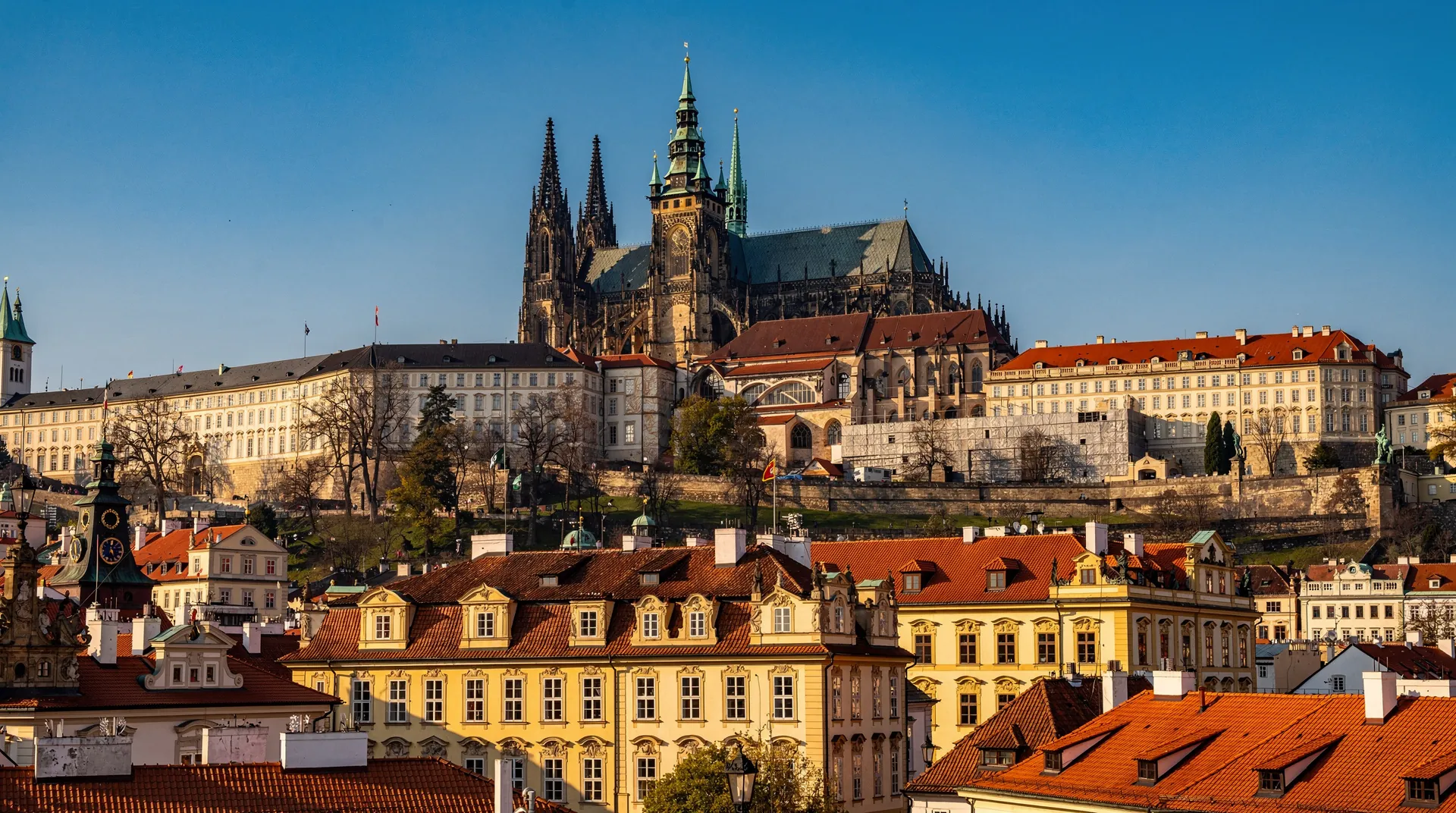
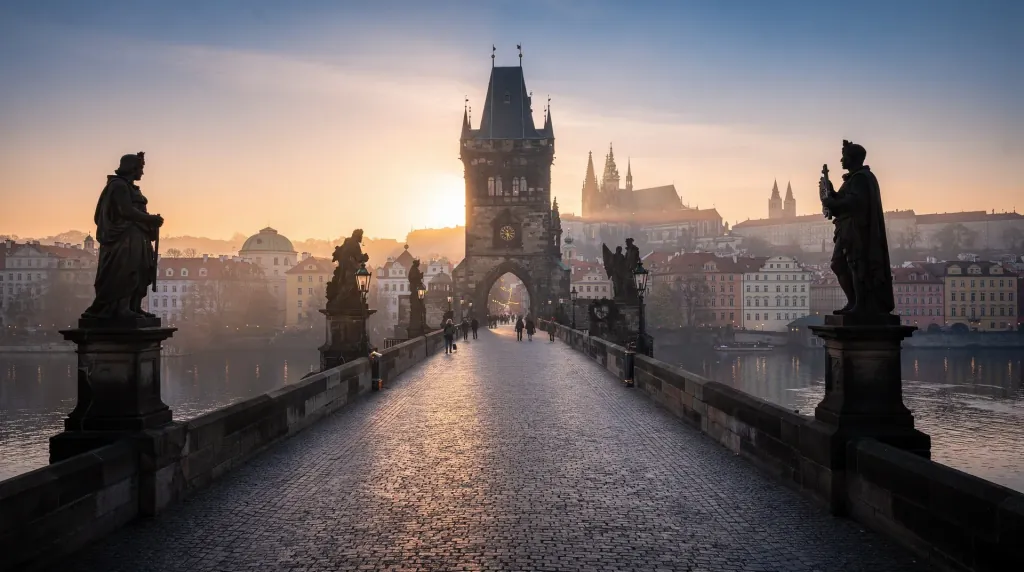
Karlův most is the kind of place that photographs can’t quite do justice to. The 30 Baroque statues lining a 14th-century stone bridge, the castle looming on the hill to the west, the Vltava below, and on a clear morning the low light turning everything amber — it genuinely earns its fame.
The problem is that roughly 20,000 to 30,000 people cross it on busy summer days, concentrated between 10:00 and 18:00. At peak hours the bridge is a slow shuffle, vendors crowd the sides, and the statues you want to examine closely are inaccessible. The bridge hasn’t lost any of its quality; it’s purely a logistics issue.
The solution: visit at sunrise or after 21:00 in summer. Both windows are reliable, and the bridge at those hours is one of the most atmospheric spots in Central Europe.
The bridge itself — what you’re looking at
Charles Bridge was built on the orders of Charles IV (the Holy Roman Emperor who also founded Prague’s New Town and Charles University) between 1357 and around 1402. The exact year 1357 July 9 at 5:31 was allegedly chosen by Charles in consultation with astrologers because it formed a palindromic sequence: 1-3-5-7-9-7-5-3-1. Whether the story is true or not, the timing has been remembered for 660 years.
The bridge stretches 516 metres over 16 arches. It replaced an earlier stone bridge, the Judith Bridge, which was destroyed by floods in 1342. For centuries it was the only crossing of the Vltava in Prague.
The Gothic bridge towers
There are three towers — the Lesser Town Bridge Towers (two towers connected by a short bridge section on the Malá Strana side) and the Old Town Bridge Tower on the Staroměstské side. The Old Town Bridge Tower (built around 1380) is considered one of the finest examples of Gothic civic architecture in Central Europe. You can climb it for a fee (around €8 / 200 CZK) for a view down the length of the bridge toward the castle.
The 30 Baroque statues
The statues lining both balustrades were added mostly between 1683 and 1714, replacing the original plain parapet. They are primarily the work of Matthias Braun and Ferdinand Maximilian Brokoff. Most depict Catholic saints and were placed here as a visible assertion of Counter-Reformation authority over Bohemia.
A few worth slowing down for:
St John of Nepomuk (no. 8 from the Old Town end, north side): The most famous statue on the bridge. Jan of Nepomuk was a Prague priest thrown into the Vltava in 1393 on the orders of King Wenceslaus IV. The bronze plaque at the base showing his body being thrown from the bridge is polished bright by tourist hands and said to bring luck. Skip the touching — the legend is late and the bronze is being worn smooth.
St Luitgard (south side, by Braun, 1710): Art historians consider this the finest Baroque sculpture on the bridge. Christ bends down from the cross to offer his wounded hand to a kneeling Cistercian nun. The composition is genuinely moving. Matthias Braun was 26 when he carved it.
The Turkish Guard and Prisoners (north side, by Brokoff): An unusual, almost theatrical grouping — an Ottoman officer watches prisoners while a dog sits at his feet. Commissioned as a Catholic triumphalist statement after the relief of the siege of Vienna, but the execution is too good to be merely propagandistic. Ferdinand Maximilian Brokoff produced this in 1714.
St Francis Xavier (south side, by Brokoff, 1711): The Jesuit missionary stands above four figures representing the peoples he converted — an Indian, a Moor, a Tatar, and a Japanese man. The colonial context is uncomfortable by modern standards but the sculpture itself is among the most compositionally ambitious on the bridge.
St Nicholas of Tolentino (north side): One of the few statues to survive intact from the original 17th-century installation without significant restoration. The black stone base is original; look at the contrast with the lighter restorations on either side.
St John of Matha, St Felix of Valois, and St Ivan (north side, Brokoff, 1714): The most narrative sculpture on the bridge — a Turk guards Christian prisoners in a dungeon-like cage, while angels assist the saints in their work of redemption. Three separate figures interact across a single pedestal in a composition that reads differently depending on your angle. Brokoff’s finest group work.
Note: the statues on the bridge are mostly 20th-century replicas. The originals are protected indoors at the Lapidárium museum in Holešovice — worth a visit for stone carving enthusiasts.
The Charles Bridge Museum
On the Staré Město side, a short walk from the bridge tower, the Charles Bridge Museum (Muzeum Karlova mostu) covers the history of the bridge, the Judith Bridge before it, and the great floods. Check the museum’s official website for current prices. Interesting for context, though not essential.
Tickets and timings
Crossing the bridge is free, 24 hours a day, 365 days a year. No ticket required.
Old Town Bridge Tower: open daily, 9:00–20:30 in June–September, 10:00–18:00 in January–March and October–November, 10:00–19:30 in December, 10:00–19:00 in April–May. Entry adult 200 CZK (about €8), reduced 130 CZK.
Lesser Town Bridge Towers: similar hours. Combined ticket with Old Town Tower available.
Seasonal notes and the bridge through the year
Winter (December–February): The bridge is genuinely uncrowded — even midday sees manageable foot traffic. Frost on the statues’ stone surfaces and low winter light make for striking photographs. The river sometimes fogs in the early morning, obscuring the lower arches and producing a ghostly atmosphere that the summer postcards cannot replicate.
Spring (March–May): The light is improving, the tourist season has not fully begun, and the morning fog lingers into April. The best overall window for experiencing the bridge without crowds is March–early April, when European spring-break tourism hasn’t peaked.
Summer (June–August): Crowded from 9:00 to 21:00. The heat radiating from the stone surface in July is noticeable. The only viable strategy is sunrise or post-21:00. The bridge is not cooler until well after dark.
Autumn (September–October): September is arguably the finest month. The crowds thin after the first week, the light turns amber-gold in late afternoon, and the castle on the hill catches the low sun in a way that photographers wait for.
Charles Bridge by season, at a glance
| Season | Crowds | Weather | Notes |
|---|---|---|---|
| Winter (Dec–Feb) | Low, even at midday | Cold, occasional fog and frost | Best value season; low winter light suits photography |
| Spring (Mar–May) | Building through April | Mild, morning fog lingers into April | March–early April is the best uncrowded window |
| Summer (Jun–Aug) | Very high 9:00–21:00 | Hot, stone radiates heat | Sunrise or after 21:00 are the only realistic options |
| Autumn (Sep–Oct) | Thins after early September | Mild, amber late-afternoon light | September is widely considered the best all-round month |
Statues, towers, or river — deciding what to prioritise
Most visitors have limited time and try to do everything on the bridge in one pass, which usually means rushing the statues to make a tower opening time. If you only have 30 minutes, skip the tower and focus on the statues at walking pace — St Luitgard and the Turkish Guard grouping reward a slow look far more than the view from the Old Town Bridge Tower, which is a similar (if slightly higher) vantage to what you already see approaching from Old Town Square. If you have a full hour and photography is a priority, add the tower for the elevated composition down the bridge deck, and pair it with an early-morning visit to Prague Castle grounds before the crowds arrive there too.
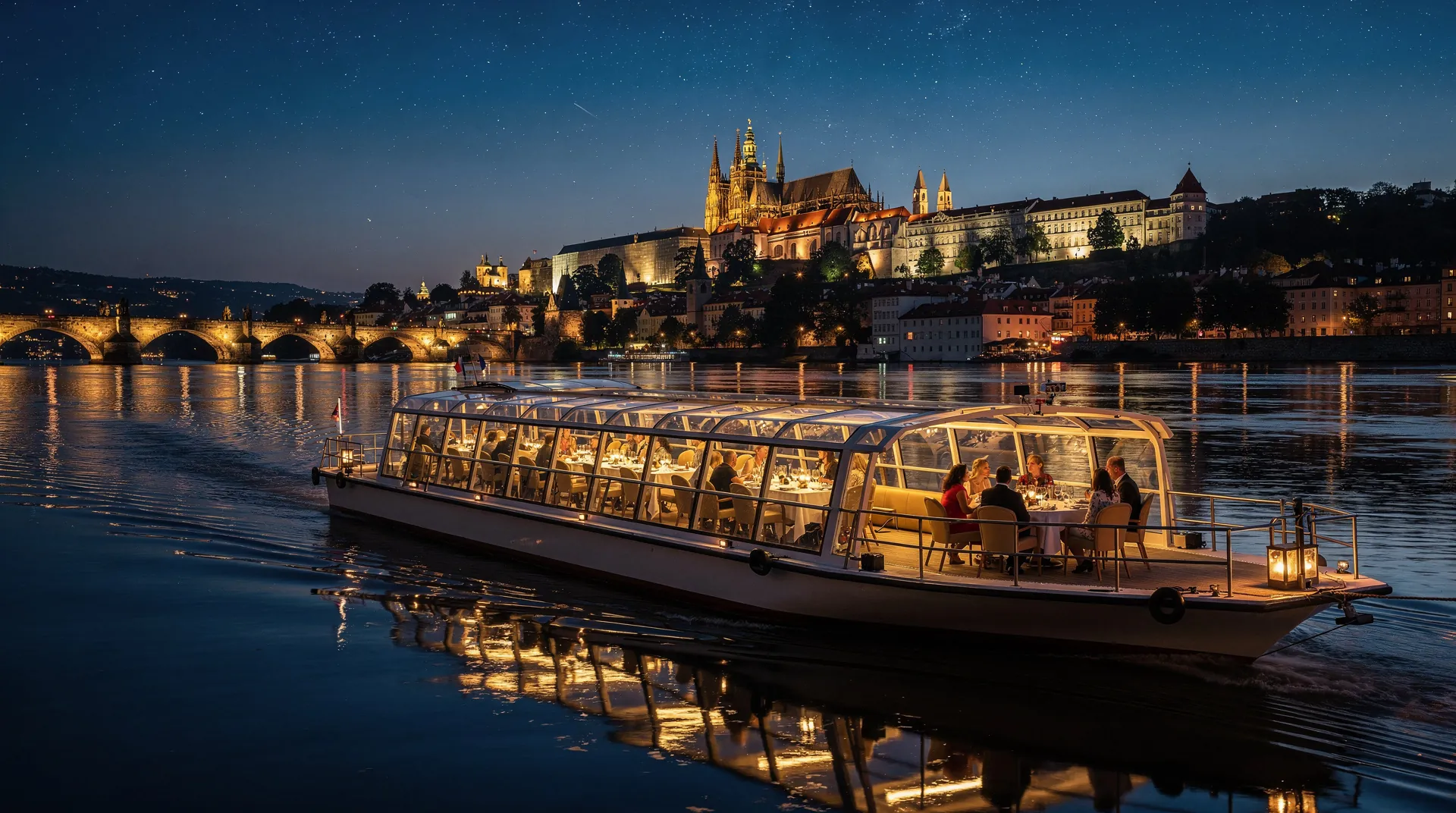
For a completely different angle on the bridge — from the water rather than from it — a short cruise passing under the arches gives you the underside view of the piers, something no amount of time on the bridge itself will show you.
Different ways to experience Charles Bridge
Photography-focused visits
The sunrise photoshoot with a professional photographer who knows the bridge’s best angles and light windows is one of the best ways to get images that don’t look like everyone else’s:
Private Prague sunrise photoshoot and walking tourFor a professional photoshoot specifically at Charles Bridge with a photographer who manages the crowds and finds the right moments:
Professional photoshoot at Charles BridgeCombined walking tours
For the full Prague classics in a single morning — Old Town, Charles Bridge, Prague Castle:
3-hour walking tour of Old Town and Prague CastleNight experience
The after-dark private tour combining castle, bridge, and Old Town in one illuminated evening:
Prague after dark — private night experience (Castle, Charles Bridge, Old Town)Insider details
The bridge at 5:45 in June: If you set an alarm for 5:30 on a clear June morning, you will be rewarded with soft pink light, barely five other people on the bridge, and a quality of silence that the summer daytime version of this space cannot produce. Bring a jacket — the river is cold even in June.
The Malá Strana end: The area immediately south of the Lesser Town bridge towers, along Kampa Island, has the best-maintained stretch of riverside in central Prague. The Přistavní (Dock) steps lead down from the bridge to the waterfront, where you can watch the river from a few feet above the water level and see the bridge arches from below.
The Klementinum tower view: The astronomical tower of the Klementinum (five minutes’ walk from the Old Town end) gives a bird’s-eye view of the bridge from above and northeast — a different perspective from the usual shots. The tower is open for guided tours:
Klementinum library and astronomical tower guided tourThe repair patches: Look at the stone surfaces of the parapet walls. The older, darker stone and the lighter, newer stone show every repair and replacement since the bridge opened. The 1890 flood repairs, the 20th-century pedestrianisation work (the bridge was open to vehicles until 1965), and the 2002 flood repairs all left visible traces.
Which tour to book
For a proper orientation to the bridge and the surrounding neighbourhoods, a walking tour is more useful than reading a guidebook:
Charles Bridge and Malá Strana walking tourIf you want to combine Charles Bridge with Prague Castle in one morning:
Charles Bridge and Prague Castle walking tourFor a unique angle on the bridge — from the water — a short canal cruise circles under the arches:
45-minute canal cruise around Charles BridgeFor a full-morning combination of city walking and the river:
Prague river cruise, Charles Bridge Museum, and walking tourGetting there
From Old Town Square (Staroměstské náměstí): Walk west on Karlova street (6–8 minutes). This is the most direct route and also passes the Klementinum.
From Malostranské náměstí: Walk east along Mostecká street (3 minutes). This is the Malá Strana approach.
Metro: Staroměstská (Line A, green) is closest to the Old Town end. Malostranská (Line A) for the castle side.
Tram: Tram 17 or 18 to Staroměstská for the Old Town end. Trams 12, 20, or 22 to Malostranské náměstí for the Malá Strana side.
Photographer’s note
Best shot positions:
- Čechův most (the decorative Art Nouveau bridge about 500m north) gives a clean side-on view of the bridge with the castle behind. Best around 6:00–7:30 in summer.
- From the Vltava itself: the canal cruise gives a perspective impossible from land.
- On the bridge at the second statue from the Old Town end, looking west toward the tower and castle — classic, and best in the 20 minutes before full sunrise.
The bridge is lit after dark, but the artificial lighting is orange-heavy and tends to produce flat images unless you use longer exposures.
Frequently asked questions about Charles Bridge
Is Charles Bridge free?
Yes. There is no charge to walk across it at any hour. The bridge towers have small entry fees if you want to climb them.
When should I visit to avoid crowds?
Before 7:30 in summer (May–September), or after 21:30. In winter, any morning is manageable. Avoid midday on summer weekends — the bridge is at near-capacity.
How long do I need to see Charles Bridge?
The crossing takes 10 minutes at a stroll if it’s empty, 20–25 if you stop at statues. Allow 45–60 minutes total with a look at the towers.
Can you stop on Charles Bridge to take photos?
Yes, there are no restrictions on stopping, sitting on the low walls, or photographing. It’s a public thoroughfare. However at peak times, stopping creates bottlenecks.
Is there anything to do under Charles Bridge?
Kampa Island, accessed by stairs on the Malá Strana side, sits directly below the bridge and has a park, a museum (Muzeum Kampa), and a restaurant row along the narrow Čertovka channel. Worth 30 minutes.
What are the grotesque faces on the arches of the bridge for?
These are water level markers — old flood measurement systems — not decorative carvings. The Czech word is “povodňové znaky” and some date to the 16th century. The most visible is on the second pillar from the Malá Strana side.
Is the sunrise on Charles Bridge actually special enough to wake up early for?
Yes. If the weather cooperates — clear sky, low mist on the river — it’s legitimately one of the best early-morning experiences in any European city. Not guaranteed, but worth checking the forecast.
Are there restrictions on busking or street performance on the bridge?
The city issues limited permits for busking on Charles Bridge. You will typically find one or two musicians (classical, jazz, or folk) at approved spots, particularly near the middle of the bridge. Amateur performance without a permit is not officially allowed but is rarely enforced for brief playing. Photography of performers is generally fine.
Is there a fee to cross Charles Bridge at night?
No. The bridge is free, 24 hours a day, permanently. Night-time visitors occasionally encounter an informal myth that there’s a charge after dark — there isn’t.
What’s under Charles Bridge?
Below the arches on the Malá Strana side, there are boat docks and the entrance to the narrow Čertovka channel. The channel separates Kampa Island from the main bank. At water level you can see the original stone foundations of the bridge piers, green with river moss. Some piers date to the original 1357 construction.
Can you take a stroller across Charles Bridge?
Yes. The cobblestone surface is rough but manageable with modern strollers. The bridge is not wheelchair-friendly in the strict sense — the cobblestones make it uncomfortable for wheeled mobility devices. There is no step or barrier, just the uneven surface.
Is Charles Bridge worth visiting if I’ve seen the photos already?
Yes — photos flatten the scale and the sound (footsteps on stone, buskers, the river below). Visiting at sunrise, when it’s nearly empty, is a different experience from the crowded daytime version that most photos are taken from.
Can I combine Charles Bridge with Prague Castle in one visit?
Yes, and it’s one of the most common combinations. Walk from the Old Town end across the bridge and continue up toward Prague Castle via Nerudova street — allow 20–30 minutes of walking plus whatever time you spend at each stop.
Practical info at a glance
- Address: Karlův most, Praha 1 (spans from Staré Město to Malá Strana)
- Opening hours: Open 24 hours, no ticket required
- Price: Free to cross; Old Town Bridge Tower ~€8 / 200 CZK
- Nearest metro: Staroměstská (Line A) for Old Town side; Malostranská (Line A) for castle side
- Nearest tram: Staroměstská (trams 17, 18) or Malostranské náměstí (trams 12, 20, 22)
- Best time to visit: Sunrise or after 21:00 in summer