The chimney cake you’re eating in Prague is not Czech
A woman at the stall near the Old Town Hall is paying 165 CZK — about €6.60 — for a spiral of warm dough coated in cinnamon sugar. It’s 11:30 in the morning, the dough smells good, and the vendor has a small Czech flag on the sign. She believes she is eating a traditional Czech pastry. She is eating a Slovak pastry that was introduced to Prague’s tourist market approximately 20 years ago. No Czech person eats trdelník as a cultural practice. The stall sells hundreds of them per day.
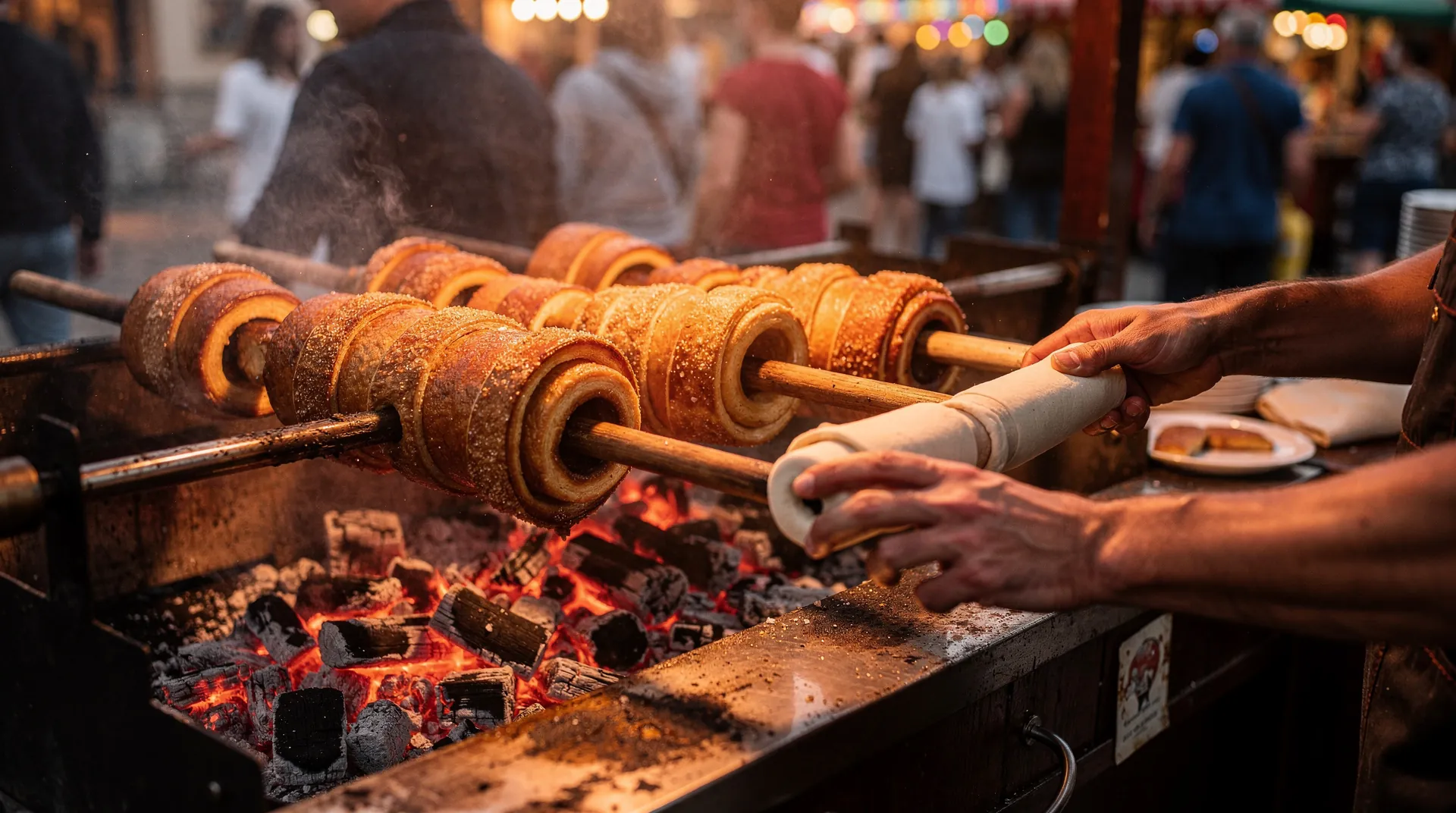
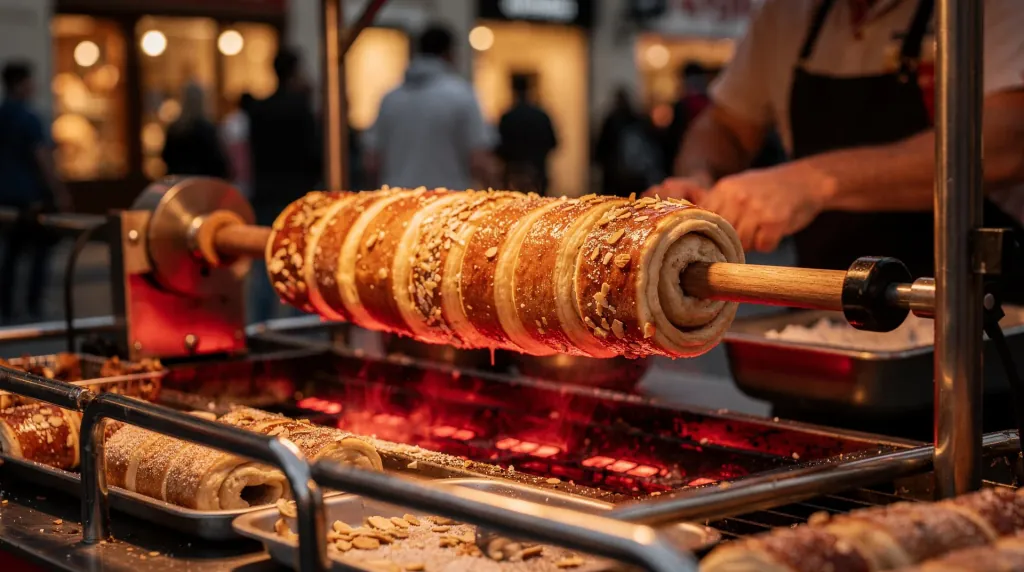
If you’ve walked through the tourist centre of Prague in the last fifteen years, you’ve seen it: a cylinder of spirally wound dough, grilled on a rotating spit over an open flame, coated in cinnamon sugar or Nutella or jam. The vendors call it trdelník. The stalls are branded with the Czech flag. The prices are €4–7 / 100–175 CZK each.
The trdelník is not Czech food.
The pastry originates in Slovakia (it is called trdelník or trdlo there, and has been for centuries) and in Transylvania (Hungarian Erdélyi kürtőskalács, meaning “chimney cake”). It appears in historical records from Slovakia and the Hungarian regions of Romania. Its connection to Bohemia — the Czech lands, where Prague is — is essentially zero prior to approximately 2005.
What happened: after the tourist boom of the early 2000s, a Slovak pastry was aggressively marketed to tourists in Prague’s historic centre as a “traditional Czech food.” Vendors set up stalls near Charles Bridge and Old Town Square. The format spread. By 2015, trdelník had become so ubiquitous in Prague’s tourist circuit that visitors genuinely believe it is traditional Czech food. The Prague city administration has debated regulating the sale of trdelník near historic monuments. The debate is ongoing.
This matters for two reasons: practical (you are paying tourist prices for a foreign pastry of no particular culinary significance) and contextual (there is genuine Czech food culture worth understanding, and the trdelník stalls obscure it).
| At a glance | |
|---|---|
| What it actually is | a Slovak/Transylvanian pastry, marketed as Czech since the mid-2000s |
| Typical tourist price | around 130–200 CZK / €5–8 |
| Real Czech pastry equivalent | koláč, around 35–55 CZK / €1.40–2.20 at a proper bakery |
| Where to find genuine Czech food nearby | streets off the tourist circuit — Dlouhá, Dušní, Maiselova |
| Best time to visit the farmer’s market | Wednesday and Saturday mornings, Náměstí Jiřího z Poděbrad |
What Czech food actually is
Czech cuisine is a Central European peasant kitchen that over centuries developed specific elegance in a few dishes. It is built around: preserved meats, root vegetables, freshwater fish, bread dumplings, sauerkraut, and — uniquely — a brewing tradition that produced the Pilsner lager style that now dominates global beer consumption.
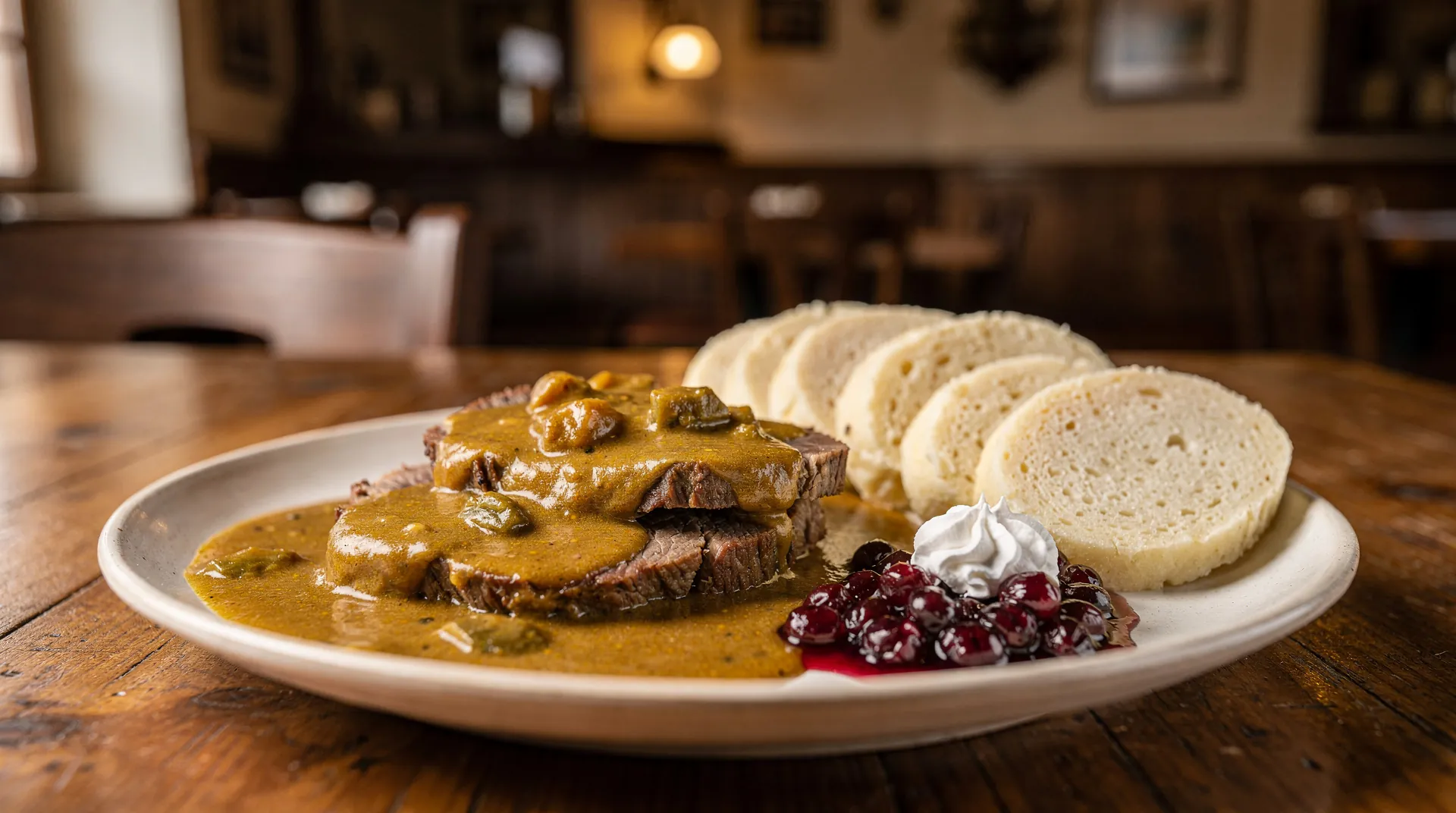
Svíčková na smetaně is the national dish in any serious reckoning: beef tenderloin slow-braised in a root vegetable cream sauce, served with bread dumplings and a slice of lemon and a spoonful of cranberry jam. It is rich, complex, and requires correct technique — the sauce should have body and acidity. A well-made svíčková in a Czech pub for €10 / 250 CZK is Czech food at its best.
Vepřo knedlo zelo is the Sunday roast of Czech cuisine: roast pork (typically shoulder or knuckle), bread dumplings, and sauerkraut. The kraut should be braised with caraway and pork fat until it has lost its harsh edge. The dumpling should absorb the sauce. Simple, filling, deeply traditional.
Guláš — the Czech goulash is distinct from Hungarian: less paprika-hot, more onion-forward, typically served with a dumpling or bread. The beef should be in substantial pieces, the sauce dark and rich.
Smažený sýr — fried cheese — is the Czech vegetarian classic and genuinely beloved. Edam or Hermelin (Czech camembert-style) is breaded and deep-fried, served with fries and tartare sauce. It is comfort food without pretension and is found in every Czech pub.
Chlebíčky — open-faced sandwiches on rye or wheat bread, typically with egg salad, smoked meat, pickled vegetables, and parsley. These are the Czech sandwich tradition: modest, precise, and genuinely good. Sisters restaurant on Dlouhá makes the best available to tourists. They cost €2–4 / 50–100 CZK each.
Bramboráky — potato pancakes — are a market and festival tradition: thick, filled with marjoram and garlic, served without adornment. Not the same as the German Reibekuchen — denser, spiced differently.
Koláče — Czech pastry — is the legitimate sweet tradition that trdelník pretends to occupy. A koláč is a sweet bun with a hollow filled with poppy seed paste, fruit jam, or tvaroh (farmer’s cheese). It is genuinely traditional, found at Czech bakeries, and significantly better than a cylinder of sugared bread on a stick.
Where the trdelník actually comes from (a brief history)
The Hungarian kürtőskalács is documented in the Transylvanian region of Romania from the 18th century. It came to Slovakia through the centuries of Hungarian cultural influence in the Carpathian region. It appears in Slovak folk festivals and regional bakeries there. The recipe is simple — a yeast dough wound on a cylinder, grilled, coated in sugar.
The association with Prague specifically begins in the mid-2000s. Several sources suggest the first prominent Prague trdelník stalls were set up by Slovak entrepreneurs who recognised the tourist market. The Czech national myth of the trdelník was essentially invented in front of tourists who had no local reference point to contradict it.
The name “trdelník” does appear in some older Czech and Moravian pastry traditions — but as a regional variant, not as a national iconic food, and not in the form now sold on Prague tourist streets.
What the Prague food market actually offers
The farmer’s market at Náměstí Jiřího z Poděbrad (metro A, Jiřák, Wednesday and Saturday mornings) offers genuine Czech artisan food: Moravian wines, organic cheeses, regional pastries including proper koláče, cured meats from small producers, and seasonal vegetables. This is what Czech food culture looks like when not processed through a tourist market model.
Naše maso on Dlouhá is a butcher and prepared-food counter where the ingredients are named and the cooking is honest. A sandwich here is €3–5 and is actual Czech food.
Country Life on Melantrichova is Prague’s original vegetarian cafeteria from the 1990s — the food is Czech-traditional ingredients in a cafeteria format, consistently decent, and aggressively cheap.
The trdelník vendors will continue to operate near every major tourist site in Prague. They sell a fast sugar hit at a tourist premium with a fabricated national story. The Czech food market, two blocks away, sells things worth eating at half the price with honest provenance.
Going beyond one meal — where to actually eat in Prague
If the trdelník revelation makes you want to rethink your whole food plan, the good news is that Prague has plenty of ways to eat well beyond a single bakery recommendation. Our best beer halls guide covers where svíčková and guláš are done properly alongside a well-kept pint, and the street food guide separates the genuinely good market stalls from the tourist-trap ones near the main squares. If you’d rather have someone show you around than research it yourself, a proper food tour comparison breaks down which operators focus on real neighbourhood food rather than a scripted tourist circuit. For a more personal option, a private Czech food and Old Town tour combines traditional dishes with the historic centre.
Why this pattern isn’t unique to trdelník
The trdelník story is really a case study in a wider Prague phenomenon: businesses that cater exclusively to tourists have every incentive to invent a “traditional” story, because visitors have no local reference point to check it against. The same logic applies to some of the tourist-trap restaurants around Old Town that advertise “authentic Czech” menus at a markup with no Czech patrons in sight. Once you know to ask “would a local actually eat this, at this price, in this spot,” a lot of Prague’s food landscape becomes much easier to navigate.
A note on Czech culinary pride
The Czechs themselves are not confused about this. Ask any Czech person whether trdelník is traditional Czech food. They will either laugh or express mild exasperation that the question is being asked. The trdelník’s takeover of the tourist food scene is a known and somewhat embarrassing phenomenon within Czech food culture.
Czech gastronomy has, since about 2010, developed a sophisticated modern restaurant scene (see Eska, La Degustation, the Vinohrady independent restaurant circuit) that bears no relationship to what tourist streets suggest. The gap between what tourists are offered and what Czechs actually eat is precisely the gap this article is trying to close.
What the trdelník vendors would say — and why it doesn’t matter
The counter-argument from the stalls: “Customers love it, it’s a local product, it makes people happy, who cares where the recipe came from?” These are all true. The trdelník is genuinely good — it is warm, sweet, fragrant, and satisfying on a cold morning near a Baroque church. Nobody is being harmed by eating one.
The problem is specifically the falsified national story. Selling a Slovak pastry as “traditional Czech food” is a lie told for commercial gain. The vendors know it. Many Czech residents know it and find it embarrassing. The Prague city government has periodic debates about regulating trdelník stalls near historic monuments — not because the pastry is a menace but because its aggressive misrepresentation of Czech food culture has a real effect on what tourists think Czech food is.
Prices: trdelník in 2026
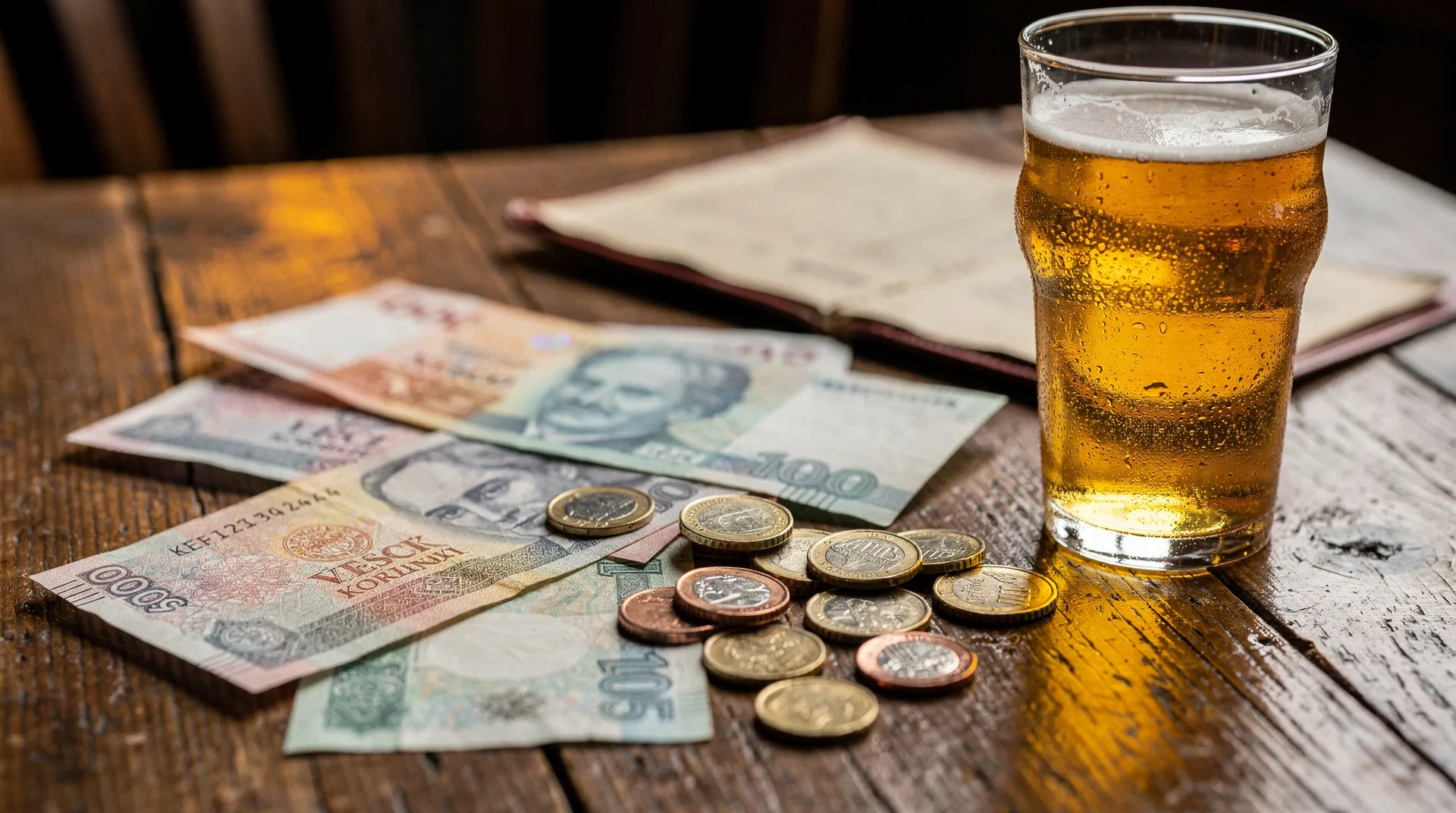
At Old Town Square stalls: 130–180 CZK (€5.20–7.20) for a standard trdelník. With Nutella or jam filling: up to 200 CZK (€8). The plain version at Wenceslas Square stalls: 100–130 CZK (€4–5.20). The ingredient cost is approximately 15–20 CZK. The 400–700% markup is possible because the product has no competition in the tourist circuit (no genuine Czech pastry stall operates within 500 metres of the Astronomical Clock) and because tourists have no price reference for Czech food.
Compare: a genuine Czech koláč pastry at a bakery costs 35–55 CZK (€1.40–2.20). A chlebíček (Czech open-face sandwich) at Sisters on Dlouhá costs 55–85 CZK (€2.20–3.40). These are actual Czech foods at actual Czech prices.
Reader questions
“I’ve already eaten one — did I do something wrong?”
Not at all. The trdelník tastes good; you spent your money as you chose. This article is for people who want to know what they’re eating and where it comes from, not to shame anyone for having enjoyed a warm pastry.
“Is there anywhere to eat proper Czech pastry near Old Town?”
Yes: any proper Czech bakery (pekárna) on streets off the tourist circuit — Dlouhá, Dušní, Maiselova — will have koláče, rohlíky, and other traditional Czech baked goods at 30–60 CZK each. The Sisters chlebíčky bar on Dlouhá is the highest-quality Czech food at the lowest price in the tourist area: open-face sandwiches made fresh to order, 55–85 CZK each.
“Is trdelník at least good quality, even if it’s not Czech?”
The better stalls make it fresh in front of you with real dough, and it can be genuinely enjoyable as a warm street snack. The issue isn’t quality — it’s the fabricated “traditional Czech” framing and the tourist-zone markup, not the pastry itself.
What this means for your 2026 Prague trip
The food you will encounter most aggressively in the historic core — trdelník, overpriced Old Town Square Czech food, tourist-facing goulash — is not representative of Czech cuisine. The gap between what visitors eat in the tourist core and what Czech residents eat in Vinohrady or Žižkov is one of the starkest in any European capital. Crossing it requires only walking 600–800 metres from the main tourist sites. The reward is eating actual Czech food at prices that reflect actual Czech economics.
If you want to experience Czech food culture properly, consider the Prague traditional Czech food tour with a local guide — a guided walk through the neighbourhood food circuit that specifically avoids tourist-trap restaurants and shows you where Czech people actually eat. Approximately 900–1,200 CZK (€36–48) including tastings.
Related reading
The Czech cuisine guide covers the traditional dishes with restaurant recommendations for each. The honest truths about Prague tourist traps covers the full range of tourist-zone food situations, including unrequested appetiser charges and fake “local” restaurants.