At a glance
| Route | Cologne Hbf → Frankfurt Hbf → Nuremberg Hbf → Praha hlavní nádraží |
| Total journey time | Around 6h 40min–7h |
| Typical fare (booked ahead) | Around €48–65 second class |
| Walk-up fare (same day) | Around €120–160 |
| Border crossing | No passport check (Schengen); conductor change only |
| Best for | Travellers from Germany/Benelux on trips of 4+ days who value the journey |
Cologne Hauptbahnhof, 06:34
The ICE to Frankfurt leaves in four minutes. We are at the platform with coffee from the Rewe in the station concourse and a small bag each, because four days in Prague does not require more than a small bag. The train arrives on time. The seats are reserved; we find them, stow the bags in the overhead rack, and sit down.
We are not rushing anywhere. We are not removing shoes at security. We are not being told to keep laptops accessible. We are sitting in a comfortable seat with a coffee and looking at the Rhine from the window as the cathedral recedes behind us.
This is the argument for the train before we’ve even left Germany.
The case for the train — and why it is not as obvious as it sounds
The flight from Frankfurt or Cologne to Prague takes 55 minutes. The train from Cologne Hauptbahnhof to Praha hlavní nádraží takes 6 hours 40 minutes to 7 hours, depending on connections. By any pure speed calculation, flying wins easily.
But the calculation changes when you account for the full door-to-door time: the 45 minutes getting to the airport, the 90 minutes of check-in and security, the 30 minutes of boarding theatre, the 55 minutes of flight, then the 45-minute bus or €20 Bolt ride from Václav Havel Airport to the city centre. Door to door from central Cologne to central Prague by air: approximately 4.5–5 hours.
By train from Cologne Hauptbahnhof to Praha hlavní nádraží: you arrive at the station 15 minutes before departure, board, sit down, look out the window, drink a coffee, read a book, arrive in the centre of Prague and walk out of the station. Door to centre: 7 hours, but 6 hours and 45 of those are productive time in a comfortable seat.
This is the actual comparison. And we made it in April 2023, when the EC (EuroCity) and upgraded services on the Cologne–Prague corridor had just been improved.
The route and connections
There is no direct Cologne–Prague train. You connect via Frankfurt or Nuremberg, depending on the routing. In 2023, the main useful option was:
Cologne Hbf → Frankfurt Hbf (ICE, 1h 10min) → Nuremberg Hbf (ICE, 1h 5min) → Praha hlavní nádraží (EC 173 EuroCity, 4h 10min)
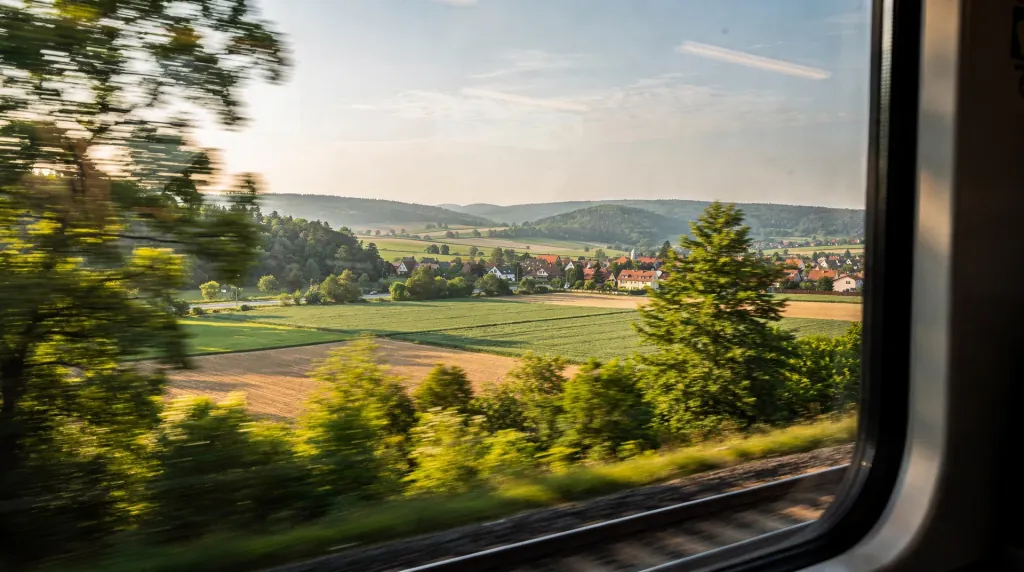
The Frankfurt and Nuremberg ICE connections are DB (Deutsche Bahn) high-speed trains — comfortable, fast, reliable if you buy a ticket that allows the connection time. The EC 173 Nuremberg–Prague leg is an EC service operated jointly by DB and České dráhy. The train crosses the Erzgebirge mountains through the Czech–German border region — genuinely scenic in the two hours approaching Prague.
The total cost in 2023 on a booking made 6 weeks ahead: €48 in second class (a DB Sparpreis fare with the Czech segment included). On the day of travel, the same journey would cost €120–140. Book ahead.
The border crossing
This is the part that almost no travel writing describes accurately. The Czech–German border crossing at Bad Schandau–Děčín has no passport control (both countries are Schengen) and no formal border stop. The train slows through a short tunnel under the mountains and emerges on the Czech side. The scenery shifts from German Saxony (pleasant, forested) to Czech Bohemia (more dramatic, the Elbe gorge in this section is remarkable).
What does happen: a conductor change. German-speaking DB staff are replaced by Czech-speaking ČD staff. The announcement language shifts. You are now in the Czech Republic.
We noticed nothing physically strange about crossing an international border in a railway carriage at 120km/h with no documentation check — which is exactly what Schengen-area travel is supposed to feel like but still manages to feel slightly remarkable when you experience it.
What Praha hlavní nádraží is actually like
Praha hlavní nádraží (Prague Main Station) is an architectural gem that spent several decades under exactly the kind of institutional neglect that Czech public buildings endured post-communism. The Art Nouveau main hall from 1909 (designed by Josef Fanta) was largely hidden behind a 1970s Communist-era addition; the great vaulted ceiling and terracotta decoration were obscured.
The 2010s restoration exposed and restored much of the original structure. The station is now genuinely impressive — the Art Nouveau dome in particular, a complex iron-and-glass construction that lets the late afternoon sun in at a remarkable angle. If you arrive in the late afternoon, look up immediately on exiting the train.
The station area itself is less impressive. The immediate surroundings include some of the city’s street drug presence (on the pedestrianised area between the station and Wenceslas Square), which can be jarring if you arrive at night. Walk directly towards the metro entrance (metro line C: Hlavní nádraží station, with a lift — one of the accessible metro stations). Three stops south: Muzeum, where you change to line A for Vinohrady or Staroměstská for Old Town.
What has improved since 2023
In 2024, the Czech Republic and Germany announced additional investment in the Nuremberg–Cheb–Prague corridor as part of the broader EU Trans-European Transport Network (TEN-T). Journey times on new high-speed rolling stock are expected to reduce to approximately 5 hours 30 minutes for the full Cologne–Prague route by 2026 (though we’re writing with reservation about specific infrastructure timelines — delays happen).
The Czech national rail operator ČD has also improved its booking system for international tickets (it was genuinely poor in 2022). The Interrail/Eurail pass now covers the EC 173 segment without supplementary charges on most days.
Was it worth it?
Unambiguously, yes — and we’d do it again. The seven hours were not wasted hours; they were hours spent in comfort, with scenery, without airport anxiety. The Erzgebirge approach to Prague through the valley is one of the better-looking train approaches in Central Europe. And arriving at Hlavní nádraží and walking to the metro, from which you are 3 stops from your hotel, is a genuinely different experience from the Bolt ride from Václav Havel Airport. If you do fly and would rather not haggle over a taxi, a shared shuttle to and from Václav Havel Airport is a simple pre-booked alternative.
For anyone travelling from Germany, the Netherlands, or Belgium for a 4-day Prague trip, the train is worth calculating properly. The comparison isn’t flight time vs. train time — it’s door-to-door time vs. door-to-door time, and the gap is smaller than it appears.
2026 fares and booking update
Prices have changed since our 2023 trip. Current reference fares for 2026:
| Route | Advance (6+ weeks) | Flexible | Notes |
|---|---|---|---|
| Cologne–Frankfurt (ICE) | €18–25 | €50–75 | DB Sparpreis or Flexpreis |
| Frankfurt–Nuremberg (ICE) | €15–22 | €45–65 | DB |
| Nuremberg–Prague (EC 173) | €19–28 | €45–60 | DB/ČD joint ticket |
| Total Cologne–Prague | €48–65 | €130–160 | Book all segments in one booking on db.de or Rail.cc |
The Interrail/Eurail Global Pass covers the full route including the EC 173 Czech segment with no supplement. If you’re combining the Prague trip with other European rail travel, the pass can make the arithmetic work.
Book the full journey in one booking on db.de, which can now issue through-tickets from German cities to Czech destinations including Prague. The ČD (Czech Railways) website (cd.cz) is reliable for the Czech segment if you want to book independently.
The counterpoint: the flight is faster, and that matters
The honest version of the “fly vs. train” calculation is more nuanced than the door-to-door time argument suggests. For some travellers, the train genuinely is not better. Timing matters as well, so check the best time to visit Prague before you pick dates.
If you are travelling with children under 10, the 7-hour journey involves managing small people across international trains with luggage, food needs, and the absence of a car seat. This is doable but qualitatively different from the 55-minute flight. Our guide to Prague with kids covers what works for a family city break once you arrive.
If you are on a 3-day trip and arriving Friday evening, arriving at Hlavní nádraží at 21:00 versus arriving at Václav Havel Airport at 20:30 is a difference in the quality of your Friday evening. The flight, in this case, gives you slightly more time in Prague.
If your originating city has no good train connection (Paris is better-connected to Prague than Cologne in many timetables; London requires either Eurostar + connections or a flight), the train advantage diminishes significantly.
The train is best for travellers from Germany, Belgium, the Netherlands, or Austria — specifically for those who value the journey itself as part of the trip, and for those on trips of 4+ days where the arrival day matters less than the quality of the experience overall.
Reader questions
“Can I book luggage storage at Hlavní nádraží?”
Yes. Praha hlavní nádraží has a left-luggage facility (úschovna zavazadel) in the lower level of the station, open from approximately 06:00 to 23:00. It is reasonably priced at 60–80 CZK / €2.40–3.20 per bag per day. If you arrive in the morning and your hotel room isn’t ready, this solves the gap. There are also several private luggage storage services (Bounce, Stasher) near the station and around Old Town with online booking.
“Is the route affected by infrastructure works in 2026?”
The Nuremberg–Cheb–Prague corridor has been subject to periodic track maintenance works in recent years (the Czech section in particular). Check the ČD timetable at cd.cz for current disruptions before booking. The normal journey time is 4h 10min Nuremberg–Prague; major works can add 30–60 minutes via diversions. DB’s booking site will show the actual scheduled time including any known delays.
“What about night trains?”
There is currently no direct night train service from Cologne to Prague. The closest option is the ÖBB Nightjet from Vienna to Cologne, which can be combined with a same-day Prague–Vienna connection — but this requires an intermediate day in Vienna and is a more complex itinerary than the daytime EC route. A direct Cologne–Prague nightjet has been discussed in European rail planning circles but is not scheduled for launch before 2028.
Making the most of arrival day
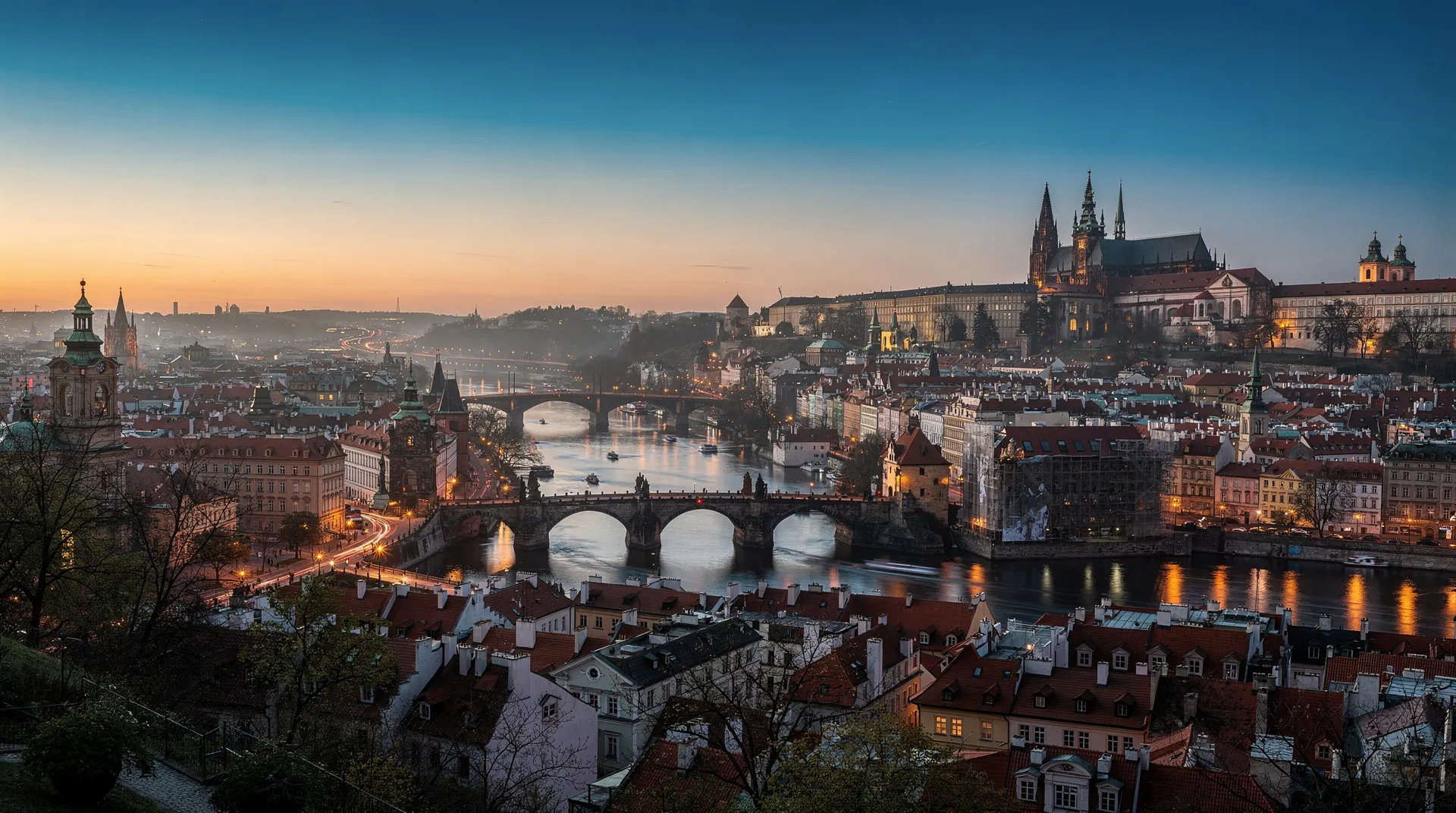
Seven hours on a train is a different kind of arrival than a 55-minute flight, and it’s worth planning the rest of the day around it rather than fighting it. If the EC 173 gets you into Praha hlavní nádraží by mid-afternoon, don’t schedule anything demanding for the evening — a short walk to check in, then an easy dinner nearby beats trying to cram in a full itinerary on travel-day legs. Our 3-day Prague itinerary assumes exactly this kind of arrival and starts the real sightseeing the next morning. If you still have energy after dinner, an easy night walk through Prague Castle with city views is a gentle way to end a travel day. The same train-first logic applies to onward trips, as our comparison of day trips by train, bus or guided tour shows.
Money matters too: the Czech Republic uses the koruna (CZK), not the euro, and some train-adjacent kiosks near Hlavní nádraží quote inflated euro-equivalent prices. Change a small amount at an ATM rather than a station exchange booth — see our currency and money guide for the specifics. If you plan to use a Czech eSIM or local data for maps on arrival, sort it before you leave home; our SIM and eSIM guide covers the options.
The area immediately around Hlavní nádraží is not the nicest part of the city after dark, but Nové Město (New Town), which the station sits inside, is otherwise a practical, well-connected base — see the Nové Město neighbourhood guide if you’re deciding where to stay for a train-arrival trip. General safety practicalities for first-time visitors are covered in our Prague safety guide.
Related reading
The full getting to Prague guide covers all arrival options (plane, train, bus) with practical booking advice. For the journey from Prague to other Czech destinations by train, the Czech public transport guide has the essential details on ČD booking.