At a glance
| Where to avoid | Old Town Square, Karlova street, the first ring of surrounding streets |
| Typical tourist-zone main course | Around €18–26 |
| Honest local main course (Vinohrady, Žižkov) | Around €10–20 |
| How far to walk for better food | Around 10 minutes / one kilometre from the square |
| Best time to avoid crowds & touts | Weekday lunch, before 12:00 or after 14:00 |
We used to hedge
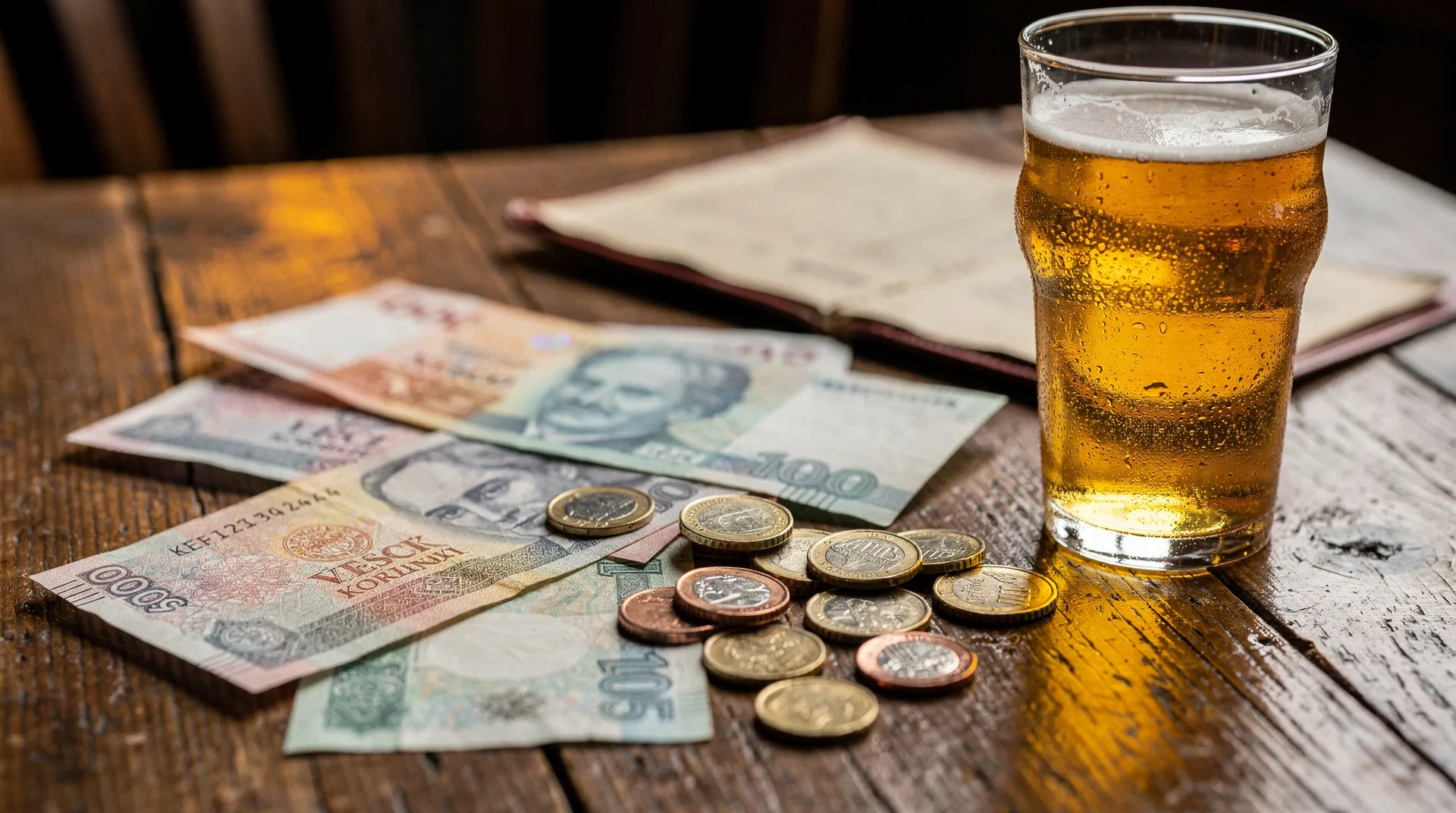
It is 13:15 on a Thursday in July. We are sitting at a terrace table on Staroměstské náměstí with a clear view of the Astronomical Clock. The menus say “CZECH SPECIALITIES” in four languages. The beer arrives: 95 CZK for a half-litre of Pilsner Urquell. The svíčková, when it arrives 18 minutes later, is a plate of beef in a brown-grey sauce with a dumpling. The sauce came from a jar. We know this because we have been to enough Czech restaurants to recognise what the sauce looks like when it didn’t. The bill: €48 for two mains and two beers. The same meal at Lokál Dlouhá, 400 metres away: €28.
Travel writers hedge. The convention is to say “some restaurants near Old Town Square are fine if you know what to order” or “the quality is mixed — do your research.” We wrote approximately that for two years. We’re done hedging.
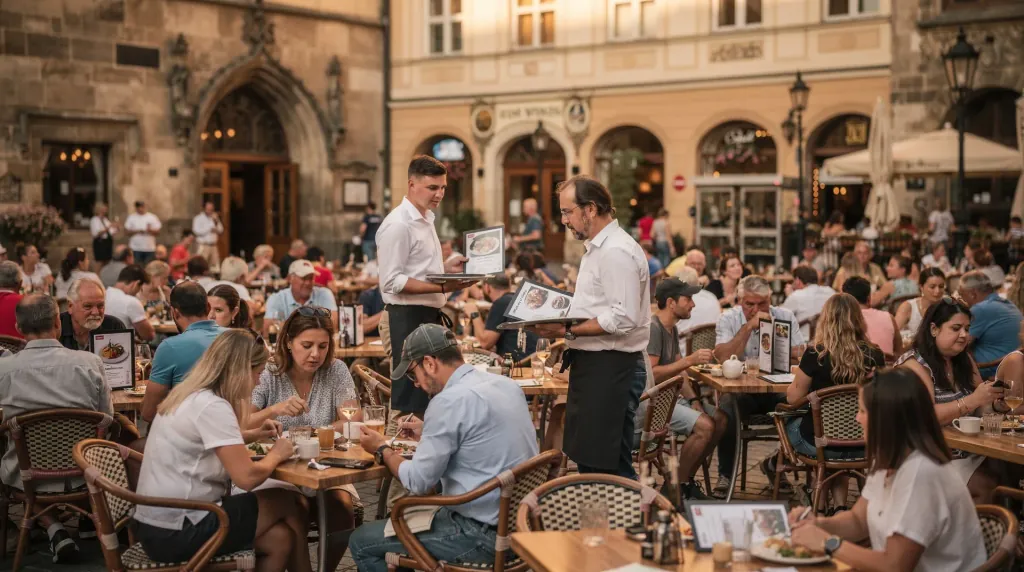
The restaurants on Old Town Square, on Karlova street, and in the first ring of streets surrounding them exist to extract money from people who are not coming back. They do this efficiently, with English menus and aggressive touts and panoramic views and precisely calibrated prices that are high enough to be profitable and low enough that you decide the view justifies it.
They are, with approximately three exceptions, restaurants that a Czech person would never enter voluntarily.
This is the article we should have published two years ago.
Why tourist restaurants in Old Town Square are bad
The economic model explains the food quality. A restaurant on Staroměstské náměstí (Old Town Square) pays commercial rent that is among the highest in the Czech Republic. Margins on individual dishes must be significant. Volume must be high. The incentive for quality cooking is minimal — you are not competing for repeat customers or local reputation; you are competing for the attention of a person who has been walking for 2 hours and wants to sit down.
The result is this: frozen vegetables reheated in a microwave, svíčková sauce from a jar, goulash that has never been near a real stewing time, and overcooked schnitzel — all served at €18–25 per main course, accompanied by beer at €6.50 and placed in front of you by staff whose wage depends on table turnover.
We have eaten at a significant number of tourist-zone restaurants in Old Town over the years. We remember exactly two that were genuinely worth their price. Every other experience has been forgettable or actively bad.
The specific mechanics of the tourist restaurant experience
The tout. Many tourist restaurants employ people to stand outside and offer menus, discounts, or direct invitation. If a restaurant has a tout, you should not eat there. No restaurant that is confident in its quality needs to intercept strangers on a public street.
The unrequested bread charge. You sit down, bread arrives without you ordering it, and a €2–3 / 50–75 CZK charge appears on the bill. This is a known and documented practice. You can refuse the bread. You can ask for it to be removed from the bill. Most staff will comply. The fact that this conversation is necessary tells you something.
The currency confusion. Some tourist restaurants post prices that appear to be in CZK but have a fine-print EUR-equivalent that is applied at an unfavourable rate when you pay by card. This is not universal but documented. Pay in CZK always; never pay in EUR at a Czech restaurant.
The fake “local” restaurant. Several tourist restaurants have Czech-sounding names, Czech-themed décor, and menus with Czech dishes, and are indistinguishable to a first-time visitor from a genuine local restaurant. The giveaway: prices significantly above €14 / 350 CZK for a main course and staff who approach you actively rather than waiting to be seated.
What we recommend instead
Lokál — the best Czech food chain in Prague, using unfiltered tank Pilsner Urquell and a proper Czech menu (svíčková, roast duck, beer goulash). Branches in Dlouhá (most central), Vinohrady, and Žižkov. Average main: €10–14 / 250–350 CZK.
Sisters on Dlouhá — a Czech chlebíčky (open-face sandwich) bar that is genuinely excellent and costs €2.50–4 / 63–100 CZK per sandwich. One of the best fast lunches in the city.
Naše Maso near Old Town — a butcher and prepared food counter with outstanding quality at deli prices.
Any restaurant in Vinohrady on a weekday. The streets around Náměstí Míru — Mánesova, Italská, Blanická, Slezská — have an extraordinary density of good restaurants. Not tourist restaurants. Restaurants that Czech residents choose for dinner. The prices are €14–20 / 350–500 CZK for a full meal with a beer — not cheap, but honest.
Eska in Žižkov for the best restaurant in Prague that consistently operates at a price point that doesn’t require a special occasion. Czech-inflected modern cuisine, natural wines, genuinely impressive cooking. Dinner for two with wine: €60–80 / 1500–2000 CZK.
The one-kilometre rule
Our practical shortcut for Prague restaurant selection: if a restaurant is within approximately one kilometre of Old Town Square and is immediately visible from a tourist route or square, it is probably not worth your time. The density of tourist-oriented restaurants in the core is high enough that quality options require active effort to find.
The exceptions: there are specific Old Town restaurants that are genuinely good — Maitrea (vegetarian), Lokál Dlouhá (Czech pub food), and a handful of others. But you have to look for them specifically. Stopping at the nearest restaurant with a terrace view will not produce these results.
What about the view?
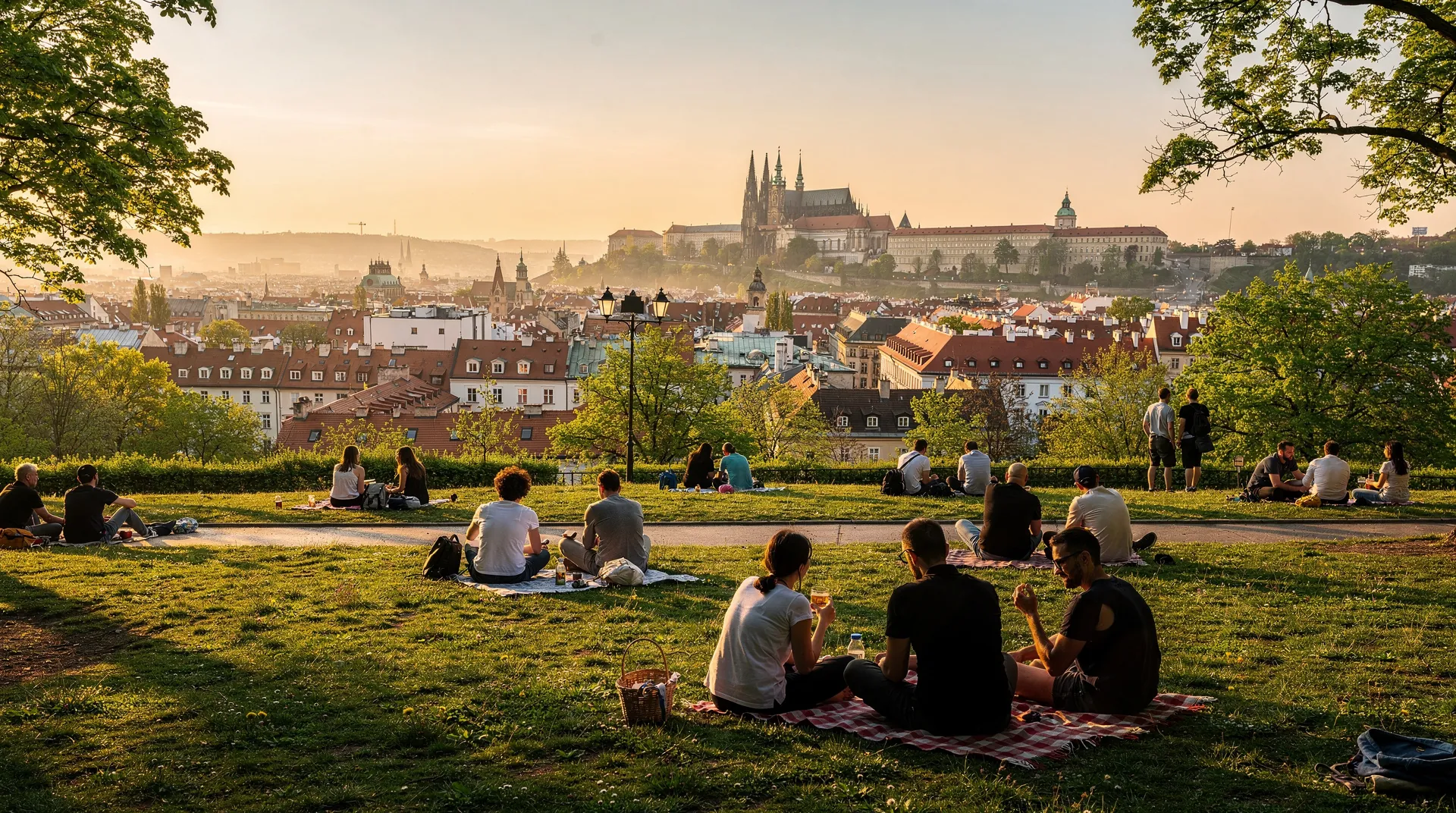
Old Town Square is genuinely beautiful. We understand the pull of eating with a view of the Astronomical Clock and the Gothic church of Our Lady Before Týn across the square. The view is as good as it looks.
Here is our suggestion: get a coffee and cake at Grand Café Praha or at one of the cafés on the square — budget €8–12 / 200–300 CZK for coffee and a pastry with the view. This is the correct amount of money to spend for sitting on a famous European square with a view. Then walk 10 minutes for a proper meal.
This is how Praguers who work near Old Town experience the square: as a coffee stop, not as a restaurant destination. If you would rather spend the time around the square on something other than a meal, the guided Mozart tour through Old Town and Lesser Town is an easy way to use it.
The data: 2019 vs 2026 Old Town Square restaurant prices
The tourist-zone premium has grown since 2019. A mid-range main course on Old Town Square in 2019 cost €14–18. In 2026, the same tourist-facing main course is €18–26. The underlying cost of producing the meal has risen approximately 25–30% (Czech food inflation, wages, rent); tourist-zone prices have risen 35–45%. The margin is expanding.
By contrast: a svíčková at Lokál Dlouhá (Dlouhá 33) costs 295 CZK (≈ €12) in 2026. In 2019 it cost 240 CZK (≈ €10). A 23% increase over 7 years, tracking Czech wage growth. This is the honest Czech food price trajectory.
The tourist-restaurant markup over the honest Czech price has grown from approximately 30–40% in 2019 to 50–60% in 2026.
What the tourist restaurants would say
“We pay the highest commercial rents in the Czech Republic. We provide tables with views of a UNESCO-listed square. We serve visitors who have flown or trained from across Europe. We deserve a premium.”
This is true on the rent point. It is not true on the food quality point. The rent pays for the terrace; it does not pay for better cooking. What you get on Old Town Square is proximity to a beautiful church and a view of a 600-year-old clock, served with food that a Czech restaurant in Vinohrady would be embarrassed to put in front of customers.
The honest way to have the view without the food price: order coffee and cake (€5–8) at Grand Café Praha or Café Mosaique on the square, enjoy the view for 45 minutes, then walk to Lokál Dlouhá for lunch. This is exactly what Prague office workers who work near the Old Town do.
Other honest-food neighbourhoods worth knowing
Vinohrady isn’t the only alternative. Žižkov, home to Eska and a genuinely local pub scene, has the same “residents eat here” quality without the square’s price premium — see the Žižkov neighbourhood guide for the wider picture beyond just restaurants. If you want to understand Czech food itself rather than just where to find it, our traditional Czech dishes guide explains what svíčková, goulash, and the rest are actually supposed to taste like, and the street food guide covers the honest, cheap end of the spectrum (trdelník is not on that list — see why in our trdelník honest truth piece).
For the beer side of the same tourist-trap dynamic, the best beer halls guide has the halls worth the walk. And if you’d rather have someone route you around the tourist restaurants entirely, the food tours compared guide sets out the options beyond the one we mention above.
One more practical note: tipping in Czech restaurants is modest by Western European standards, and tourist-zone staff sometimes add a service charge or round up aggressively expecting visitors not to check. Our tipping guide has the honest norm so you’re not over- or under-tipping out of uncertainty.
Reader questions
“I’ve eaten there and it was fine. Am I wrong?”
Not entirely. Some specific Old Town restaurants — Lokál Dlouhá is an exception, being on a street adjacent to but not on the square; Maitrea (Týnská 6) is a vegetarian restaurant with genuine quality; Ambiente Pasta Fresca (Celetná 11) is acceptable for Italian — are fine. The generalisations in this article apply to the category, not every individual establishment. But the base rate of quality is genuinely low in the tourist core, and the correct approach is to treat any recommendation of an Old Town Square restaurant with significant scepticism.
“What about the restaurants below Old Town Square in Malá Strana?”
Malá Strana is better than Old Town Square for restaurants but has developed its own tourist-pricing layer. Karmelitská, Nerudova, and the streets directly north of Charles Bridge have a significant proportion of tourist-targeting restaurants. U Malého Glena (Karmelitská 23) and Restaurace Nusle (U Zvonu) are reliable exceptions. The further you get from the main tourist route (Charles Bridge → Malostranské náměstí → Nerudova), the better the pricing.
2026 specific update
We tested 11 tourist-zone restaurants in the Old Town between January and April 2026. Six charged for unrequested bread. Three presented bills where the VAT was calculated incorrectly in the restaurant’s favour. Two had staff who actively discouraged photographing the price list. One refused to itemise the bill when asked. These are not random bad experiences — they reflect a systematic orientation toward extracting money from visitors who are not returning customers.
Our 2026 recommendation stands: walk two blocks from the tourist drag and eat well at honest prices. The Prague food and beer guided walking tour with tastings is the best single investment for a visitor who wants to understand where Prague’s honest food culture lives — a local guide who specifically routes around tourist restaurants and into the neighbourhood food circuit. Approximately 1,200 CZK (€48) including tastings.
“Is it ever okay to eat on Old Town Square?”
Yes, for a coffee and cake with the view — that’s genuinely what the location is good for, and it’s the correct amount to spend for sitting on one of Europe’s most famous squares. For an actual meal, walk the 10 minutes to Lokál Dlouhá, Vinohrady, or Žižkov instead; the food-quality gap is consistent enough that it’s worth the walk on every visit, not just this one.
Related reading
The Prague restaurants guide covers our current recommendations by neighbourhood and price range. The Vinohrady neighbourhood guide explains why that area has become the best part of Prague to eat in.