At a glance: Prague Spring Festival
| Where | Municipal House (Smetana Hall), Rudolfinum (Dvořák Hall), Klementinum (Mirror Chapel) |
| Cost | Around €10–100 depending on concert and seat tier; opening night premium seats highest |
| Time needed | A single evening per concert; the full festival runs 3–4 weeks (12 May–3 June) |
| Getting there | Metro B to Náměstí Republiky (Municipal House) or tram to Náměstí Jana Palacha (Rudolfinum) |
| Best time to book | January, the moment tickets go on sale, for the opening night; February–April for everything else |
What and when
The Prague Spring International Music Festival (Pražské jaro) has opened on 12 May every year since 1946 — the anniversary of the death of Bedřich Smetana, the father of Czech music. The 12 May opening concert is invariably a performance of Smetana’s symphonic cycle Má vlast (My Homeland) — six tone poems depicting Bohemian landscapes, rivers, and legends. This has been the unbroken opening tradition since 1952, when it replaced the original Beethoven Ninth Symphony programme. For Czech audiences, the Má vlast opening is not merely a concert but a national ritual.
The festival runs through 3 June each year, with 3–4 weeks of daily concerts across Prague’s finest venues. International orchestras (Berlin Philharmonic, Vienna Philharmonic, Royal Concertgebouw, BBC Symphony), celebrated conductors, and the world’s leading soloists all appear in the programme. The festival is consistently among the most prestigious in Europe and the most important cultural event in the Czech Republic.
In 2026: The festival opens on Wednesday, 12 May 2026 at 7 PM at the Municipal House Smetana Hall. The programme and artists are announced in January/February; check festival.cz.
The venues
Obecní dům — Municipal House, Smetana Hall
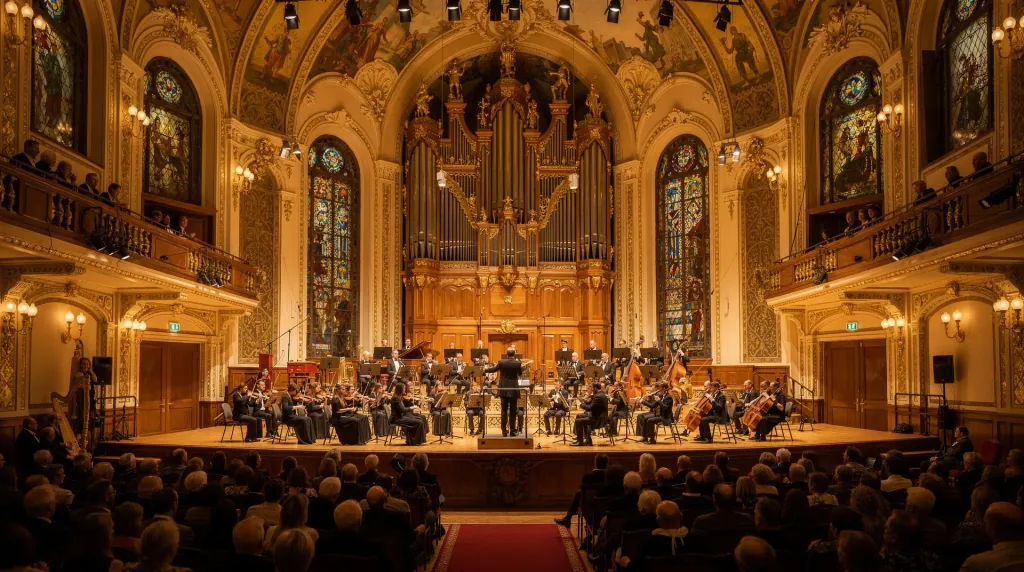
The Art Nouveau Municipal House (completed 1911) on Náměstí Republiky is Prague’s most spectacular concert venue and the festival’s ceremonial home. The Smetana Hall occupies the central section of the building, with a gilded Art Nouveau interior seating approximately 1,200. The acoustic is warm and detailed, the sight lines are good throughout, and the interior — with Alfons Mucha’s allegorical decorations and the distinctive Smetana ceiling panel — is extraordinary. Opening night is always here.
Getting there: Metro B (Náměstí Republiky station), direct exit to the square.
Rudolfinum — Dvořák Hall
The Rudolfinum (1885) on the Vltava embankment is home to the Czech Philharmonic Orchestra and the festival’s second principal venue. The Dvořák Hall is a magnificent neo-Renaissance concert hall seating approximately 1,200, with excellent acoustics and a more formal atmosphere than Smetana Hall. Many of the festival’s orchestral headliners appear here.
Getting there: Tram 17, 18 to Náměstí Jana Palacha. Walk across Mánesův bridge from Old Town.
Klementinum — Mirror Chapel (Zrcadlová kaple)
The Baroque Mirror Chapel in the Klementinum complex holds approximately 150 people and is used for chamber music concerts. An intimate, warm, exceptionally beautiful space — gilded mirrors, frescoed ceiling, excellent acoustics for small ensembles. Festival chamber concerts here are among the programme’s highlights for those lucky enough to get tickets, which sell out fast.
Getting there: 5 minutes’ walk from Old Town Square, on Křižovnická Street.
Other festival venues
The festival uses additional spaces including the Rudolfinum Suk Hall (smaller chamber format), the Dvořáčova Exhibition Hall, St. Agnes Convent (Anežský klášter), and occasionally Czech National Theatre. The full venue list is in the annual programme.
The opening concert: Má vlast
Attending the Má vlast opening on 12 May is a bucket-list classical music experience, but getting tickets requires early action. The opening concert sells out within hours of ticket release — typically in January or February of the festival year.
What is Má vlast? Bedřich Smetana’s cycle of six symphonic poems (1874–1879) depicts the landscape and history of Bohemia: Vyšehrad (the ancient fort above Prague), Vltava (a musical portrait of the river from its mountain spring to its meeting with the Elbe), Šárka (a Bohemian legend), From Bohemia’s Woods and Fields, Tábor (the Hussite stronghold), and Blaník (sleeping knights who will wake in Bohemia’s greatest need). The Vltava movement is the world’s most recognised, with its swooping melody representing the river’s course through Prague. Hearing it in Prague, played by a world-class orchestra, is a singular experience.
Ticket prices (approximate, 2026): €20–80 (510–2,030 CZK) for general programme concerts. Opening night premium seating: €60–100 (1,525–2,540 CZK). Check festival.cz for the 2026 price list.
How to get tickets
Festival website (festival.cz): The primary and most reliable source. Tickets go on general sale usually in January. Sign up for the festival newsletter to be notified of the sale date.
Box offices: The Municipal House box office (Náměstí Republiky 5) and the Rudolfinum box office (Alšovo nábřeží 12) both sell tickets in person during office hours. Last-minute availability sometimes exists here when the website shows sold out — some seats are held back.
Resale: The festival discourages resale platforms; the official source is the only reliable one. Informal resale exists but prices are significantly above face value for opening night.
What to do if opening night is sold out: Book a chamber concert at the Klementinum or a Rudolfinum orchestral evening. Both are high-quality and easier to access. Walking up to the box office on the afternoon of a non-opening concert often produces last-minute availability.
What to expect
Dress code: The opening concert and major orchestral evenings are smart-to-formal. Men typically wear dark suits or jackets; women wear dresses or formal separates. For chamber concerts at the Klementinum, smart casual is accepted.
Timing: Arrive 20–30 minutes before the concert start time to navigate the venue, collect tickets from the box office if needed, and find your seat. Pre-concert drinks are served at the Municipal House’s ground-floor café and bar.
Programme length: Major orchestral concerts run approximately 2 hours with one 20-minute interval. Chamber concerts at the Klementinum run 1–1.5 hours without an interval.
Language: Concert programmes are printed in Czech and English. The festival website is bilingual.
Beyond the headline concerts
The festival’s wider programme includes:
Young talent concerts: The festival runs an international competition for young instrumentalists and singers, with finalists performing at smaller venues. These concerts offer high-quality music at lower prices.
Late-night events: Some years see late-night concerts or post-concert events in unusual venues (churches, wine cellars, courtyards) as part of the festival’s fringe programme. Check the festival programme for details.
Exhibitions: The Municipal House and surrounding buildings typically run festival exhibitions on Czech music, composers, or music-related art during the festival period. Free to enter or at minimal cost.
2026 festival dates and ticket-buying timeline
Festival opening: Wednesday, 12 May 2026, 19:00, Smetana Hall, Municipal House. Festival close: Wednesday, 3 June 2026.
Booking timeline
| Date | Action |
|---|---|
| January 2026 | Ticket sale opens for all concerts at festival.cz — monitor the newsletter |
| January (within days of sale opening) | Opening night Má vlast tickets sell out |
| February–March 2026 | Major orchestral concerts at Rudolfinum sell through; buy now |
| April 2026 | Klementinum chamber concerts selling out; last-chance purchases |
| May 2026 (during festival) | Box offices may have last-minute returns for non-headline concerts |
Sign up for the festival newsletter at festival.cz to receive sale-opening notification before general public announcement.
Ticket prices and seat tiers
| Concert type | Lowest available (rear gallery) | Standard stalls | Premium stalls |
|---|---|---|---|
| Opening Má vlast (12 May) | €35 / 889 CZK | €60 / 1,525 CZK | €100 / 2,540 CZK |
| Major orchestral (Rudolfinum) | €20 / 508 CZK | €40 / 1,015 CZK | €65 / 1,651 CZK |
| Chamber concert (Klementinum) | €20 / 508 CZK | €30 / 762 CZK | €45 / 1,143 CZK |
| Young talent concerts | €10 / 254 CZK | €15 / 381 CZK | — |
Prices are approximate based on recent festival seasons; the 2026 price list is published with the programme in January/February 2026 at festival.cz.
Compared to Vienna: A comparable evening at the Vienna Philharmonic in the Musikverein costs €50–150 for equivalent seats. Prague Spring is significantly better value.
Compared to London: BBC Proms tickets run £6–50, but the international soloist concerts at Royal Festival Hall can reach £70–100. Prague Spring is competitive on price and surpasses London for historical atmosphere.
What to wear, when to arrive, and how to plan the evening
Dress: Opening night and major orchestral concerts: smart to formal. Dark suit or jacket for men; dress or formal separates for women. Black tie is not required but not unusual on opening night. Chamber concerts at the Klementinum: smart casual is entirely appropriate.
Arrive: 25–30 minutes before the stated concert time. The Municipal House box office processes ticket collection; allow time for queuing. Pre-concert drinks are available at the Municipal House ground-floor café (open from 18:00 on concert evenings).
After the concert: The Municipal House café-bar at ground level serves until late on concert evenings. Alternatively, Náměstí Republiky has several good restaurants and bars within 3 minutes’ walk. The combination of an 19:00–21:30 concert and a late May evening in Prague (daylight until 21:00) allows a post-concert walk along the riverside — one of Prague’s finest experiences.
The full programme structure
The festival typically presents 30–40 main concerts over 3 weeks. The structure:
Week 1 (12–18 May): Opening Má vlast plus the first round of major international orchestras and headline soloists at Smetana Hall and Rudolfinum.
Week 2 (19–25 May): The festival’s mid-programme: chamber concerts begin at the Klementinum, young talent competition rounds, additional orchestral concerts.
Week 3 (26 May–3 June): The closing sequence. Closing concert at the Municipal House is typically another major orchestral event, sometimes with a Czech premiere or significant commission. Chamber and recital events continue through the final days.
Fringe events: On some years, the festival organises late-night concerts in unusual venues — a church crypt, a wine cellar, a castle courtyard. These are announced in the programme and are always worth booking when they appear.
Questions people ask about the Prague Spring Festival
How early do I need to book tickets for Prague Spring?
For the opening Má vlast concert: book in January when tickets go on sale. It sells out within hours or days. For other major orchestral concerts: 4–6 weeks ahead during the festival period. For chamber concerts: 2–4 weeks ahead, though last-minute availability sometimes exists.
What is special about Má vlast being performed in Prague?
Smetana composed Má vlast while completely deaf, working from memory of the Bohemian landscape he could no longer hear or see. He died on the same date (12 May) in 1884. Hearing the Vltava movement — which depicts the river flowing through Prague — while sitting in a concert hall overlooking that river, in the city Smetana celebrated and mourned, is a profoundly specific experience. It is not just a concert; it is a cultural ceremony.
Is the Prague Spring Festival only classical music?
Primarily yes — it is a classical music festival with orchestral, chamber, and recital formats. The programme occasionally includes jazz or world music crossover events at fringe venues, but the main programme is firmly classical.
What other classical music events run in Prague in May and June?
Outside the Prague Spring Festival, year-round classical programming at the Rudolfinum (Czech Philharmonic), Estates Theatre (opera), Smetana Hall (Municipal House), Spanish Synagogue, Klementinum Mirror Chapel, and St. Agnes Convent provides multiple concert options throughout May and June.
Can I attend Prague Spring if I’m not a classical music expert?
Absolutely. The Má vlast opening is deliberately accessible — the Vltava movement is one of the world’s most recognisable orchestral pieces, and the visual spectacle of the Smetana Hall on opening night is worth the experience on those terms alone. Chamber concerts at the Klementinum are similarly accessible. You do not need specialist knowledge to enjoy world-class music in extraordinary spaces.
How Prague Spring compares to Prague’s other classical venues
If the festival’s headline concerts are sold out, Prague runs a rich year-round classical calendar outside the festival window. The Rudolfinum hosts the Czech Philharmonic’s regular season both before and after the festival dates, often at lower prices and with far easier booking. The Klementinum’s Mirror Chapel likewise runs chamber concerts year-round, not just during the festival’s 3-week window — worth checking if May and June don’t suit your travel dates.
Where to base yourself for the festival
Staré Město puts you within a 10-minute walk of the Municipal House and the Klementinum, useful for evenings with a concert followed by a late dinner. Malá Strana is the better choice if the Rudolfinum is your main venue, and offers a quieter, more atmospheric walk home after a late concert along the Charles Bridge.
Can I visit Prague for the festival without attending a concert?
Yes — the festival period (12 May–3 June) coincides with some of Prague’s best spring weather and events, including the tail end of blossom season and Náplavka’s Saturday market. See our spring guide for building a trip around the season generally, with a festival concert as one component rather than the whole plan.
Is it worth attending the Prague Spring Festival if I don’t understand Czech?
Absolutely — it’s an entirely instrumental and orchestral programme; language isn’t a factor. Programme notes are printed in Czech and English, and the Vltava movement of Má vlast in particular needs no translation to land emotionally.