At a glance
| Where | Vinohrady is the historic gay neighbourhood; Old Town and Žižkov are solid alternatives |
| Scene size | Around 8–12 regularly open LGBTQ+ venues citywide — modest compared to Berlin or Amsterdam |
| Prague Pride | Usually the second week of August, parade + a week of cultural events |
| Getting there | Metro line A to Náměstí Míru puts you in the middle of the Vinohrady scene |
| Best time | May, June or September for value and comfort; August for Pride itself, at peak-season prices — see best time to visit |
The honest picture of LGBTQ+ Prague
The Czech Republic has one of the more liberal social climates in Central Europe on LGBTQ+ questions. Same-sex partnerships have been legally registered since 2006; same-sex marriage was passed by parliament in 2024 and came into force in 2025, making the Czech Republic the first country in the former Eastern Bloc to legalise it. Anti-discrimination protections exist in employment and services. Hate crimes against LGBTQ+ people are relatively rare and prosecuted.
That said: Prague is not Amsterdam or Barcelona. The dedicated LGBTQ+ nightlife scene is small (a handful of bars and clubs, concentrated in Vinohrady and partly in the Žižkov/Vinohrady border area). The mainstream Czech social culture is not demonstratively rainbow-positive — you’re unlikely to see straight Czechs actively engaging with LGBTQ+ solidarity in everyday public life. It’s more a live-and-let-live attitude than enthusiastic affirmation, which is a meaningful distinction depending on what you’re looking for.
For same-sex couples travelling together: holding hands and walking through Vinohrady, Malá Strana, or the tourist core of Old Town will not generate significant attention or discomfort. In outer residential districts or on suburban metro routes late at night, exercise the same situational awareness you would in any European city.
LGBTQ+ highlights and scene
Vinohrady is the traditionally gay neighbourhood — the Vinohradská street corridor and its side streets have the highest concentration of gay-friendly bars, cafés, and clubs. The area is also the most liveable and pleasant neighbourhood in Prague, which makes it doubly recommended as a base.
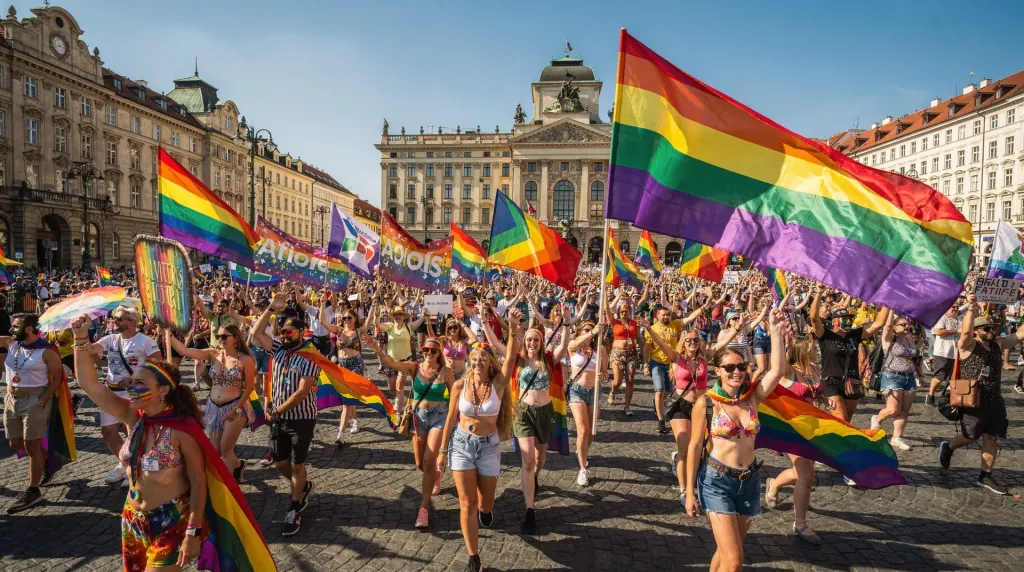
Prague Pride. The annual Prague Pride festival takes place in August (usually the second week). It includes a week of cultural events, panel discussions, and an outdoor concert in Letná Park, closing with a parade through the city centre. It is a well-organised, festive event that draws 30,000–50,000 participants and is police-escorted through the route. It is not the size of Vienna or Amsterdam Pride but it is a genuine celebration.
Saints Bar (Mánesova, Vinohrady) — the longest-running gay bar in Prague, known for its relaxed mixed crowd, good cocktails, and reliable opening hours. Not a club but a genuinely comfortable meeting spot any night of the week.
Termix Club (Třebízského, Vinohrady) — the most mainstream gay club in Prague, mixed crowd, good for dancing, open until 4am at weekends. Commercial music policy.
Friends Club (Bartolomějská, Staré Město) — a gay bar in the Old Town with a popular terrace in summer. More central than the Vinohrady spots, draws a tourist-heavier crowd.
Cultural Prague. The Czech New Wave cinema tradition and Prague’s literary history have significant LGBTQ+ dimensions. The Mucha Museum, the Kafka Museum, and the broader Art Nouveau/Secession cultural tradition attract a queer-interested audience for reasons that go beyond nightlife.
Alternative and queer arts scene. Prague has an active independent arts scene with queer-positive spaces: Klub Světozor (cinema), NoD club (Roxy building), and Meetfactory (Smíchov) all programme queer-friendly events and exhibitions. Check their calendars before arrival.
Where to stay
Vinohrady is the clear recommendation for LGBTQ+ travelers. It is the city’s historically gay neighbourhood, has good hotel and apartment stock, is calm and safe at all hours, and offers the best café and restaurant culture in Prague.
Old Town works for centrality and proximity to tourist sights. No hostility; mixed but not specifically LGBTQ+-oriented. Good boutique hotel options.
Žižkov is adjacent to Vinohrady and has budget accommodation with an arty, alternative feel. The neighbourhood is young, bohemian, and generally welcoming.
Where to eat
Vinohrady has by far the best restaurant culture for LGBTQ+ diners — in the sense that the neighbourhood’s liberal, internationally-minded demographic creates comfortable environments. Specific recommendations:
Café Místo (Mánesova) — a Vinohrady favourite, excellent coffee, queer-friendly staff and atmosphere, good brunch.
Eska (Žižkov) — one of the best restaurants in Prague by any measure. Modern Czech, sustainable sourcing, cool-crowd clientele.
Maso a Kobliha (Holešovice) — butcher and doughnut shop in a hip Holešovice context. Not specifically queer but emphatically not the type of place where anyone looks twice at anything.
What to watch out for
Small scene size. If you’re coming from a major gay scene (London, Amsterdam, Berlin), Prague’s dedicated LGBTQ+ nightlife will feel modest. There are perhaps 8–12 regularly open LGBTQ+ venues in the whole city. The scene is social and friendly but not extensive.
Outer districts. Public displays of affection in outer residential districts or rural areas around Prague can attract unwanted attention. It is not dangerous in most cases, but situational awareness is worthwhile. The suburban metro rides late at night (especially line C towards the southern outskirts) can feel more conservative in atmosphere.
Religious and political pockets. The Czech Republic is one of the least religious countries in the EU, which generally correlates with social tolerance. However, some older demographics hold conservative views. Prague’s tourist core and Vinohrady are not representative spaces for this — it’s more relevant in day-trip destinations and smaller towns.
Transgender visibility. Czech law on legal gender recognition is more restrictive than several EU countries. Trans travelers should be aware of this in administrative contexts (border crossing, hotel check-in with documentation). In social contexts, Prague’s city centre is generally urban-tolerant.
Day-by-day sample (2 days)
Day 1 — Old Town and Vinohrady Morning: Old Town walking tour (t516688 — private walking tour) or a self-guided walk through the Jewish Quarter and along the embankment. Afternoon: move between Old Town and Vinohrady by metro (line A, Náměstí Míru station). Coffee at Café Místo. Evening: dinner in Vinohrady (Eska, Pasta Fresca, or any of the Italská/Mánesova street options), then a drink at Saints Bar.
Day 2 — Alternative city, arts, and night Morning: alternative Prague tour (t42172) covering Žižkov and Vinohrady’s local character. Afternoon: National Gallery at Veletržní palác (Holešovice), which has a strong programme of 20th-century and contemporary Czech art with consistent LGBTQ+-relevant work in the collection. Evening: Termix Club or check the NoD/Roxy event calendar for the weekend programme.
Questions LGBTQ+ travelers actually ask
Is Prague safer for LGBTQ+ travelers than other Central European cities?
Yes, significantly. Poland and Hungary have both had periods of actively hostile political rhetoric and anti-LGBTQ+ legislation. The Czech Republic has moved in the opposite direction, and Prague’s urban culture is relatively tolerant. Budapest, Krakow, and Warsaw are more complicated contexts currently. Prague is the most comfortable LGBTQ+ destination in the former Eastern Bloc by a clear margin.
Is Prague Pride worth timing a trip around?
If the timing works, yes — it is a week of events with good cultural programming. But the city doesn’t need Pride week to be worth visiting as an LGBTQ+ traveler. August is also high season and the most expensive and crowded period to visit. September or May are better value and very comfortable.
Are there specific gay-friendly hotels?
Most central Prague hotels are gay-friendly without marketing themselves as such. Specific affirmative marketing in this space is limited. Staying in Vinohrady is the clearest vote for a gay-friendly neighbourhood context.
What’s the legal status of same-sex relationships in Czech Republic?
Same-sex marriage has been legal since 2025. Registered partnerships were available since 2006. Adoption by same-sex couples is legal under certain conditions. Anti-discrimination law covers sexual orientation and gender identity in employment and services.
2026 LGBTQ+ budget in Prague
Prague is affordable compared to Amsterdam, Berlin, or Barcelona — the cities most commonly used as comparison points for LGBTQ+ travel.
| Category | Budget | Mid-range |
|---|---|---|
| Accommodation | €18–25 (Vinohrady hostel dorm) | €80–130 (boutique hotel double) |
| Dinner for two | €30–50 / 750–1250 CZK | €60–100 / 1500–2500 CZK |
| Bar entry + drinks (per person) | €8–15 / 200–375 CZK | €15–30 / 375–750 CZK |
| Activities | €0–15 (walking tours) | €30–60 (concert, cruise) |
| Transport (24h pass each) | €6 / 150 CZK | €6 / 150 CZK |
Comfortable LGBTQ+ city break budget (2 people, per day): €180–280 / 4500–7000 CZK. Prague is 35–50% cheaper than Amsterdam or Barcelona for equivalent quality accommodation and dining.
Recommended 2-day LGBTQ+ itinerary
Day 1 — Old Town, Vinohrady, and the scene
9:00 — Alternative Prague walking tour (t42172) — covers Žižkov and Vinohrady’s local character, small group, strong queer-adjacency in its focus on counterculture and post-communist social geography. 12:00 — Lunch in the Josefov area (Café Franz Kafka or Mistral Café) — then walk the Jewish Quarter. The Mucha Museum and Kafka Museum are both within a 15-minute walk from Josefov. 14:30 — Evening Vltava Eco Cruise with Prosecco (t217848, 50 minutes, departs from Rašínovo nábřeží).
Perfect pre-evening activity for couples, scenic and relaxed. 17:00 — Walk or metro to Náměstí Míru (Vinohrady). Coffee at Café Místo (Mánesova — explicitly queer-friendly staff and atmosphere). 19:30 — Dinner at Eska (Žižkov, the city’s most respected restaurant, cool-crowd clientele, entirely unremarkable for same-sex couples). 22:00 — Saints Bar on Mánesova for a drink. Termix Club if you want to dance.
Day 2 — Culture and the city’s alternative layer
9:30 — National Gallery at Veletržní palác (Holešovice) — one of the finest collections of 20th-century Czech and Slovak art, with consistent LGBTQ+-relevant work in the collection. Allow 2–3 hours. 13:00 — Lunch at Maso a Kobliha (Holešovice) — hip, non-judgemental, excellent food. 15:30 — Hidden gems tour (t605901) or self-guided walk through Holešovice’s DOX Centre for Contemporary Art (strong contemporary queer programming calendar). 19:00 — Dinner at Nota Bene or Aromi (Vinohrady) — both draw the neighbourhood’s international-minded professional crowd. 21:00 — Check the NoD/Roxy calendar for queer events, or Klub Světozor for arthouse cinema with queer programme nights.
Getting around and staying oriented
Vinohrady sits on metro line A, two stops from Old Town via Náměstí Míru — Muzeum — Staroměstská, so a Vinohrady base never feels cut off from the historic centre. Trams 11 and 13 run along Vinohradská itself, useful late at night when you’d rather not wait for a connection. For the wider practical picture — transport passes, safety norms, and general orientation that apply regardless of who you’re travelling as — the trams and buses guide and the safety guide are both worth a skim before arrival.
If nightlife beyond the dedicated LGBTQ+ venues is part of the plan, Prague’s broader best bars and rooftop bars scenes are mixed and unremarkable for same-sex couples in the central, cosmopolitan parts of town — Vinohrady, Karlín, and the Old Town core specifically. A short weekend itinerary built around Vinohrady evenings and Old Town/Castle days during the day is the easiest way to structure a first visit.
What LGBTQ+ travelers often get wrong
The scene’s size. Prague has approximately 8–12 regularly open LGBTQ+ venues citywide. If you are coming from London’s Soho, Berlin’s Schöneberg, or Amsterdam’s Reguliersdwarsstraat, this will feel modest. The scene is social, friendly, and genuinely welcoming, but it is not extensive. The appeal of Prague as an LGBTQ+ destination is the quality of city life, not the depth of the scene.
Outer district awareness. The vast majority of Prague is fine. The qualifier: suburban metro rides on line C south at 1am, and residential districts outside the centre, can feel more conservative in atmosphere. Exercise the same situational awareness you would in any European city — not alarm, just awareness.
Prague Pride timing. Pride week (August, typically second week) is festive and well-organised. But August is also Prague’s most expensive and most crowded month. May, June, and September are significantly better value for the same city experience without the tourist peak. Don’t plan an entire trip around Pride unless the festival itself is the specific goal.
Local LGBTQ+ hacks
Saints Bar as a base. Saints Bar on Mánesova is the safest option for a first Vinohrady evening — reliably open, relaxed mixed crowd, no cover charge, good cocktails. It operates as a community hub rather than a club: you can arrive at 19:00 and have a quiet drink, or at midnight and find it lively.
Meetfactory in Smíchov programmes regular queer-positive exhibitions and events. Check meetfactory.cz before arrival — it’s the most interesting venue for contemporary art with LGBTQ+ programming outside of DOX.
Czech natural wine bars (Tleskač, Veltlin, Červená Trnka) tend to attract a cosmopolitan, progressive crowd. Not specifically LGBTQ+ spaces, but comfortable environments for same-sex couples without any second thought.
Expanded LGBTQ+ FAQ
Is Prague more accepting than other Central European cities for LGBTQ+ travelers?
By a considerable margin. Poland and Hungary have both had periods of active anti-LGBTQ+ legislation and political rhetoric. The Czech Republic has moved in the opposite direction — same-sex marriage legal since 2025, strong anti-discrimination protections, low rates of hate crimes. In the EU context, Prague is genuinely among the more comfortable cities for LGBTQ+ visitors in the Central/Eastern European zone.
Which Vinohrady streets have the highest LGBTQ+ venue density?
Mánesova street and its immediate cross-streets (Blanická, Korunní) have the highest concentration. Saints Bar, Termix Club, and several cafés with queer-friendly reputation are within a 5-minute walk of each other around the Náměstí Míru metro exit.
Are there queer-friendly guesthouses or hotels in Prague?
Most central Prague hotels are welcoming without marketing themselves specifically. In Vinohrady, several boutique guesthouses on Mánesova and Korunní have been consistently rated positively by LGBTQ+ guests in review platforms. Staying in Vinohrady is the clearest environmental signal — it is the city’s historically gay neighbourhood.
What is Prague Pride’s relationship with the city government?
Positive. Prague Pride has had consistent support from Prague’s city government (particularly since the 2018 election). Police escort and city-funded security for the parade route are standard. The Czech national government’s position has been more conservative, but Prague as a city has actively supported the event.
Is the Vltava evening cruise comfortable for same-sex couples?
Entirely. The Evening Eco Cruise with Prosecco (t217848) is a general-public sightseeing cruise and same-sex couples are unremarkable on it. Prague’s tourist infrastructure is broadly welcoming and the river cruise operators specifically are international-audience businesses.
Evening Vltava Eco Cruise with Prosecco — 50 minutes along the castle riverfront with prosecco; excellent pre-dinner activity for couples, completely welcoming environment.
Book experiences for exploring Prague
Alternative Prague walking tour — covers Žižkov and Vinohrady’s local character, smaller group, relaxed guide culture.
Prague hidden gems tour with local guide — focuses on the city beyond the tourist trail.
Vintage car tour of Prague — a private-feel option for couples wanting a less group-tour experience of the city.
Prague Old Town private guided walking tour — private format, set your own pace.