At a glance
| Where scams cluster | Old Town Square, Charles Bridge approaches, lower Wenceslas Square, airport arrivals |
| Typical loss if caught | Around €20–50 (menu/exchange scams) up to €200+ (airport taxi, club bill) |
| Time to learn the patterns | About 10 minutes reading — the same handful of tricks repeat everywhere |
| Best defence | ATM for cash, Bolt/Uber for rides, posted menu prices before sitting down |
| Risk level | Low physical risk, moderate financial risk in tourist-dense zones only |
Prague scams are financial, not violent
Let’s be clear about the threat model: Prague scams are about parting tourists from their money through deception, not physical threat. Pickpocketing (opportunistic, covered in the safety guide), fake exchange rates, crooked taxis, manipulative club touts — these are the real risks. Understanding how each works takes the power away from the people running them.
Scam 1 — rigged currency exchange offices
The most widespread scam in Prague, and the one that catches the most tourists.
How it works: An exchange office displays a board showing an excellent buy rate — say, 26 CZK/EUR. You hand over €100. The cashier:
- Applies a minimum transaction fee of 200 CZK “not shown on the board”
- Uses the sell rate instead of the buy rate (you’re selling EUR, so the relevant rate is their buy rate — which is 18 CZK/EUR, not 26)
- Charges a “handling fee” of 5%
- Quotes the final figure quickly in Czech
You get 1 600 CZK instead of the expected 2 600 CZK. Technically legal. Practically a ripoff.
Where it’s concentrated: Old Town Square and surrounding streets, Charles Bridge approaches, lower Wenceslas Square.
How to avoid: Use an ATM. Or use only bank-branch exchange counters (Česká spořitelna, Komerční banka). If you must use a směnárna, ask for the total CZK you will receive for your specific amount before handing over anything. Get it in writing or confirmed on the display. If they won’t do this, walk away.
See the currency and money guide for more detail on legitimate exchange options.
Scam 2 — airport and tourist-area taxi overcharging
Prague’s airport has a specific problem with unlicensed or semi-licensed taxis targeting arrivals.
How it works: A man approaches you in the arrivals hall — sometimes in a vest that looks official, sometimes just friendly and helpful. He quotes a “fixed price” of €25 or 800 CZK. The ride begins. At the destination, the price has become €80 or 2 500 CZK due to “luggage fee,” “night surcharge,” “motorway toll,” or simply “that was the minimum.”
Variations happen in tourist areas: a taxi ranks near Charles Bridge or Old Town Square where drivers cruise for tourists and quote flat prices. The flat price quoted outside the car is always high; if you try to negotiate, the price drops — which tells you everything about what it’s actually worth.
How to avoid: Use Bolt or Uber with app-confirmed pricing. At the airport, walk past all touts to the rideshare zone or book a pre-vetted private transfer in advance. Never get in an unlicensed car. For details: taxis, Uber and Bolt guide.
Scam 3 — fake police officers
Less common than it was a decade ago, but still reported.
How it works: Two men approach you (usually near tourist attractions or ATMs), identify themselves as “police,” show ID-looking cards quickly, and ask to “inspect your currency for counterfeit notes” or “check your passport.” In the confusion, cash or valuables disappear.
Variant: one person bumps into you (creating a distraction), the “police” then approach saying they saw suspicious behaviour and need to search you.
How to avoid: Czech police never conduct random cash searches on tourists. Real police have a full uniform (dark blue), official badges (not just cards), and do not work in plain-clothes pairs stopping tourists on the street. If someone claiming to be police approaches you, ask to be taken to the nearest police station (request this in English — “police station, please”). Scammers will always back off at this point.
If you are genuinely stopped by police, you have the right to see a badge number and to call the police station to confirm they are real officers.
Scam 4 — the “free drink” or dance club invitation
This one targets men, particularly groups.
How it works: Near lower Wenceslas Square or Žižkov, a friendly young woman (sometimes two) strikes up a conversation and suggests going to a nearby “great bar” or “private club.” Everything seems free. The bill at the end is 8 000–15 000 CZK (~€320–600) for a few drinks — charged for “bottle service” or “entertainment fee” that was never mentioned. The venue employs large doormen and the atmosphere makes it clear that paying is the path of least resistance.
How to avoid: Simple: don’t follow strangers to unknown venues. Prague has dozens of excellent, transparently-priced bars. If someone you just met on the street is enthusiastically recommending a specific bar, they’re getting a commission (at minimum) or running the scam. Look up a bar you want to go to before you go out.
Scam 5 — menu swap and hidden charges
This operates in tourist restaurants, particularly in Old Town Square and near major sights.
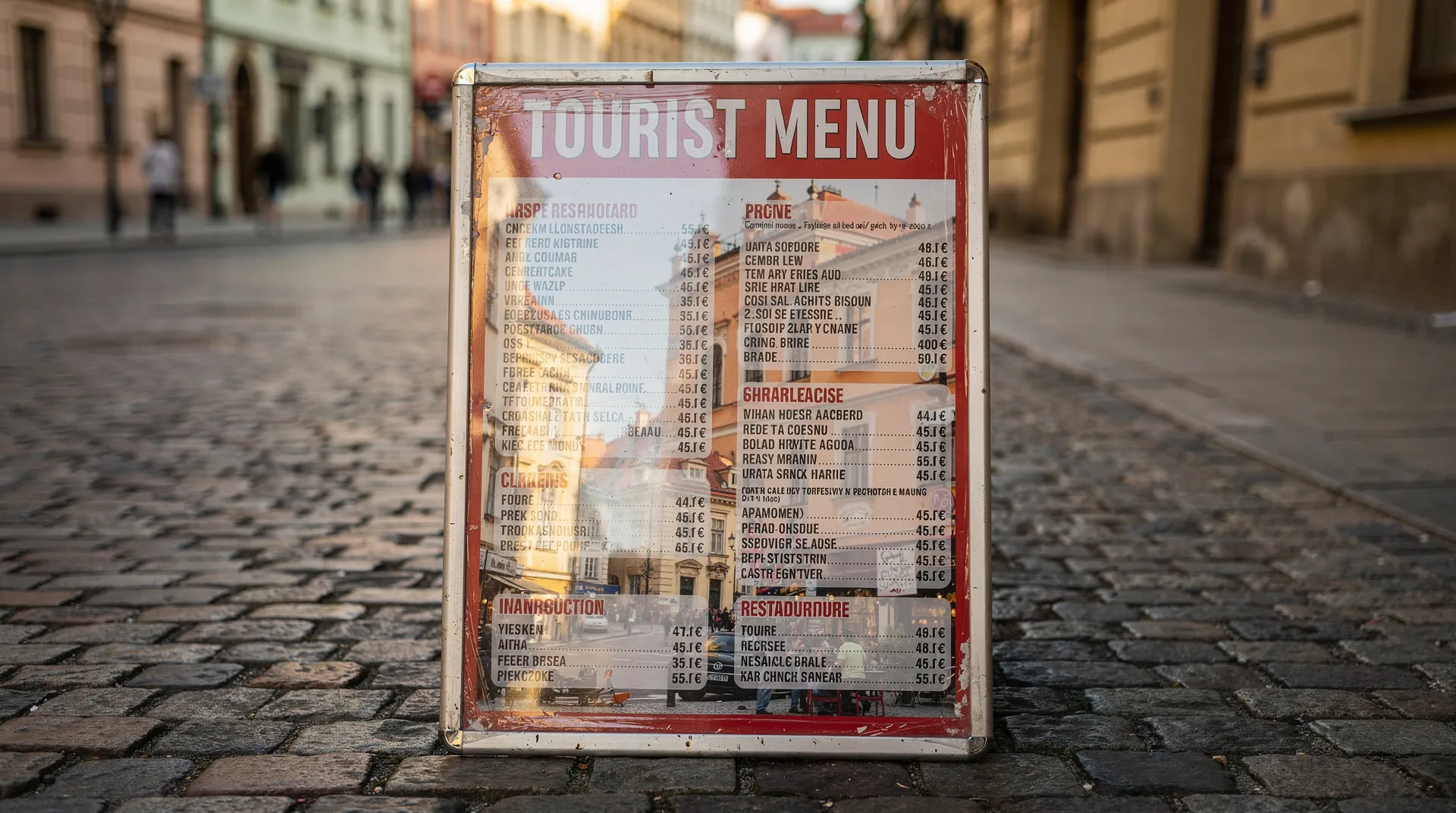
How it works: You’re handed a menu (or a laminated card) showing prices that look reasonable. You order. The bill arrives with:
- A “tourist menu” price several times higher than what was displayed
- A bread charge (sometimes 45–80 CZK per person for bread you didn’t ask for)
- A cover charge (50–100 CZK per person just for sitting)
- A service charge of 15% added on top
None of these were mentioned at ordering. If you object, the response is hostile or the manager “doesn’t speak English.”
How to avoid: Before sitting at any restaurant in Old Town, look at the menu displayed outside — the actual posted menu with prices. If prices aren’t posted outside, walk on. Before ordering, ask if there is a cover charge or bread charge. Check your bill in detail before paying. Full detail in the tourist menu traps guide.
Scam 6 — the “lucky” bracelet or flower
Mostly operates in Old Town Square area.
How it works: Someone (often claiming to be Roma, sometimes women, sometimes men) approaches and ties a bracelet on your wrist, hands you a rosemary sprig, or places a “lucky charm” in your hand. Once it’s in your possession or attached to you, they demand payment — typically 500–1 000 CZK. The situation is designed to create social pressure.
How to avoid: Never accept anything placed on your body or in your hands by a stranger without confirmed free consent. If someone tries to tie something on you, step back and say “no” firmly. Return any item that’s been placed in your hands. This scam relies entirely on social discomfort — removing that discomfort removes the scam.
Scam 7 — DCC at card terminals
Less obviously a “scam” but the most financially costly for many tourists.
How it works: A restaurant, hotel, or ATM terminal asks whether you want to pay in CZK or your home currency. Choosing your home currency activates Dynamic Currency Conversion, where the merchant converts the transaction at their own (unfavourable) exchange rate.
How to avoid: Always choose CZK. Always. See currency and money guide for full detail.
Seasonal and situational variations worth knowing
Scam pressure isn’t constant across the year or across every part of a trip.
Christmas markets (December): Mulled wine (svařák) stalls sometimes serve a smaller cup than displayed, and change-giving in a crowd is where short-changing happens. Count your change before moving on. See the best time to visit guide for how crowd density shifts scam risk month to month.
Peak summer (June–August): The highest concentration of tourist menu traps and bracelet scammers, simply because foot traffic in Old Town is at its yearly peak. Off-season visitors report noticeably fewer approaches.
Airport transfers specifically: If you’ve pre-booked any transfer, drivers meeting you will hold a name sign — never accept a ride from someone without one, even if they claim to be “your driver.” Full detail in the airport to city transfer guide.
On the metro and trams: Genuine ticket inspectors aside, pickpocketing (not really a “scam” but often lumped in) spikes on the crowded tram 22 route past the castle and on line A during rush hour. See the metro guide for validating tickets correctly, which also avoids an accidental real fine.
Language barrier as a lever: Several of the scams above (menu swap, taxi disputes) rely on the tourist not being able to argue in Czech. Learning a few phrases — see language basics — won’t stop a scam outright, but a confident “Kolik to stojí?” (how much does this cost?) asked before committing to anything signals you’re paying attention.
Guided tours as a scam-avoidance shortcut: If navigating solo feels like extra risk on your first day, a reputable guided walking tour removes almost all of the exposure above — no exchange offices, no restaurant menus to check, no taxi negotiation. Compare the trade-offs in the private vs group tours guide.
What we’d actually do
Three rules cover 90% of Prague scam situations:
- Use an ATM (not an exchange office) for cash.
- Use Bolt or Uber (not street taxis) for rides.
- Never follow a stranger to an unresearched bar or venue.
Apply these and the risk of financial scam drops dramatically.
Common mistakes
Assuming official-looking = legitimate: Exchange offices with professional signage and an official-seeming setup are often the most deceptive. The quality of the signage is irrelevant; the posted rate and the actual transaction rate are what matter.
Not checking the bill in detail: Menu prices in tourist areas require verification before you pay. A bill that doesn’t match your mental calculation should be questioned before you hand over money.
Engaging with touts: Once you engage (stop, make eye contact, ask “how much”), it becomes harder to disengage. The best response to any unsolicited offer is a polite, non-engaging “no thank you” while continuing to walk.
Assuming scams only happen to naive tourists: Experienced travellers get caught by Prague scams too, particularly the DCC one and the menu swap, because they happen in legitimate-looking contexts. Check every transaction.
Questions people actually ask
Are there areas of Prague where scams are more common?
Yes. Old Town Square and the streets between it and Charles Bridge have the highest concentration of exchange office scams, tourist menu traps, and bracelet/lucky charm people. Lower Wenceslas Square (below Můstek) late at night has the dance club/bar touts. The airport arrivals hall has taxi touts. These are geographic patterns, not random.
What should I do if I’ve already been scammed?
Report to police (at the Old Town police station or dial 158). You’ll need the report for any insurance claim or bank dispute. For taxi overcharging, note the car registration and company. For exchange office issues, the Czech Trade Inspection Authority (ČOI) handles consumer complaints. In most cases, recovering money from scammers is difficult — the value is in the police report for insurance and in warning others.
Are Prague exchange offices all bad?
No. Bank-branch exchange counters (Česká spořitelna, Komerční banka, Raiffeisenbank) are generally transparent and fair. A few independent exchange offices away from tourist zones (Vinohrady, Dejvice) operate honestly. The problem is specifically with the high-density tourist-area operations. See the currency guide for names of reliable options.
Is the ticket inspector on the tram a scam?
No. DPP inspectors are legitimate city transport employees. If you’re caught with an unvalidated ticket, the 1 500 CZK fine is real and enforceable. However, there are occasional reports of people posing as inspectors in tourist areas — real inspectors always have a DPP badge, carry a handheld device for reading tickets/app QR codes, and will take you to a proper enforcement process if you dispute. If you’re unsure, ask to go to the nearest DPP office.
How do I identify a legitimate exchange office?
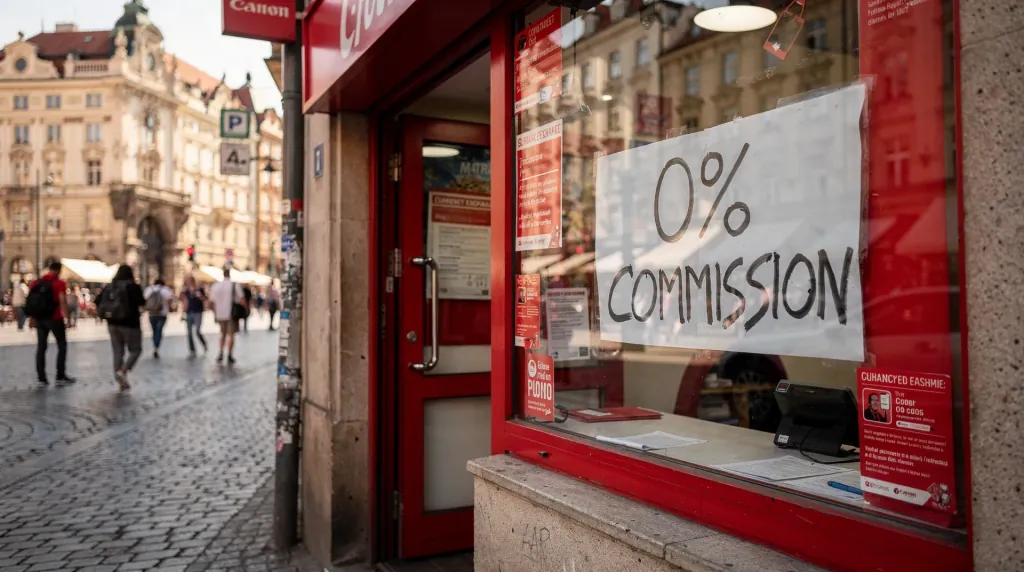
Look for: rates posted clearly with no asterisks or small print; the office states “0 commission + 0 fees” clearly; the office is inside a bank branch or operated by a bank. Ask the cashier: “If I exchange €100, how many CZK will I receive?” and get a number before you hand over anything. A legitimate office will tell you directly.
Is it safe to walk around Prague at night as a tourist?
Yes, physically Prague is a safe city at night — violent crime against tourists is rare. The scams above are financial, not physical, and they mostly target you when you’re distracted or in a decision-making moment (choosing a restaurant, hailing a ride, exchanging money), not randomly on the street.
Do these scams happen outside the Old Town tourist core?
Rarely. Neighbourhoods like Vinohrady, Karlín, and Žižkov (away from the lower end near Wenceslas Square) see almost none of this activity — locals shop and eat there, and the economics of running a scam don’t work without a constant stream of first-time visitors.