The language reality in Prague
| Official language | Czech (Slavic, seven grammatical cases) |
| English level | Widespread in the tourist core, hotels, and under-50s |
| Effort needed | A handful of greetings — genuinely appreciated |
| Backup tool | Google Translate camera function for menus |
| Where it’s hardest | Local pubs, outer districts, older residents |
Czech is a Slavic language and genuinely one of the harder ones for English speakers to learn. The grammar has seven grammatical cases, consonant clusters that look unpronounceable (and are), and diacritical marks that change vowel sounds significantly. Nobody expects tourists to speak it.
What matters in practice: English is widespread in the tourist core and among Czechs under 50 in urban environments. Hotel staff, restaurant servers, ticket office workers, and most shop staff in central Prague will have at least functional English. Older Czechs (60+), particularly in non-tourist contexts, may default to Czech or German. Russian is understood by older generations but not typically welcomed as a first choice.
German is a useful backup after English, especially in western Bohemia (near the German border). French and other Romance languages are rarely helpful beyond the basics.
How far English gets you, by context
Where English works reliably:
- All hotels and hostels in central Prague
- Restaurants in Staré Město, Nové Město, Vinohrady, Malá Strana
- Prague Castle ticket offices and major museums
- Václav Havel Airport
- DPP customer service points
- Most shops on major shopping streets
Where English is hit or miss:
- Local pubs (pivnice) in outer districts
- Traditional market stalls (Náměstí Míru farmers’ market, Holešovice market)
- Older pharmacies in residential areas
- Trams and buses (drivers don’t interact much, but announcements are Czech-only)
- Smaller accommodation outside the tourist centre
Where you need Czech (or pointing):
- Local grocery shops (Žabka, Albert) — usually no issue since it’s self-service, but cashiers rarely speak English
- District health centres and non-English-friendly pharmacies
- Any bureaucratic interaction (police report, etc.) — though translation support is available
Pronunciation quick guide
Czech pronunciation is largely phonetic once you learn the rules. The main challenges:
Diacritical marks change the sound completely:
- á, é, í, ó, ú, ý — long versions of the vowel (hold the sound longer)
- ě — sounds like “ye”
- č — “ch” as in “church”
- š — “sh” as in “shop”
- ž — “zh” as in “measure”
- ř — unique to Czech — a trilled “r” with a “zh” sound simultaneously. There’s no equivalent in English. The name “Dvořák” has this sound.
- ň — “ny” as in “canyon”
- ch — “kh” as in Scottish “loch”
Stress: Always on the first syllable. PRa-ha (Prague). VÁC-lav. JO-sef-ov. This is consistent and makes speaking more natural once you know it.
15 phrases worth knowing
Czechs genuinely appreciate tourists making the effort. Even a mispronounced “děkuji” gets a smile.
| Czech | Pronunciation | Meaning |
|---|---|---|
| Dobrý den | DOH-bree den | Good day / Hello (formal) |
| Ahoj | AH-hoy | Hi / Bye (informal) |
| Prosím | PROH-seem | Please / Here you go / You’re welcome |
| Děkuji | DYEH-koo-yih | Thank you |
| Díky | DEE-kih | Thanks (informal) |
| Promiňte | PROH-min-yeh | Excuse me / Sorry |
| Nemluvím česky | neh-MLOO-veem CHES-kih | I don’t speak Czech |
| Mluvíte anglicky? | mloo-VEE-teh ahn-GLITS-kih | Do you speak English? |
| Kolik to stojí? | KOH-lik toh STOH-yee | How much does it cost? |
| Kde je…? | gdeh yeh | Where is…? |
| Pivo | PIH-voh | Beer |
| Voda | VOH-dah | Water |
| Účet, prosím | OO-chet PROH-seem | The bill, please |
| Na zdraví | nah ZDRAH-vih | Cheers (when toasting) |
| Ano / Ne | AH-noh / neh | Yes / No |
Bonus cultural note on “prosím”: This single word does extraordinary duty in Czech. It means please, here you go (when handing something), you’re welcome, come in, and even “pardon?” when you haven’t heard something. Czechs use it constantly and generically. Saying it in the right context will feel instinctive within a day.
Numbers for practical use
You don’t need to count fluently, but knowing numbers helps at markets:
1 (jeden), 2 (dva), 3 (tři), 4 (čtyři), 5 (pět), 6 (šest), 7 (sedm), 8 (osm), 9 (devět), 10 (deset)
100 = sto, 200 = dvě stě, 500 = pět set, 1000 = tisíc
In practice, you’ll read prices on displays or menus — Czech cashiers are accustomed to tourists who point and use cards.
Czech place names and their correct spelling
Prague place names use diacritical marks. Using the correct spelling in maps, navigation apps, and conversations avoids confusion:
- Praha — the Czech name for Prague (used in Czech contexts, addresses, etc.)
- Václavské náměstí — Wenceslas Square
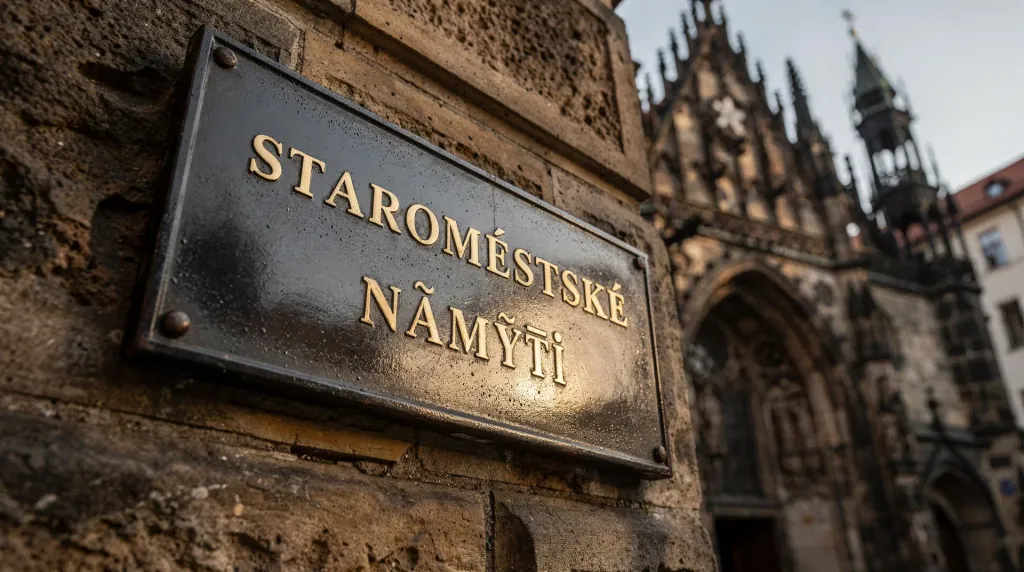
- Staroměstské náměstí — Old Town Square
- Malostranské náměstí — Lesser Town Square
- Josefov — Jewish Quarter
- Hradčany — the castle district
- Malá Strana — Lesser Town
- Staré Město — Old Town
- Nové Město — New Town
- Vinohrady — the wine-hill neighbourhood east of centre
- Žižkov — gritty creative district
- Holešovice — northern bohemian neighbourhood
- Hlavní nádraží — Main Train Station
Google Maps handles these correctly if you type them with diacritics. Without diacritics, maps usually still find the right place.
Language on menus and at markets
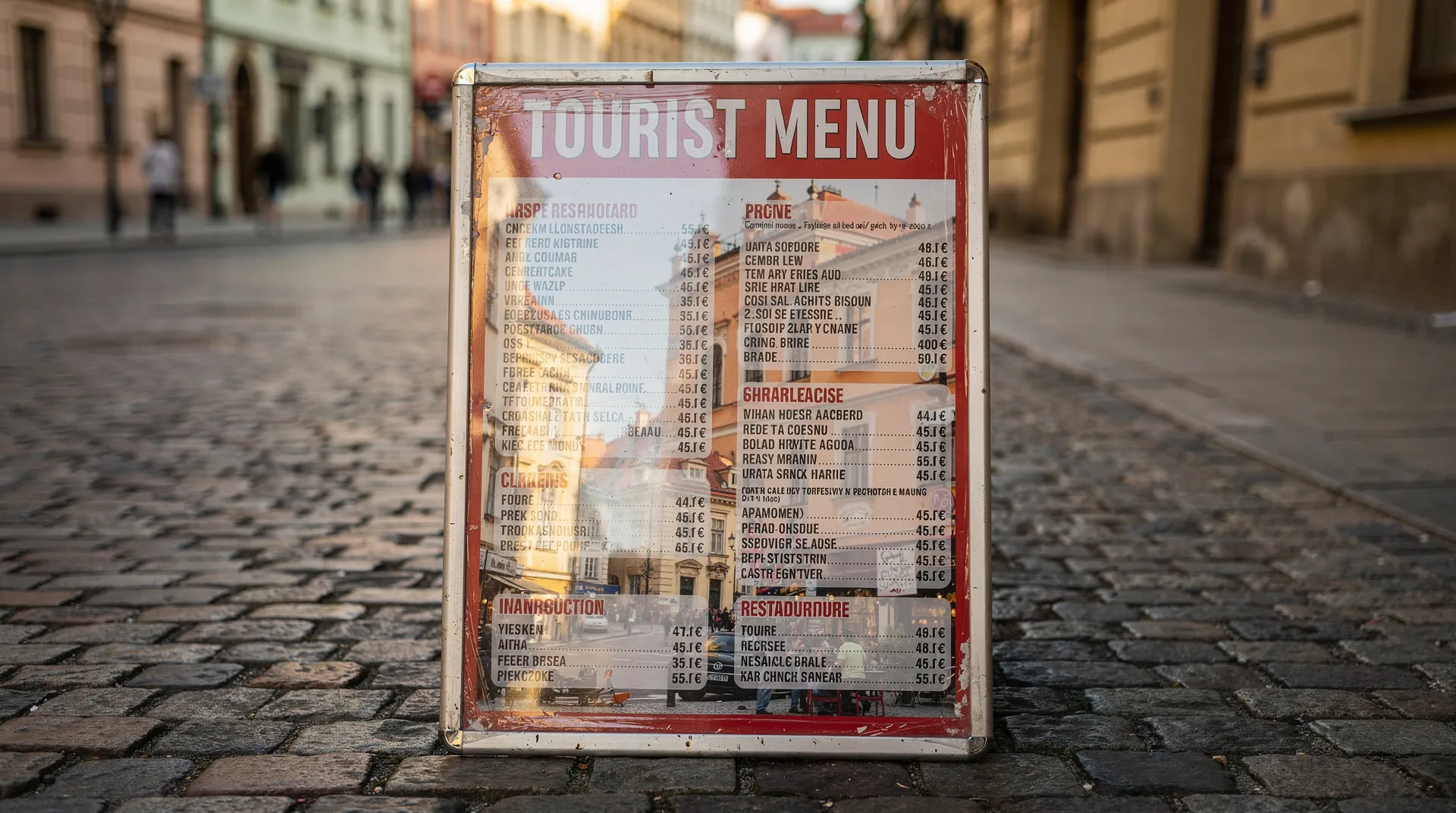
Menus are one of the few places Czech-only text actually gets in the way of enjoying yourself. See the traditional Czech dishes guide for the dish names worth recognising before you sit down, and the tourist menu traps guide for the tricks some restaurants use with unlabelled prices. At markets and food stalls (see the street food guide), pointing plus a number and “prosím” gets you a long way even with zero Czech.
Language on public transport
Metro and tram stop announcements are Czech-only, though signage is usually clear enough with the metro guide as a reference for line names and directions. Ticket machines have an English option, so language rarely becomes a real barrier for getting around — it’s more of a listening challenge on the vehicle itself.
What we’d actually do
Learn these five before arriving: dobrý den (hello), děkuji (thank you), prosím (please), promiňte (excuse me), and na zdraví (cheers). Use them consistently. The response from locals — especially in non-tourist contexts — is warmer than you’d expect.
Use Google Translate for anything more complex. Its camera function (point at a menu item and see a translation) is genuinely useful for deciphering pub menus written entirely in Czech.
Common mistakes
Pronouncing “Praha” as “Prahhh-ha”: The stress is on the first syllable, both vowels are similar in length — PRAH-hah. The extra breath that English speakers add in the middle is not there.
Using English loudly and slowly as a substitute for Czech: Czechs understand English at conversational speed when they speak it. Shouting slowly is not more helpful. A phone screen showing what you need is much better.
Forgetting “prosím” works in both directions: When a Czech person says “prosím” to you after you thank them, they’re saying “you’re welcome” — not asking you to do something. It takes a day to calibrate.
Ignoring the formal/informal distinction: “Ahoj” is for friends and casual encounters — don’t use it to address hotel staff or older strangers. “Dobrý den” is always safe.
Questions people actually ask
Is Czech similar to Slovak, Polish, or Russian?
Czech is most similar to Slovak — speakers of one language can generally understand the other with moderate effort. Polish is more distantly related and speakers can catch some words but not follow a full conversation. Russian uses a different script (Cyrillic) and the grammar differs enough that they’re not mutually intelligible to casual learners, though Czech and Russian share enough vocabulary to help in reading food labels or menus.
Will Czech people be offended if I don’t speak their language?
Not at all. Czechs have no expectation that foreign tourists speak Czech, and the language is rare enough outside the country that nobody expects proficiency. What they do notice is manners — greeting and thanking in Czech is appreciated. Being dismissive or impatient with language barriers is less well-received.
Is Czech the only language spoken in Czech Republic?
Czech is the official language. Slovak is widely understood and spoken by a significant minority. Roma communities have their own language. In western Bohemia (near Germany/Austria), German is a practical second language. English is the first choice in tourism and business contexts across the country.
What’s the best translation app for Czech?
Google Translate handles Czech well for basic tourist phrases and menu translation. DeepL is better for longer, nuanced texts. For offline use in areas without data, download Czech to your Google Translate app before travelling — the offline package is around 50 MB.
Are restaurant menus in English in Prague?
In tourist areas, most restaurants have English menus or English-language menu boards. In local pubs and restaurants outside the tourist zone, Czech-only menus are common. The Google Translate camera function works well for this — point it at a menu and get a reasonable translation of most items.
Do I need to tip or greet staff in Czech to be polite?
Tipping etiquette is separate from language — see the tipping guide for the norms. A simple “dobrý den” on arrival and “děkuji” when paying is the extent of what’s expected and appreciated; nobody expects more.
Is it rude to speak English first without asking?
No, but a quick “Mluvíte anglicky?” (do you speak English?) before launching into English is a small courtesy that’s noticed positively, especially with older staff or outside the tourist core.