At a glance
| Where | Staroměstské náměstí 1, on the Old Town Square, Staré Město |
| Cost | Hourly show: free. Tower entry: around €14 (350 CZK) |
| Time needed | 3–5 minutes for the show; around 45–60 minutes with the tower climb |
| Getting there | Metro A to Staroměstská, then a 4-minute walk; or a 6–8 minute walk east from Charles Bridge |
| Best time | Just before 9:00 (first show, near-empty square) or after 21:00 (evening light, thinner crowds) |
Who built the Orloj and when — setting the record straight
The standard tourist story credits Master Hanuš (Jan Růže) with the entire clock, and adds the legend that he was subsequently blinded by the town councillors to prevent him from building a better version elsewhere. Neither claim survives historical scrutiny.
The astronomical dial was almost certainly built by Master Mikuláš of Kadaň (Mikuláš z Kadaně), likely with scholarly input from astronomer Jan Šindel (Jan Ondřejův), a professor at Charles University. The date of 1410 is confirmed in a contemporary chronicle. Mikuláš was a clockmaker; Šindel provided the astronomical calculations. The collaboration between a craftsman and a university-trained astronomer was typical of the period.
Master Hanuš appears in municipal records in 1490 as the man who made significant improvements to the clock — probably adding the calendar dial and refining the astronomical mechanism. He was a real person and a real clockmaker, but the blinding legend appears to have been invented in the early 16th century by the humanist chronicler Václav Hájek z Libočan, who invented many things for his 1541 chronicle of Bohemia. Modern scholars found no contemporaneous document supporting it.
The clock mechanism was severely damaged on 8 May 1945 when German forces deliberately set fire to the Old Town Hall as they withdrew from Prague. The astronomical dial survived relatively intact; the Apostle figures, the calendar dial, and parts of the mechanism had to be reconstructed after the war. The 27 wooden Apostle figures visible today were carved by restorer Karel Novák between 1948 and 1970. The 2017–2018 restoration — the most thorough since the 19th century — returned the clock to the best condition it has been in for decades.
Why the Astronomical Clock is genuinely remarkable
The Prague Orloj (astronomical clock) is the oldest working astronomical clock in the world, and it’s been running — with interruptions — since 1410. That’s over 600 years of daily operation in the centre of a city that’s survived wars, fires, occupations, and the complete transformation of European civilization.
What makes it remarkable isn’t just its age. It’s the complexity of what it actually does. The clock simultaneously displays:
- Solar time (the standard 12-hour clock)
- Old Czech time (counting hours from sunset)
- Babylonian time (hours from sunrise)
- Sidereal time (rotation of the Earth relative to distant stars)
- The position of the sun on the ecliptic (its path through the zodiac signs)
- The position of the moon, and its phase
- The time of sunrise and sunset on any given day of the year
All of this information is packed into a single dial using a system of concentric rings and a mechanical arm, driven by a single clock mechanism. Medieval Prague’s ability to build and maintain this machine is not an accident — Bohemia under Charles IV was one of the most technologically and intellectually advanced societies in 14th and 15th century Europe.
Reading the clock face
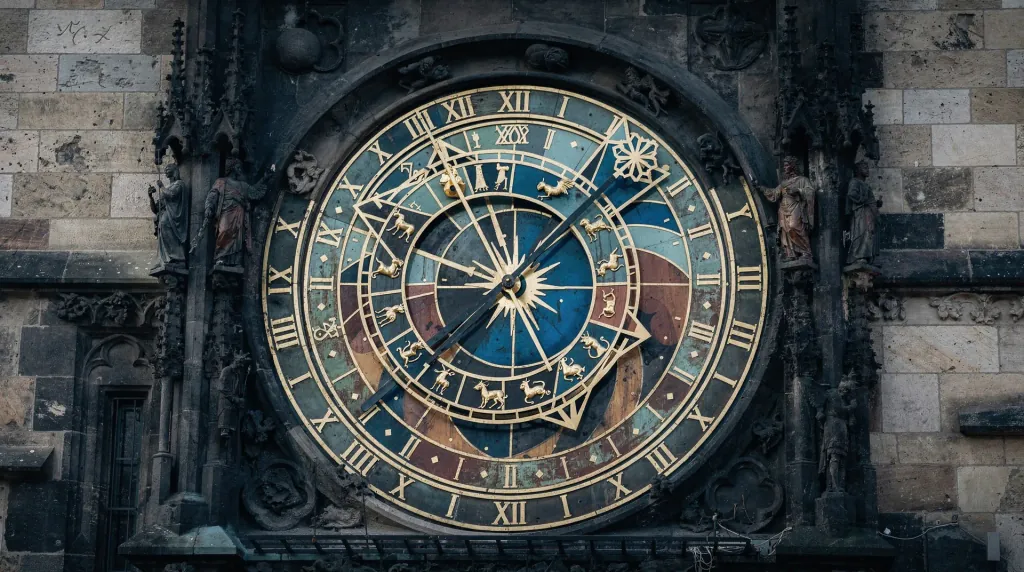
The main astronomical dial is the large blue-gold circle mounted on the lower half of the clock face. A few key elements:
The golden hand with a sun symbol: This traces the position of the sun relative to the horizon and the zodiac. When the sun symbol crosses the golden horizon ring at the outer edge, it’s sunrise; when it crosses on the opposite side, sunset.
The silver moon ball: Shows the lunar phase. The ball is half black, half silver, and rotates to show a crescent or full moon.
The outer rotating ring with Gothic numerals: This is Old Czech time, counting 24 hours from sunset (so “hour 1” is one hour after the previous sunset). Almost nobody reads it today; it was primarily used by medieval citizens.
The zodiac ring: The 12 signs rotate past a fixed indicator to show where the sun is in the ecliptic. The sun currently moves through Aries from late March to late April, Taurus from late April, and so on.
The black, blue, and golden zones: The disk map shows the spherical sky flattened into a plane. Golden zone = above the horizon; blue zone = twilight; black = night.
The calendar dial below the clock
The lower dial (the calendar face) is a 19th-century replacement. It shows the months and their associated agricultural activities and zodiac signs in richly coloured panels. The original medieval calendar was removed and is displayed inside the tower.
The hourly show
On the hour, from 9:00 to 23:00 (midnight is skipped), two windows above the clock face open and wooden figures of the Apostles pass by in a procession. Below, four allegorical figures on the clock frame move simultaneously: Death (a skeleton) rings a bell; Vanity admires himself in a mirror; Greed clutches a bag of gold; a Turk shakes his head (originally representing Pagan/Ottoman invasion). A golden cockerel atop the windows crows to end the show.
The entire performance lasts about 60 seconds. The figures are 19th-century replacements; the mechanism driving them is the same basic design as the medieval original.
Practical note: At peak season, the crowd in front of the clock during the hourly performance can be 100–300 people deep. The figures are small (about 20 cm tall) and visible from 20–30 metres away without difficulty. There is no queue or ticket required. Arrive 3–4 minutes before the hour, stand anywhere with a clear line of sight to the clock face, and watch.
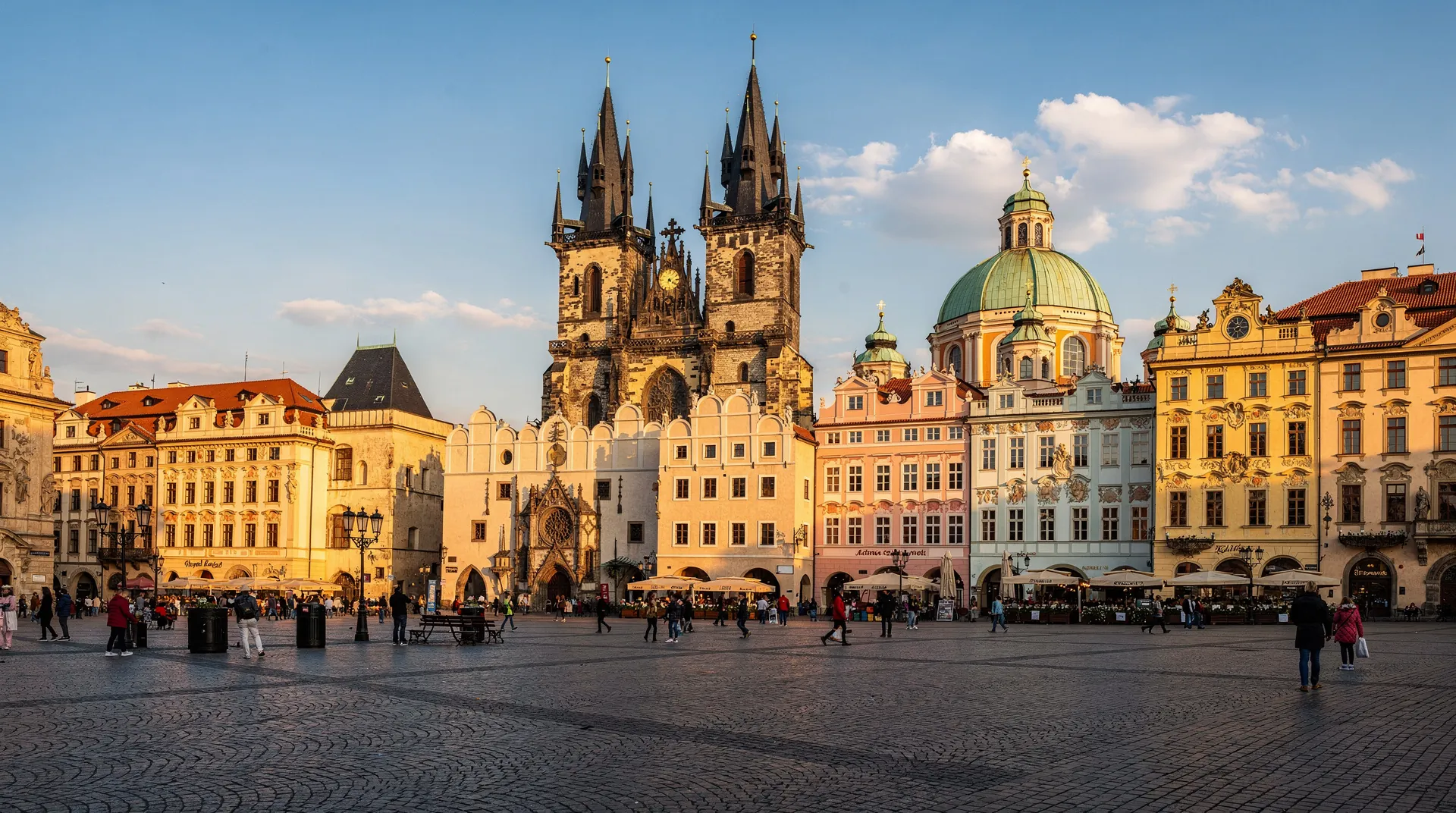
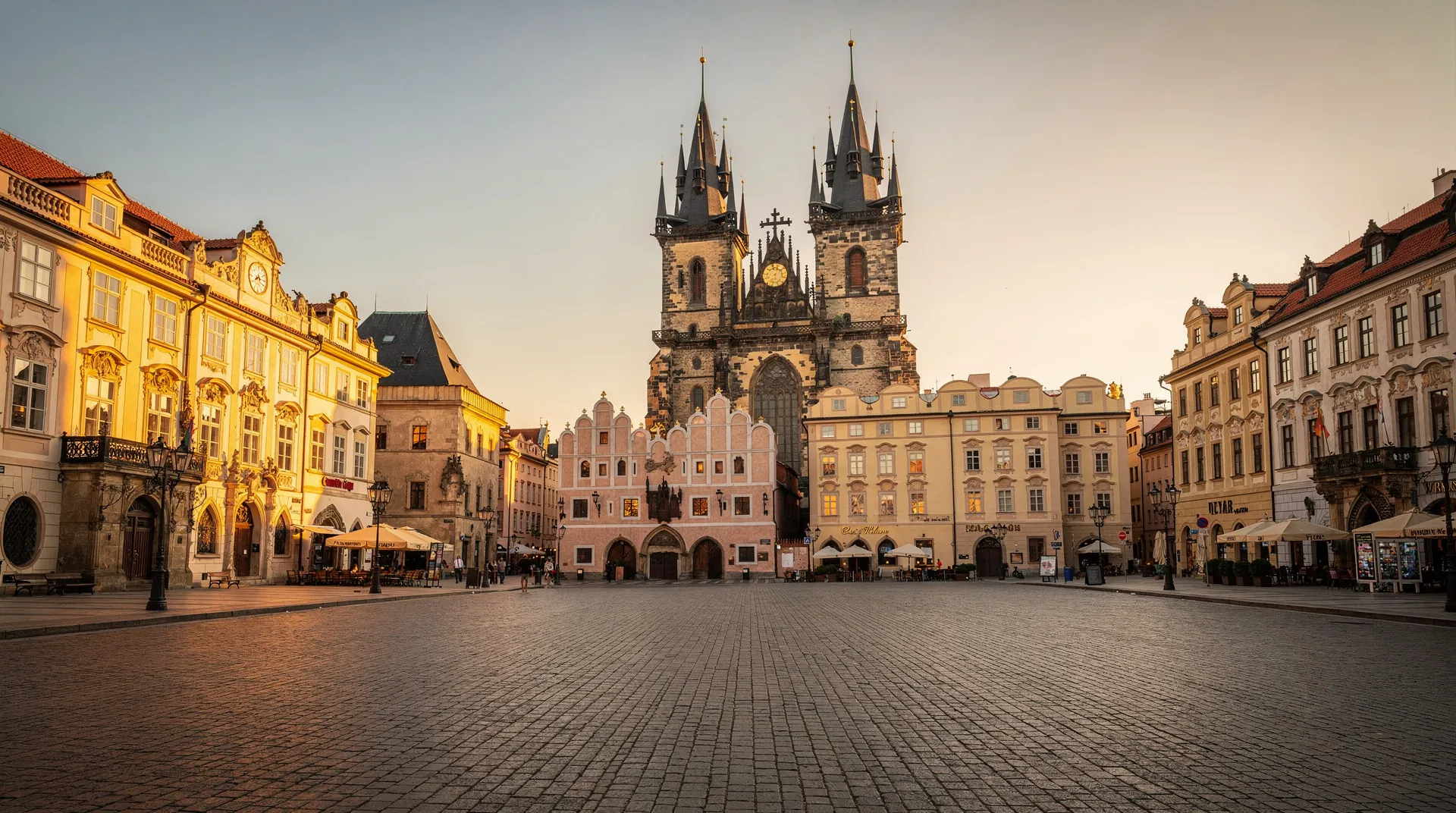
Combine the visit with the rest of the Old Town Square — the Týn Church and the Jan Hus memorial are steps away — and with the Jewish Quarter, a short walk north through the Staré Město neighbourhood.
The tower climb — is it worth it?
The Old Town Hall tower entry (~€14 / 350 CZK for adults) includes:
- The clock room — the back side of the clock face, where you can see the painted medieval astronomical dial up close and read the explanatory panels. Fascinating for anyone interested in how the mechanism works.
- The mechanism room — the clockwork itself, drive weights, and the escapement system. More interesting than it sounds.
- The rooftop terrace — views over Staroměstské náměstí and the Old Town roofline. Not the highest point in Prague, but a good mid-range perspective.
The tower is accessible by lift (elevator) as well as stairs, making it one of the more accessible tower climbs in the city.
Astronomical Clock tower entry ticket and audio guide Old Town Hall tower entry ticketFor a guided 3-hour tour that includes clock admission and a broader sweep of Old Town:
3-hour Prague tour with Astronomical Clock admissionFor the underground angle — the medieval cellars beneath the Old Town Hall:
Old Town, Astronomical Clock, and underground tourHistory and near-disasters
1410: Master Mikuláš of Kadaň, likely with input from astronomer Jan Šindel, builds the original clock. The astronomical dial is original; the calendar face is much later.
1490: Hanuš of Ruze (Jan Růže) overhauled the mechanism and made significant improvements. He has traditionally been credited with building the original clock, but modern scholarship attributes it to Mikuláš.
1945: During the Prague Uprising against the German occupation in the final days of WWII, the clock was destroyed when the Germans set the Old Town Hall on fire. The 27 repaired Apostle figures visible today were carved after 1948. The astronomical dial itself survived relatively intact.
2018: The clock was removed for the most comprehensive restoration in its history — mechanism, face, and figures — and returned in 2018 to mark the 100th anniversary of Czechoslovakia. The current condition is as good as it has been in centuries.
Different ways to experience the clock
Free — just watch
The hourly show is entirely free from the square. You need nothing but a clear line of sight and three minutes of patience. The figures are small but visible from 25 metres. No ticket, no app, no reservation. Stand slightly left of centre (northeast) to see the Death figure more clearly.
Tower ticket with audio guide
The audio guide significantly deepens the experience — it walks you through the astronomical dial face in detail, explains the concentric ring system, and covers the history of the building. Without an audio guide, the mechanism room in the tower is interesting but under-explained:
Astronomical Clock tower entry ticket and audio guideGuided 3-hour tour with admission
If you want the clock explained in person alongside a broader sweep of Old Town:
3-hour Prague tour with Astronomical Clock admissionThe Klementinum for comparison
If the Orloj’s medieval mechanism interests you, the astronomical tower of the Klementinum (five minutes’ walk from the clock, on Mariánské náměstí) has a Baroque-era astronomical tower and the Czech Republic’s longest continuous meteorological record. Tours of the library and tower run daily:
Klementinum library and astronomical tower guided tourCombined admission (Castle, Jewish Quarter, Clock Tower)
For efficiency if you’re covering all three major Old Town sites:
Prague Castle, Jewish Quarter, and Clock Tower combined admissionSeasonal notes
High summer (July–August): The crowd in front of the clock at the hourly show can reach 200–400 people from 10:00 to 18:00. There is no way to get a clear view standing directly in front. Arrive at 9:00 for the first show of the day — the crowd is a fraction of midday size. Alternatively, use the second-floor balcony of the Starbucks across the square (yes, really) for an elevated line of sight.
Christmas: The square fills with the Christmas market from late November. The clock tower is decorated with seasonal lighting. The show is still the same, but the market crowd creates even worse visibility at the hourly performances.
Evening visits: The clock operates until 23:00. The evening shows (21:00–23:00) have smaller crowds than midday, the square is lit beautifully, and the blue and gold of the astronomical dial is more vivid under artificial light than in daylight. The 23:00 show is the last — the clock does not perform at midnight.
Low season (January–March): Uncrowded. You can stand directly in front of the clock with space to breathe and actually examine the dial faces at leisure. The Apostles are 20 cm tall wooden figures; up close, the painting and detail are visible in ways the summer crowds prevent.
Insider details
The correct way to read the time: Most visitors look at the clock and try to find a conventional 12-hour readout. There is one — the golden hand points to the Roman numerals on the inner fixed ring. But the outer rotating ring with Gothic numerals (Old Czech time, counting from sunset) is what medieval citizens actually used. At sunset, that ring reads “1” — one hour after sunset.
The painted figures on the corners: The four allegorical figures at the corners of the clock frame — Vanity, Greed, Death, and a Turk — move during the show but are also present at rest. Death the skeleton, on the right side, holds an hourglass in the right hand and rings a bell with the left. The figures are post-1945 replacements but follow the original design.
The bar crawl connection: The Clock Tower Bar Crawl starts near the astronomical clock at 21:00 — if you want to see the 21:00 show and then move into the Prague nightlife circuit:
Prague Clock Tower Bar Crawl with drinks and shotsThe rooftop terrace view: The Old Town Hall tower terrace gives a view directly down Pařížská boulevard (the Art Nouveau luxury shopping street running north to the Jewish Quarter) that most visitors never see. Face north from the terrace to capture the whole boulevard tapering toward the river.
Getting there
Metro: Staroměstská (Line A, green) — 4-minute walk south along Kaprova. The clock is on the south side of the town hall, on the Old Town Square.
Tram: Lines 17 and 18 to Staroměstská, then a short walk.
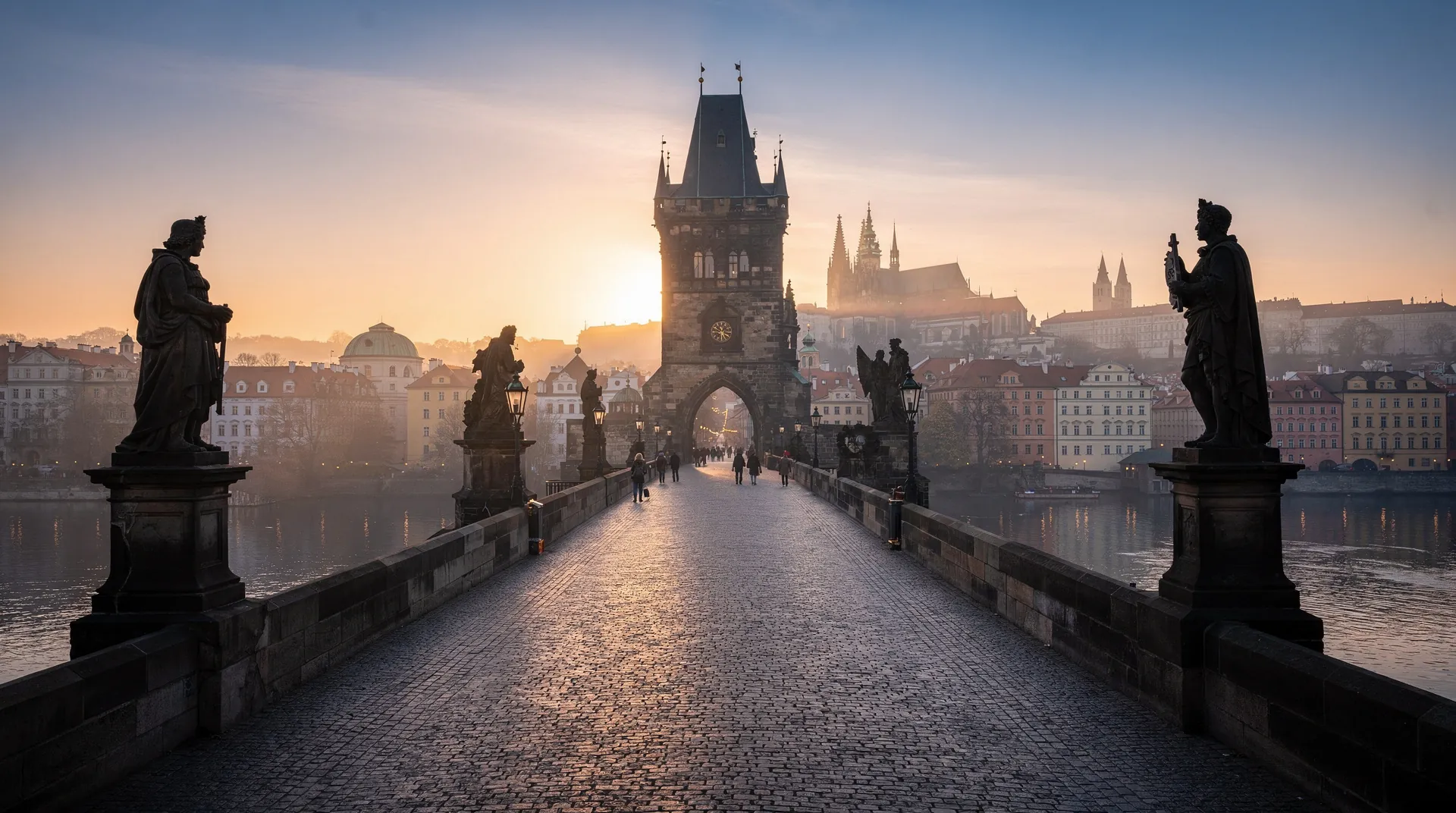
On foot: From Charles Bridge, walk east on Karlova — 6–8 minutes.
Photographer’s note
The full clock face photographs well from about 15–20 metres directly in front. In the early morning (before 8:00 in summer), the square is quiet and you can shoot the clock without crowds. The clock is particularly striking after dark when lit — the blue and gold of the astronomical dial is more vivid under artificial illumination than in daylight.
From the tower terrace: the shot down into the square showing the Jan Hus monument and the surrounding roof lines is reliable. Midmorning (10:00–11:00) gives good front light on the south-facing buildings around the square.
Frequently asked questions about Prague’s Astronomical Clock
How old is the Prague Astronomical Clock?
The astronomical dial was installed in 1410. The calendar dial below it is a 19th-century addition. Parts of the mechanism have been replaced over the centuries, but the core design is over 610 years old.
What happens if you miss the hourly show?
Nothing — it happens again in an hour. The show runs every hour from 9:00 to 23:00. The clock continues to display all astronomical information at all times, whether or not the Apostles are appearing.
Is the Prague Astronomical Clock the oldest in the world?
It is the oldest working astronomical clock. There is an older clock in Wells Cathedral in England (1386) but it no longer functions with its original mechanism. The Orloj retains much of its original design and has been kept in continuous operation.
Can children enjoy the Astronomical Clock?
The hourly show appeals to most children for its moving figures. The tower climb can be done by lift. The clock mechanism room is interesting for children who like how things work.
Does the clock ever stop?
The clock is stopped for maintenance and has been through major restorations. It was last restored in 2017–2018. Under normal conditions it runs continuously.
Is there a legend about the clock’s maker being blinded?
Yes — the story goes that Master Hanuš was blinded by the town councillors who feared he would build a similar clock for another city, and in revenge he put his hand into the mechanism to stop it, dying in the process. It is a good story and almost certainly fictional. There is no contemporaneous historical evidence for it.
Can you book the tower visit in advance?
Yes. Online booking via the Muzeum hl. m. Prahy website or GetYourGuide lets you select a time slot. During peak season (July–August), same-day tickets sometimes sell out by mid-afternoon. Booking the day before is usually sufficient; booking a week ahead guarantees your preferred time.
Is there anything to see in the tower besides the view?
Yes — the clock room (back of the astronomical dial), the mechanism room (the clockwork drive weights and escapement), and the original medieval calendar disc (moved indoors for conservation; the current outdoor calendar face is a 19th-century copy). These three things justify the ticket price beyond the rooftop view alone.
What time does the last hourly show happen?
23:00. The clock does not perform at midnight. The mechanism switches to a rest position at 23:00 and resumes at 9:00 the next day. The clock continues to display all astronomical information overnight regardless.
Is the clock accessible for visitors in wheelchairs?
The tower has a lift (elevator), making it one of the more accessible towers in Prague. The square in front of the clock is paved in cobblestones — manageable but rough. The mechanism room inside the tower is accessible via the lift without stairs.
How long should I plan for the Astronomical Clock?
Budget 5–10 minutes if you’re only watching the free hourly show, or 45–60 minutes if you’re adding the tower climb. Most visitors combine it with a broader walk around Old Town Square, which extends the visit naturally without extra planning.
Is the Astronomical Clock near Charles Bridge?
Yes — it’s a 6–8 minute walk east along Karlova street from Charles Bridge, making the two easy to combine on the same morning or evening walk through Staré Město.
Practical info at a glance
- Address: Staroměstské náměstí 1, 110 00 Praha 1
- Hourly show: 9:00–23:00 daily; free to watch from the square
- Tower opening hours: Jan–Mar daily 10:00–19:00; Apr–Dec daily 9:00–20:00 (Mondays included)
- Tower entry price: ~€14 / 350 CZK adult; 230 CZK reduced (ages 6–15, 65+); 280 CZK ages 16–26; family 750 CZK; free up to age 5. Tower lift: +100 CZK
- Nearest metro: Staroměstská (Line A, green)
- Official website: muzeumpraha.cz