Prague is small. The country around it is not.
| At a glance | |
|---|---|
| Fastest option | Karlštejn — 45 minutes by train |
| Most demanding | Český Krumlov — around 2h 45min each way by bus |
| Cheapest full day | Kutná Hora — around €7 return plus €4.50 ossuary entry |
| Best booked as a tour | Český Krumlov and Terezín — logistics or context genuinely benefit |
| Best done independently | Kutná Hora, Karlštejn, Dresden — public transport is simple and cheaper |
Prague’s historic core is compact enough to cover on foot in two full days. By day three of a typical city break, most visitors have walked Charles Bridge, climbed the castle, explored the Jewish Quarter, and eaten svíčková at least once. By day four, they start looking outward.
The good news is that within a two-hour radius of Prague’s main train station, there are more genuinely worthwhile destinations than most of Europe can match. A UNESCO-listed medieval town. One of the most important Holocaust memorial sites in Central Europe. A national park with sandstone rock formations that look borrowed from another continent. A German Baroque city rebuilt from rubble. The brewery where lager was invented. You don’t have to choose Prague or the rest of Bohemia — most of these are reachable, visited, and back-in-your-hotel within 12 hours.
The harder question is which ones are actually worth a full day away from a city that is, itself, exceptional. Not every destination earns that trade-off equally. Some are half-day trips dressed up as full-day ones. Some are crowded in ways that change the experience. Some require more planning than others to deliver what they promise. This is our honest ranking, updated for 2026, based on the actual trade-off between what each trip costs in time and effort, and what it returns.
How we ranked them
Distance-to-payoff ratio. A destination 90 minutes away needs to deliver less than one that takes two hours and forty-five minutes each way. We penalised trips where transit time dominates the day.
Year-round reliability. Does it work in March? In August? Or only in a narrow seasonal window? Trips that are excellent regardless of month ranked higher than those requiring careful timing to avoid disappointment.
DIY vs. guided-tour dependence. Some destinations are straightforward independently; others genuinely benefit from a guide — whether for logistics, access, or context. We noted where the guided-tour premium actually pays off.
Honest crowd reality. If a place is overwhelmed in peak season, we said so. This ranking is based on a reasonable visit, not an idealised one.
#1 — Český Krumlov — 2h 45min by bus
The obvious choice at number one, and it earns it.
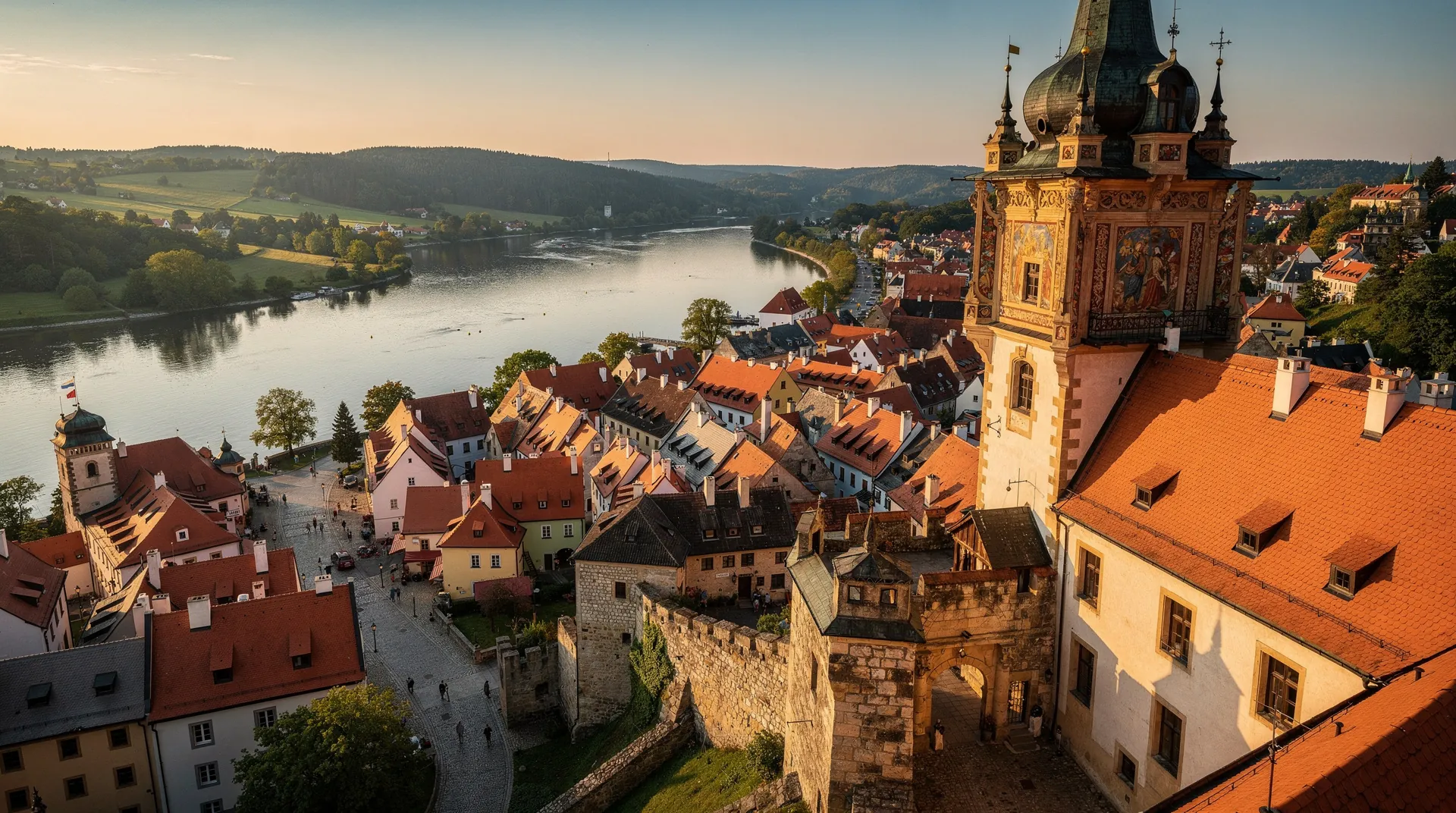
Český Krumlov is one of the most complete medieval and Baroque town environments in Central Europe. The horseshoe bend of the Vltava river below the castle complex produces one of those views that is genuinely as good as the photographs suggest. The castle itself — second largest in Bohemia — contains a 17th-century Baroque theatre with original stage machinery still intact. This is not a reconstruction. The counterweights, the wing sets, the painted drops: all original, working, and extraordinary. Nothing in Prague matches it for sheer historical vertigo.
The honest caveat is distance. At 180km south of Prague, with a bus journey of nearly three hours each way, this is a serious commitment of a day. The other honest caveat is crowds: in July and August, between 10am and 3pm, the main tourist circuit is genuinely busy. The solution is to arrive early (aim for the first castle tour at 9am) and to accept that some parts of the day will involve sharing space with a lot of other people. Neither caveat should stop you going. They should shape how you plan.
Who it suits: First-time visitors to the Czech Republic with a full free day. Anyone interested in Baroque architecture, castle history, or the specific pleasure of a medieval town that has not been modernised. Couples doing a romantic-ish day out. Who should skip it: Anyone already at day four or five of a trip who has limited bandwidth for a three-hour bus ride; anyone in July who can’t arrive by 9am.
Concrete tip: The Baroque theatre tour (Route I) books out weeks ahead in July and August. Book at zamek-ceskykrumlov.eu before you leave Prague. This is the single most important logistical step for the whole day.
Full-day Český Krumlov tour from Prague with hotel pickup — organised tours handle the driving, get you there before the coach rush, and include castle entry. Approximately €65–85 per person. Worth it specifically because they depart early enough to beat the mid-morning crowd.
#2 — Kutná Hora — 1h by train
The best day trip per unit of effort from Prague. The train from Hlavní nádraží takes just under an hour. The return fare is around €7. And what you get at the other end — the Sedlec Ossuary and St Barbara’s Cathedral in a single morning — is one of the stranger and more affecting experiences in the Czech Republic.
The Sedlec Ossuary (the Bone Church) is exactly what it sounds like: a 14th-century Gothic chapel whose interior is decorated with the bones of approximately 40,000 people. Femurs form garlands. Skulls are stacked in pyramidal towers. There is a chandelier made from every bone in the human body. It is not macabre for the sake of it — the bones date from plague victims and Hussite Wars casualties whose mass graves were excavated over centuries and eventually arranged here. It is strange, historically dense, and genuinely unlike anything else you’ll see. Entry is €4.50 / 112 CZK.
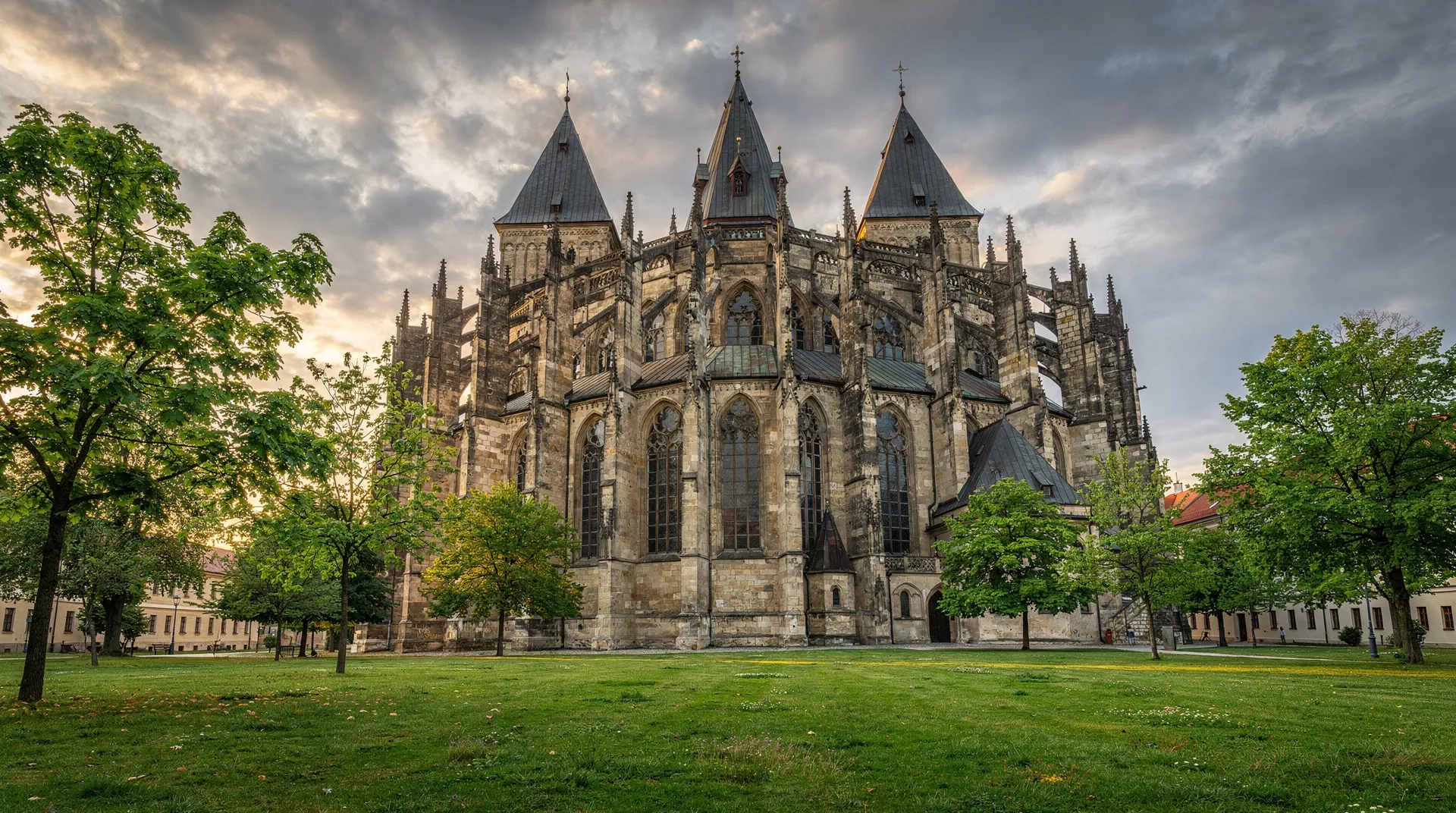
St Barbara’s Cathedral, a 15-minute walk uphill through the old town, is one of the finest Gothic churches in Central Europe — started in 1388, worked on intermittently for 500 years, and never quite finished. The ribbed vaulting of the nave, the flying buttresses viewed from outside, and the late-Gothic frescoes inside make it architecturally significant even without the bone church context. The two together fill a comfortable half-day; add a lunch in the town and an afternoon walk through the Jesuit College to the viewpoint over the valley, and you have a full day without rushing.
Concrete tip: Combine the ossuary and cathedral into a morning visit, then eat at Restaurace U Rychty or Pivovarská restaurace before the afternoon — both serve decent Czech food at local prices (€8–12 main), unlike the tourist restaurants near the ossuary entrance.
From Prague: Kutná Hora, St Barbara’s Church and Sedlec Ossuary guided tour — a guide significantly enriches both the ossuary and the cathedral; the historical context of who these people were and why they ended up here makes the experience more affecting, not less.
#3 — Bohemian Switzerland National Park — 2h by train + bus
Bohemian Switzerland is the Czech Republic’s least typical landscape: sandstone pillars rising from dense beech forest, a natural rock arch (Pravčická brána — the largest in Europe) 30 metres wide, and river gorges that make you feel you’ve been transported to Saxon Germany, which is in fact exactly where you are when you continue across the border. The national park sits in the far northwest of the country, straddling into Germany’s Saxon Switzerland.
The payoff is visual in a way that is genuinely different from anything else within two hours of Prague. If you’ve been in the city for several days and want a day that is mostly outdoors and mostly quiet, Bohemian Switzerland is the right answer. The main hiking circuit from Hřensko (the border village) to Pravčická brána and back through the Kamenice gorge takes 5–6 hours and requires comfortable shoes — it’s not difficult hiking, but it’s a real walk, with some steep sections and wet rocks near the gorge.
The honest negative: getting there independently involves a train to Ústí nad Labem and then a connecting bus to Hřensko, which works perfectly well but requires some navigation. An organised tour from Prague simplifies the logistics considerably and means you’ll spend the day walking rather than deciphering regional bus timetables.
Who it suits: Anyone who wants a day outdoors rather than in towns and museums. Hikers, photographers, people who’ve had enough cobblestones. Who should skip it: Anyone primarily interested in history and culture — there isn’t much here beyond the geology. Anyone with limited mobility; the gorge route involves boats and ladders.
Concrete tip: The Kamenice gorge boat ride (through narrow canyon, gondola-style, €4–6 each way) is the best 20 minutes in the park and shouldn’t be skipped.
Bohemian Switzerland National Park: hiking tour from Prague — transport from Prague included, guide handles the route, leaves time for both Pravčická brána and the gorge.
#4 — Karlovy Vary — 2h by bus
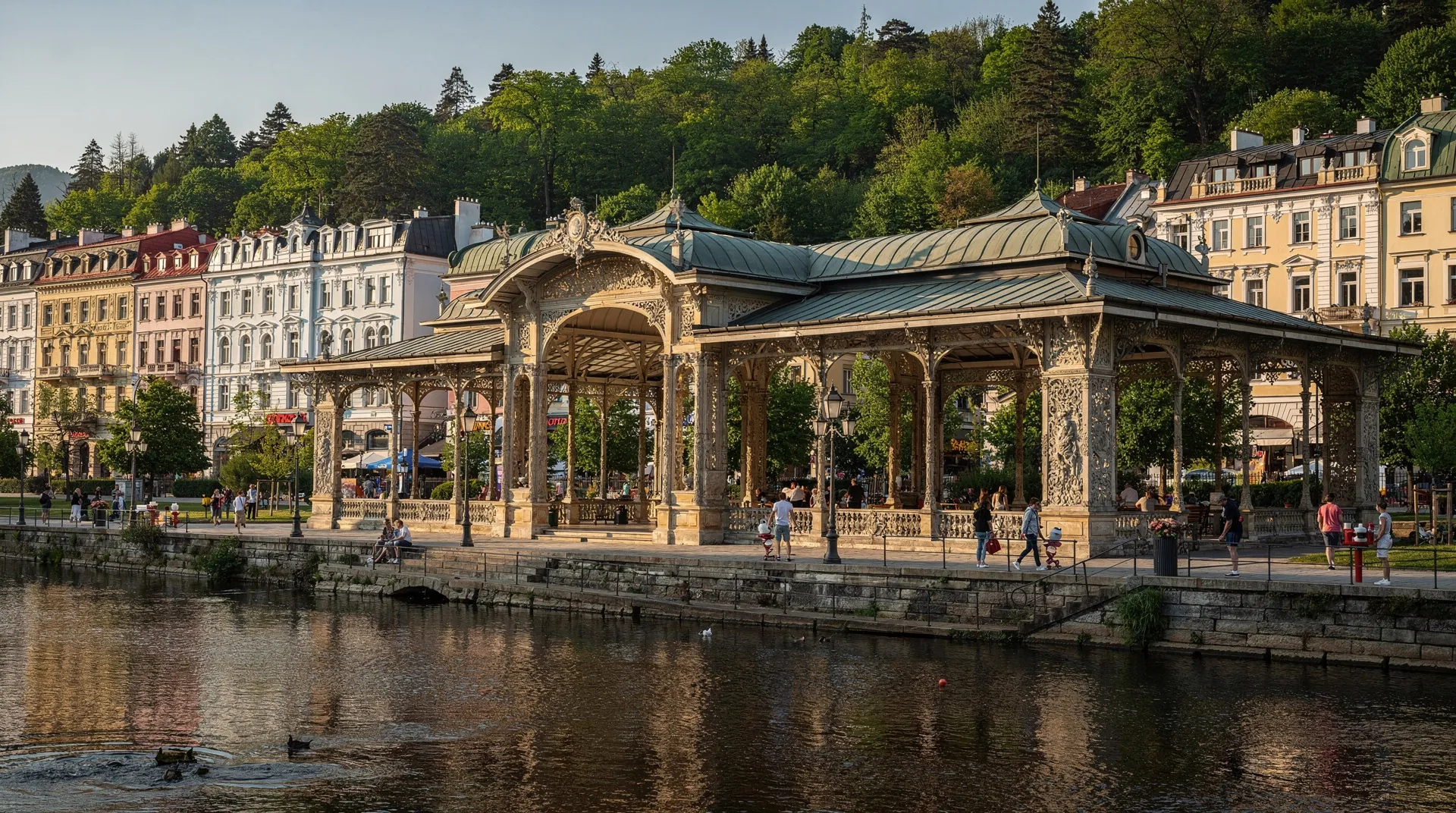
Karlovy Vary is the most architecturally coherent of the Czech spa towns and the most interesting one to visit for its built environment rather than for its spa treatments. The colonnades — long covered promenades above the Teplá river gorge — are genuinely beautiful Belle Époque architecture, and the town’s vertical topography (built in a narrow wooded valley, with stacked layers of hotels and promenades climbing the hillside) gives it a compressed, almost theatrical quality that photographs poorly but works extremely well in person.
The spa water tradition is worth engaging with honestly: the town has 12 hot springs, and the local custom is to drink the mineral water directly from one of the springs using a lázeňský pohár (spa cup, sold in every shop in town for €3–5). The water is deeply unpleasant — saline, warm, and with a sulphurous edge. You should drink it anyway. It is the specific experience of Karlovy Vary.
The Moser glass factory, 5km outside the town centre, is genuinely worth visiting if you have any interest in decorative arts — the factory has been producing luxury crystal since 1857 and the factory tour shows the mouth-blowing and cutting process. The nearby Grand Hotel Pupp (the filming location for the casino in the 2006 Casino Royale, appearing as “Hotel Splendide”) deserves a coffee on the terrace simply for the architecture.
Concrete tip: Skip the main tourist restaurants along the colonnades — overpriced and coasting on captive foot traffic. Walk 15 minutes uphill from the main colonnade to the Zámeček restaurant area for better food at half the price.
Karlovy Vary day trip from Prague with Moser Factory visit — the factory tour is a genuine addition that the independent trip requires organising separately.
#5 — Dresden — 2h 15min by train
Dresden is the only destination on this list that requires crossing an international border, and it is also the most genuinely urban option — a real city rather than a day-trip town. The Zwinger (a Baroque palace complex housing major art collections), the rebuilt Frauenkirche, and the Semperoper opera house are all within walking distance of each other in the Altstadt (old town), and the density of architectural quality within that small area is exceptional.
The context matters: Dresden’s historic centre was almost entirely destroyed in the Allied bombing of February 1945. What you see today is a combination of painstaking reconstruction (the Frauenkirche was rebuilt from original stones gathered from the rubble, a project completed in 2005) and careful new building. Knowing this as you walk through the Neumarkt square changes how you look at it — these are not old buildings; they are very good replicas of old buildings, rebuilt by a society that chose to restore rather than replace.
Getting there is straightforward: direct trains from Prague Hlavní nádraží to Dresden Hauptbahnhof run several times daily, journey time approximately 2h15, return fare around €30–50 depending on advance booking. No guided tour is strictly necessary — the Zwinger’s audioguide is excellent and the Frauenkirche can be entered freely.
Who it suits: Anyone interested in Baroque art, European history, or who simply wants to spend a day in a different kind of city. Architecture lovers. Who should skip it: Anyone exhausted by museums who wants greenery and fresh air — this is a city day.
Concrete tip: The Zwinger’s Old Masters gallery houses Raphael’s Sistine Madonna (the original) and Giorgione’s Sleeping Venus. Don’t try to see all of the Zwinger in one visit — one gallery properly is better than three hurriedly.
Dresden full-day tour from Prague — handles the transport and gives you a local guide for the Altstadt; useful if you want the history context on the reconstruction and the bombing.
#6 — Karlštejn Castle — 45min by train
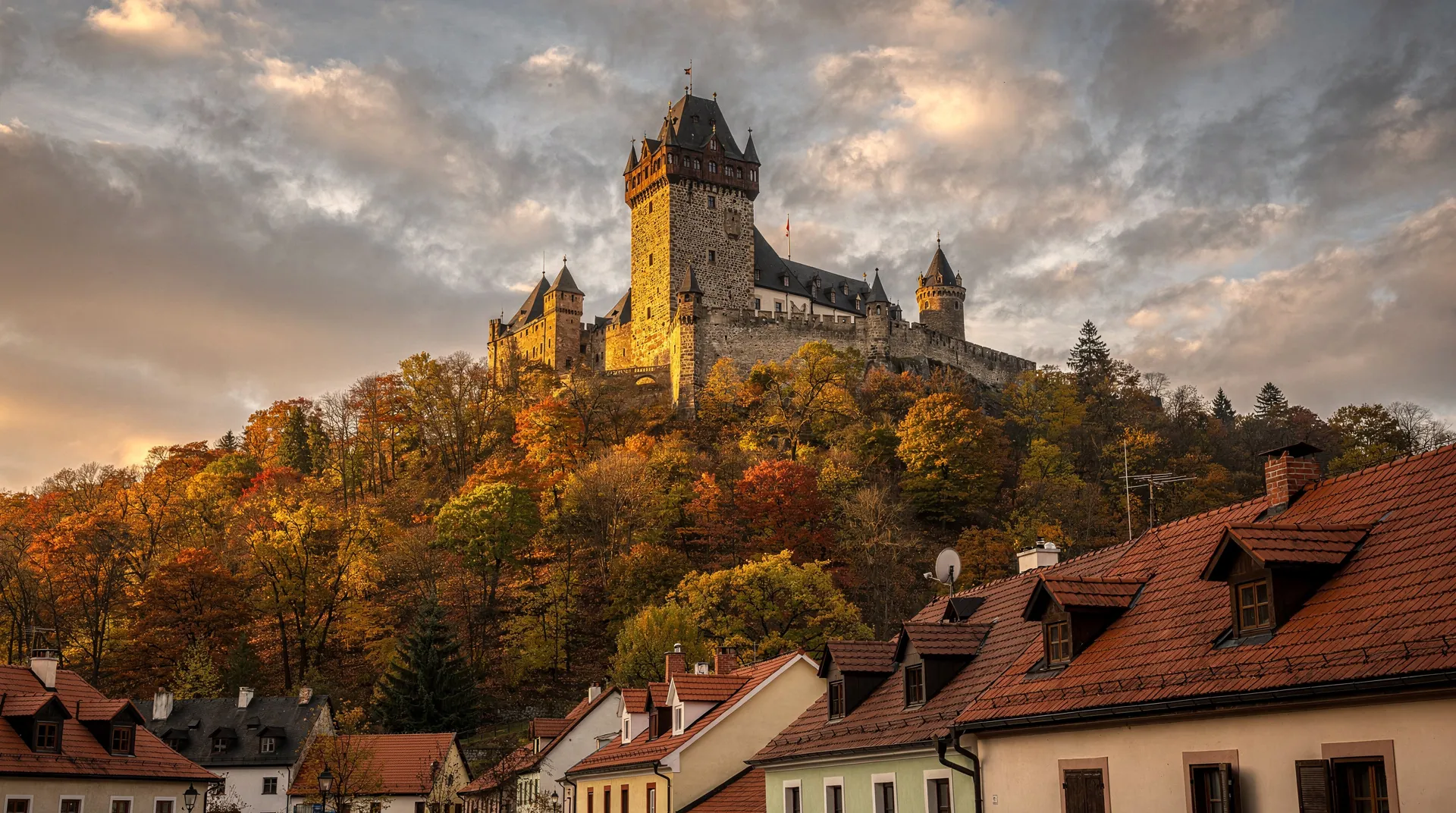
Karlštejn is the half-day option on this list, and it’s here precisely because of that format. If you have a free afternoon, or if you’re travelling with children who don’t want a full-day museum commitment, Karlštejn is the answer. The train from Prague Smíchov station takes 45 minutes, costs €3 each way, and drops you at a small village with the castle visible on the hill above you. The walk up takes 20 minutes. The castle is 14th-century, founded by Charles IV as a treasury for the Bohemian crown jewels and holy relics, and the Chapel of the Holy Cross (accessible only on the longer guided tour) has an extraordinary interior clad with gilded gypsum panels, semi-precious stones, and 130 painted panels by Master Theodoric.
The honest caveat: Karlštejn is the most heavily visited castle in Bohemia outside Prague, and the village strip between the train station and the castle gate is one continuous row of souvenir shops, trdelník stands, and tourist restaurants. This corridor is genuinely unpleasant and can be walked through quickly. The castle itself, once you’re past the gate, is considerably better.
Who it suits: People with a free afternoon rather than a full day; families with children; anyone who wants a castle visit without committing to an all-day trip. Who should skip it: Anyone expecting a pristine rural experience — the tourist village strip will disappoint.
Concrete tip: The Chapel of the Holy Cross requires the longer tour (Tour II, approximately 100 CZK more than Tour I) and is worth the additional cost. Tour I covers the exterior and the Great Tower; Tour II adds the chapel, which is the actual reason the castle exists.
From Prague: Karlštejn Castle skip-the-line ticket and tour — skips the queue at the gate, which in peak season is the difference between a 10-minute wait and a 45-minute one.
#7 — Terezín — 1h by bus
Terezín is not a pleasant day out, and it is not trying to be. It is the most important Holocaust memorial site in the Czech Republic: a garrison town 60km north of Prague that was converted by the Nazis into a transit ghetto and concentration camp between 1941 and 1945. Approximately 144,000 Jews passed through Terezín; 33,000 died there; most of the rest were transported to Auschwitz and other extermination camps. The ghetto was also used as a propaganda site, presented to Red Cross inspectors in 1944 as evidence of humane conditions in a cynically staged “inspection.”
The Small Fortress (a separate Habsburg-era prison used for political prisoners) and the Ghetto Museum together take about three to four hours. The museum is well-curated and does not soften the history. The children’s drawings and poems produced in the ghetto — now displayed in the museum — are among the most affecting documents of the period. The combination of the site itself, the museum, and the Magdeburg Barracks (which reconstructs the internal cultural life of the ghetto) constitutes a genuinely important historical experience.
Who it suits: Anyone with an interest in 20th-century European history who wants to understand what happened in the Czech Republic under the Nazi occupation. Adults and teenagers. Who should skip it: Anyone who needs a day that is restorative rather than demanding — Terezín is absorbing and serious and leaves you quiet. That’s its purpose.
Concrete tip: A guide makes a significant difference here. The context of who Terezín’s residents were, what the propaganda function of the ghetto was, and what happened after liberation — this is information that enriches what you’re looking at. The site itself does not explain everything without help.
From Prague: Terezín day tour with expert guide — the guide is genuinely worth the premium here; the historical context is layered enough that an expert interpreter changes the experience.
#8 — Pilsen — 1h 30min by train
Pilsen (Plzeň in Czech) is the fourth-largest city in the Czech Republic and the birthplace of the Pilsner style of lager. In 1842, a Bavarian brewer named Josef Groll combined Czech hops, soft Bohemian water, and bottom-fermentation yeast to produce the first Pilsner Urquell — a pale, clear, hop-forward lager that became the template for the majority of the world’s beer. The brewery that produced it has been operating continuously ever since, and the brewery tour — which includes a visit to the original underground lagering cellars and a glass poured from an unfiltered wooden cask — is one of the better industrial heritage experiences in Bohemia.
The honest caveat is that Pilsen works primarily for beer-interested visitors. The old town is pleasant — there’s a fine Gothic cathedral (St Bartholomew’s, with the tallest church steeple in Bohemia) and a handsome Republic Square — but the main draw is the brewery. If you don’t particularly want to learn about fermentation and drink very good unpasteurised Pilsner, there are more compelling destinations on this list.
The Pilsner Urquell brewery tour includes the underground tunnels where the beer was historically fermented at near-zero temperatures in enormous wooden barrels. The current production uses modern stainless-steel tanks, but one small-batch production line still uses traditional methods to maintain the original flavour profile — and the unfiltered, unpasteurised beer you drink at the end of the tunnel tour is materially different from the bottled version you can buy anywhere in Europe.
Concrete tip: Book the brewery tour at pilsner-urquell.com in advance. The English-language sessions fill up on weekday mornings when coach tours arrive. The afternoon session (usually around 2pm) is typically quieter.
Pilsen: Pilsner Urquell Brewery tour with beer tasting — includes the underground cellars and the unfiltered cellar beer; the standard version of the tour you want.
#9 — Český Krumlov + České Budějovice combo — full day by tour
This combination appears separately because it functions as a different kind of trip from Český Krumlov alone. České Budějovice (Budweis) is 22km from Krumlov — the Czech city whose brewery gave the world “Budweiser” before the American brand appropriated the name. The Budvar brewery (which legally still produces the original Budweiser in most European markets) offers a brewery tour that, combined with Krumlov, makes for a day that is coherent rather than scattered.
The honest reality is that this combination is genuinely rushed if you try to do both destinations justice. Doing it as an independent trip — bus from Prague to Krumlov, afternoon bus to Budějovice, train back to Prague — produces a day of checking connections and moving between places without settling into either. The organised tour version is meaningfully better here because someone else is managing the logistics and the timing is designed to give reasonable time at each stop.
České Budějovice itself is primarily worth visiting for its main square (one of the largest in Bohemia, surrounded by Baroque facades) and the Budvar brewery. The wax museum and the Black Tower can be safely skipped.
Concrete tip: If you’re doing this combination independently, reverse the route: take the morning bus to České Budějovice, do the brewery tour at noon, then bus to Krumlov for a late afternoon visit, and take the evening bus back to Prague. You arrive in Krumlov when the worst of the midday crowds have gone.
From Prague: Český Krumlov and České Budějovice day trip — handles the Krumlov-to-Budějovice transfer and ensures both stops get enough time.
#10 — Konopiště Castle — 1h by train + bus
Konopiště sits at the bottom of this list not because it’s underwhelming but because it requires knowing what you’re coming for. The castle was the private estate of Archduke Franz Ferdinand of Austria — the heir to the Austro-Hungarian throne whose assassination in Sarajevo in June 1914 triggered the First World War. He bought Konopiště in 1887 and spent two decades obsessively modifying it, hunting the surrounding estate (the castle displays over 100,000 hunting trophies — tens of thousands of them personally shot by Franz Ferdinand), and collecting arms and armour.
The result is one of the most peculiar castle interiors in Bohemia: extraordinary Neo-Gothic rooms filled with ranks of stuffed animals, cases of weapons, and the personal effects of a man who was one of the last Habsburgs and would be dead by 28 June 1914. If you find yourself drawn to fin-de-siècle Central European history, the Habsburg dynasty, or the specific circumstances of a world about to destroy itself, Konopiště is quietly extraordinary. The rose garden (one of the finest in Bohemia) and the bear moat are additional draws.
Getting there requires a train to Benešov (55 minutes, €5 each way) then a bus or a 2.5km walk to the castle. The walk through the castle park is pleasant; the bus is easier.
Concrete tip: Tour Route III (the private apartments) is the most interesting interior circuit and includes Franz Ferdinand’s personal library, the arcade gallery, and the rooms exactly as he left them in June 1914. Book this tour specifically — Routes I and II are the standard ones advertised and are less personal.
Konopiště: Chateau tour from Prague — includes transport and covers the castle history with the First World War context that makes Franz Ferdinand’s story land properly.
What we left off and why
Olomouc — an architecturally lovely city with one of the best Baroque plague columns in Europe. The problem is that it’s 2.5 hours each way by train. That’s 5 hours in transit for a city that most visitors can cover in 3–4 hours. It works as an overnight stop on the way to or from Brno; it doesn’t justify a day trip.
Brno — the second city of the Czech Republic, genuinely interesting and much less touristy than Prague. Same problem as Olomouc: 2h 30min each way by train, which eats most of a day before you’ve seen anything. If you have two days spare, Brno is worth a proper overnight visit.
Liberec — pleasant, has a decent botanical garden and the Ještěd Tower, neither of which requires 1h 45min of transit to reach. Skip it unless you’re specifically interested in Communist-era architecture.
Lednice-Valtice — genuinely beautiful UNESCO landscape in South Moravia, with a Romantic-era castle, formal gardens, and minaret in the middle of a flat agricultural plain. Absolutely worth visiting; hopelessly impractical as a day trip from Prague at 2h 45min each way by train.
Hluboká nad Vltavou — a Neo-Gothic château 10km north of České Budějovice that looks like a Welsh fantasy of Windsor Castle. Worth combining with a Český Krumlov overnight if you have a car. Not worth a separate day trip.
How day trips fit into a longer Prague itinerary
If you’re mapping this against a full trip, our 4-day Prague itinerary and 5-day Prague itinerary both assume one day trip slotted in — the shorter 3-day itinerary generally doesn’t have room for one without cutting the city short. For the logistics question that comes up constantly — train, bus, or organised tour — our dedicated day trip comparison and by train vs bus vs tour breakdowns go deeper than we can here.
Two of the rankings above have their own dedicated guides worth reading before you book: Kutná Hora vs Karlštejn for one day if you’re torn between the two, and Český Krumlov: is it worth it? if you want the longer, unranked case for and against. If timing is the deciding factor, check the best time to visit Prague — several of these destinations (Bohemian Switzerland especially) reward a specific season more than others. Families should also see our dedicated day trips with kids guide, which reorders this list by what actually works for children.
FAQs
How far in advance should I book a day trip from Prague?
For Český Krumlov in summer, book 1–2 weeks ahead minimum — the castle baroque theatre tour sells out weeks in advance in July. Kutná Hora, Terezín, and Karlštejn tours can usually be booked 2–3 days out. Guided tours generally depart earlier than public transport, which improves your day significantly.
Which day trip from Prague requires the least planning?
Karlštejn. The train from Prague Smíchov takes 45 minutes, the castle is visible from the station, and the half-day format means you can decide the morning of. No advance bookings are strictly required outside July–August peak weekends.
Can I do two destinations in one day?
Realistically, only the Český Krumlov + České Budějovice combo works as a designed itinerary (they’re 22km apart), and even that is rushed if you try to do both justice. The Konopiště + Karlštejn combination is also available as a single guided day trip. For everywhere else, trying to combine two destinations produces a day of rushing between bus stops.
Which day trips are best with children?
Karlštejn (short, visual, genuine castle) and Konopiště (bear moat, hunting trophy rooms, atmospheric park) are the most reliably child-friendly. Kutná Hora works for children over 10 who can handle the ossuary. Bohemian Switzerland’s gorge boats are popular with children. Terezín is serious history — appropriate from around 13 onwards, and powerful for teenagers.
What’s the cheapest day trip from Prague?
Kutná Hora by train costs about €7 return and the ossuary entry is €4.50. You can have a complete, memorable day for under €20 including lunch. Karlštejn is similarly cheap. Český Krumlov and Dresden cost significantly more by the time you add transport and entry fees.
Is a guided tour worth the premium over going independently?
For Český Krumlov (logistics and castle timing genuinely benefit from a guide) and Terezín (context matters enormously to the experience), yes — the premium is justified. For Kutná Hora, Karlštejn, and Karlovy Vary, an independent trip on public transport is perfectly manageable and noticeably cheaper. Dresden works well independently since the Zwinger has excellent audioguides.