| At a glance | |
|---|---|
| Where | Central Bohemia, 30 km southwest of Prague |
| Cost (DIY) | around €15–25: train + Tour Route I and/or II |
| Cost (tour) | around €35–55 including transport and often a guided circuit |
| Time needed | half a day (2.5–4 hours on site, plus travel) |
| Getting there | direct train from Prague Smíchov, 38–45 minutes; do not drive up (village road closed to cars) |
| Best time | May, June, September for full tour access with manageable crowds |
Charles IV and the imperial treasury fortress
Karlštejn was built between 1348 and 1365 at the direct commission of Charles IV (Karel IV), Holy Roman Emperor and King of Bohemia, one of the most powerful rulers in medieval European history. The castle’s explicit purpose was not residence but security: it was built to house the Bohemian Crown Jewels, the imperial regalia of the Holy Roman Empire, and a collection of holy relics that Charles had assembled over his lifetime — fragments of the True Cross, the Crown of Thorns, and relics of numerous saints.
The castle rises in three defensive stages that correspond to increasing holiness and security: the Lower Castle (imperial residential wing), the Middle Tower (Church of Our Lady and Chapel of St. Catherine), and the Great Tower (the Chapel of the Holy Cross, where the crown jewels were kept). This vertical hierarchy was intentional — the holiest objects were literally the most protected, at the highest and most fortified point.
The Chapel of the Holy Cross, completed around 1365, is the most extraordinary space. Its walls are set with approximately 2,200 semi-precious stones (amethyst, jasper, cornelian, chalcedony) that were meant to represent the Heavenly Jerusalem from the Book of Revelation. The 129 panel paintings by court painter Master Theodoric (created between 1357 and 1367) are among the finest examples of 14th-century Central European painting — serene, individuated saints that anticipate the realism of the following century.
The 19th-century neo-Gothic restoration (1887–1899), directed by architect Josef Mocker, replaced most of the medieval residential interiors with Romantic reconstruction. This is the source of the frequently noted “disappointment” with Karlštejn’s interiors — visitors expecting authentic medieval rooms find Victorian recreation. The Chapel of the Holy Cross is the exception: its 14th-century art survived and dominates.
Why Karlštejn is the easiest castle day trip from Prague
At 30 km from Prague, Karlštejn isn’t really a day trip in the traditional sense — it’s more like a very long morning. The direct train from Prague Smíchov takes 40 minutes, costs almost nothing, and deposits you at a small station from which the castle is a 20-minute uphill walk through a village selling wine and crystal.
The castle itself is one of the best-preserved Gothic fortresses in Central Europe. Charles IV had it built between 1348 and 1365 as a repository for the Bohemian Crown Jewels and the imperial regalia — the treasures of the Holy Roman Empire. The architecture reflects this purpose: the castle rises in three distinct defensive stages, each more fortified than the last, culminating in the Great Tower where the crown jewels were kept.
The interiors are almost entirely 19th-century neo-Gothic restoration, which is worth knowing before you go. The current appearance owes more to Romantic reconstruction than to Charles IV. The exception is the Chapel of the Holy Cross in the Great Tower — largely preserved from the 14th century, with walls encrusted with semi-precious stones and 129 panel paintings by the Czech court painter Master Theodoric. This chapel requires a separate, pricier ticket and must be booked in advance; it’s the best reason to visit Karlštejn beyond the exterior and setting.
How to get there
By train
The best option by far. Trains depart from Prague Smíchov (not the main station) roughly every 1–2 hours. Journey time: 38–45 minutes. Price: around 50–60 CZK one way (€2). Book at cd.cz or buy at the station — this is genuinely cheap.
Prague Smíchov is on metro line B (Anděl station, then 5-minute walk, or Smíchovské nádraží station directly). The journey through the Berounka valley is scenic.
From Karlštejn station, it’s a flat 3-minute walk to the village, then a 15–20 minute walk uphill to the castle entrance. The path is well-paved and has tourist shops on both sides.
By car
Prague to Karlštejn via Route 4 south then Route 116: about 35–40 minutes. Parking is available in the village, but the road up to the castle is closed to private vehicles — you walk the same uphill path. Useful if combining with the Koněprusy Caves nearby.
By organised tour
Half-day tours from Prague make sense if you want a guide for the castle interiors or prefer not to manage the train. Several good options, including tours that combine Karlštejn with Konopiště or the Koněprusy Caves.
Half-day and full-day tours from Prague to Karlštejn Castle:
Hour-by-hour day plan (9 a.m. to 3 p.m.)
9:00 a.m. — Train from Prague Smíchov. Platform varies; check the departure board. Buy the ticket at the automated machine (accepts cards) — approximately 50–60 CZK (€2) one way. The 40-minute ride through the Berounka valley is already scenic.
9:40 a.m. — Arrive at Karlštejn station. Flat 3-minute walk to the village entrance. The castle is visible above the trees from here.
9:45–10:05 a.m. — Village walk uphill. The main path (Karlštejn village high street) takes 15–20 minutes at a normal pace. Stop at any of the wine stalls for a glass of local Berounka valley white wine (50–80 CZK / €2–3) on the way back down — not on the way up.
10:05 a.m. — Castle entrance and ticket desk. Buy Tour Route I at the door if you haven’t pre-booked (advisable in summer); confirm your pre-booked Tour Route II slot if you’ve reserved it.
10:30 a.m.–11:30 a.m. — Tour Route I (Imperial Palace, guided, 60 min). Hall of Charles IV, Church of Our Lady, Chapel of St. Catherine. The guide is obligatory — no self-guided access to the interior. English tours run at set times; check hrady.cz for the schedule.
11:30 a.m.–12:30 p.m. — Tour Route II (Great Tower with Chapel of the Holy Cross, guided, 60 min). If you’ve pre-booked this slot, it is the primary reason to come. The chapel interior is extraordinary — semi-precious stone inlays, Theodoric panel paintings. Groups are limited to 12 visitors. Worth every one of the 600 CZK (€24).
12:30–1:30 p.m. — Lunch at Restaurace Koruna (castle approach path, main street). Roast pork, goulash, Czech soups. Terrace views. Around €8–12 (200–300 CZK).
2:00 p.m. — Optional: Koněprusy Caves (6 km by car or tour van). If you’ve rented a car or are on the combined tour, this is a 90-minute detour to the largest cave system in Bohemia.
2:30–3:00 p.m. — Walk back down to the station, train to Prague Smíchov. Trains run approximately every 1–2 hours; check cd.cz for the return schedule.
Photography notes
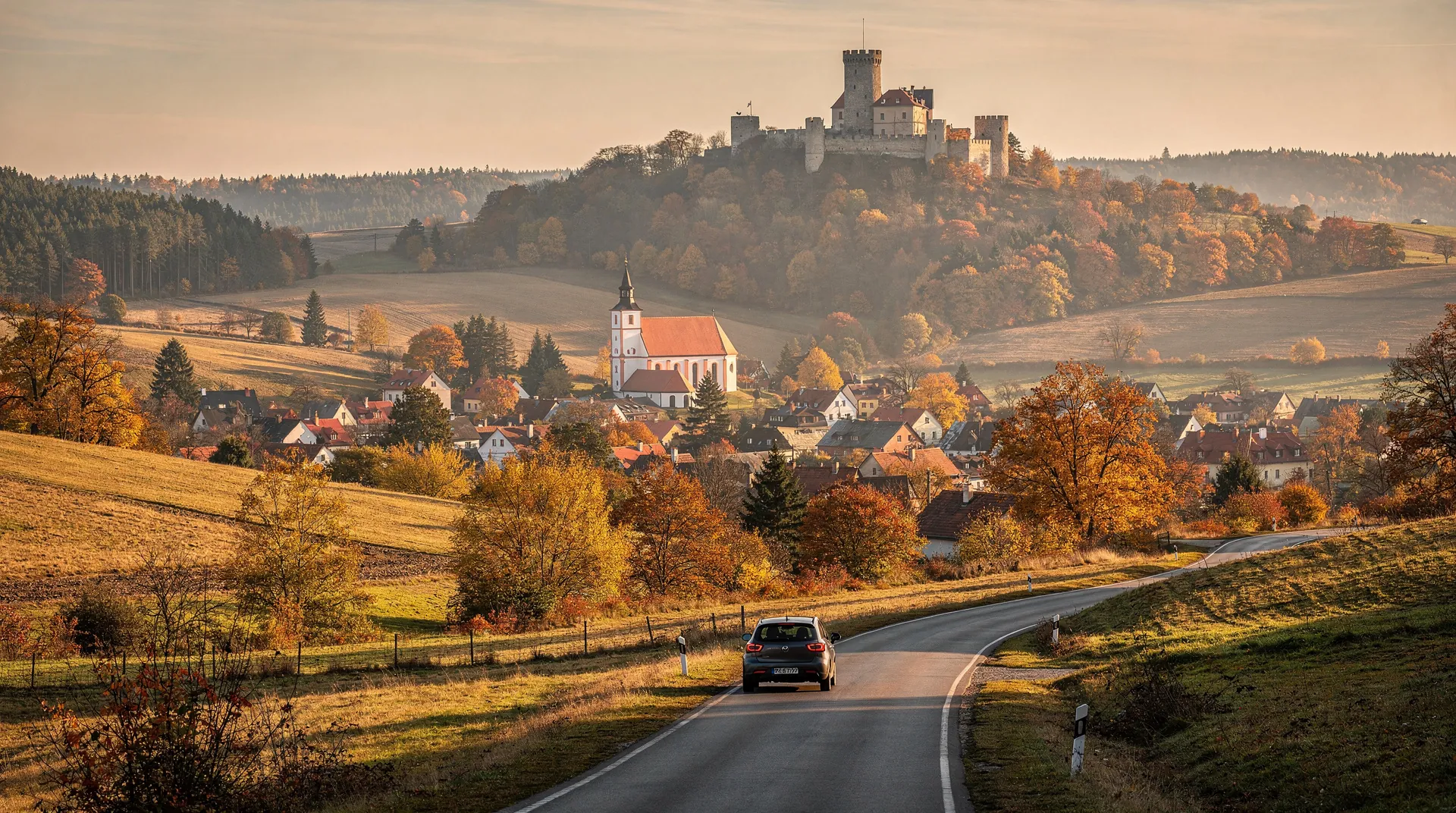
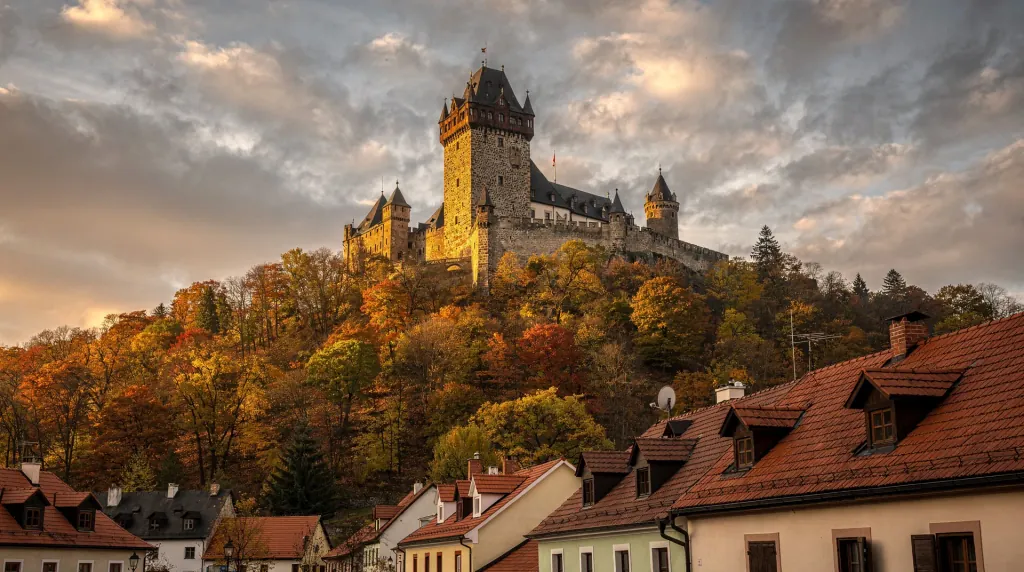
Castle exterior from the village path looking up (best 9–10 a.m.): The classic angle — the Gothic towers rising from the forest against the sky. Shoot from the middle of the path for the three-tower composition. Morning light is from the east (catches the towers).
Castle from across the Berounka valley (afternoon, 2–4 p.m.): Cross the small bridge below the village and walk south 200 metres for the full castle silhouette against the forested hillside. This is the widest and most complete view.
Chapel of the Holy Cross interior: Photography is restricted inside the chapel. Some tour groups are permitted limited photography — confirm with the guide. Flash is prohibited. The semi-precious stone walls are difficult to photograph well in any case.
Village stalls and crystal shops: The Berounka valley crystal and Bohemian glass stalls provide colourful foreground subjects with the castle as backdrop.
What to see, realistically
Castle exterior and grounds (free, 45 minutes). You don’t need to buy a ticket to walk up to the castle and see the exterior. The views from the village path up to the gates, and the views back over the Berounka valley, are the most photographed aspect of Karlštejn — and they’re free. If you’re short on time or budget, this alone is pleasant.
Tour Route I — Imperial Palace (1 hour, approximately 310 CZK / €12). The main guided tour covers the residential apartments: the Hall of Charles IV, the Church of Our Lady, and the Chapel of St. Catherine (Charles IV’s private oratory). All are neo-Gothic restorations with some authentic medieval elements. English guided tours run at set times — check the schedule on hrady.cz and arrive early enough to secure a spot.
Tour Route II — Great Tower with Chapel of the Holy Cross (1 hour, approximately 600 CZK / €24). This is the important one, but it requires advance booking at hrady.cz — visitor numbers are strictly limited to protect the medieval paintings. The Chapel of the Holy Cross has 129 panel paintings by Master Theodoric from the 1360s, an extraordinary collection of 14th-century art. The walls are studded with semi-precious stone inlays. It is unlike any other space in Bohemia.
If you only have time or budget for one tour circuit, choose Route II if you can get a booking; otherwise Route I.
Koněprusy Caves (6 km from Karlštejn, 1.5 hours). The largest cave system in Bohemia, discovered in the 1950s. If you’ve rented a car or are on the combined Karlštejn and Koněprusy Caves tour, this is a worthwhile add-on. Entry around 200 CZK (€8).
Where to eat
The village of Karlštejn has several restaurants catering primarily to day-trippers. Quality varies but prices are honest.
Restaurace Koruna (Karlštejn village, on the main path): Straightforward Czech food — pork knuckle, svíčková, fried carp — at around €8–12 (200–300 CZK) per main. Terrace with views. Good for a post-castle lunch.
Café U Janů (lower village): Coffee, cake, and cold drinks. Good for a break before or after the climb.
Wine stalls in the village: The Berounka valley is wine-growing country. Small local wineries set up stalls in the village selling Czech wine by the glass — around 50–80 CZK (€2–3). Worth trying.
Common mistakes and what we’d do differently
Not pre-booking Route II (Chapel of the Holy Cross). This is the best thing in the castle, has very limited daily visitor slots, and sells out weeks in advance in summer. Book at hrady.cz as soon as you know your dates.
Going in July or August without a plan. The village path becomes genuinely crowded in peak season and the tour slot times fill. Go earlier in the day, or visit in May, June, or September.
Expecting medieval interiors throughout. The castle interior is almost entirely 19th-century restoration. If you’re expecting to see the authentic medieval rooms that Charles IV would have recognised, manage your expectations — the exception is the Chapel of the Holy Cross.
Tour vs DIY — which to choose for Karlštejn
Book a guided tour if:
- You want to combine Karlštejn with Konopiště or the Koněprusy Caves in one day without managing connections
- You want a guide for the castle interiors
- You prefer having transport from Prague organised
Go on your own if:
- You’re happy with the cheap, frequent train from Smíchov
- You want maximum flexibility on timing (trains run every 1–2 hours return)
- You’re combining the visit with a walk in the Berounka valley
Our recommendation: Karlštejn is the simplest independent day trip on this list. Train from Prague Smíchov, walk up, see the castle, walk back, train home. Pre-book Route II if you want the Chapel of the Holy Cross. For a combined castle day with Konopiště, see the Konopiště and Karlštejn combo guide.
For visitors who want a more unique experience, the fairytale Karlštejn Castle trip in a retro-style vintage car is genuinely different — you travel from Prague to Karlštejn in a classic car, which turns the journey itself into an experience.
Ideal for couples or anyone who wants the aesthetic of the day to match the medieval castle destination. The Karlštejn Castle and Crystal Manufactory private tour combines the castle with a visit to a Bohemian crystal workshop in the same day — useful if you want to see traditional Czech glassmaking as well as the castle.
Season-specific notes
January–March: The castle grounds are open, but tour routes have severely reduced availability — Route II (Chapel of the Holy Cross) may be suspended entirely. Check hrady.cz before visiting in winter. The village is quiet and the walk up has a different, starker quality.
April–May: Full access from April. May is ideal: spring flowering, manageable crowds, and the full range of tour slots available. Weekdays in May are almost entirely crowd-free.
June–August: Peak season. Route II (Chapel of the Holy Cross) books out weeks in advance. Route I can also sell out on summer weekends — book online at hrady.cz. The village path is genuinely crowded by 11 a.m. Arrive on the first train of the day (approximately 8–9 a.m. from Smíchov).
September–October: Excellent. Crowds drop after school starts in September. Autumn light on the Berounka valley forest surrounding the castle is outstanding. October often has the best visibility for photography. Route II remains available but the season closes in late October.
Karlštejn versus other Central Bohemia castle day trips
Karlštejn is the closest and easiest castle day trip from Prague, but it isn’t the only one, and it isn’t right for everyone. Here’s how it stacks up:
| Castle | Character | Time from Prague | Best for |
|---|---|---|---|
| Karlštejn | Gothic fortress, Crown Jewels history, mostly 19th-century interiors | 40min by train | Shortest half-day castle trip, dramatic exterior |
| Konopiště (full guide) | Late-Romantic aristocratic residence, Franz Ferdinand’s home | ~50min by train | Personal history, WWI connection, authentic interiors |
| Kutná Hora | Gothic cathedral town, medieval silver-mining heritage, Bone Church | ~1h by train | Cathedral architecture and a genuinely macabre ossuary |
For a direct comparison of Kutná Hora against Karlštejn, see the Kutná Hora vs Karlštejn one-day comparison. And if you want to fold Konopiště into the same day as Karlštejn, the dedicated Konopiště and Karlštejn combo guide covers exactly that logistics puzzle.
Getting the most from a short window in Central Bohemia
Because Karlštejn is so close to Prague, it’s tempting to treat it as an afterthought squeezed between other plans. It rewards a bit more intention than that. If you’re deciding how to structure a wider Central Bohemia day, the full day-trip comparison table lines up Karlštejn against every other option from Prague, and the train vs bus vs tour guide is useful if you’re unsure whether the train, a rental car, or a guided tour makes more sense for your itinerary.
If Karlštejn is one stop on a longer Prague stay, the Prague destination guide and the 3-day Prague itinerary help slot a half-day trip like this one into a wider plan without over-scheduling.
Frequently asked questions about Karlštejn Castle
Is Karlštejn Castle worth visiting?
Yes, particularly if you have even a passing interest in Gothic architecture or the Czech medieval period. The exterior is genuinely dramatic, the village approach is scenic, and the Chapel of the Holy Cross is exceptional. It’s also the closest castle day trip from Prague by far.
Is there a direct train from Prague to Karlštejn?
Yes — from Prague Smíchov (metro line B), no change required, 38–45 minutes. Trains run throughout the day. This is the recommended way to visit independently.
Do I need to book castle tours in advance?
For Tour Route I, it’s advisable in summer but not always essential — you can often buy tickets at the door. For Route II (Chapel of the Holy Cross), advance booking is essential in high season. Book at hrady.cz.
Is Karlštejn Castle open in winter?
The castle grounds are accessible year-round but tour routes have limited availability November–March. The Chapel of the Holy Cross tour is sometimes suspended in winter. Check hrady.cz for current seasonal schedules before visiting between October and April.
How long does a visit take?
The uphill walk from the train station: 20 minutes. Tour Route I: 1 hour. Tour Route II: 1 hour. Add time for the exterior and grounds. Total: 2.5–4 hours depending on which tours you take. A perfect half-day trip.
Can I combine Karlštejn with Konopiště in one day?
Yes — the Konopiště and Karlštejn combo page covers this specifically. The easiest way is the dedicated Konopiště and Karlštejn full-day tour from Prague, which handles transport between both castles.
Is the village path stroller-accessible?
The village path is paved cobblestone — manageable with a sturdy stroller but not smooth. The castle itself has steep sections inside the gate that are not stroller-accessible. Bring a baby carrier for anyone planning to enter with an infant or toddler.
Are there public toilets at Karlštejn?
Yes — at the castle entrance (included with ticket) and in the village restaurants. The village has public facilities near the bottom of the path approximately 200 metres from the station.
What is the Český Šternberk combination?
Český Šternberk Castle, 40 km southeast of Karlštejn, is a 13th-century Gothic and Baroque castle above the Sázava river — well-preserved, far less visited than Karlštejn, and often preferred by people who want an authentic medieval atmosphere without tourists. The two castles can be combined by car in one day from Prague (Karlštejn in the morning, Český Šternberk in the afternoon). No GYG tour covers this specific combination; it requires independent driving.
Is Karlštejn better than Konopiště?
They’re not really comparable — Karlštejn is a Gothic fortress with the more dramatic exterior and setting, while Konopiště is a lived-in aristocratic residence with a far more personal, human story. Most visitors who’ve done both prefer Karlštejn for the scenery and Konopiště for the story. If you can only do one, choose based on which draws you more; if you have a full day and a car, the combo guide covers doing both.
Practical info
- Distance from Prague: 30 km southwest
- Travel time: 38–45 min by train from Prague Smíchov
- Tour Route I: ~310 CZK (€12); English-language guided tours at set times
- Tour Route II (Chapel of the Holy Cross): ~600 CZK (€24); advance booking essential
- Opening hours: Apr–Oct daily 9 a.m.–5 p.m. (last tour earlier); Nov–Mar limited
- Booking: hrady.cz
- Best time: May–June, September