| At a glance | Kutná Hora | Karlštejn |
|---|---|---|
| Where | 70km east of Prague | 28km southwest of Prague |
| Cost (main sights + lunch) | Around €25–35 / 625–875 CZK | Around €15–22 / 375–550 CZK |
| Time needed | Half-day to full day | Half-day |
| Getting there | Direct train from Hlavní nádraží, around 1 hour | Direct train from Hlavní nádraží, around 40 minutes |
| Best time | Weekday morning, arrive at ossuary opening | Weekday morning, before 11am in summer |
The Sedlec Ossuary at 08:02 in October
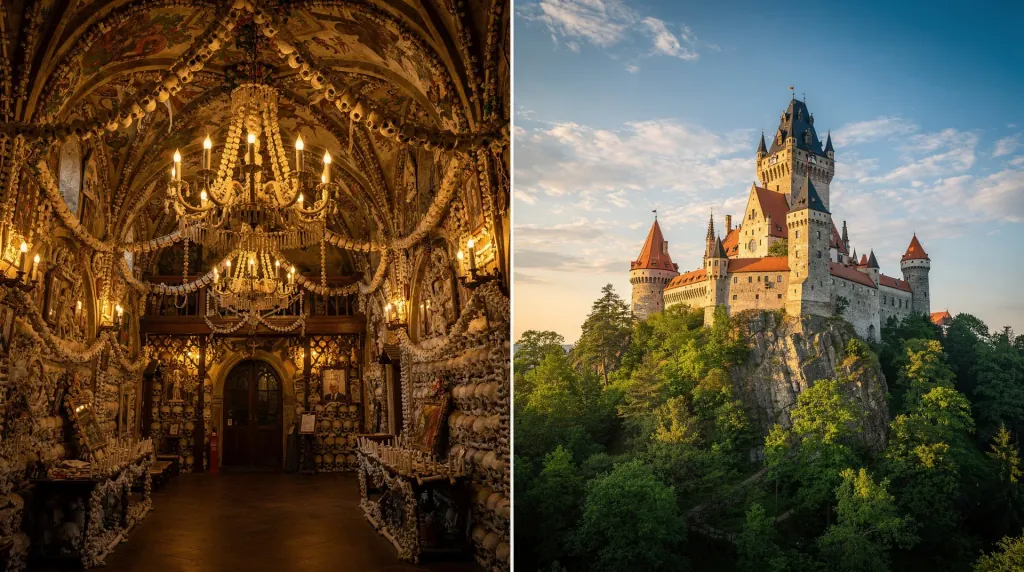
We arrive at the ossuary before the ticket office is fully staffed. A woman in a fleece jacket is setting up the card reader; the interior is already open. We are the second visitors through the door. The space is very quiet and slightly cold, and for about eight minutes we have it to ourselves — the chandelier made of skulls, the Schwarzenberg coat of arms made of bones, the garlands of femurs along the walls. Then a tour group arrives, Dutch, with a guide speaking rapidly in English, and the atmosphere shifts from the reverently strange to the museum-casual.
Those eight minutes at the ossuary without crowds is the argument for going early on a weekday. It is also the argument for Kutná Hora over Karlštejn: no comparable moment exists at Karlštejn, because Karlštejn’s best content is locked behind advance-booking requirements that reduce the spontaneous visit to exterior photography.
The question comes up constantly: Kutná Hora or Karlštejn?
Both towns are within 70km of Prague. Both are accessible by direct train from Hlavní nádraží. Both are heavily photographed. And if you have only one free day for a day trip — which most city-break visitors do — you need to pick one.
Here is our honest comparison after multiple visits to both.
What Kutná Hora actually is
Kutná Hora is a medieval silver-mining town about 70km east of Prague, accessible by direct train in approximately 1 hour. At its peak in the 14th century, it was the second most important city in Bohemia — the silver from its mines funded the Bohemian crown, built the Cathedral of St. Barbora, and made it a genuine European power centre for about 150 years.
The historical main draw is the combination of three sites within easy walking distance of each other:
The Sedlec Ossuary (Kostnice) — popularly known as the Bone Church — is the single most-visited thing in Kutná Hora and one of the more remarkable spaces in Central Europe. It is a small Gothic ossuary where the bones of approximately 40,000–70,000 people (estimates vary) have been arranged into decorative structures by the artist František Rint in 1870. There are bone chandeliers, bone coats of arms of the Schwarzenberg family, and garlands of skulls. It is strange, beautiful, and deeply unusual. Entry is around €4 / 100 CZK.
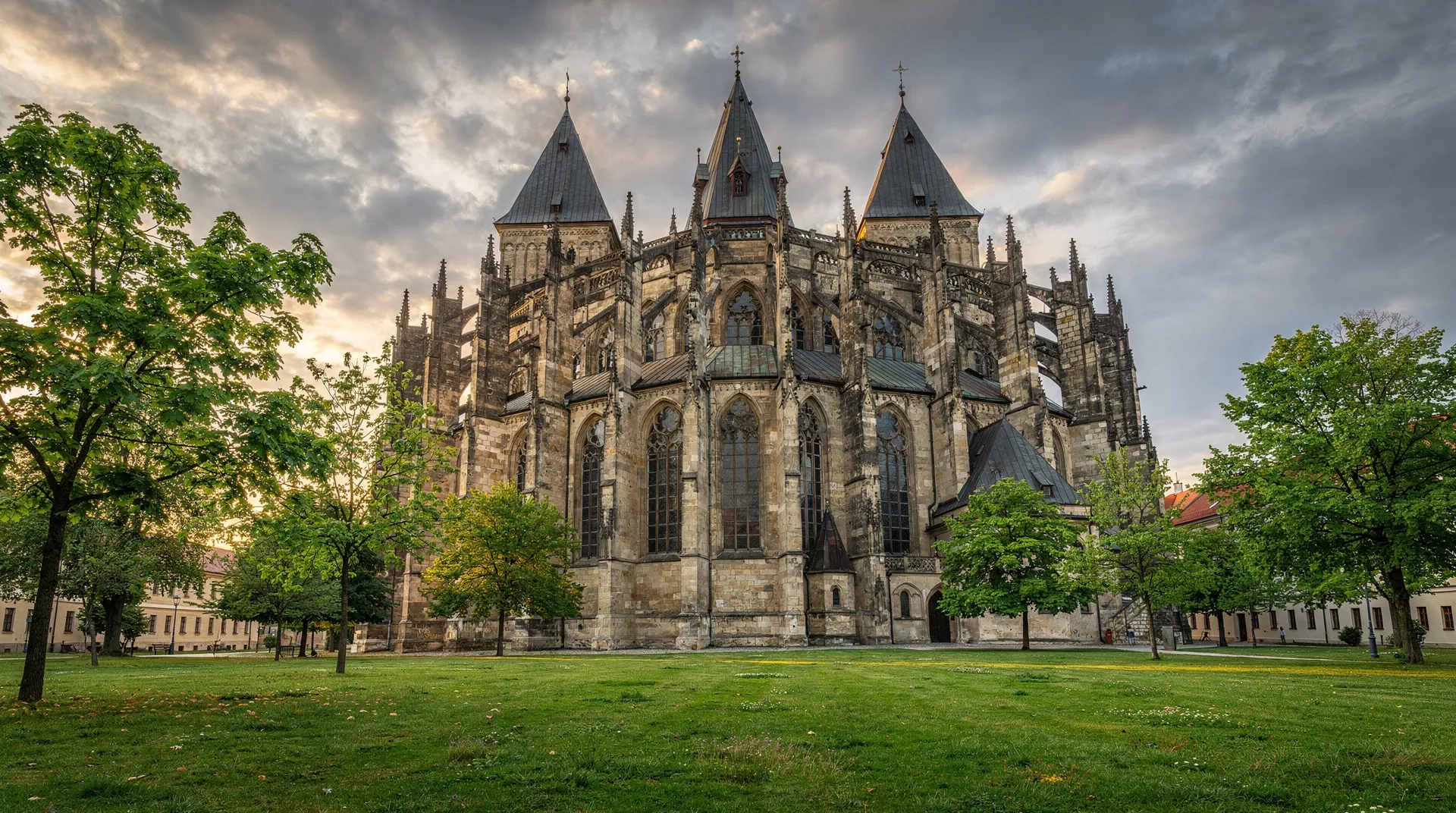
St. Barbora’s Cathedral (Chrám svaté Barbory) is a late Gothic cathedral that took 500 years to build (started 1388, consecrated 1905) and is one of the outstanding Gothic church interiors in Central Europe. The nave, the flying buttresses, the late Gothic ceiling vaulting, and the painted scenes from the medieval mining trade are all extraordinary. Entry is around €3 / 75 CZK.
The Jesuit College and Italian Court are worth seeing from the outside. The Italian Court (Vlašský dvůr) was the original Bohemian mint — where the Prague Groschen silver coin was minted. Tours of the interior are available.
The town itself has a genuine historic centre with good restaurants and a non-touristy atmosphere beyond the immediate ossuary area. If you would rather not organise the trip yourself, this guided tour to Kutná Hora covers the main sights with a guide.
What Karlštejn actually is
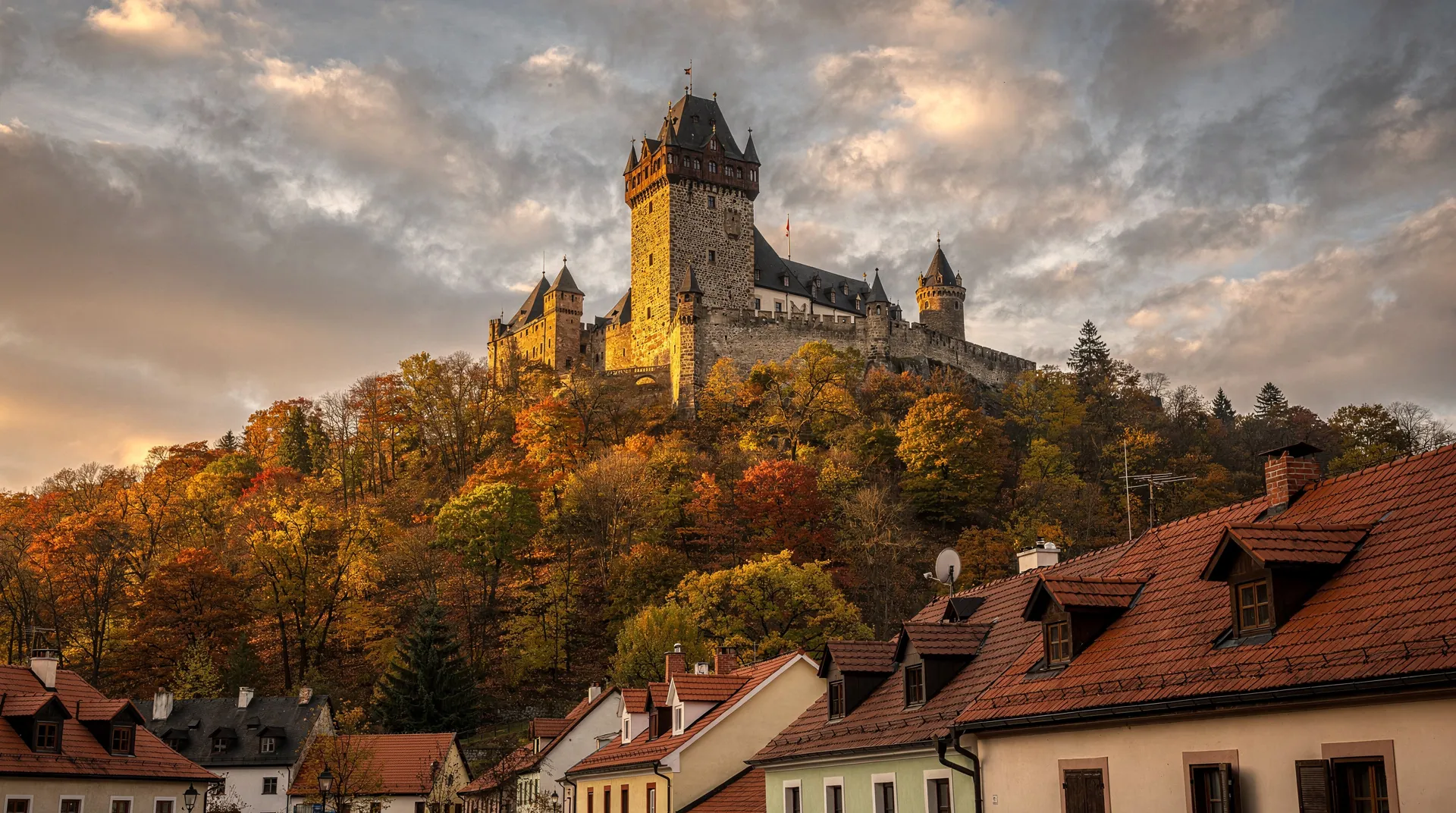
Karlštejn is a Gothic castle 28km southwest of Prague, built by Emperor Charles IV starting in 1348 as a repository for the Crown Jewels of the Holy Roman Empire and royal relics. It sits on a prominent promontory above the Berounka River valley and is one of the most-photographed castles in the Czech Republic.
The train from Hlavní nádraží takes approximately 40 minutes and drops you in the village of Karlštejn, from which a 20-minute uphill walk leads to the castle gates.
The castle’s exterior is dramatically photogenic — it is the classic “Central European gothic castle on a hill” that appears on Czech tourism imagery constantly. The interior access is more limited: the main areas require a guided tour, and the most important interior (the Chapel of the Holy Cross, containing the original altarpieces by Master Theodoric) requires a separate, more expensive tour that must be booked well in advance. The standard tour (Tower II — the Imperial Palace) is less extraordinary.
The village below has tourist shops, restaurants, and a pleasant river walk. If you want to pair the castle with a second stop, the Konopiště and Karlštejn combo day trip shows how that works.
The honest comparison
| Factor | Kutná Hora | Karlštejn |
|---|---|---|
| Distance from Prague | 70km | 28km |
| Train journey | ~1 hour (direct) | ~40 minutes (direct) |
| Main draw | Sedlec Ossuary + Cathedral | Gothic castle exterior |
| Interior quality | Both sites are world-class | Limited access to best interiors |
| Crowds (summer) | Moderate–high (at ossuary) | High (main tourist season) |
| Town character | Genuine historic town | Tourist village below castle |
| Day-trip duration | Half-day or full day | Half-day comfortable |
| Food options | Good local restaurants | Limited in the village |
| Cost | €7–10 for both main sights | €10–18 depending on tour |
Our verdict
Choose Kutná Hora in almost all circumstances.
The Sedlec Ossuary is genuinely singular — there is nothing quite like it in Europe, and the combination with St. Barbora’s Cathedral makes Kutná Hora a complete day trip with high content density and genuine historical depth. The town has enough to sustain a full day comfortably, and the food options mean you can have a good lunch without being trapped in a tourist restaurant.
Choose Karlštejn if: you’ve already done Kutná Hora, you specifically want to photograph the castle (it is genuinely dramatic), or you’re combining it with hiking in the Beroun valley (there are good walk options from the castle area). The shorter train journey also makes it more viable as a half-day if you want to be back in Prague by early afternoon.
The main reason we don’t lead with Karlštejn for first-time visitors: the castle’s interior is less accessible than the marketing suggests. The Chapel of the Holy Cross — the real jewel — requires advance booking for a separate tour. The standard interior tour is fine but not exceptional. You can see the castle more fully from the outside than from inside it on a standard visit.
Practical notes for both
Kutná Hora: The ossuary is at Sedlec, a 20-minute walk from the town centre, or a 2-minute taxi from the station. Arrive at the ossuary when it opens (April–September: 8:00am) before the coach tours. The cathedral is in the town centre, 15 minutes on foot from the ossuary. The town’s main square has several reliable lunch options. For a set itinerary, this trip from Prague to the ossuary and St. Barbara’s bundles both sites in one booking.
Karlštejn: The castle closes earlier than expected (typically 17:30 in summer, 16:00 in shoulder season). Arrive by 11am on a summer weekend to avoid the worst of the castle queues. The village has one reliable restaurant (Restaurace pod Karlštejnem) and several tourist cafés. The Berounka River walk below the castle is pleasant and free.
For both: book train tickets at the Czech Railways website (cd.cz) — online booking is simple and cheap, with print or mobile ticket options. Seat reservations are optional on both routes but recommended on summer weekends.
2026 price update: what you actually pay
| Site | 2023 price | 2026 price | Change |
|---|---|---|---|
| Sedlec Ossuary | €3.50 / 87 CZK | €4.50 / 112 CZK | +29% |
| St. Barbora’s Cathedral | €3 / 75 CZK | €4 / 100 CZK | +33% |
| Italian Court (Vlašský dvůr) interior | €5 / 125 CZK | €6 / 150 CZK | +20% |
| Karlštejn Tower II (Imperial Palace tour) | €9 / 225 CZK | €11 / 275 CZK | +22% |
| Karlštejn Chapel of the Holy Cross (advance) | €15 / 375 CZK | €18 / 450 CZK | +20% |
| Prague–Kutná Hora return train | €5.50 / 137 CZK | €7 / 175 CZK | +27% |
| Prague–Karlštejn return train | €4 / 100 CZK | €5 / 125 CZK | +25% |
If you are also buying a city pass, our city pass comparison is worth a look before you pay for sights separately. Kutná Hora’s full day-trip cost (both main sites + lunch) runs approximately €25–35 / 625–875 CZK per person. Karlštejn’s cost for a standard visit (Tower II + lunch) runs €15–22 / 375–550 CZK — cheaper, but with less sightseeing content.
The Karlštejn counterargument
We’ve been dismissive of Karlštejn relative to Kutná Hora, and it is worth being direct about when that dismissal is wrong.
Karlštejn is legitimately better than Kutná Hora for three specific visitor profiles:
Hikers. The trail network around Karlštejn through the Beroun valley is genuinely excellent — the forests above the river are beautiful, the trails are well-marked, and a circuit combining the castle with a 2-hour river walk is a more physically satisfying day than walking the flat streets of Kutná Hora. The Karlštejn hiking base is one of the better within-1-hour-of-Prague hiking options.
Photographers specifically interested in castle architecture. Karlštejn from the village approach, on a clear morning with good light, produces some of the most dramatic medieval castle photographs available in the Czech Republic. The positioning — castle on a promontory, river below, forested hillside behind — is textbook romantic castle composition. Kutná Hora’s photographic interest requires more effort to find.
Return visitors who have already done Kutná Hora. If you’ve done the ossuary and cathedral on a previous trip, Karlštejn fills the “day trip to a medieval landmark” slot adequately and adds the hiking dimension.
For first-time visitors with one day available: Kutná Hora, without hesitation.
Reader questions
“Can I do both in one day?”
Technically possible, impractical. Kutná Hora and Karlštejn are in opposite directions from Prague — Kutná Hora is 70km east, Karlštejn 28km southwest. Getting between them directly would take 2.5–3 hours including transit through Prague. A full day does Kutná Hora or Karlštejn well; it does not do both well.
“The ossuary sounds morbid. Is it appropriate to visit?”
The question is fair. The Sedlec Ossuary was created as a sacred space — a charnel house for victims of plague and the Hussite Wars, arranged with genuine artistic and theological intention by František Rint in 1870. It is a European church that happens to be decorated with human remains rather than gold leaf. The context of the visit is devotional, not macabre. Many visitors who expect something sensational find it quieter and more affecting than anticipated.
“What’s the Monday closure situation?”
The Sedlec Ossuary is closed on Mondays from November through March. St. Barbora’s Cathedral has variable hours. If you’re visiting on a Monday in the off-season, check the Kutná Hora tourist board website (kutnahora.cz) before travelling — arriving to a closed ossuary is the most common day-trip disappointment at Kutná Hora.
If neither day trip fits: other options worth weighing
Kutná Hora and Karlštejn are our top two picks for a single free day, but they’re not the only options. Our day-trip comparison guide ranks the full set (Český Krumlov, Terezín, Karlovy Vary, and more) against each other for people who have more than one day to give. If you’re deciding how to actually get there rather than which town to pick, the train vs bus vs tour comparison is worth five minutes — for both Kutná Hora and Karlštejn, the direct train is almost always the better option over a guided coach tour, on cost and flexibility. For a similar breakdown on a longer trip, see our Český Krumlov bus, train and tour comparison.
If you’d rather build the day trip into a wider itinerary instead of deciding in isolation, our 3-day itinerary shows where a day trip slots in without gutting your time in the city itself, and the best-time-to-visit guide explains which months make train travel to either town easiest (icy platforms and reduced winter timetables are a real factor from December to February).
Reader questions (continued)
“Which is better for a family with young kids?”
Kutná Hora, with a caveat. The ossuary’s subject matter (arranged human bones) is striking rather than frightening for most children, but sensitive kids or ones prone to nightmares may find it unsettling — read the room before going in. Karlštejn involves a 20-minute uphill walk to the castle gates and a further walk inside on the standard tour, which is more physically demanding for small children than Kutná Hora’s flatter town-centre walk between the ossuary and cathedral.
“Is a guided tour worth it for either town?”
For Kutná Hora, no — both main sites (ossuary, cathedral) have enough posted information and audio-guide options that a paid group tour adds little beyond transport. For Karlštejn, a guide is effectively mandatory for the interior circuits (both Tower II and the Chapel of the Holy Cross are guided-only by policy), so the “guided tour” question there is really about whether to book a private guide versus join the standard group slot — private costs more but lets you set the pace.
Related reading
The Kutná Hora day trip guide covers the ossuary, cathedral, and town in detail with current entry prices and transport schedules. The Karlštejn guide explains the interior tour booking process for the Chapel of the Holy Cross.