| At a glance | |
|---|---|
| Where | Historic cafés cluster in Staré Město/Nové Město (Slavia, Louvre, Orient); specialty coffee is heavier in Vinohrady, Žižkov, Holešovice |
| Cost | Espresso around €3–4.50 / 75–112 CZK depending on café type |
| Time needed | Allow at least 45 minutes to sit properly — this isn’t a grab-and-go culture |
| Best time | Weekday mornings, 09:00–11:00, for the historic grand cafés at their quietest |
| Full guide | See our Prague cafés guide for a current neighbourhood-by-neighbourhood list |
Café Louvre, 10:45 on a Thursday
The billiard room is through a door in the back. We didn’t know about the billiard room on our first visit; we found it by accident when looking for the bathroom. Three full-size billiard tables in a room with high ceilings and natural light, next to a café that has been open more or less continuously since 1902. Einstein played billiards here during his Prague years. This is not a tourist plaque — it is a factual consequence of the city’s 20th century intellectual geography.
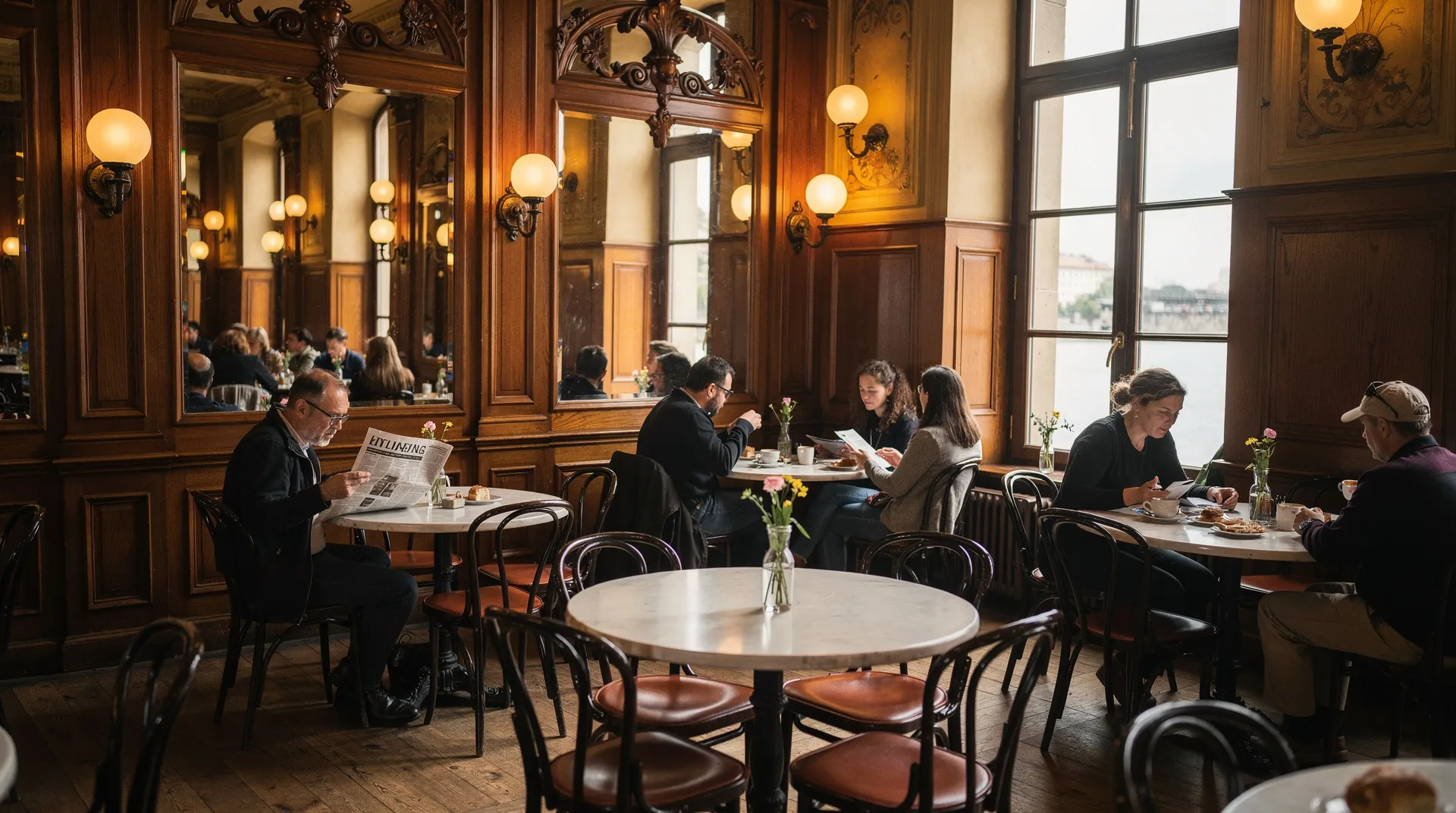
We order coffee (Café Louvre does a competent but not exceptional espresso, which is not the point) and sit at a window table overlooking Národní třída. There is no music. There is a man working on a laptop in the corner who has been here, apparently, for at least an hour before us. There is a couple at the next table who are not speaking to each other but are also, clearly, perfectly comfortable. The waiter does not hover. The light through the large windows is the particular quality of Central European autumn light that makes everything look like a photograph before you’ve taken one.
This is what the kavárna is.
The kavárna is not a café in the Western sense
In English, a café is where you get coffee and possibly a sandwich. In the Czech kavárna tradition, the café is something more structurally significant — an institution with a role in intellectual life, political dissent, professional networking, and daily domestic rhythm that has no exact equivalent in the anglophone world.
The comparison is Vienna. Prague and Vienna are the two cities that developed the Central European grand café tradition to its fullest expression, and for similar reasons — both were capitals of a multinational empire, both had large intellectual classes, and both operated in political environments where the café was a semi-public space that was safer than a private meeting for discussing inconvenient ideas.
Prague’s kavárna tradition peaked in the First Czechoslovak Republic (1918–1938) — the period between the wars when Czechoslovakia was, by any measure, the most sophisticated democracy in Central Europe. Writers including Karel Čapek (who invented the word “robot”), Jaroslav Hašek (author of The Good Soldier Švejk), and Max Brod (Franz Kafka’s publisher and friend) were café regulars. The central European coffee-house was their library, their office, and their social club simultaneously.
The specific cafés that matter
Kavárna Slavia on Smetanovo nábřeží is the most historically significant café in Prague. It has been open almost continuously since 1884, and its clientele reads like a Czech 20th century history: Kafka, Čapek, Rainer Maria Rilke, the Czechoslovak independence movement, then dissident culture under communism. During the Velvet Revolution in 1989, Václav Havel and his colleagues met here. The river view (National Theatre visible, the castle beyond) is one of the great café views in Europe. If you want to see the same stretch from the water, a Vltava river cruise with coffee and cake makes a relaxed kavárna-style way to do it.
The Slavia was closed by the post-communist government in 1992 in a privatisation dispute, and writers, artists, and Czech civic society campaigned publicly for its reopening. It reopened in 1997. The fact that Prague’s intellectual class treated the closing of a café as a serious political event tells you everything you need to know about the kavárna’s cultural status.
Café Louvre on Národní třída has been open since 1902 with interruptions. Einstein played billiards here during his Prague years (1911–12). The billiard room still exists. The café has been restored to something close to its First Republic appearance — high ceilings, mirrors, Art Nouveau details. It works as a café and as a museum simultaneously.
Grand Café Orient in the House of the Black Madonna on Celetná is the world’s only surviving Cubist café interior (designed by Josef Gočár, 1912). Czech Cubism, which emerged in Prague between 1910 and the First World War, applied Cubist principles to architecture and design rather than painting — an entirely Czech contribution to 20th century design history that almost no visitor to the Astronomical Clock has ever heard of. The café is small and quiet. The design is extraordinary. Go.
Café Imperial on Na Poříčí has extraordinary original Secession tile-work covering every surface — a technical feat of early 20th century ceramic art that was covered in plaster during the Communist period and restored to its full staggering depth in 2007. Breakfast here is expensive (€15–25 / 375–625 CZK) and worth it once as a design experience.
What happened during Communism
The Communist period (1948–1989) was complex for Czech café culture. The private café was nationalised — individual owners replaced by state operators with minimal incentive for quality. Some historic cafés survived in diminished form; others closed. The function of the kavárna as a meeting place for dissent survived informally — some cafés were known gathering spots for writers, artists, and intellectuals who were not welcome in official cultural institutions.
Václav Havel, during his years as a dissident playwright, operated in the café networks of Vinohrady and Malá Strana. The connection between Czech café culture and political resistance — which goes back to the 1848 Spring of Nations — was quietly maintained under communism and then celebrated publicly after 1989.
After 1989: the grand café revival, then the third wave
The 1990s saw the restoration of many historic cafés and the opening of new ones in the post-communist economic opening. The Second Republic nostalgia of the 1990s was strong — Praguers were reaching back to the First Republic as an alternative model of Czech identity.
By the 2010s, the third-wave specialty coffee movement arrived in Prague from London, Berlin, and Copenhagen. The key question was whether specialty coffee culture — obsessive about single origin, pour-over, precise extraction — could coexist with the kavárna tradition, which had always valued atmosphere, time, and social function over coffee quality per se.
The answer in Prague has been: yes, partially. The specialty coffee scene and the traditional kavárna tradition have developed in parallel rather than in conflict. You can find excellent specialty coffee in Vinohrady (Café Nona, EMA Espresso Bar) and the two cultures have influenced each other — many traditional cafés have improved their coffee significantly since 2015, and several specialty cafés have incorporated the unhurried table culture of the kavárna.
Current state: what to drink and where
For the historic grand café experience: Kavárna Slavia (embankment view, history), Café Louvre (billiard room, good lunch menu), Grand Café Orient (Cubist interior, very small, worth the effort).
For Secession/Art Nouveau interior: Café Imperial (extraordinary tilework, expensive but stunning), Café Savoy in Malá Strana (neo-Gothic vault ceiling, excellent pastries baked on-site).
For specialty coffee in a modern Vinohrady kavárna setting: EMA Espresso Bar (Wenceslas Square area), Doubleshot (Žižkov, highly regarded by Czech coffee professionals), Café Nona (Holešovice, excellent brunch).
For pure tradition: U Zlaté studně in Malá Strana for the courtyard; Café Savoy for the pastries; any establishment in Vinohrady on a weekday morning where the local demographic is Czech residents, not tourists.
The ritual of sitting
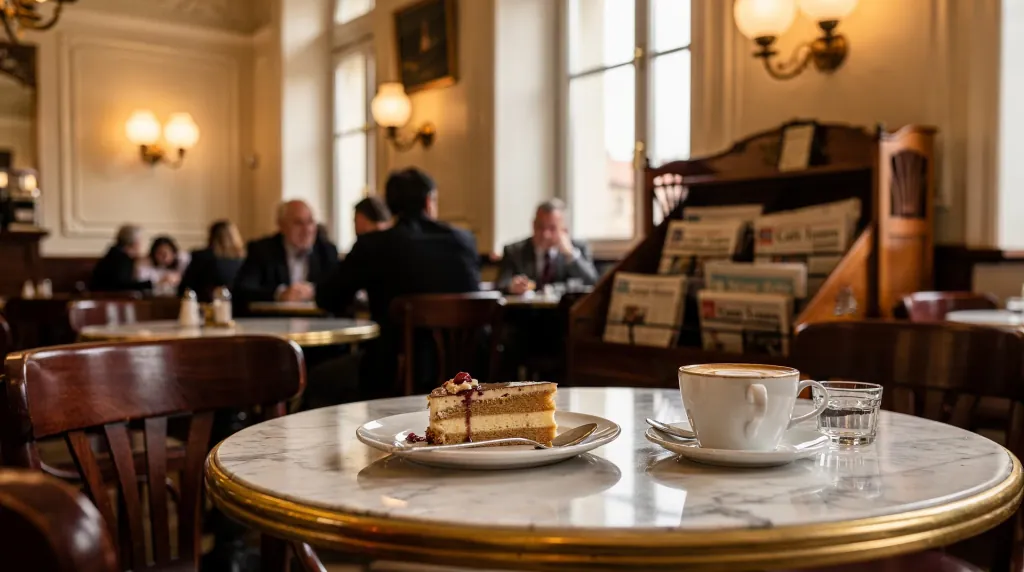
The one thing that distinguishes the Central European kavárna from its Anglo-American equivalent: you are not expected to leave. If you occupy a table for 3 hours with a single coffee and a newspaper, no one will approach you. No one will hover. The concept of table turnover, as it operates aggressively in London or New York coffee shops, does not apply. The kavárna is an extension of your domestic space — a sitting room with professional coffee and no one you have to talk to unless you choose to.
This is not laziness in the Czech cultural interpretation. It is the institutional function of the kavárna. Hašek wrote most of Švejk in café sittings. Kafka met Brod in the café regularly without an agenda. The freedom to sit without obligation is the freedom that made the kavárna politically important — and it remains its most distinctive characteristic.
Current prices: what a kavárna visit costs in 2026
| Item | Historic grand café (Slavia, Louvre) | Specialty coffee (EMA, Doubleshot) | Tourist area café |
|---|---|---|---|
| Espresso | €3–3.50 / 75–88 CZK | €3.50–4.50 / 88–112 CZK | €4–6 / 100–150 CZK |
| Flat white / cortado | €4–5 / 100–125 CZK | €4–5.50 / 100–138 CZK | €5–7 / 125–175 CZK |
| Cake / pastry | €4–6 / 100–150 CZK | €4–5.50 / 100–138 CZK | €5–9 / 125–225 CZK |
| Lunch (main course) | €12–18 / 300–450 CZK | Typically snacks only | €16–25 / 400–625 CZK |
The historic kavárnas have become somewhat expensive for coffee specifically — the €3.50 espresso at Café Louvre would have been €2.20 in 2019. The specialty coffee shops are often similarly priced but competing on quality rather than atmosphere. The tourist-area cafés (Grand Café Praha, the terraces on Old Town Square) are charging for the address.
The value calculation: if you want the historic atmosphere without tourist pricing, Kavárna Slavia on the embankment and Café Louvre on Národní třída are the best balance. Both are visited by Prague residents as well as tourists; neither is operating purely on visitor traffic.
The counterpoint: does the kavárna tradition still exist in any meaningful sense?
The cynical view: the historic grand cafés are largely museums. Kavárna Slavia’s current clientele is 60–70% tourists in July; its atmospheric quality on a summer Saturday has more in common with a scenic terrace than a First Republic intellectual salon. The billiard room at Café Louvre is photographed more than it is played on. The tradition has been preserved architecturally while the social function has dissipated.
This is partially true and misses the essential point. The kavárna as institution — the place where you sit without obligation, where time moves differently, where nothing requires you to leave — is alive and functional in the neighbourhood kavárnas of Vinohrady, Žižkov, and Holešovice. It is less visible to visitors because it is not in a famous building near the Astronomical Clock. But the man working on his laptop at Café Nona in Holešovice for four hours on a Tuesday morning is doing exactly what Kafka was doing at the Arco in 1912. The form is continuous. The address has changed.
Reader questions
“Which café is best for someone who has one morning in Prague?”
Kavárna Slavia, without hesitation. The river view (National Theatre, the castle beyond), the Art Deco interior, the history, and the genuine service make it the most complete single kavárna experience in the city. Go on a weekday, not a weekend, between 09:00 and 11:00 when it is at its quietest. Order a coffee and a pastry. Sit by the window. Allow 45 minutes minimum.
“Is Café Imperial worth the price?”
Yes, once. The Secession tile-work is one of the most remarkable interior surfaces in Prague — hundreds of thousands of hand-made ceramic tiles covering walls, columns, and ceiling in a technical achievement from 1914 that was hidden under plaster for 40 years and fully restored in 2007. Breakfast here (€18–25 / 450–625 CZK) is expensive by Prague standards. The interior is worth experiencing once; the food is good but not exceptional. Think of it as a museum with breakfast rather than a restaurant with nice décor.
“What’s the difference between a kavárna and a hospoda?”
The hospoda is a pub; the kavárna is a café. In practice: the hospoda is organised around beer (Czech lager, dark lager, sometimes wine) and pub food; the kavárna around coffee, tea, cake, and sometimes lunch. The social functions overlap — both are sit-without-obligation spaces — but the hospoda is louder, more beer-focused, and historically more working-class. The kavárna has a more intellectual and bourgeois register in the Czech cultural imagination. Both institutions are worth a visit; they complement each other.
2026 note: the specialty coffee scene continues to improve
Prague’s third-wave coffee scene has added several notable establishments since 2022. Doubleshot in Žižkov (which opened in 2020) has become a reference point for single-origin espresso in Central Europe, winning regional barista competitions. Café Nona in Holešovice has expanded and is now one of the better brunch destinations in the city, combining specialty coffee quality with the unhurried table culture of the traditional kavárna.
The most interesting development: several traditional kavárnas have upgraded their coffee equipment significantly. Café Savoy in Malá Strana — which was primarily known for its neo-Gothic interior and excellent pastries — has since 2023 been using specialty-grade Czech roasters and a proper espresso programme. The boundary between third-wave specialty and traditional kavárna is, in 2026, less clear than it was five years ago.
Pairing a kavárna visit with actual food
A kavárna visit works well as a standalone hour, but it also slots naturally into a food-focused day. If you want a proper meal rather than cake and coffee, the traditional Czech dishes guide and our dedicated goulash guide cover the hospoda side of things — the two institutions complement each other rather than compete, as the reader question below explains. If you would rather eat your way through the city with a guide, a guided Prague food and culture tour is an easy way to cover Czech dishes and the city’s history in one outing.
For itinerary planning: a kavárna morning fits comfortably into either our weekend itinerary or a slower 3-day itinerary, ideally scheduled for a day when you also have a museum or the Castle circuit planned, since the kavárna break gives you somewhere unhurried to sit afterwards. If you’re visiting outside the busiest months, the best-time-to-visit guide is worth checking — the historic grand cafés are dramatically quieter, and more genuinely usable as sitting rooms, outside July–August.
Reader questions (continued)
“Do I need to order food, or is coffee alone acceptable for a long sit?”
Coffee alone is entirely acceptable at every café mentioned here. The sit-without-obligation principle applies regardless of spend — nobody will hover or suggest you order more. That said, the pastries at Café Savoy and the breakfast at Café Imperial are worth ordering on their own merits, not out of any social obligation to the table.
“Are these cafés wheelchair accessible?”
It varies by building age. Café Louvre requires a short flight of stairs to reach the main café (there is no lift), which is a genuine limitation given the building dates to the early 1900s. Kavárna Slavia and the modern specialty cafés in Vinohrady and Holešovice are generally step-free at the entrance. If accessibility is a firm requirement, phone ahead — historic buildings in central Prague vary case by case and online information is not always current.
Related reading
The detailed Prague café guide covers our current favourite establishments in each neighbourhood. The Vinohrady neighbourhood guide explains why that area remains the best for the combination of kavárna culture and good food.