At a glance
| Where | Old Town Square, Wenceslas Square, Prague Castle, Náměstí Republiky, Vinohrady |
| Cost | Around €30 for a 3-hour visit with food, drink, and one souvenir |
| Season | Last weekend of November through 6 January |
| Getting there | Metro A/B to Staroměstská, Můstek, or Náměstí Republiky |
| Best time | Weekday mornings, 10–11 AM, for the calmest visit |
How Prague’s markets compare with each other
If you only have time for one market, Old Town Square is the obvious pick for the Týn Cathedral backdrop, but it’s also the most crowded. For a genuinely different, calmer experience, the Prague Castle market at Hradčanské náměstí has fewer stalls but higher craft quality and better views — pair it with a castle-grounds walk since the walk down into Malá Strana afterward is only 10–15 minutes. Wenceslas Square is the largest and most commercial, useful if you want a carousel or ice rink for kids; Náměstí Republiky, beside the Municipal House, is the best middle ground between atmosphere and lower crowds.
Table: which market fits which traveller
| Market | Best for | Crowd level |
|---|---|---|
| Old Town Square | First-time visitors, photos | Highest |
| Prague Castle (Hradčanské náměstí) | Quieter atmosphere, craft quality | Low-moderate |
| Wenceslas Square | Families, carousel/ice rink | High |
| Náměstí Republiky | Balance of atmosphere and calm | Moderate |
| Náměstí Míru (Vinohrady) | Locals-only feel, no tour groups | Lowest |
Pairing a market visit with the rest of your day
The Old Town Square market sits a short walk from the Astronomical Clock and Jewish Quarter, so a market visit slots naturally into any Old Town sightseeing day — go in the late afternoon as the light fades and the market lighting takes over. If you’re staying in Vinohrady, the small Náměstí Míru market is close enough to combine with dinner without a detour into the crowded centre.
What the markets are, and when to visit
Prague’s Christmas markets — Vánoční trhy — have been held on Staroměstské náměstí (Old Town Square) and Václavské náměstí (Wenceslas Square) since the 1990s revival of Czech Christmas traditions. The tradition itself is much older: medieval Prague’s Advent markets date to the 14th century, and the form of the markets — mulled wine, decorated trees, wooden stalls selling seasonal food and crafts — follows a Central European template shared with Vienna, Nuremberg, and Bratislava but in a uniquely Bohemian setting.
In 2026, the markets are expected to run from the last Saturday or Sunday of November through 6 January (Epiphany / Zjevení Páně). The Old Town Square tree lighting ceremony, usually held the evening the market opens, is a popular city event. Check prague.eu for the exact 2026 opening date.
Hours: Approximately 10 AM–8 PM daily (some stalls open from 9 AM; food stalls close at 9 PM or later on busy evenings). The markets close completely on 24 December and operate limited hours on 25–26 December.
The markets, stop by stop
Staroměstské náměstí — Old Town Square
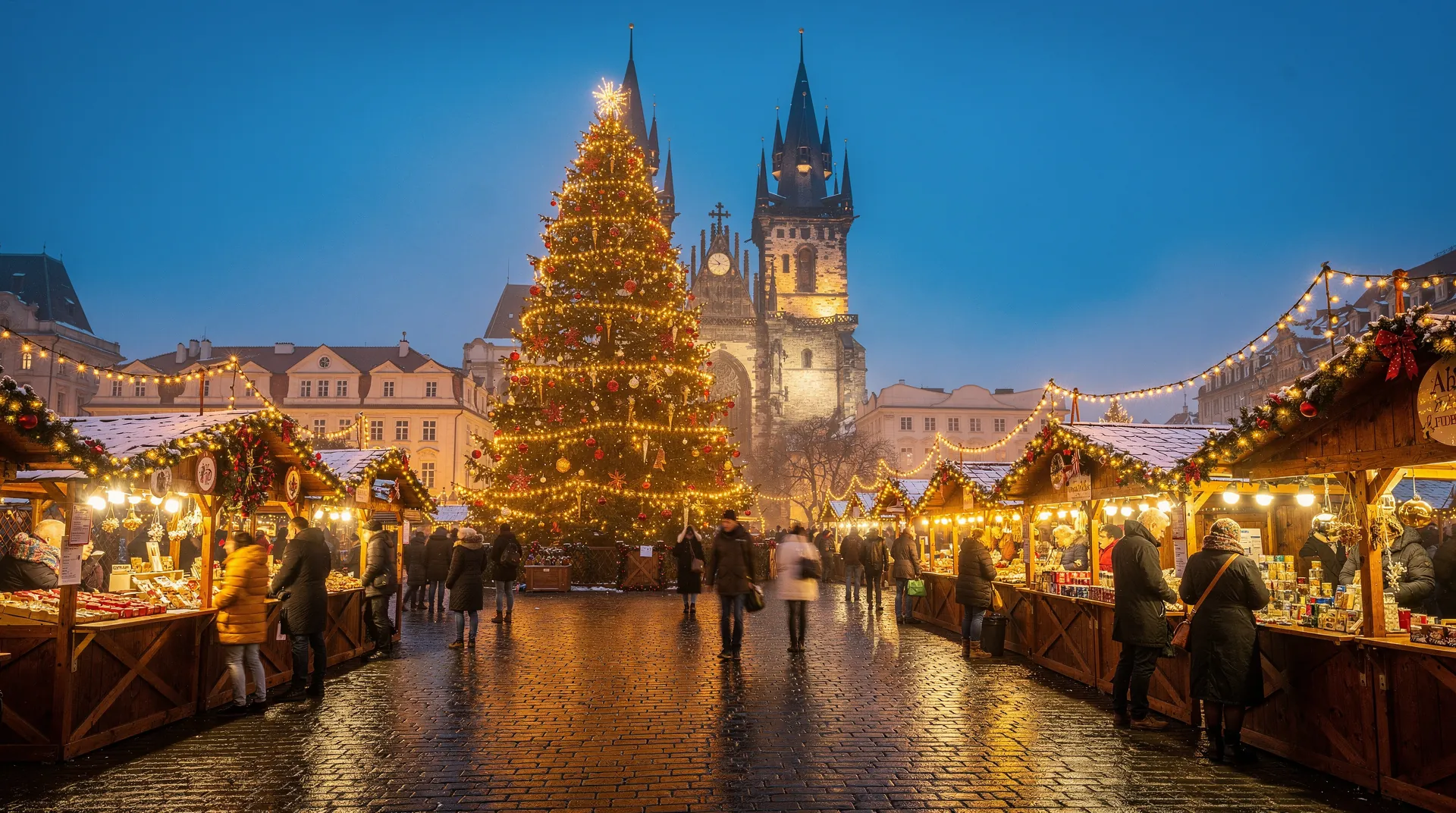
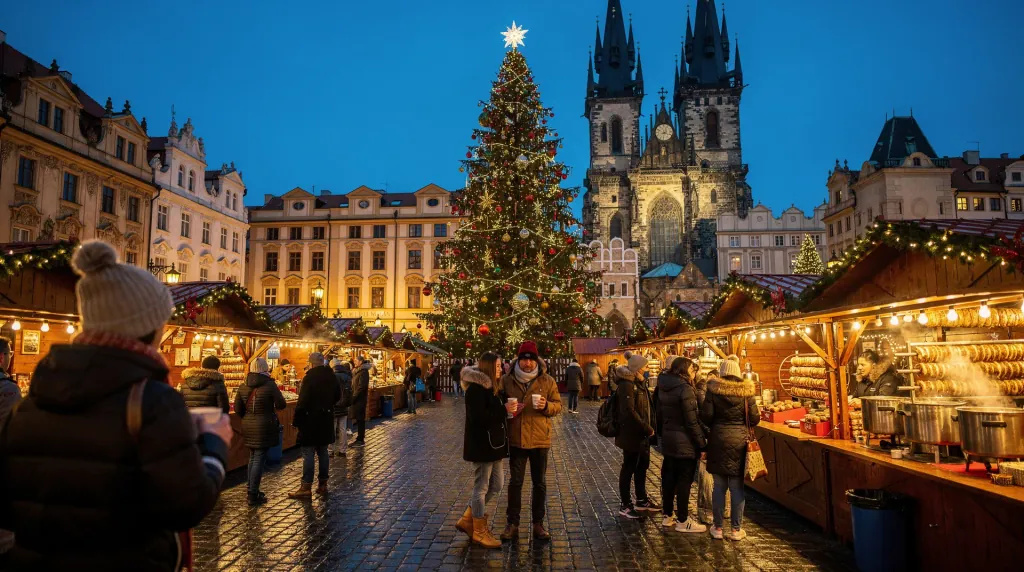
The main Prague Christmas market, and the most photographed. The Týn Cathedral’s twin Gothic spires (built 1365–1511) frame the scene from the east; the Old Town Hall tower with the Astronomical Clock occupies the west side; the Baroque palaces of the Kinský family and the Stone Bell House fill the remaining facades. The market occupies most of the central square with wooden stalls in an organic spiral around the central tree.
What to find: Artisan craft stalls selling hand-painted Bohemian glass ornaments, kraslice (hand-decorated eggs in Christmas patterns), hand-woven linen, hand-poured beeswax candles, wooden folk toys, and embroidered table linens. Food stalls selling klobása (grilled sausage) over open coal fires, trdelník (chimney cake — a spiral pastry grilled on a rotating spit, dusted with sugar and cinnamon), svařák (mulled wine served in souvenir ceramic cups), medovina (honey mead, warm), and svíčková rolky (beef rolls in cream sauce, in small portions).
Best time: 10–11 AM on weekdays. The light is better in the morning, the stall holders are fresh, and you can actually talk to the artisans about their work. Saturday from 4–8 PM is beautiful in the Advent atmosphere but uncomfortably crowded.
Metro: Line A (Staroměstská station) or Line B (Náměstí Republiky station), 5–8 minutes’ walk. Tram: lines 2, 17, 18 to Staroměstská.
Václavské náměstí — Wenceslas Square
The second major market, running the length of the upper Wenceslas Square boulevard, below the equestrian statue of St. Wenceslas (patron saint of Bohemia) and the National Museum steps. The setting is less medieval than Old Town Square but the market is larger, slightly more commercial, and often includes a Christmas carousel and ice rink (check each year’s programme).
What to find: More of the same craft stalls as Old Town Square, plus Czech-made toys, jewellery, and pottery. A strong food section with chimney cakes, roasted chestnuts (kaštany), and a wider variety of hot drinks including Czech grog (hot rum with lemon and cloves).
Best time: Similar to Old Town Square — weekday mornings are far more pleasant than weekend afternoons.
Metro: Line A or C (Muzeum station), Line A or B (Můstek station).
Hradčanské náměstí — Prague Castle district
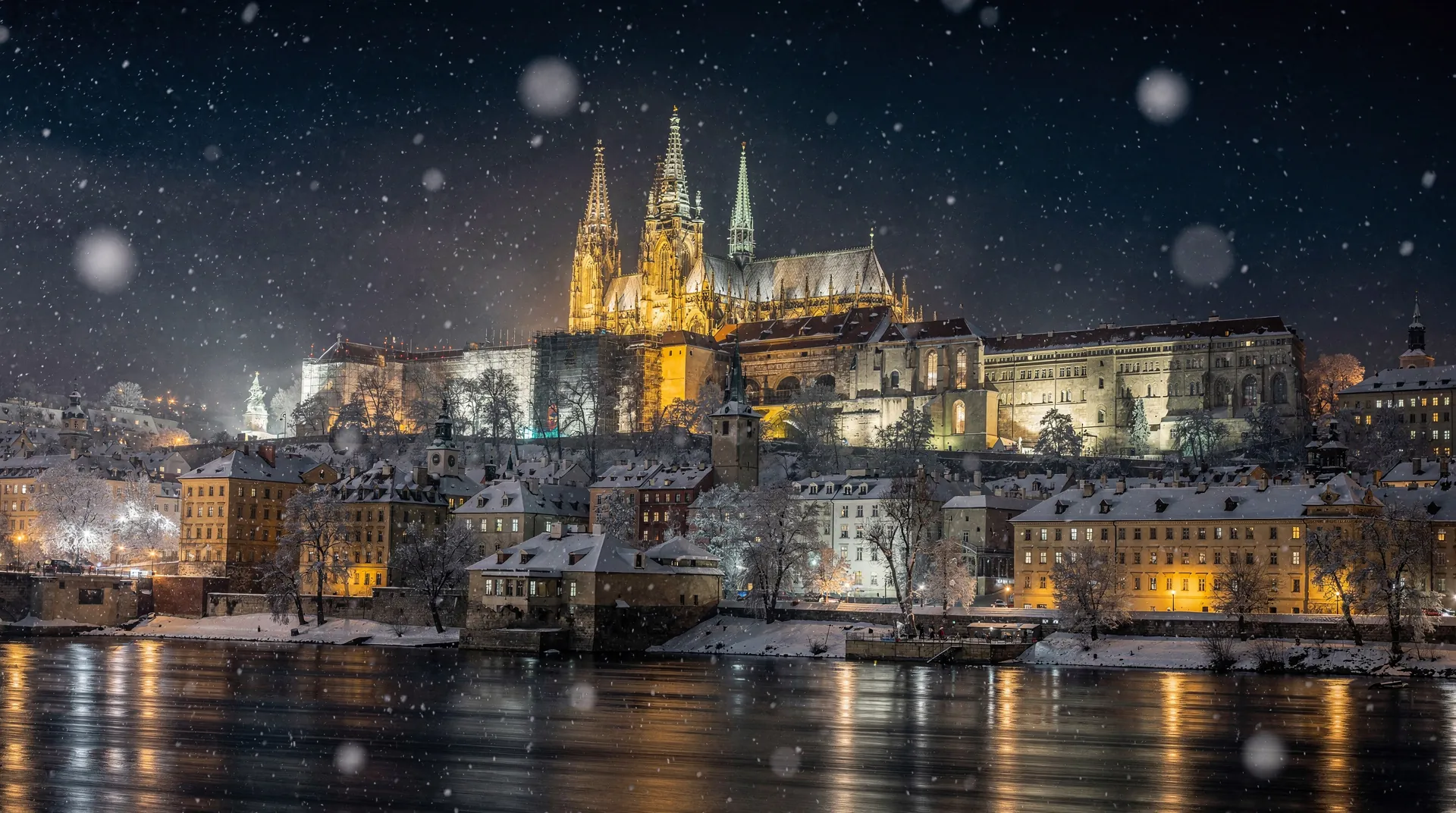
A smaller, quieter market in the castle approach square. This is the version to seek out if you want an atmospheric, less commercially intense experience. The stalls are fewer and the quality of craft goods is generally higher. The castle views from this area are magnificent, and the Advent lighting on the castle facades creates an extraordinary backdrop for evening visits.
Hours: Slightly shorter than the city-centre markets — approximately 10 AM–7 PM. Check hrad.cz for exact times.
How to reach it: Tram 22 to Pohořelec, then a 5-minute walk, or the steep walk up from Malostranské náměstí.
Náměstí Republiky — Republic Square
A third city-centre market, adjacent to the Art Nouveau Municipal House (Obecní dům). The setting is architecturally spectacular — the Municipal House’s gilded Secession facade alongside the medieval Powder Gate. This market tends toward higher-end craft and food goods. Less crowded than Old Town Square on most evenings.
Metro: Line B (Náměstí Republiky), direct exit into the square.
Náměstí Míru — Vinohrady
The residential neighbourhood’s market around the neo-Gothic Church of St. Ludmila is smaller and predominantly local — few tour groups, reasonable prices, good Czech food stalls. Worth combining with a Vinohrady café or wine bar visit.
Metro: Line A (Náměstí Míru).
What to eat and drink
Svařák (mulled wine): The standard Christmas market drink. Decent quality at most stalls — made from red wine, spices (cinnamon, cloves, star anise), and hot water. Served in a ceramic souvenir mug (ceramic cup / keramický hrnek) for which you pay a deposit (záloha, usually 40–50 CZK / €1.60–2). Return the cup to any stall to reclaim the deposit, or keep it as a souvenir.
Medovina (honey mead): Underrated and worth seeking specifically. Warm honey mead has a sweeter, less tannic character than svařák. Buy from stalls that make their own — there are usually 2–3 specialist medovina producers at the Old Town market.
Klobása (grilled sausage): The open coal-fire klobása stalls are one of the market’s great sensory experiences. A pork or smoked-pork klobása with mustard (hořčice) and a chunk of rye bread: approximately €3–4 (76–102 CZK). Eat standing over the fire to stay warm.
Trdelník (chimney cake): The spiral pastry grilled on a rotating spit, dusted with sugar, cinnamon, and sometimes walnut, is a Czech Christmas-market staple. Note: in recent years, tourist-facing versions filled with Nutella and ice cream have proliferated; these are not traditional. The proper trdelník is the plain (or lightly spiced) version.
Roasted chestnuts (pečené kaštany): Sold from barrel braziers by vendors with paper cones. Hot, sweet, slightly smoky. An excellent cold-hand solution.
Svíčková na smetaně (beef in cream sauce): Available at some of the larger food stalls in small portions or in bread rolls. The Czech national dish in a market format — worth trying if the queue is manageable.
Practical information
Prices: Svařák €2.50–3.50 (64–89 CZK) plus cup deposit. Klobása with bread €3–4 (76–102 CZK). Craft ornaments €4–15 (102–380 CZK) for glass ornaments; quality Czech hand-painted eggs €6–20 (152–508 CZK) depending on complexity.
Payment: Most stalls accept cards (contactless payment); cash is also widely accepted. The CZK is the currency. EUR is accepted at some tourist-facing stalls but at poor exchange rates — use Czech crowns.
Crowds by day of week: Saturday afternoon (3–9 PM) is the most crowded. Friday evenings are nearly as busy. Tuesday and Wednesday are the quietest weekdays. Sunday mornings are manageable; Sunday afternoons build toward Saturday levels.
Crowds by time of day: Before noon is always significantly better than afternoon or evening. The market atmosphere with Advent lighting is most beautiful after dark — aim for a weekday evening (Tuesday–Thursday) if you want both the visual atmosphere and manageable crowds.
What to buy: Hand-painted glass ornaments from genuine Czech glassblowers are the best souvenir — durable, beautiful, and genuinely Czech. Avoid mass-produced tourist trinkets. The kraslice eggs (hand-painted with traditional Czech folk patterns) are excellent gifts. Beeswax candles and hand-woven linen are other reliable quality purchases.
Tours worth it
A guided Christmas market tour adds historical and cultural context to the market visit, navigates the crowd for you, and typically includes multiple warm-up stops at a local wine bar or café — extremely useful on cold December evenings.
Prague: 3-hour winter walking tour with warm-up stops — covers the Christmas market with historical context and café breaks Prague Castle and Castle District: 2-hour guided tour — pair with the Hradčanské náměstí Christmas market Prague: Advent classical concert at the Klementinum Mirror Chapel — the perfect evening complement to a market visit Prague: Christmas concert at Rudolfinum Dvořák Hall — book months ahead for December dates2026 market dates and hours
Old Town Square (Staroměstské náměstí): Expected opening last Saturday of November 2026 — confirm at prague.eu. Runs through 6 January 2027. Daily 10:00–20:00 (food stalls may open from 09:00 and stay until 21:00 on busy evenings). Closed 24 December; limited hours 25–26 December; reopens fully 27 December.
Wenceslas Square (Václavské náměstí): Opens same weekend as Old Town Square. Similar hours. Extends further along the square toward the National Museum steps. Includes the upper and lower boulevard sections.
Prague Castle — Hradčanské náměstí: Opens approximately 1–3 days after the city-centre markets. Hours 10:00–19:00. Shorter operating season — may close a few days before 6 January. Check hrad.cz for exact 2026 dates.
Náměstí Republiky: Opens with the main markets. Hours similar to Old Town Square. Adjacent to the Art Nouveau Municipal House facade — spectacular backdrop.
Náměstí Míru (Vinohrady): Smaller, opens approximately 1–2 weeks into the main market season. Runs through Christmas Eve. Weekday and weekend hours 10:00–20:00.
Stall-by-stall guide
Artisan ornament stalls are concentrated along the south side of the Old Town Square market, near the Kinský Palace. These are the stalls to prioritise. What to look for: slight variations between individual ornaments (indicating hand-painting), the maker present at the stall, and price range of €6–20 per glass ornament. A mass-produced bauble costs €2 and is indistinguishable from any Christmas market in Western Europe. An individually blown and hand-painted Bohemian glass ornament costs €10–15 and is worth it.
Kraslice (decorated egg) stalls are usually 3–5 specialist vendors, often positioned in the eastern section of the Old Town Square market near the Jan Hus monument. Regional producers from Moravia and Bohemia bring very different styles — Moravian geometric folk motifs in red and black; Bohemian painted floral designs. Budget €4–12 per egg for Christmas-pattern versions; €15–25 for elaborate single-piece art eggs.
Klobása and grill stalls are easy to find by smell. The open coal-fire klobása stands are positioned along the main stall rows. A smoked pork klobása with mustard (hořčice) and a slice of rye bread: €3–4 (76–102 CZK). The best klobása stalls have whole sausages on the grill rather than pre-grilled portions kept warm.
Trdelník stalls (chimney cake) are visible from a distance by the rotating spit. The original version: plain dough on a spit, grilled and dusted with cinnamon-sugar. The tourist version: same dough but served as a cone filled with whipped cream, Nutella, or ice cream — not traditional but popular. Both varieties are available at most markets.
Medovina specialists — look for the word medovina on the stall sign. The honey mead producers often offer 3–4 varieties (dry, semi-sweet, sweet; with various herbs). Sampling before buying is encouraged.
Hand-woven linen and textile stalls cluster in the outer rows. Czech hand-woven linen (table runners, napkins, decorative cloths) is a genuine craft product with a long regional tradition. Prices: €15–45 per item depending on size and complexity.
Beeswax candle stalls sell hand-poured and hand-rolled beeswax candles, often decorated with pressed flowers or seasonal motifs. These travel well and make excellent gifts. €4–12 depending on size.
What to buy — and what to avoid
Buy: Individually painted glass ornaments, hand-decorated kraslice eggs, beeswax candles, hand-woven linen, artisan ceramics, regional food products (Czech honey, Šumava forest jam, Moravian wine).
Avoid: “Made in China” tourist souvenirs masquerading as Czech crafts — the Astronomical Clock fridge magnets, the “I love Prague” merchandise, and the mass-produced glassware from non-Czech factories. The difference in quality between a genuinely Czech artisan product and a tourist souvenir is dramatic and obvious when you compare them side by side.
Rule of thumb: If a stall has 50 identical ornaments at €2 each, it is not a Czech craftsperson. If a stall has 20 slightly different ornaments at €10–15 each and the maker is at the table, it is.
Booking timeline and what to plan ahead
- Accommodation: Book 8–12 weeks ahead for any December date, especially weekends and the Christmas (24–26 December) and NYE (31 December) windows. Central Prague hotels sell out completely for those dates.
- Rudolfinum Christmas concert: Book at rudolfinum.cz or ceskafilharmonie.cz in September–October. Sells out months ahead.
- Guided Christmas market tour: Book 3–7 days ahead in December. Available same-day in early December but limited on peak weekends.
- Klementinum Mirror Chapel concerts: Book 1–2 weeks ahead in December. More available than the Rudolfinum but some dates fill quickly.
- Restaurants near the market: Book Friday and Saturday dinner 1–2 weeks ahead in December. Christmas Eve dinner (24 December) should be booked as soon as possible — most restaurants close, and those that open fill instantly.
Sample day budget at the Christmas market
A 3-hour Christmas market visit for one person, including food, drinks, and one craft purchase:
| Item | Cost (CZK) | Cost (€) |
|---|---|---|
| Svařák × 2 (ceramic cup deposit refunded) | 150 | €6 |
| Klobása with bread | 100 | €4 |
| Trdelník | 80 | €3 |
| Roasted chestnuts | 60 | €2.40 |
| One hand-painted glass ornament | 380 | €15 |
| Total | 770 | €30.40 |
Cup deposit (40–50 CZK / €1.60–2) is refundable. The ornament is the only significant cost; the food circuit is very reasonable.
Questions people ask about Prague Christmas markets
When do the Prague Christmas markets open in 2026?
The exact date varies year to year. In 2026, the opening is expected on the last weekend of November. The Old Town Square tree-lighting ceremony marks the opening. Check prague.eu for the confirmed 2026 dates as December approaches.
What is the best Prague Christmas market?
Old Town Square is the most spectacular setting — the Týn Cathedral backdrop and the Astronomical Clock make it uniquely beautiful. But for a quieter experience, the Hradčanské náměstí market at Prague Castle has better atmosphere and higher-quality craft stalls with fewer crowds. Visit both if you can.
Are the markets open on Christmas Day?
Most stalls are closed on 24 December (Christmas Eve, the main celebration day in Czech tradition). 25 and 26 December see reduced market hours — some stalls open, some don’t. The markets are in full operation from 27 December through 6 January.
Can you buy authentic Czech Christmas decorations at the market?
Yes — but you need to distinguish authentic craft stalls from tourist souvenir stalls. Look for stalls where the vendor is also the maker, where the ornaments are individually painted (slight variations between each one), and where the price reflects actual craft work (€6–20 for a quality glass ornament, not €2 for a mass-produced bauble). The artisan-craft association stalls at Old Town Square are a reliable indicator of quality.
Is Prague more expensive during the Christmas markets?
Yes — hotels are 30–50% more expensive than January, and popular restaurants near the market require advance booking. The market food and drink prices are reasonable (svařák under €3.50). If budget is a priority, stay slightly outside the immediate Old Town centre (Vinohrady, Žižkov) and save significantly on accommodation.
What are the best Advent concerts in Prague?
The Rudolfinum Christmas concert (Dvořák Hall) is the most prestigious — book at rudolfinum.cz months ahead. The Klementinum Mirror Chapel concerts run throughout December and are more accessible. St. Nicholas Church in Malá Strana and the Spanish Synagogue in Josefov also run Advent programmes. The Estates Theatre (Stavovské divadlo) typically programmes festive opera.
Is it better to visit the Christmas markets or come in autumn instead?
Depends on the goal. The markets give festive atmosphere but at the year’s highest prices and crowds; autumn (especially September) gives better weather, real park colour, and far lower prices with no festive market. If a Christmas market specifically is the draw, come in December; otherwise autumn is the better value trip.