| At a glance | |
|---|---|
| Where | Old Town Square and Wenceslas Square, plus a smaller stall at Náměstí Míru in Vinohrady |
| Cost | Free to browse; food/drink around €3–6 per item, a quality kraslice egg around €6–20 |
| Time needed | 1.5–3 hours for a proper visit; 30 minutes for a quick pass |
| Getting there | Walk from Old Town or Malá Strana; metro A to Staroměstská or Můstek |
| Best time | Weekday mornings in the 2 weeks before Easter; avoid Saturday afternoons |
What and when
Prague’s Easter markets (Velikonoční trhy) are smaller and quieter than the Christmas version but arguably more authentically Czech in character. While the Christmas markets draw a predominantly international tourist crowd, the Easter markets attract a meaningful proportion of Czech visitors who come specifically for the traditional goods — particularly the hand-painted kraslice eggs, which are treated as serious folk art.
In 2026, Easter Sunday falls on 5 April. The markets typically open approximately 2 weeks before Easter (around 22 March) and run through Easter Monday (6 April), sometimes with limited hours on Good Friday. The main locations are Staroměstské náměstí (Old Town Square) and Václavské náměstí (Wenceslas Square), with a small supplementary market at Náměstí Míru (Peace Square) in Vinohrady.
Hours: Approximately 10 AM–8 PM daily. Good Friday (3 April 2026): reduced hours. Easter Saturday and Easter Sunday: full hours but expect significant crowds. Easter Monday: market may close early.
The Easter traditions behind the market
Czech Easter (Velikonoce) is one of Central Europe’s richest folk traditions. Unlike the increasingly commercialised Western Easter, Czech Easter has retained a remarkably direct connection to pre-Christian spring fertility rituals, filtered through Catholic and folk culture.
Pomlázka: The Easter whip — a braided switch of fresh green willow, decorated with ribbons — is the Easter Monday tradition. Czech boys (and men) traditionally tap girls (and women) on the legs with the pomlázka on Easter Monday morning to bring them health and fertility through the coming year. In return, the women present the men with kraslice eggs and sometimes a shot of slivovitz (plum brandy) or a ribbon to tie to the whip. The market sells these wicker switches, from simple to elaborately braided works of craft.
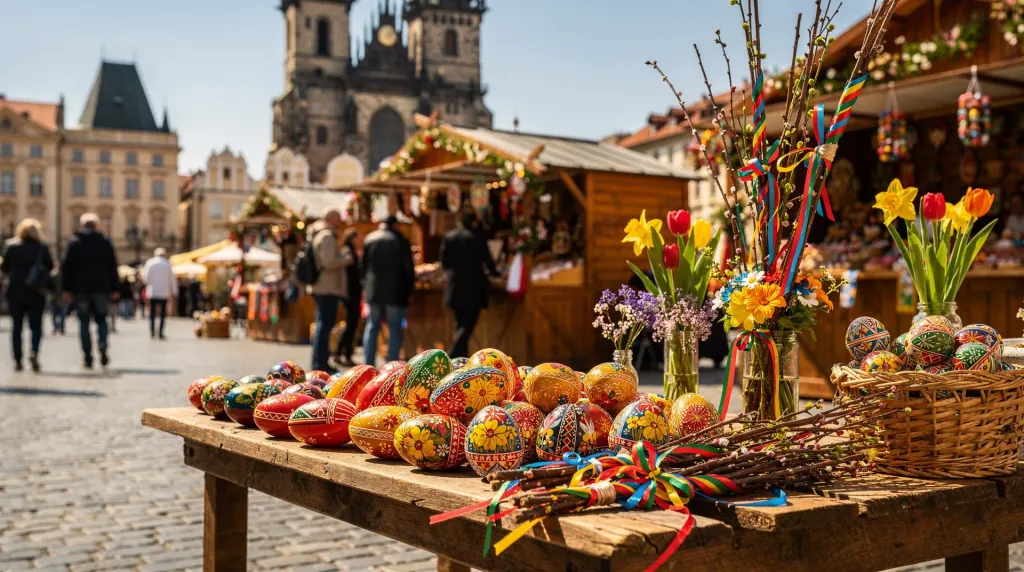
Kraslice: Hand-painted Easter eggs are the market’s finest product. Traditional Czech kraslice are made using various techniques: batik (hot wax resist), scratch engraving on a dyed egg surface, and appliqué of dried flowers, wheat, or grass. The patterns are regional — Moravian kraslice often feature geometric folk motifs; Bohemian ones lean toward floral and naturalistic designs. A quality single egg from an established maker costs €4–15 (102–380 CZK); elaborate engraved eggs can reach €25–40.
Mazanec: A round, sweet yeast bread traditionally baked for Easter morning breakfast, decorated with a cross incision on top. Sold at bakery stalls at the market. Similar to a light brioche with a hint of lemon zest. Excellent with butter and cream cheese.
Jidáše: Long, braided pastries representing the rope of Judas — a specifically Czech Easter pastry sold at bakery stalls in the days before Easter.
The markets, stop by stop
Staroměstské náměstí — Old Town Square
The main Easter market occupies roughly half the space of the Christmas market (no 15-metre tree to contend with). The square’s spring greenery — tubs of pussy willow, primroses, and tulips decorating the stall fronts — is visually different from Christmas but equally beautiful. The Astronomical Clock tower behind the market stalls provides the iconic backdrop.
What to find: Kraslice eggs from multiple regional producers, braided pomlázka whips in all sizes, hand-woven Easter baskets, spring flower decorations, folk toys, and linen goods. Food stalls: grilled klobása, trdelník, mazanec, and the returning svařák (mulled wine remains popular in April’s still-cool temperatures).
What’s distinctive about Easter: The Easter market has a noticeably more craft-focused character than Christmas. Many stall holders are actual artisan producers who demonstrate their techniques at the stall — egg-painting demonstrations are common and fascinating.
Václavské náměstí — Wenceslas Square
The upper section of Wenceslas Square hosts an Easter market similar in scope and content to Old Town Square, with additional space for live folk music performances on Easter weekend. The stalls tend toward a slightly broader merchandise range, including Czech-made ceramics and textiles alongside the specifically Easter items.
Náměstí Míru — Vinohrady
The smaller Vinohrady market around the neo-Gothic St. Ludmila Church is primarily local — Czech families rather than international tourists, neighbourhood producers, and a quieter, more intimate atmosphere. Good for high-quality purchases without crowds.
What to eat and drink
Svařák remains the signature hot drink even at the Easter market — Prague’s spring is cool enough (8–15°C in March/April) to make mulled wine a comfort. The ceramic cup deposit system applies as at Christmas.
Medovina (honey mead): Warm mead is perhaps even better at Easter than Christmas — the lighter, honey-floral character suits the spring season. Look for specialist medovina producers.
Grilled klobása: The sausage-over-open-fire experience is available year-round at the market. With mustard and rye bread: €3–4 (76–102 CZK).
Mazanec: Buy a small round from a bakery stall and eat it warm, ideally with butter. The best mazanec has a slightly sweet, yeasty, fragrant character.
Jidáše with honey: The Judas pastry, eaten symbolically before Easter, is traditionally dipped in honey. Buy from the bakery stalls in the days leading up to Easter Thursday/Friday.
Practical information
Crowds: The Easter market is significantly less crowded than the Christmas market, but Easter weekend itself (Good Friday through Easter Monday) sees a meaningful increase. Saturday before Easter and Easter Sunday are the busiest days. Weekday mornings in the 2 weeks before Easter are pleasantly calm.
Weather: March and early April in Prague are variable. Dress for 8–14°C with the possibility of rain. The svařák is warm and welcome on a cool Easter market morning.
Photography: The Easter market is excellent for detail photography — the painted eggs, braided whips, and spring flower arrangements are all visually rich. The morning light on the Týn Cathedral towers through the Easter stall banners is particularly good.
Tours worth it
Prague: food and beer guided walking tour — includes Czech Easter food traditions and market context Prague: Old Town, Jewish Quarter and Astronomical Clock walking tour — pairs well with an Easter market visit Prague: Jewish Quarter walking tour with admission tickets — Josefov is particularly atmospheric at Easter2026 dates and hours
Easter Sunday 2026: 5 April. The Prague Easter markets are expected to run from approximately 22 March through 6 April 2026 (Easter Monday). Confirm the exact opening date at prague.eu in early March.
Old Town Square market hours: Daily 10:00–20:00. Good Friday (3 April): possible reduced hours; some stalls may open later (12:00) due to the holy day observance. Easter Sunday: full hours, but expect elevated crowds. Easter Monday: market may close early (14:00–16:00) as the city winds down.
Wenceslas Square hours: Same as Old Town Square.
Náměstí Míru (Vinohrady) hours: Daily 10:00–18:00. This smaller market may open a week after the main markets.
Stall-by-stall guide
Kraslice egg stalls are the Easter market’s most distinctive feature. The best are positioned in the eastern section of Old Town Square, near the Jan Hus monument. Artisan egg-painters often demonstrate their technique at the stall — the batik (wax-resist) method, scratch-engraving on a dyed shell, and the appliqué technique (dried flowers or wheat pressed onto the egg surface). What to look for: a maker at the stall, slight variations between individual eggs, and prices in the €4–20 range. Beware of imported eggs — genuine Czech kraslice have a specific regional character and are usually signed or marked by the maker.
Regional styles to seek: Slovácká kraslice (Moravian style) with tight geometric cross-hatching patterns in red, black, and white; Bohemian watercolour kraslice with loose floral paintings in pastel tones; Záhoří technique scratch-engraved eggs with dense folk ornamentation on a deep red or black ground.
Pomlázka (Easter whip) stalls sell freshly braided green-willow switches in sizes from 30 cm (decorative) to 1 metre (functional). The traditional pomlázka is made from 3, 8, or 12 strands of willow; the finest versions have 24 strands and are decorated with ribbon. A functional 8-strand whip costs €4–8 (102–203 CZK). The elaborate 24-strand versions cost €15–25 (381–635 CZK) and are primarily decorative. The willow must be fresh (the stalls refresh stock daily in the days before Easter Monday).
Bakery and food stalls at the Easter market include: mazanec (the round Easter bread — buy warm, eat with butter), jidáše (Judas pastry, available Thursday and Friday before Easter), hot klobása with mustard and bread, trdelník, and svařák / medovina. The food stalls at Easter are identical in format to Christmas but the menu has the specifically Easter items that Christmas lacks.
Spring flower and decoration stalls sell: pussy willow branches (decorated with ribbons), tulips, daffodils, willow-bark woven baskets, and handmade paper flower decorations. The willow branch arrangements are a distinctive Czech Easter decoration — worth buying to understand the spring aesthetic of the tradition.
Folk art and textile stalls are similar to Christmas market equivalents: hand-woven linen Easter table runners (often with Easter motifs — chicks, eggs, spring flowers), embroidered folk costumes for children, and wooden folk toys.
What to buy and what to avoid
Best purchases: A quality kraslice egg (even one) by an artisan maker is the definitive Easter market souvenir — fragile but extraordinary. A braided pomlázka is lightweight, distinctive, and packs easily. Mazanec bread from a market bakery stall, eaten warm on the square, is the right market food. The regional honey and Czech Easter-recipe cookbooks available at some stalls are practical and high-quality.
Avoid: Mass-produced eggs with glitter-glue decoration and no craft content — these are tourist-facing and not traditional. The rule from the Christmas markets applies: if it’s identical, it’s imported. Also avoid: the Nutella-filled trdelník versions (not traditional), the oversized portion sizes that cost €8–10 at stalls positioned directly at tourist-facing viewpoints.
Fragile item transport: Kraslice eggs should be wrapped individually in tissue paper and packed in a rigid container. Many artisan sellers will supply a small padded box for €0.50–1.00. Alternatively, the egg cartons sold at the market are designed for this. Airlines may require eggs to be in checked luggage.
Booking timeline
- Accommodation: Book 4–6 weeks ahead for Easter weekend (3–6 April 2026). This is a European holiday weekend and central Prague fills up. Vinohrady and Žižkov hotels are 15–25% cheaper than Old Town equivalents.
- Guided tours: Book 3–7 days ahead in the 2-week market period. Available same-day on weekday mornings; limited on Easter weekend.
- Day-trip combination with Český Krumlov: If combining the Easter market with a Český Krumlov day trip, book the tour transport 1–2 weeks ahead — bus and guided tours fill quickly at Easter.
- Restaurant dinner (Easter Saturday/Sunday): Book 1–2 weeks ahead for any good restaurant. The market creates demand for post-market dinners.
Sample day budget at the Easter market
A 3-hour Easter market visit for one person including food and one craft purchase:
| Item | Cost (CZK) | Cost (€) |
|---|---|---|
| Svařák or medovina × 2 (cup deposit refunded) | 160 | €6.40 |
| Klobása with bread | 100 | €4 |
| Mazanec (Easter bread from bakery stall) | 50 | €2 |
| One quality kraslice egg (artisan, batik technique) | 300 | €12 |
| Small pomlázka (decorative) | 150 | €6 |
| Total | 760 | €30.40 |
The eggs and whip are optional; the food circuit alone costs €12–15.
How this compares to visiting in other spring weeks
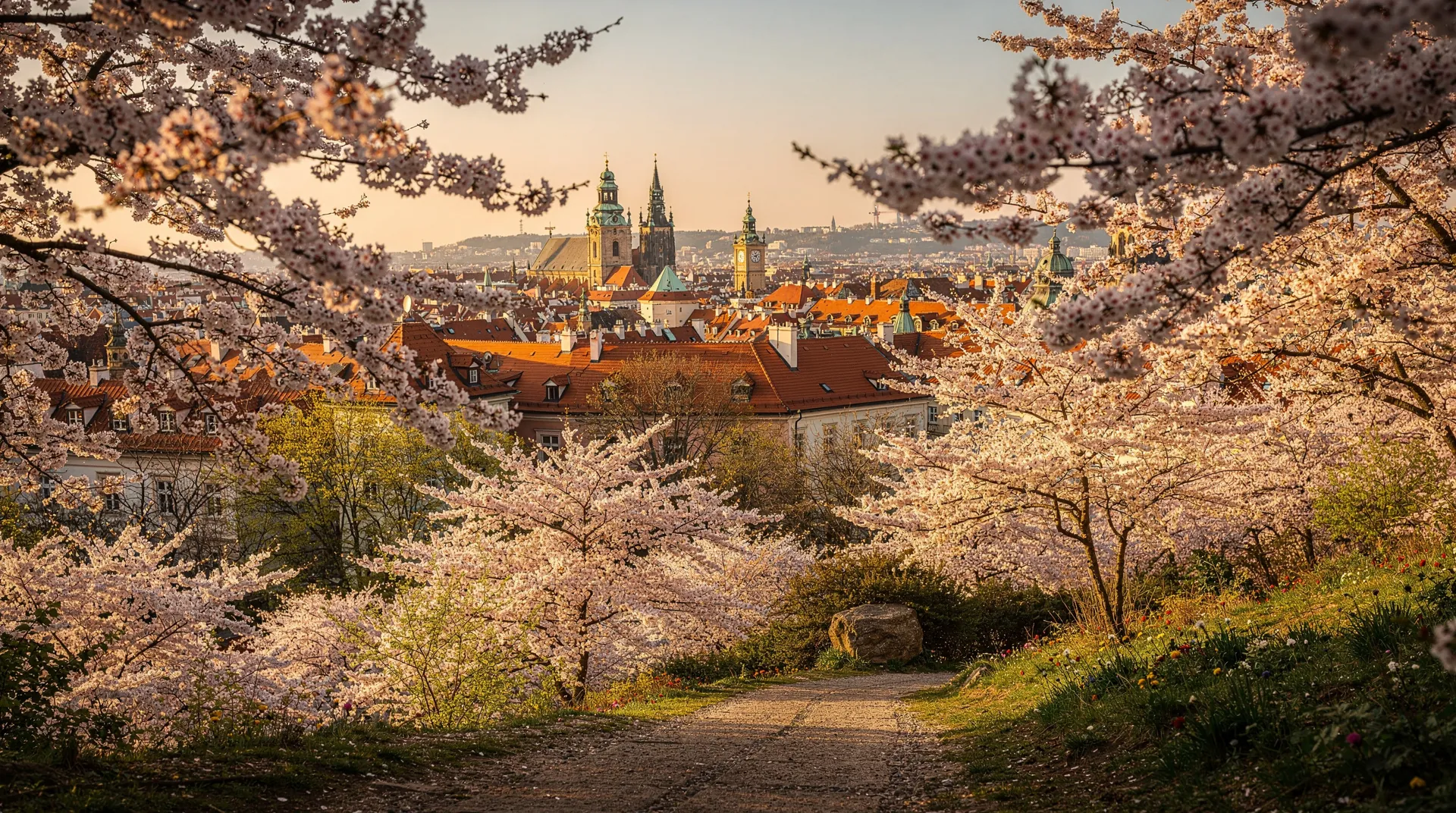
If the Easter market isn’t the draw itself, the wider month matters more than the specific dates. Our Prague in April guide covers the blossom season around Petřín Hill alongside the market, and Prague in March covers the quieter run-up weeks when the first stalls go up but crowds are thin. If Easter dates don’t line up with your trip, the spring overview explains how the season unfolds month by month.
Combining the market with a half-day elsewhere
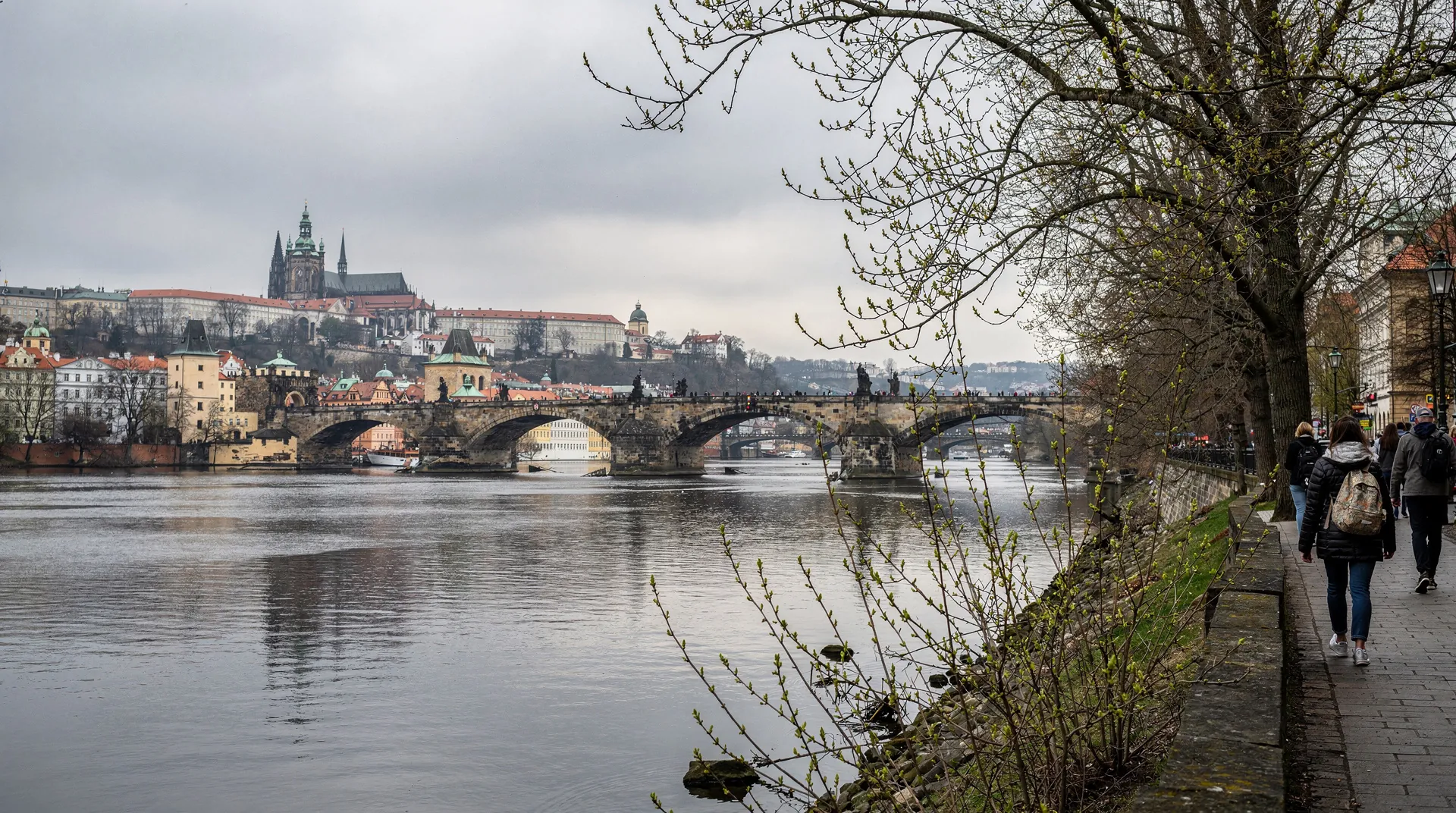
Because the Easter market itself only takes an hour or two even done properly, most visitors pair it with something else the same day. Charles Bridge at dawn before the market opens is the classic combination — quiet bridge, then a warming svařák once the stalls start serving. The Jewish Quarter (Josefov) is a 10-minute walk from Old Town Square and works well in the early afternoon once the market crowd peaks. For a change of pace entirely, Kutná Hora as a day trip the day before or after Easter weekend avoids competing with market crowds altogether.
Questions people ask about Prague Easter markets
When are Prague Easter markets in 2026?
Easter Sunday 2026 falls on 5 April. The markets are expected to open around 22 March and run through 6 April. Check prague.eu for confirmed 2026 dates.
What is a kraslice and where can I buy the best ones?
A kraslice is a hand-decorated Easter egg, the most distinctive Czech Easter craft. Quality varies enormously at the market — look for stalls where the eggs are visibly hand-decorated (slight variations between each one), the maker is at the stall, and prices are in the €6–20 range for serious examples. The batik-technique eggs (wax resist, dyed in multiple colours) and the scratch-engraved eggs (geometric patterns cut into dyed shells) are the highest-quality forms.
What is the Czech Easter Monday tradition?
Czech Easter Monday (Velikonoční pondělí) is marked by the pomlázka tradition: men visit the homes of female relatives and friends with a braided willow switch (pomlázka) and symbolically tap them on the legs to transfer health and fertility for the coming year. Women give kraslice eggs and sometimes shots of slivovitz in return. It sounds alarming to some visitors but is in practice a cheerful folk tradition observed with good humour.
Is the Easter market better than the Christmas market?
Different rather than better or worse. The Christmas market has more spectacular visual atmosphere (Advent lighting, decorations, illuminated tree). The Easter market has more authentic folk-craft content, lower crowds, and a distinctly Czech character that the more internationally commercialised Christmas market sometimes loses. For folk-craft shopping, Easter is superior.
Can I buy Czech Easter decorations to take home?
Yes — kraslice eggs are the obvious choice, though they are fragile (wrap them well). Pomlázka whips are lightweight and pack surprisingly well. Hand-carved wooden Easter decorations and folk-art items at the stalls are good options. The Czech Easter egg batik technique products make genuinely distinctive gifts.
Is Prague crowded at Easter?
Yes, increasingly. Easter has become a popular short-break destination for visitors from Germany, Austria, and the UK. Hotel prices in the historic centre rise 20–30% over Easter weekend. Book accommodation 4–6 weeks ahead. The Easter market itself is crowded on Easter weekend but manageable on weekday mornings in the preceding two weeks.
Do I need cash at the Easter market?
Most stalls now accept cards, but small artisan sellers — especially for individual kraslice eggs under €10 — often prefer cash. Bring a mix, and see the currency and money guide for current exchange advice and where to avoid bad rates near the square.
Is one visit to the market enough, or should I go on different days?
One well-timed visit (weekday morning) covers the market itself. If you’re in Prague across the whole Easter build-up, a second visit on Easter Saturday for the folk-music performances at Wenceslas Square adds a different atmosphere, but it’s not essential — the stalls and stock don’t change meaningfully day to day.