| At a glance | |
|---|---|
| Where | Hemingway Bar (Malá Strana), Alchemy Bar (Staré Město), and select historic cellar tastings — avoid the touts near Old Town Square |
| Cost | Around €7–15 per measure at a legitimate bar; €15–25 at tourist-trap cellars for far worse product |
| Time needed | 30–45 minutes for a proper tasting; a guided cellar experience runs about an hour |
| Best for | Spirits-curious visitors wanting the real Czech story, not the fire-ceremony tourist version |
| Booking ahead | Not usually required for a walk-in drink; the guided cellar tasting is worth reserving on a busy weekend |
The Prague absinthe story: myth, reality and marketing
Prague became associated with absinthe in the 1990s and early 2000s for reasons that had more to do with post-Communist tourism economics than any deep Czech absinthe heritage. The city was cheap, bohemian tourism was booming, and absinthe — banned in France and Switzerland for most of the 20th century but legal in the Czech Republic — became a selling point for the bar and nightlife sector.
The association stuck. Today, visitors arrive in Prague half-expecting to find absinthe on every corner, often with a vague sense that drinking it is somehow more transgressive or exotic here than elsewhere. The bars near Old Town Square have monetised this expectation aggressively, serving overpriced, low-quality absinthe with theatrical fire rituals that have no historical basis in absinthe service tradition.
The reality is more interesting and less dramatic: the Czech Republic does produce legitimate absinthe, there are serious bars in Prague where it’s served correctly, and absinthe is worth understanding as a spirit on its own terms rather than as a novelty.
What absinthe actually is
Absinthe is a high-proof spirit (typically 45–74% ABV) made by macerating and redistilling a blend of botanicals: grande wormwood (Artemisia absinthium), green anise, sweet fennel, and optionally other herbs including petit wormwood, hyssop, melissa, and coriander. The combination of these botanicals — specifically the anise and fennel alongside the wormwood — produces the spirit’s characteristic bitter-anise flavour and its green colour (from chlorophyll in the herbs).
The legendary “hallucinogenic” properties of absinthe are a myth. The psychoactive compound in wormwood, thujone, is present in legitimate absinthe at such low levels (required by EU regulation: maximum 35mg/kg) that it has no perceptible effect. The spirit’s reputation for causing visions and madness in 19th-century Paris was driven primarily by its high alcohol content and the social conditions of La Belle Époque bohemian culture, not by thujone. The “green fairy” (la fée verte) mythology was effective marketing, not pharmacology.
Absinthe was banned in France and Switzerland in 1915, largely due to lobbying by the wine industry and temperance movements rather than genuine public health evidence. It was re-legalised in the EU in 1988. Czech producers were among the first to commercialise the re-legalised product.
Czech absinthe: what’s actually produced
The Czech Republic produces absinthe, but the domestic tradition is different from the Franco-Swiss model:
Czech absinth (note the spelling — without the final “e”) often refers to a style that uses cold-maceration of herbs rather than redistillation, which produces a different flavour profile — sometimes harsher, less nuanced, with more prominent bitterness. Some Czech commercial products marketed as absinthe are closer to a wormwood-based vodka than to the traditional French-style absinthe. Read ingredients and production methods if quality matters to you.
Genuine high-quality Czech absinthe does exist: producers like Žufánek (in Moravia) and Sebor produce redistilled absinthes using traditional methods that compare well to Swiss and French equivalents. These are not the products in the tourist-trap cellar bars.
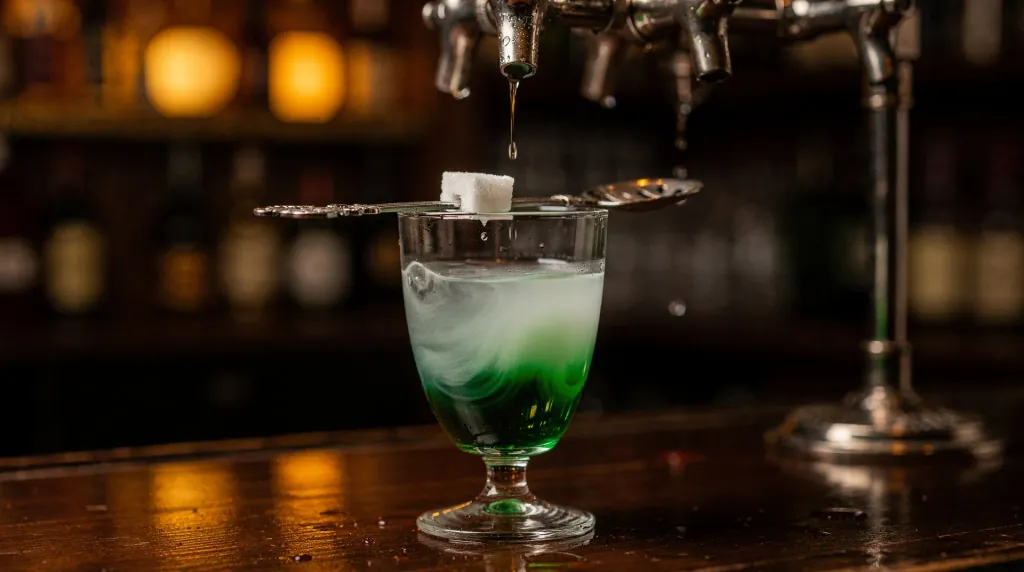
The fire ritual — setting absinthe alight after pouring it over a sugar cube — has become the standard tourist-bar service in Prague. It’s not a traditional absinthe ritual. The traditional louche (dilution with cold water, observing the milky transformation as the anise compounds precipitate) is the correct historical method. The fire ritual was popularised by Czech bars in the 1990s as a spectacle and has no basis in absinthe’s historical service tradition. It also burns off alcohol unnecessarily and slightly damages the botanical character.
Where to drink absinthe properly in Prague
The Absinthe Bar (historic cellar, Old Town)
Several bars near Old Town claim to be the “original” or “historic” absinthe venue in Prague. The most legitimate operation for a GYG-bookable experience is the Historic Cellar Absinthe Tasting — a guided tasting in a properly atmospheric setting that includes several Czech absinthes with explanation of the traditional preparation method and the history of the spirit.
Absinthe tasting Prague: historic cellar experience — the most reliable guided absinthe experience in Prague, with proper explanation and quality Czech absinthes.
Hemingway Bar
Address: Kajetánská 7, Malá Strana
Hours: Mon–Fri 17:00–01:00, Sat–Sun 14:00–01:00
Price: Absinthe €8–15 (200–375 CZK) per measure depending on product
Hemingway Bar is the most serious cocktail operation in Prague — named for the writer’s famous absinthe consumption, it stocks the widest and most curated selection of quality Czech and international absinthe available in the city. Service is traditional-method (cold water louche, no fire), and the bartenders can explain what differentiates the products on the shelf.
This is not a budget option but it is a legitimate one. The bar also makes exceptional classic cocktails.
Alchemy Bar
Address: Železná 2, Staré Město
Hours: Daily 18:00–03:00
Price: Absinthe €7–12 (175–300 CZK)
Alchemy Bar leans into the mystical Prague aesthetic — stone walls, candlelight, theatrical staging — but backs it up with a genuinely decent absinthe selection and correct service. Considerably better than the anonymous tourist cellar bars nearby. The bartenders know their products.
The tourist-trap cellar bars: what to avoid
The streets between Old Town Square and Charles Bridge are lined with basement bars that pitch aggressively to passing tourists with promises of “the strongest absinthe in Prague” and theatrical fire ceremonies. These places share common features:
- Menus outside quoting low drink prices that escalate mysteriously at the bill
- Fire ritual as the primary entertainment rather than the quality of the spirit
- Staff working on commission to bring people inside
- Extremely poor quality absinthe (often synthetic colour, cold-maceration without distillation)
- Prices of €15–25 (375–625 CZK) per shot for products worth €3–5
The correct response when approached by a tout outside any of these bars is to decline and walk on. The legitimate absinthe bars in Prague (Hemingway Bar, Alchemy Bar, the GYG cellar tasting) are not on the tourist crawl and don’t employ people to drag customers off the pavement.
Signs of a tourist-trap absinthe bar:
- Staff actively recruiting outside
- “Strongest absinthe” or “Bohemian absinthe” claims without specifics
- No bottle labels visible or identifiable products
- Fire ritual described as “traditional Czech ceremony”
- Price board outside but drinks priced differently inside
How absinthe fits into a wider Prague drinking evening
Absinthe works best as one stop in a longer evening rather than the centrepiece of a night out — the high ABV makes it a poor choice to drink in volume, and the flavour (aggressively anise-forward) rewards a slow, single serving over dinner-hour conversation rather than repeated rounds.
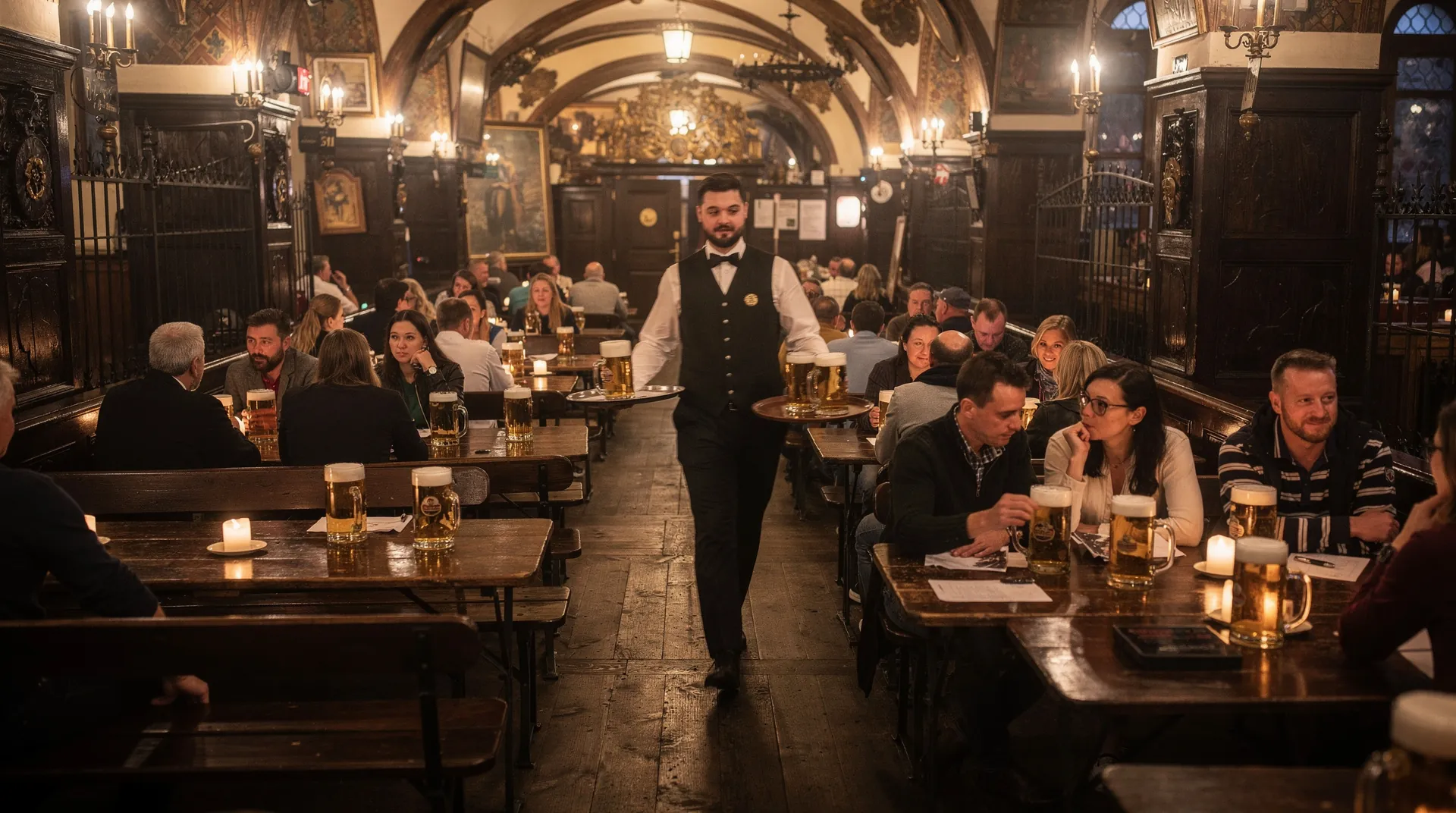
A sensible sequence: a Czech dinner in Staré Město or Malá Strana, one properly served absinthe at Hemingway Bar or Alchemy Bar afterward, then a beer hall for the rest of the night if you’re still going. Trying to “do absinthe” as a standalone activity for hours tends to produce the worst version of a Prague night — expensive, poorly paced, and centred on tourist-trap venues rather than the city’s actual best drinking culture, which is its beer halls.
If you’re building a broader spirits itinerary, pair an absinthe stop with a visit to the Monarch shop for Moravian slivovitz, or add a stop in Vinohrady for its wine bars — a useful contrast to the anise-forward absinthe profile.
Becherovka: the Czech herbal spirit that’s actually Czech
While we’re discussing Czech spirits, Becherovka deserves mention because it is an actually traditional Czech liqueur — produced in Karlovy Vary since 1807, made from a secret recipe of herbs and spices that includes cinnamon and anise as identifiable elements. It’s 38% ABV, served chilled (often as a digestif), and found in virtually every Czech restaurant and bar.
The Czech expression for the Becherovka shot is “třináctý pramen” (the thirteenth spring) — a joke reference to Karlovy Vary’s famous healing mineral springs, implying Becherovka is the most effective. It’s genuinely pleasant if you like herbaceous, slightly sweet digestifs. A shot costs €2–3 (50–75 CZK) in a standard bar.
Becherovka and tonic (known as “Beton” — Becherovka + tonic = “BeTon”) is a Czech bar classic and considerably better than it sounds.
Slivovitz and Czech fruit spirits
Czech and Moravian fruit brandy (pálenka or destilát) is another legitimate Czech spirits tradition. Slivovitz (švestkovice or slivovice) is double-distilled plum brandy — the Moravian versions from small producers are exceptional, far superior to the commercial versions sold in tourist shops.
Czech fruit spirits also include meruňkovice (apricot brandy), hruškovice (pear brandy), and trnkovice (sloe brandy). These are agricultural products tied to specific fruit orchards and regional harvest traditions. A proper slivovitz from a Moravian farmhouse producer is one of the finest spirits in Central Europe. Ask in specialist spirits shops (like the Monarch wine and spirits shop at Na Perštýně 15) or at Hemingway Bar, which stocks premium Moravian pálenky.
Common traps in Prague spirits culture
“Bohemian absinthe” as a quality indicator — this means nothing. Bohemia is a region, not an absinthe quality designation. French-style absinthe and Czech-style absinth both have legitimate forms and poor commercial versions. The term is used to add mystique without committing to quality.
Pre-mixed absinthe shots — some tourist bars sell pre-made absinthe shots that have been diluted and pre-sweetened. This is not absinthe service; it’s bar economics. Real absinthe is served unmixed and diluted with cold water at the table by the drinker, not pre-prepared.
Heritage claims about Czech absinthe — absinthe in Prague is primarily a 1990s tourism phenomenon, not a centuries-old Czech tradition (unlike Becherovka or Czech beer). Anyone claiming Prague has a “centuries-old absinthe heritage” is embellishing.
Frequently asked questions about Prague absinthe
Is absinthe legal in the Czech Republic?
Yes, completely legal, with no restrictions on sale or consumption beyond standard alcohol licensing. The Czech Republic never participated in the early 20th-century absinthe bans and has produced the spirit commercially since the 1990s.
Will drinking absinthe in Prague make me hallucinate?
No. Modern regulated absinthe contains thujone at levels far too low to cause any psychoactive effect. The reputation derives from 19th-century temperance movement propaganda and the high alcohol content of the spirit. You may be drunk; you will not hallucinate. Anyone claiming otherwise is either uninformed or trying to sell you something.
What is the correct way to prepare and drink absinthe?
The traditional French method: pour absinthe into a glass (typically 30–50ml), place a slotted spoon with a sugar cube across the glass, slowly drip ice-cold water over the sugar cube until it dissolves (ratio roughly 3–5 parts water to 1 part absinthe). The spirit will turn milky (the “louche”) as the anise compounds precipitate. Drink slowly. The fire method (setting the sugar alight) is a post-1990s invention with no historical basis.
How strong is Czech absinthe?
Commercial Czech absinth (without the “e”) often runs 60–70% ABV. Traditional-method Czech and French-style absinthes are typically 55–72% ABV. Even diluted with water at a 3:1 ratio, the resulting drink is 15–18% ABV — approximately twice the strength of wine. Pace yourself accordingly.
Where can I buy quality Czech absinthe to take home?
Hemingway Bar stocks bottles for retail sale. The Monarch wine and spirits shop (Na Perštýně 15, Staré Město) has the best spirits selection in the city centre. At the airport, the selection is worse and prices are higher — buy in the city.
Is absinthe tasting a good activity to pair with a Prague food tour?
Yes, in moderation — several Prague food tours include a single absinthe or spirits tasting alongside beer and Czech dishes, which is a sensible way to try it without committing to a standalone cellar visit. See food tours compared for options that include a spirits component.
Book a guided absinthe experience
Absinthe tasting Prague: historic cellar experience — the most reliable guided experience, with a curated selection of Czech absinthes and proper tasting instruction.
Prague: Czech beer and spirits tasting experience — a broader tasting tour that covers Czech spirits (including Becherovka and slivovitz) alongside the beer tradition.