The honest picture: Prague accessibility in 2026
| At a glance | |
|---|---|
| Where to base yourself | Vinohrady or Nové Město — flat, metro-connected, wide pavements |
| Typical cost | No accessibility premium; adapted taxis around €12–20 / 300–500 CZK per ride |
| Time needed | Add 20–30% extra time versus a standard itinerary for route planning |
| Getting there | Tram 22 is the single most useful accessible route (Castle, Malá Strana, Vinohrady) |
| Best time | Year-round; wet cobblestones in winter add extra caution on Old Town/Malá Strana routes |
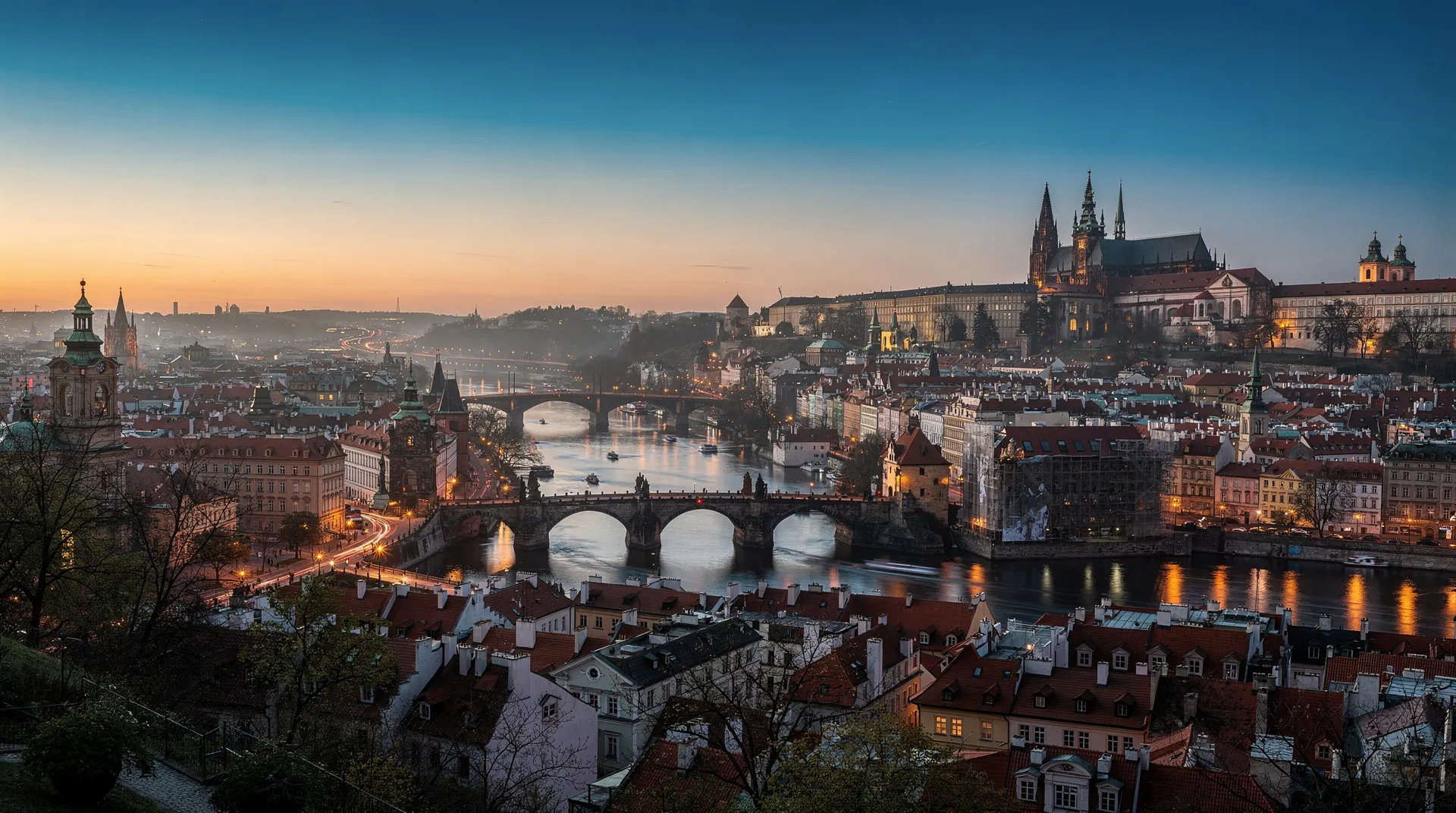
Prague is a city of extraordinary beauty and significant accessibility challenges. Built over centuries on irregular terrain, its historic core has cobblestone streets that are challenging even for pedestrians without mobility aids. The Castle district, the approach to Charles Bridge from Malá Strana, and the lanes of Nerudova are obstacles that need to be planned around.
But Prague also has areas that are genuinely excellent for wheelchair users: the flat riverbank embankments, Nové Město (New Town), Vinohrady, Letná, and much of Old Town Square’s immediate surroundings. The metro has lifts at a significant and growing number of stations. Low-floor trams operate on most city routes. Newer construction in Prague is fully accessible.
This guide is about specifics — which metro stations have lifts, how to reach the Castle accessible, what the river cruise access is like, and which neighbourhoods to base yourself in. It is not a list of encouraging generalisations.
Metro accessibility — stations with lifts (2026)
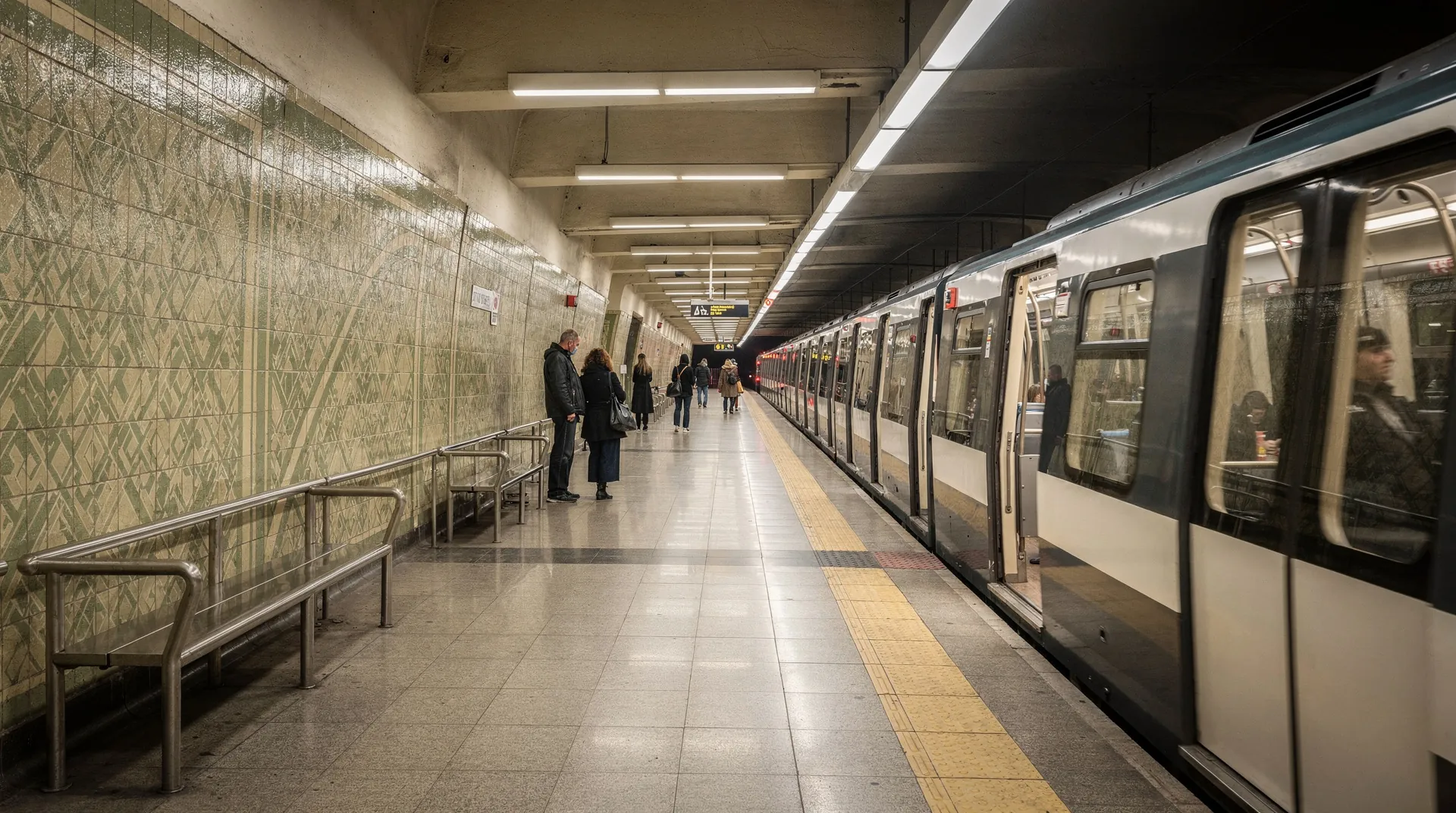
Prague’s metro has three lines (A, B, C). Not all stations have lifts. The confirmed accessible stations with operational lifts as of April 2026:
Line A (green):
- Dejvická (interchange, north-west terminus — lift fully operational)
- Hradčanská (closest metro to Castle, but the Castle itself requires separate planning — see below)
- Náměstí Míru (Vinohrady — lift operational)
- Muzeum (interchange with C — operational)
- Hlavní nádraží (interchange with C — lift to street and platforms)
- Flora (Žižkov — operational)
- Skalka (eastern Prague — operational)
Line B (yellow):
- Náměstí Republiky (Old Town edge — lift operational)
- Florenc (interchange with C — operational)
- Křižíkova (Karlín — operational)
- Invalidovna (Karlín — operational)
- Černý Most (eastern terminus — operational)
Line C (red):
- Florenc (interchange with B — operational)
- Hlavní nádraží (Praha main station — operational, major interchange)
- I.P. Pavlova (lift operational)
- Vyšehrad (near Vyšehrad fortress — lift operational)
- Pankrác (south Prague — operational)
- Budějovická (south Prague — operational)
- Háje (south terminus — operational)
- Chodov (south Prague — operational)
- Opatov (south Prague — operational)
- Roztyly (south Prague — operational)
- Nádraží Holešovice (interchange, north — operational)
- Letňany (north terminus — operational)
Important notes on metro access:
- Staroměstská (line A, Old Town) — NO lift as of 2026. The most central station has deep escalators only.
- Malostranská (line A, Malá Strana) — NO lift. Use tram instead.
- Můstek (lines A/B interchange, centre) — partial accessibility; the interchange between lines at Můstek involves steps. Avoid for direct wheelchair transit.
- Always verify before your visit: the DPP (Prague Public Transport) website at dpp.cz maintains an updated accessibility map.
Trams — the better option for much of the historic centre
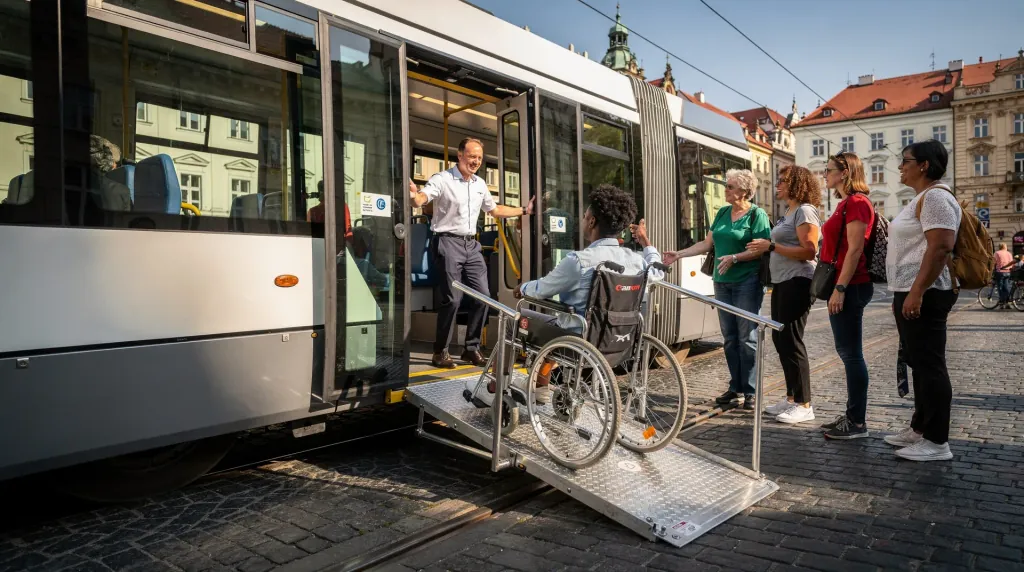
Low-floor trams (označené nízkopodlažní tramvaje) operate on the majority of Prague’s tram lines. These have level entry (or a very small step) with space for one to two wheelchairs inside. The Prague DPP tram map indicates which lines and vehicles are low-floor.
Key accessible tram routes for wheelchair users:
- Tram 22 (Vinohrady — New Town — Malá Strana — Strahov — Bílá Hora) — passes Náměstí Míru, through the city centre, towards the Castle upper entrance. This is the recommended approach to Prague Castle for wheelchair users — alight at Pohořelec or Pražský hrad stop.
- Tram 17 and 2 — along the Vltava riverbank, both directions.
- Tram 1 and 8 — to Letná Park viewpoint.
- Night trams — most night trams are older rolling stock and less consistently accessible. Check before using.
At tram stops, the button to signal a low-floor tram stop (if installed) should be pressed — some stops have a requesting system for drivers to ensure the door aligns correctly with the platform height.
Prague Castle — accessible routes
Prague Castle is one of the most-visited sites in Central Europe and has acknowledged accessibility challenges. Here is the honest detail:
The accessible recommended approach:
- Take tram 22 to Pražský hrad (Prague Castle) or Pohořelec stops. These are on the west side of the castle complex, at the same level as the castle entrance — no hill to climb from this direction.
- Enter via the Hradčanské náměstí (Castle Square) western entrance — this is accessible with gentle ramps at the gate transition.
Inside the castle complex:
-
The main courtyard between the entrance and the Cathedral is on level ground and accessible.
-
St. Vítus Cathedral: the nave is accessible from ground level (main door). The tower climb is not accessible. The crypt requires steps.
-
Old Royal Palace (Starý královský palác): ground floor of the Vladislav Hall is accessible — one of the largest secular Gothic interiors in Central Europe, worth it.
-
Golden Lane (Zlatá ulička): the lane itself is on a level path and accessible; the small house interiors are not (very small doors, low ceilings). Worth passing through even without entering.
-
Castle rampart walks: uneven historic stone, not accessible.
-
Lobkowicz Palace: has a lift to the main gallery — the most reliably accessible interior building in the castle complex.
The eastern exit (Jiřské náměstí and Jiřská street) descends steeply via stairs or old paving towards Malostranská. Avoid this exit in a wheelchair — either retrace to the western entrance or take the tourist stairs path, which has some ramp sections, to the Malostranská funicular area.
Charles Bridge
Charles Bridge itself is accessible — the bridge deck is even and wide. However, the approaches on both sides are problematic:
- Old Town side (Křižovnické náměstí): approach from the river embankment is flat and accessible.
- Malá Strana side: the immediate bridge approach involves heavy cobblestones on Mostecká street and Malostranské náměstí. These are passable in a robust manual or power wheelchair, but challenging. The route along the river to Cihelná or the Kampa island path offers a flatter alternative approach.
The bridge surface itself has worn cobblestones — robust wheelchair recommended.
Neighbourhoods by accessibility
Most accessible:
- Nové Město (New Town) — modern pavements, flat, excellent transport connections.
- Vinohrady — wide pavements, flat terrain, metro and tram access.
- Letná — mostly flat, good tram access, accessible parks.
- Holešovice — flat, tram-served, newer streetscape.
- Náplavka riverbank — purpose-built promenade, completely flat and smooth.
Partially accessible (requires planning):
- Staré Město (Old Town) — mix of accessible main streets and cobblestone side lanes. Old Town Square is accessible but reached through lanes with variable surface quality.
- Josefov (Jewish Quarter) — mostly accessible with some cobblestone near the synagogues.
Challenging (significant preparation needed):
- Malá Strana — steep lanes, cobblestones everywhere. Use tram 22 to minimise walking.
- Hradčany/Castle district — accessible via the western tram approach; the internal streets are otherwise difficult.
- Žižkov — some steep hills; specific accessible routes exist but the terrain is variable.
River cruises and boat access
The Vltava river cruise embarkation points are on the Rašínovo nábřeží (New Town embankment) and near Nusle Bridge. Most cruise boats have a gangway with a gentle slope — advance booking is recommended so operators can prepare for wheelchair boarding. The panoramic cruise (t52534) and similar short sightseeing cruises are generally accessible; confirm directly with the operator when booking.
Hotels — what to verify before booking
Prague’s historic buildings present accessibility challenges that online booking systems often understate. Before confirming:
- Confirm that accessible rooms are truly step-free from entrance to room (check: entrance step, lift access, bathroom configuration).
- Ask specifically about bathroom grab rails and roll-in shower access.
- Verify the hotel entrance approach — many historic Old Town hotels have a step or two at the door that appears in no listing.
- Hotels built or substantially renovated after 2000 are more reliably accessible: NH Collection Prague, Marriott Prague, Hilton Prague Old Town, and similar international chains in Nové Město.
Day-by-day sample (2 days, accessible routing)
Day 1 — Old Town, Jewish Quarter, riverbank Start at Náměstí Republiky (metro B, lift operational). Walk to Old Town Square via Celetná street (mostly smooth pavement). Josefov — Jewish Quarter synagogues (most ground floors accessible). Lunch near Old Town Square (Lokál on Dlouhá, accessible entrance). Afternoon: tram 17 or 2 along the Náplavka embankment — the most accessible scenic route in the city. Evening: boat cruise from the embankment (confirm wheelchair access when booking).
Day 2 — Prague Castle from the west Tram 22 from your hotel (or from Náměstí Míru if staying in Vinohrady) to Pražský hrad stop. Enter the castle via the western Hradčanské náměstí entrance. Cathedral nave, Vladislav Hall (Old Royal Palace ground floor), Golden Lane exterior, Lobkowicz Palace with lift (t48430 — optional concert at noon). Return by tram 22. Afternoon: Náplavka walk, Vyšehrad by metro C (Vyšehrad station, lift operational). Vyšehrad grounds are largely accessible.
Questions wheelchair users and mobility-impaired travelers ask
Is the Prague Zoo accessible for wheelchairs?
The zoo has significant accessibility investment — most main paths are paved, there is a mobility aid loan scheme at the entrance, and an accessible parking area. Some natural-terrain sections are less accessible. The zoo’s own website has an accessibility map.
Are there accessible taxis and adapted vehicles?
Yes. Liftago and some Bolt drivers have adapted vehicles (request in-app under accessibility options). Prague city hall maintains a list of accessible taxi services. Hotel concierge services can arrange pre-booked adapted transfers.
Can I visit Kutná Hora in a wheelchair?
The train journey is accessible (České dráhy have accessible carriages — request a wheelchair space when booking). At Kutná Hora: the centre is on mostly level ground. St. Barbora’s Cathedral has accessible ground floor access. Sedlec Ossuary (Bone Church) has an accessible entrance. The town is one of the better day-trip destinations for wheelchair users.
What about accessible toilets in Prague’s historic centre?
Accessible toilets exist in most major museums, at Prague Castle, at the larger metro stations (Hlavní nádraží, Florenc, Nádraží Holešovice), and in many modern restaurants. In the historic core, accessible WC coverage is patchy. A useful resource is the ToiletFinder mobile app (crowdsourced accessible toilet locations).
2026 budget for wheelchair users in Prague
Prague is affordable for wheelchair users, with no significant cost premiums for accessibility adaptations. Key cost items:
| Category | Cost | Notes |
|---|---|---|
| Accessible hotel room (per night) | €80–150 / 2000–3750 CZK | Verify roll-in shower before booking |
| Prague Castle Basic ticket | €18 / 450 CZK adult | Accessible via western approach only |
| Jewish Museum (all sites) | €24 / 600 CZK | Most ground floors accessible |
| DPP 24h transport pass | €6 / 150 CZK | Low-floor trams free with disability card |
| River cruise | €15–25 / 375–625 CZK | Confirm gangway access when booking |
| Adapted taxi (Liftago) | €12–20 / 300–500 CZK | Book 24h ahead |
Recommended itinerary daily budget: €130–200 / 3250–5000 CZK for accommodation, meals, accessible transport, and one paid activity per day. Prague’s flat accessible areas (Náplavka, Vinohrady, Nové Město) make 2–3-hour activity windows very manageable without excessive fatigue.
Recommended 2-day accessible itinerary
Day 1 — Old Town, Jewish Quarter, riverbank
9:30 — Take metro B to Náměstí Republiky (lift operational, confirmed). Walk down Celetná street to Old Town Square (mostly smooth pavement, 10 minutes). 10:30 — Old Town Square: the Astronomical Clock show is visible from the square (no entry required). Walk to Josefov via Pařížská (good pavement). Most synagogue ground floors are accessible — Pinkas Synagogue and Spanish Synagogue are the most reliably accessible interiors.
12:30 — Lunch at Lokál Dlouhá (Dlouhá street, accessible entrance). 14:00 — Tram 17 or 2 to the Náplavka riverbank (alight at Palackého náměstí). The Náplavka is the most reliably smooth and flat walkway in Prague — purpose-built promenade for 2+ km along the water. 16:00 — Boat cruise from Rašínovo nábřeží (confirm wheelchair gangway access when booking — most operators accommodate with advance notice). 18:00 — Tram back to hotel.
Day 2 — Prague Castle from the west
9:00 — Tram 22 from your hotel to Pražský hrad stop (low-floor tram, direct to castle level — no hill). 9:30 — Enter via western Hradčanské náměstí gate (gentle ramp at gate transition). Cathedral nave (accessible), Vladislav Hall in the Old Royal Palace (ground floor, fully accessible — one of the largest secular Gothic interiors in Europe). Golden Lane exterior (accessible path).
Lobkowicz Palace (lift to main gallery — the most accessible interior building in the entire castle complex). 12:30 — Lobkowicz Palace café (accessible) for lunch. 14:00 — Return by tram 22. 15:30 — Vyšehrad by metro C (Vyšehrad station, lift operational). Vyšehrad grounds are largely accessible — smooth paths, good panorama of the Vltava bend. 17:30 — Return by metro C.
What wheelchair users often get wrong
The Old-New Synagogue is NOT accessible. The Staronová synagoga — the oldest functioning synagogue in Europe, the most historically significant building in Josefov — has several steps at its entrance and no lift. Even the entrance area has stone step thresholds. If you’re visiting Josefov in a wheelchair, prioritise the Spanish Synagogue (accessible ground floor) and Pinkas Synagogue (accessible main floor) instead. The Old-New Synagogue’s historic significance is real — this is not a criticism, simply a planning note.
The eastern Castle exit is inaccessible. If you enter Prague Castle from the western (tram) side, do not exit via the eastern Jiřská street gate — it descends steeply via stairs and rough old paving to the Malostranská area. Return the way you came (western gate, tram 22) or ask castle staff about the accessible alternative exit route.
Not all boats are equally accessible. The panoramic cruise boats on the Vltava vary significantly in their gangway gradient. The glass-roof boats (t71030) are typically easier to board than some of the older vessels. Always call ahead or select the specific boat in your booking confirmation, and specify that you need wheelchair access. The Evening Eco Cruise (t217848) has been reported as accommodating with advance notice.
Malostranská metro station has no lift. This is important for visitors who plan to take the metro to Malá Strana. There is no accessible route from Malostranská metro to the street for wheelchair users. Use tram 22 for all Malá Strana access.
Local accessibility hacks
The Náplavka is your default afternoon option. The river embankment path from Palackého Square to the National Theatre (approximately 2 km) is completely flat, smooth, wide, and consistently maintained. It is the best accessible walk in Prague — good views, river atmosphere, accessible toilets at the National Theatre area. Many wheelchair users build their Náplavka walk into every day in Prague as a reliable, unstressful outdoor activity.
Prague Zoo’s accessibility map (downloadable from the zoo’s own website) marks every path on-site as either accessible, challenging, or inaccessible. Download this before arrival. The zoo is one of the best-organised accessible venues in Prague — mobility aid loan scheme at entrance, accessible parking, most main paths paved to good standard.
Adapted taxi booking. Liftago app has a specific accessible vehicle option. Bolt’s app has an accessibility filter. For Prague Castle visit days, booking an adapted taxi to the Pohořelec tram stop and back is the most stress-free solution (typically €15–20 / 375–500 CZK one way from central accommodation).
Accessible day trips and neighbourhood planning
Beyond the city, Kutná Hora (day trip guide) is genuinely one of the better options — the town centre is mostly level, and the train from Prague has accessible carriages if booked ahead. If you’re comparing how to reach any day trip, our train vs bus vs tour comparison is worth reading before booking, since coach transfers vary widely in how well they handle a wheelchair.
Within the city, pair an accessible day with the flatter neighbourhoods: Vinohrady for wide pavements and metro access, or Holešovice for tram-served streets near the zoo. For an overall trip structure that accounts for slower, more deliberate pacing, our 3-day Prague itinerary can be adapted around the accessible routes above rather than the standard walking version. It’s also worth reading the safety guide for general orientation before you travel.
Expanded accessibility FAQ
Which hotels in Prague are genuinely accessible?
Hotels built or substantially renovated after 2000 are most reliable: NH Collection Prague (Nové Město, step-free from entrance to all floors), Marriott Prague, Hilton Prague Old Town, and the Vienna House Andel’s (Smíchov). These all have roll-in shower option available and confirmed step-free access from street to room. Historic boutique hotels in Old Town and Malá Strana: always call and ask specific questions — entrance step height, bathroom rail configuration, corridor width — rather than trusting booking.com accessibility filters.
Can I visit Kutná Hora in a wheelchair?
The train journey is accessible (České dráhy have accessible carriages, request a wheelchair space at booking). At Kutná Hora: the town centre is mostly flat. Sedlec Ossuary (Bone Church) has an accessible entrance route (approach from the car park side, not the main gate). St Barbora’s Cathedral has accessible ground floor access. The town is one of the better day-trip destinations for wheelchair users from Prague.
How do I request a wheelchair space on Czech trains?
When booking via cd.cz (Czech Railways website), there is a specific option for wheelchair spaces in accessible carriages. These must be booked in advance (not available for purchase on the platform). Call the CD accessibility line (+420 221 111 122) if the online booking is unclear. The accessible carriages are positioned at specific points on the platform, which is indicated on the station information boards.
Is there accessible toilet coverage along tourist routes?
Most major museums, Prague Castle, metro stations with lifts (Hlavní nádraží, Florenc, Nádraží Holešovice, Náměstí Republiky), and the National Theatre have accessible toilets. The ToiletFinder app (crowdsourced) is useful for real-time coverage. In the Malá Strana cobblestone area, coverage is sparse — plan around museum facilities.
Is Prague harder to navigate in a wheelchair than Vienna or Budapest?
Generally yes, because of the historic cobblestone core, but Prague’s metro-lift coverage and low-floor tram network are comparable to both cities. The honest difference is that Prague’s most photogenic areas (Malá Strana, the Castle approaches) are also its least accessible, whereas in Vienna the historic core is flatter. Planning around tram 22 and the Náplavka embankment closes most of the gap.
Book accessible Prague experiences
Prague city highlights by bus, boat and on foot — minimises walking through cobblestone areas while covering the main sights.
City Sightseeing Prague hop-on hop-off bus (48h) — the hop-on hop-off buses are generally accessible; confirm with the operator when booking.
Prague panoramic bus tour and river cruise — combination of bus and boat minimises the need for extended walking on cobblestones.