What Dejvice offers that the center can’t
Dejvice is the answer to a specific travel question: where do you stay in Prague if you want a real apartment in a real neighborhood, walking-distance to a good bakery and a farmers’ market, without the noise of the tourist center, with direct metro access to everything, and a quick hop to the airport?
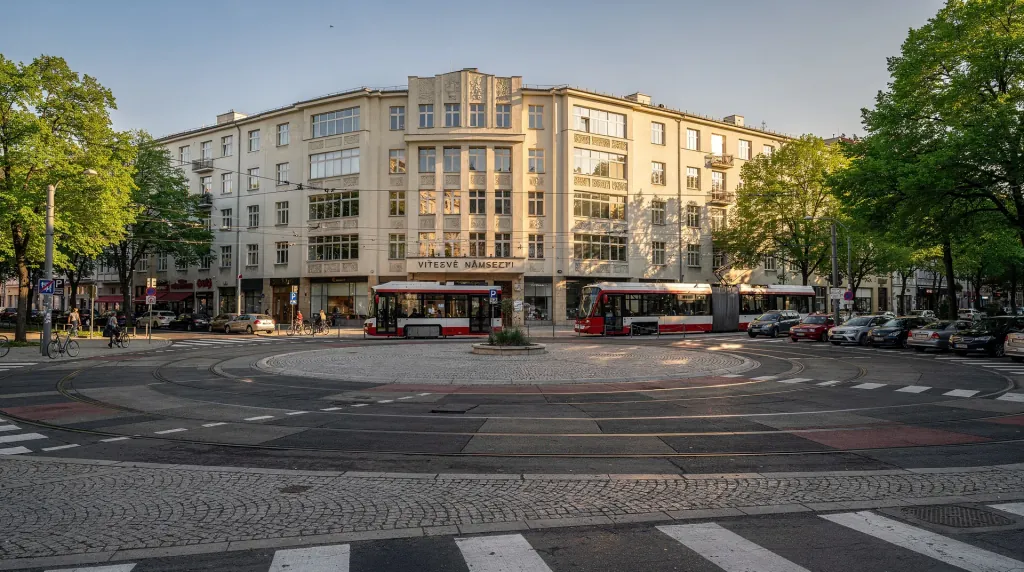
The neighborhood was developed in the 1920s as Prague’s first planned garden suburb — wide avenues radiating from the Vítězné náměstí (Victory Square) roundabout, lined with functionalist and Art Deco apartment buildings housing the diplomatic corps, academics from the nearby Czech Technical University, and the professional class that didn’t want the density of Nové Město.
That DNA persists. Dejvice has more embassies and diplomatic residences than anywhere in Prague. It has the best bakery density outside of Vinohrady. It has almost no nightlife and is almost entirely quiet after 10 pm. The airport is 20 minutes on metro line A (Dejvická is the terminal station for the airport bus). For families with young children, for business travelers, and for anyone visiting for a week who wants to feel like they have a home base rather than a hotel room — Dejvice makes considerable sense.
| At a glance | |
|---|---|
| Where | Prague 6, west of Hradčany, around Vítězné náměstí |
| Cost to visit | Free to walk; a coffee and pastry runs around €4–5 (100–125 CZK) |
| Time needed | 2–3 hours for the walk; a half-day if you add Divoká Šárka |
| Getting there | Metro A to Dejvická (western terminus), or trams 2/20/26 |
| Best time | Weekday mornings for the Baba Colony; summer afternoons for Divoká Šárka swimming |
A walk through Dejvice
Allow two to three hours at a relaxed pace. For visitors comparing neighborhoods to base themselves in, Dejvice sits at the quiet end of the spectrum — see how it stacks up against Hradčany and Holešovice below.
How Dejvice compares to nearby neighborhoods
| Neighborhood | Vibe | Best for | Distance to castle |
|---|---|---|---|
| Dejvice | Quiet, residential, diplomatic | Long stays, families, airport access | 20 min walk |
| Hradčany | Hilltop, monumental, quiet after hours | Castle visitors wanting depth | Adjacent |
| Holešovice | Post-industrial, arts-adjacent | DOX, Letná beer garden, markets | 25–30 min |
| Vinohrady | Residential, café-dense, lively | Food, nightlife balance | 30+ min |
Start at Vítězné náměstí (Victory Square), the neighborhood’s organizing hub — a large roundabout from which six avenues radiate outward. The square is flanked by a functionalist post office, a cinema (Kino Dejvice — repertory and arthouse), and various embassies. It’s not beautiful in the way that Náměstí Míru is beautiful, but it’s purposeful and human-scaled.
Walk north on Jugoslávských partyzánů toward the Baba House Colony — a residential settlement of functionalist villas built in 1928–1940 by Czech architects influenced by the Bauhaus and Dutch modernism. The colony was created by the Czech Werkbund as a model modern housing development and represents some of the finest early modernist domestic architecture in Central Europe. Walk the streets — Matějská, Na Ostrohu, Průhledová — and look at the buildings. Most are still residential and most are in excellent condition.
Return south and walk west along Čs. armády toward Bubeneč and the edge of Divoká Šárka — a nature reserve on the northwestern edge of Prague that encompasses a rocky valley with trails, a reservoir for swimming, and a beach area. The reserve starts about 20 minutes’ walk from Dejvická metro and is where the neighborhood’s residents go in summer for what amounts to countryside within city limits.
Back toward the center, walk south on Dejvická to the Czech Technical University (ČVUT) campus and the collection of functionalist faculty buildings from the 1930s. The university’s main building on Technická has a notable interior with functionalist fittings that are rarely seen by non-students.
Prague Castle and monastery segway tour (2 h, from €43)Where to eat
Quick lunch
Café Sladkovský on Jugoslávských partyzánů is the neighborhood’s most popular lunch café — daily menus of Czech classics and seasonal plates at €7–10 (175–250 CZK), always busy with university staff and embassy workers. Restaurace Nebozízek on Petřínské sady (technically Petřín/Smíchov border but close) is Prague’s most atmospheric hilltop restaurant — Czech cuisine with the city panorama below, mains €12–18 (300–450 CZK).
Dinner
Cobble’s on Bubenečská is the neighborhood’s best dinner option — modern Czech cooking in a comfortable, resident-facing room, mains €16–22 (400–550 CZK). For something more casual, Bistro Rydl on Dejvická serves good Czech-French bistro food to the neighborhood’s professional population at accessible prices. The neighborhood doesn’t have a dense restaurant scene, which is part of its character — residents cook at home or take the ten-minute metro to Vinohrady.
Cafes and bakeries
Pekar Šimek on Jugoslávských partyzánů is the gold standard — a serious bakery producing sourdough bread, rye loaves, and pastries that justify the morning queue. Café Patio near Vítězné náměstí is the local espresso benchmark for the embassy and university crowd. Kavárna Větrník near the Divoká Šárka entrance is a cyclist café with good coffee and a terrace that fills with cyclists in summer.
Where to drink
Dejvice is not a drinking neighborhood. U Bílého lva on Čs. armády is the honest neighborhood pub — Czech lager, standard prices, no pretension. Vinotéka Degustation on Dejvická is a wine bar with a serious Czech and Moravian wine list, serving the residents who prefer wine to beer. For anything more ambitious, the metro to Vinohrady is ten minutes.
Where to stay
Dejvice works excellently for accommodation — you get apartment-style residential neighborhood pricing, quiet streets, and the fastest access to the airport in the city. The Hotel International Prague on Náměstí Curieových (actually in Bubeneč, but adjacent) is a well-known mid-range option in a communist-era building with a vintage-Stalinist interior that is either fascinating or alarming depending on your perspective. Hotel President nearby is more anonymous but reliable. For serviced apartments, Dejvice has the best supply of genuine long-stay apartment rentals in a pleasant neighborhood without tourist premium.
Getting here and around
Dejvická is the western terminus of metro line A (green). This makes it the most convenient neighborhood for airport travel — the airport bus (119) and the new metro line D (under construction, with a future station nearby) both serve this area. Walking time from Dejvická to Hradčany/castle: 20 minutes. To Malostranská: 15 minutes. Trams 2, 20, 26, and the seasonal tram 41 (historical tram) run through the neighborhood.
Common misses in Dejvice
The Baba House Colony is genuinely unknown to most visitors even though it’s architecturally significant and completely accessible — you just walk the streets of a 1930s functionalist housing development. No ticket, no tour, no brochure. The houses on Na Ostrohu and Matějská are the most architecturally notable.
Divoká Šárka reservoir in summer: swimming in a reservoir surrounded by forest within 20 minutes of the city center. There is a beach, rental paddleboats, and a kiosk. Absolutely no one from the tourist circuit knows this exists.
Kino Dejvice on Vítězné náměstí is the best repertory cinema in Prague after Kino Aero — programming of classic and international arthouse cinema in a neighborhood cinema that has been running since 1929. Screenings in original language with Czech subtitles.
Prague Castle District segway tour (2 h, from €39)Frequently asked questions about Dejvice
How long does it take to get from Dejvice to the airport?
From Dejvická metro station, bus 119 takes about 20 minutes to Václav Havel Airport. Alternatively, the new Prague metro line A extension now connects more directly (check current service status as of your visit date). Total travel time from Dejvice to your gate: about 30–35 minutes.
Is Dejvice far from the tourist sights?
The metro puts you in the center fast. From Dejvická: two stops to Hradčanská (walk to castle), three stops to Malostranská, five stops to Staroměstská (Old Town Square). Total journey: 8–12 minutes. Most people’s concern about being “far” from the center is not borne out in practice.
What is the Baba Colony?
The Baba Villa Colony (Kolonie Baba) is a residential estate of 33 functionalist villas built between 1928 and 1940, designed by leading Czech architects as part of the Czech Werkbund’s model housing project. Each house was built as an individual commission, resulting in a coherent but varied streetscape. It’s listed as an architectural landmark and is genuinely one of the finest collections of early modern domestic architecture in Central Europe.
Are there any parks near Dejvice?
Divoká Šárka (Wild Šárka) nature reserve is the main one — a rocky valley with trails, a reservoir for swimming, and protected wildlife. Stromovka Park (the city’s largest park) is 15 minutes on foot to the east, via Bubeneč. The Royal Garden at Prague Castle is 20 minutes on foot to the south.
Is Dejvice good for children?
Very good. Divoká Šárka has safe swimming in summer, and the neighborhood streets are quiet enough for cycling. The Czech Technical University campus has open green spaces. Stromovka Park and Prague Zoo are reachable in 20 minutes. The neighborhood has good primary schools and is where many expat families with children choose to live.
Is Dejvice safe at night?
Yes — it’s one of the calmest neighborhoods in Prague after dark, precisely because it isn’t a nightlife district. If you’re weighing safety and logistics across the whole city, the safety guide and scams to avoid page cover what actually matters for visitors, and neither issue is prominent in Dejvice.
What’s the best way to get from the airport to Dejvice?
The airport bus (119) terminates at Dejvická metro, making Dejvice one of the fastest neighborhoods to reach from Václav Havel Airport — see the airport-to-city guide for the full range of options if you’re comparing taxi, bus, and transfer costs.
Full day in Dejvice: 9 am to 10 pm
9:00 — Start at Pekař Šimek (Jugoslávských partyzánů 22) for coffee and fresh sourdough — the best morning bakery in the neighborhood, morning queue of embassy workers and ČVUT faculty. Buy a loaf for the evening if you have accommodation with a kitchen.
10:00 — Walk north on Jugoslávských partyzánů and turn right toward the Baba House Colony — enter via Matějská or Na Ostrohu. The colony contains 33 functionalist villas designed by Czech Werkbund architects between 1928 and 1940. Walk slowly along the streets: each house is an individual commission, resulting in a coherent but varied collection of early modernism. No ticket, no brochure, no visitors. Just walk the streets and look at the buildings.
11:30 — Return to Vítězné náměstí and examine the roundabout architecture: the functionalist post office (1930s, still the neighborhood’s main post office), the Kino Dejvice (1929, still showing repertory cinema in original-language versions), and the surrounding apartment facades. The square has a rational beauty that grows on you.
12:30 — Lunch at Café Sladkovský (Jugoslávských partyzánů 24) — daily menus of Czech classics at €7–10 / 175–250 CZK. Always full of university staff and embassy workers eating the polévka (soup) and main-course special; service is quick and competent.
14:00 — Walk or take tram 2/20 west to Divoká Šárka nature reserve. In summer, the reservoir has a beach and rentable paddleboats; in any season the rocky valley trails are excellent for an hour’s walking. This is where Dejvice residents go when they want countryside without leaving the city. From the reserve entrance, the walk back to Dejvická metro takes about 20 minutes along Šáreckého údolí trail.
16:00 — Coffee stop at Kavárna Větrník near the Šárka entrance — a cyclist café with a good terrace and reliable espresso, serving the park-and-Baba-Colony crowd.
17:00 — Walk south toward the ČVUT campus (Czech Technical University, Technická 2). The 1930s functionalist faculty buildings are open during working hours; the main hall on Technická has interior fittings that show Czech interwar modernism at its most considered. Rarely visited by anyone outside the university.
18:30 — Aperitivo at Vinotéka Degustation (Dejvická 14) — a wine bar with a serious Czech and Moravian wine list. A glass of Moravian Welschriesling or Frankovka costs €5–7 / 125–175 CZK. This is where Dejvice residents drink when they’re not going south to Vinohrady.
20:00 — Dinner at Cobble’s (Bubenečská 19, Bubeneč, 10 minutes on foot) — modern Czech cooking in a neighborhood-facing room. Mains €16–22 / 400–550 CZK. One of the best restaurants in this part of the city and almost unknown to visitors. Book ahead for evenings.
21:30 — If there’s an evening programme at Kino Dejvice (Vítězné náměstí 16), this is the correct way to end a Dejvice day. The cinema has been programming arthouse and classic cinema since 1929. Ticket €7 / 175 CZK.
Dejvice’s daily rhythm
6:30–9 am — The most purposeful part of the day: faculty and embassy workers at Pekař Šimek and Café Patio, trams full of commuters, Jugoslávských partyzánů busy with the working population heading toward Dejvická metro.
9 am–12 pm — The neighborhood empties into offices and lecture halls. Best time to walk the Baba Colony without anyone in the way. Divoká Šárka is quiet on weekdays.
12–2 pm — University and embassy lunch hour. Café Sladkovský and the daily-menu restaurants in the streets around Vítězné náměstí are full. Brief, purposeful crowds.
2–6 pm — Quietest period, especially Monday to Friday. Baba Colony walks are excellent now. Divoká Šárka reservoir swimming in summer.
6–10 pm — Evening residential atmosphere. Vinotéka Degustation fills. Kino Dejvice programmes at 18:30 and 21:00. The neighborhood is genuinely quiet after 10 pm — this is not a late-night district.
After 10 pm — Almost silent. Residents sleep. Trams run until midnight. For late-night activity, the metro to Vinohrady takes 8 minutes.
Where to stay in Dejvice
Hotel International Prague — Náměstí Curieových 43, Bubeneč (adjacent to Dejvice), from €85 / 2125 CZK per night. A 1952 Stalinist-era hotel built in the “wedding-cake” Soviet style, renovated to current comfort standards while preserving the extraordinary lobby and public spaces. Pros: genuinely unique architectural experience, large rooms, excellent location near Dejvická metro. Cons: the décor is either fascinating or unsettling depending on your disposition; the surrounding Bubeneč streets are residential and very quiet after 8 pm.
Hotel President — Náměstí Curieových 100, Bubeneč, from €100 / 2500 CZK per night. The anonymous business hotel adjacent to Hotel International — reliable, modern, forgettable in the best possible way. Pros: good facilities, consistent quality, direct tram connections. Cons: no character, could be anywhere in Europe.
Serviced apartments (various) — Dejvice has the best supply of genuine long-stay apartment rentals in a pleasant Prague neighborhood at non-tourist prices. Airbnb and local agencies both offer apartments in the functionalist buildings around Vítězné náměstí from €65–90 / 1625–2250 CZK per night for a studio, less for weekly rates. Pros: you genuinely live in the neighborhood, access to the bakeries and markets, more space than a hotel room. Cons: no hotel services; requires self-catering orientation.
Food recommendations in Dejvice
Café Sladkovský — Jugoslávských partyzánů 24, Dejvice. Open Mon–Fri 8 am–8 pm, Sat 9 am–4 pm. The neighborhood lunch institution — daily Czech menus at €7–10 / 175–250 CZK, queue at noon. Good polévka (soup), solid svíčková, unpretentious atmosphere.
Cobble’s — Bubenečská 19, Bubeneč (10 min walk from Vítězné náměstí). Open Tue–Sat 6 pm–11 pm. Modern Czech cooking in a neighborhood-facing room; one of the better dinners in this part of Prague. Mains €16–22 / 400–550 CZK. Reservations recommended.
Bistro Rydl — Dejvická 5, Dejvice. Open Mon–Fri 11 am–9 pm. Czech-French bistro food at accessible prices; the neighborhood’s casual dinner option. Mains €11–16 / 275–400 CZK. Good steak tartare and daily fish.
Pekař Šimek — Jugoslávských partyzánů 22, Dejvice. Open Mon–Fri 7 am–7 pm, Sat 8 am–2 pm. The serious bakery: sourdough, rye, levain loaves baked overnight. Croissant €1.60 / 40 CZK, bread loaf €5 / 125 CZK. Morning queue standard on weekdays.
Kavárna Větrník — Near the Divoká Šárka entrance, Bubeneč side. Open daily in summer 9 am–8 pm; closed Nov–Mar. A cyclist café with espresso and snacks, terrace overlooking the park entrance. Coffee €2.80 / 70 CZK. Seasonal and weather-dependent.
Bars and cafés in Dejvice
Café Patio — Near Vítězné náměstí, Dejvice. The local espresso benchmark for the embassy and university crowd. Flat white €3 / 75 CZK. Good for morning meetings; quiet afternoons.
Vinotéka Degustation — Dejvická 14, Dejvice. Open Mon–Sat 4 pm–11 pm. The neighborhood wine bar — Czech and Moravian wines by glass and bottle, with knowledgeable staff. Glass from €4.50 / 112 CZK. Not a tourist destination; residents only in the evenings.
U Bílého lva — Čs. armády 22, Bubeneč. The honest neighborhood pub — Czech lager at pub prices, no renovation, standard Prague non-tourist atmosphere. Half-litre Kozel €1.60 / 40 CZK.
Hidden details in Dejvice
The Baba Colony’s design principle — the 33 houses of the Kolonie Baba (accessible via Matějská and Na Ostrohu streets) were each commissioned from different Czech architects, with the constraint that they demonstrate progressive living principles: flat roofs, large windows, terraces for outdoor living, flexible interior layouts. The project, organized by the Czech Werkbund in 1928–1940, was deliberately residential rather than monumental — it was intended as a demonstration that good architecture belonged in ordinary domestic life, not just in public buildings. The houses are still private residences; you walk the street, not inside.
ČVUT main building interior — the Czech Technical University’s main building at Technická 2 has a 1930s functionalist interior that is rarely seen by non-students. The main hall, staircase, and faculty corridors preserve original fittings — terrazzo floors, steel-framed windows, built-in furniture — that show Czech interwar architecture at its most rigorous. Visitors can enter during university hours without special permission; just walk in as if you belong.
Kino Dejvice’s programming — the cinema at Vítězné náměstí 16 has been programming non-commercial cinema since 1929, with the only interruption being forced closures under Nazi and communist occupation. The current programme leans toward world cinema and classic repertory, screened in original language with Czech subtitles. Tickets cost €7 / 175 CZK. The building itself — an interwar functionalist cinema facade — is worth looking at from the street even if you don’t go inside.
Practical at a glance
- Metro: Dejvická (A, green line — western terminus)
- Trams: 2, 20, 26 connecting to Malá Strana and the center
- Walking time to Prague Castle: 20 min
- Airport bus: 119 from Dejvická, about 20 min
- Vibe: Quiet, diplomatic, residential, functionalist architecture, great bakeries
- Best for: Long stays, families, airport convenience, those wanting neighborhood calm