| At a glance | |
|---|---|
| Where | South and east of Staré Město, anchored by Wenceslas Square and the National Theatre |
| Cost to visit | Free to walk; National Theatre standing room from around €6 (150 CZK); hotels 20–35% cheaper than Old Town |
| Time needed | Half a day for the main walk; longer if you’re using it as your base |
| Getting there | Metro Můstek (A/B) or Muzeum (A/C); trams 2, 3, 5, 9, 14, 18, 24 |
| Best time | Morning for the Art Nouveau facades with good light; avoid the lower square late at night if you’re not interested in the nightlife strip |
The part of Prague that actually functions like a city
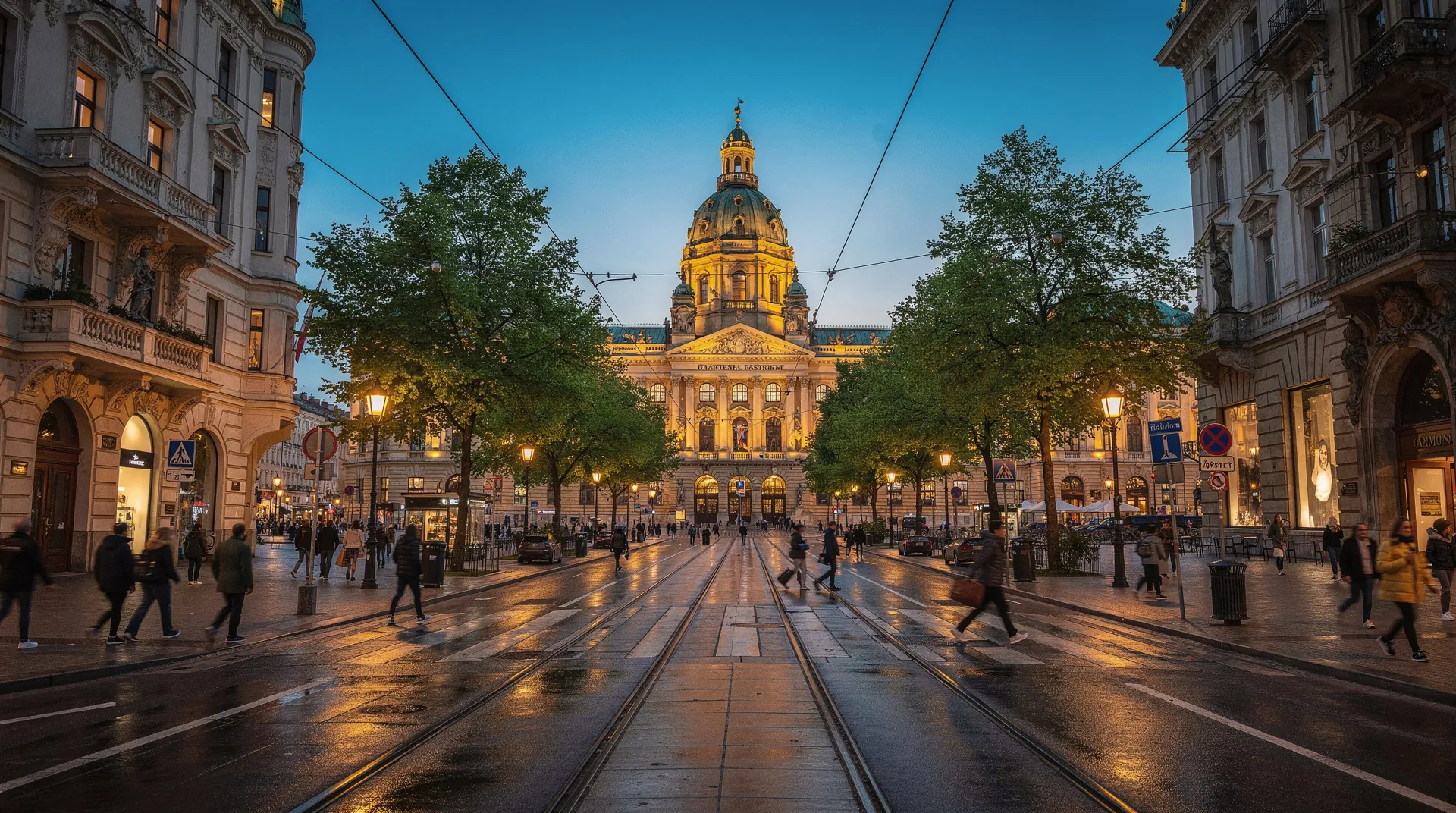
The name means New Town, but Nové Město was founded in 1348 by Charles IV — it’s been “new” for almost 700 years. Where Staré Město is a medieval theme park (in the best and worst senses), Nové Město is where Prague runs. The main post office is here. The major department stores and shopping streets are here. The National Theatre is here. And the Art Nouveau architecture — particularly along Wenceslas Square and the surrounding streets — is among the most concentrated in Europe.
Nové Město makes an excellent base for most visitors precisely because it isn’t Old Town. Hotel prices are 20–35% lower for comparable quality. The tram and metro networks radiate from here, so you’re never more than two stops from anything. And the crowds that choke Staroměstské náměstí simply don’t appear here, even in August.
The honest caveat: Václavské náměstí (Wenceslas Square) is beautiful at the top near the museum, functional in the middle, and seedy at the bottom, where the pedestrian zone dissolves into a strip of nightclubs, exchange offices, and fast food. The neighborhood has range — it contains both the National Theatre and the street where most of Prague’s sex industry operates. You navigate it accordingly.
How Nové Město compares to nearby neighborhoods
| Neighborhood | Vibe | Best for | Distance from Nové Město |
|---|---|---|---|
| Nové Město | Commercial, cultural, Art Nouveau | Value stays, shopping, theatre | Within it |
| Staré Město | Medieval core, tourist-dense | Old Town Square, Astronomical Clock | 8–10 min |
| Vinohrady | Residential, leafy, local-feeling | Longer stays, real neighborhood life | 10–15 min |
| Vyšehrad | Quiet fort, views, park | A slower afternoon, escaping crowds | 20 min |
A walk through Nové Město
Start at the top of Václavské náměstí (Wenceslas Square) at the equestrian statue of St Wenceslas in front of the Národní muzeum (National Museum). The square isn’t a square — it’s a 750-meter boulevard, originally a horse market. Walk the full length slowly and look at the Art Nouveau facades, particularly the Hotel Evropa at the midpoint (currently under restoration but visually extraordinary from the outside). The square witnessed the most significant moments of 20th-century Czech history: the declaration of independence in 1918, the Nazi occupation in 1939, the Soviet tanks in 1968, and the Velvet Revolution in 1989.
At the bottom of the square, turn right onto Jindřišská to find the Jindřišská věž (St Henry’s Tower), a Gothic bell tower with a café at the top offering urban views. Turn left down Na Příkopě — this street follows the line of the medieval moat that once separated Staré Město from Nové Město and is now the city’s prime retail street.
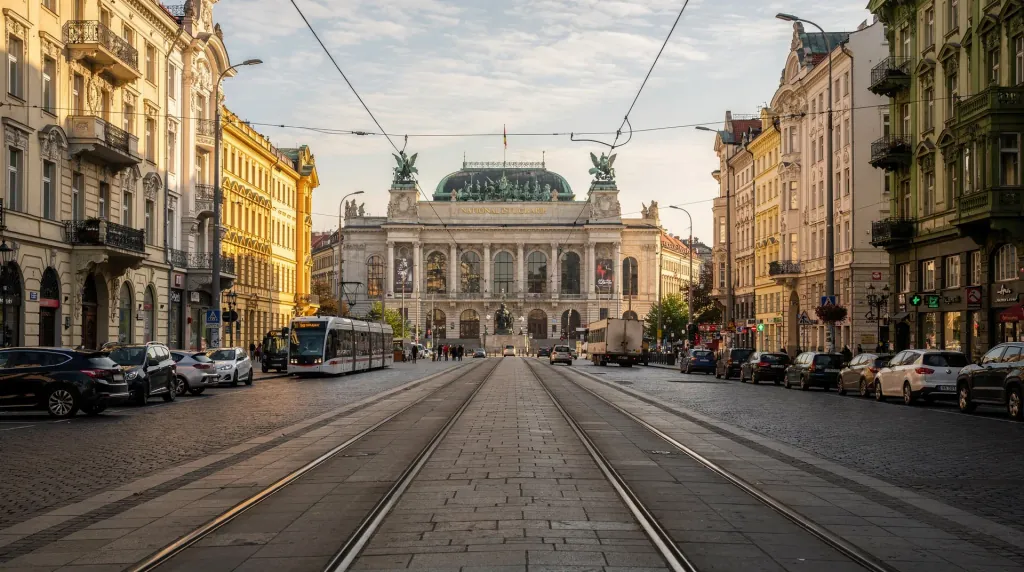
Cut south toward Národní třída (National Avenue), the cultural spine of the neighborhood. The Národní divadlo (National Theatre) on the riverbank is a neo-Renaissance jewel, funded by public subscription in the 1880s. Even if you don’t attend a performance, the building’s position on the Vltava is spectacular from the bridge opposite.
Walk back east along Vodičkova into the covered gallery of Lucerna Palace — designed by Václav Havel’s grandfather, it is the grandest of Prague’s many Art Nouveau shopping arcades, with a cinema, bar, and a famous kitsch sculpture by David Černý (an upside-down St Wenceslas on an upside-down horse, suspended from the arcade ceiling). The Vinohrady Theatre at Náměstí Míru is technically in the next neighborhood but is a worthwhile detour.
Prague Art Nouveau walking tour (2 h, from €16)Where to eat
Quick lunch
Café Louvre on Národní is the neighborhood’s most storied lunch spot — a turn-of-the-century Viennese-style café where Kafka and Einstein reputedly played billiards. Soups and mains cost €7–11 (175–275 CZK) and the atmosphere is genuine rather than staged. Sansho on Petrská is the city’s best pan-Asian-Czech fusion spot, where the kitchen sources from Czech farmers and applies Southeast Asian technique; lunch menus run €12–15 (300–375 CZK).
Dinner
Eska in the Manifesto Holešovice zone (technically Nové Město’s east side) is a Nordic-influenced Czech restaurant in a converted industrial bakery — naturally leavened bread, fermented vegetables, creative meat dishes, mains €16–24 (400–600 CZK). One of the city’s best. Brewbar Národní on Národní třída has good craft beer and a solid food menu without any tourist pretension. U Fleků on Křemencová is a 15th-century brewery pub — the city’s oldest operational brewpub, making a strong dark lager since 1499. Touristy, yes, but the beer is the point. A half-litre costs around €3.50 (90 CZK) and the food is serviceable Czech pub fare.
Cafes and bakeries
Místo on Mánesova is a neighborhood café with good pastries and laptops on every second table. Kavárna Světozor attached to the Světozor cinema on Vodičkova is a low-key cinephile hangout with coffee and snacks. For breakfast pastries, the Náměstí Míru farmers’ market (Saturday mornings in Vinohrady, technically adjacent) is worth the ten-minute walk.
Where to drink
Hemingway Bar on Karolíny Světlé is the city’s most serious cocktail destination — just inside the Nové Město–Staré Město border. Bar Cobra near Náměstí Míru is the local regular’s choice: honest wine list, low prices, no tourism. Pivovarský dům on Ječná is a microbrewery with beer varieties you won’t find at a regular pub — coffee stout, banana wheat beer, nettle lager. Not all of them are good, but several are, and the price is right.
Where to stay
Nové Město is arguably the best all-round base for most Prague visitors. You’re 15 minutes on foot from Old Town Square, one metro stop from the castle district, and the hotel stock is diverse — large business hotels on Wenceslas Square, boutique apartments in Art Nouveau buildings on Národní, and solid mid-range options throughout. Hotel King George near Jindřišská is reliable mid-range. The Iron Gate Hotel on Michalská (near the Staré Město border) is a boutique choice in a medieval building with genuinely good rooms. Budget travelers find the most options in this neighborhood.
Getting here and around
Multiple metro stops: Můstek (A and B lines), Muzeum (A and C lines), I. P. Pavlova (C line). Trams 2, 3, 5, 6, 9, 14, 18, 24 run through the neighborhood in various directions. Walking time from Můstek to Old Town Square: 8 minutes. Walking time from Muzeum to Vyšehrad: 20 minutes.
Common misses in Nové Město
The Mucha Museum on Panská is one of the most visited galleries in Prague, but the Obecní Dům (Municipal House) around the corner on Náměstí Republiky has interior spaces that rival any Mucha painting for pure Art Nouveau saturation — the Mayor’s Hall in particular is extraordinary. Most people only see the café on the ground floor.
Václavské náměstí after midnight has a completely different character — the surface-level daytime bustle gives way to something rawer. If you’re curious about Prague’s red-light geography, this is where it is; if you’re not, just be aware that the square at night is a different proposition than the square at noon.
Vinohrady Theatre on Náměstí Míru: technically in Vinohrady but worth noting as one of the most beautiful Art Nouveau theatre buildings in Central Europe, and often overlooked because it’s not on the standard walking route.
3-hour walking tour of Old Town and Prague Castle (from €19)Frequently asked questions about Nové Město
Is Nové Město safe?
The neighborhood is broadly safe. The area around the bottom of Wenceslas Square and the side streets near Řeznická have a higher concentration of nightclubs, sex venues, and associated pickpocketing risk — especially late at night. Keep your wits about you in these zones but don’t be alarmed. The rest of Nové Město is perfectly normal urban Prague.
What is the best thing to see in Nové Město?
The National Theatre for architecture. The Lucerna Palace arcade for David Černý’s sculpture and Art Nouveau commercial atmosphere. U Fleků for historical continuity. The Mucha Museum if you want a focused Art Nouveau experience.
How far is Nové Město from the castle?
From Můstek metro station, Prague Castle is about 20 minutes on foot (across the river via Most Legií and up through Malá Strana) or 15 minutes by tram 22 from Národní třída.
Can I attend a performance at the National Theatre?
Yes — tickets range from around €6 (150 CZK) for standing room to €40+ (1000+ CZK) for premium seats. The National Theatre has three stages (the main building, the Estates Theatre in Staré Město, and the Nová Scéna modern building). Book ahead for popular productions; many seats can be bought same-day at the box office.
Is Nové Město Art Nouveau or Gothic?
Primarily Art Nouveau and late 19th-century historicist (neo-Renaissance, neo-Gothic). The neighborhood was largely rebuilt in the 1880s–1910s, which is why it has a coherent Belle Époque character quite different from the medieval density of Staré Město. Individual Gothic survivals exist — St Henry’s Tower, various churches — but the dominant vocabulary is later.
Is Nové Město better than Vinohrady as a base?
It depends what you want. Nové Město is more central and better connected by metro, with a wider spread of hotel price points. Vinohrady feels more like an actual residential neighborhood, with better everyday cafés and a calmer evening atmosphere, at the cost of being slightly further from the main sights. Most first-time visitors do better in Nové Město; repeat visitors often prefer Vinohrady.
Full day in Nové Město: 9 am to 10 pm
9:00 — Start at the top of Václavské náměstí at the equestrian statue of St Wenceslas. Walk the full 750-meter length of the square slowly, reading the Art Nouveau facades — particularly Hotel Evropa (midpoint, currently under restoration, €900 / 22500 CZK per night when open) and the Wiehl House (corner of Vodičkova). This walk works better going north-to-south (museum end to Můstek) in the morning, with the light behind you.
10:00 — Turn right off the square onto Štěpánská to reach the covered arcade of Lucerna Palace (Štěpánská 61) — designed by Václav Havel’s grandfather in 1907, it is the grandest of Prague’s Art Nouveau shopping arcades. Inside: David Černý’s sculpture of an upside-down St Wenceslas on an upside-down horse, suspended from the arcade ceiling. The café below it serves coffee to people photographing the sculpture.
10:45 — Walk through Lucerna and exit onto Vodičkova, then continue west to Národní třída (National Avenue). Turn south toward the Národní divadlo (National Theatre, Národní 2) — the neo-Renaissance building on the river was funded by Czech public subscription in the 1880s as a statement of national cultural identity. Even without a ticket, the exterior and the adjacent riverside view from Most Legií are worth the detour.
11:30 — Return east along Národní to Café Louvre (Národní 20, first floor). One of Prague’s most storied café-restaurants — a turn-of-the-century Viennese-style interior where Kafka and Einstein reputedly played billiards in the back room (still there, still in use). Order the daily soup and main menu: €8–11 / 200–275 CZK. The back reading room with billiard tables is the correct table to request.
13:00 — Walk south on Vodičkova to Karlovo náměstí (Charles Square) — the largest square in Central Europe at 8.5 hectares, laid out by Charles IV in 1348 as a cattle market. The park in the center has benches and trees; the surrounding streets contain significant Art Nouveau and historicist buildings including the 14th-century Novoměstská radnice (New Town Hall).
14:00 — Art Nouveau tour: either join the GetYourGuide walking tour (t129828) departing from near the Municipal House, or self-guide using the Municipal House (Obecní dům, Náměstí Republiky 5) as anchor. The Mayor’s Hall inside has the most concentrated Art Nouveau interior in Prague — murals, furniture, light fittings and stained glass all by Alfons Mucha. Tour €13 / 320 CZK. The ground-floor café is open without a tour ticket; the upper rooms require booking.
16:00 — Walk through the Powder Tower into Staré Město briefly, then return and explore the covered arcades (pasáže) that run through the Nové Město buildings between Václavské náměstí and Národní: Pasáž U Nováků (Vodičkova 30), Pasáž Broadway (Na Příkopě 31), and Palác Alfa (Václavské náměstí 28). These interconnected Art Deco and functionalist arcades were built in the 1920s–30s and allow you to walk several blocks indoors.
17:30 — Coffee and cake at Kavárna Světozor (Vodičkova 41, attached to the Světozor cinema) — low-key cinephile café with good pastries and a deliberately unpretentious atmosphere.
19:00 — Pre-dinner drink at Hemingway Bar (Karolíny Světlé 26, on the Nové Město/Staré Město border) — the city’s most serious cocktail destination. Cocktails €12–18 / 300–450 CZK. Service is formal and knowledgeable; reservations recommended.
20:30 — Dinner at U Fleků (Křemencová 11) — the city’s oldest working brewpub, established 1499. A strong dark lager brewed on-site, served in a beer hall that fills with a mixture of tourists and regulars. The food is serviceable Czech pub fare; the reason to come is the beer (half-litre €3.50 / 88 CZK) and the continuity of a brewing tradition that has run without interruption for 527 years.
22:00 — End at Pivovarský dům (Ječná 15) for an unusual Czech craft beer — the brewery makes coffee stout, banana wheat, and nettle lager alongside the standard světlý ležák. Half-litre from €2.50 / 62 CZK. Not all varieties are excellent but some are.
Nové Město’s daily rhythm
7–9 am — The commuter rhythm: metro stations at Můstek and Muzeum handle very large flows. Národní třída and Václavské náměstí are busy with office workers. The bakeries on Štěpánská and the side streets around Vodičkova serve the working population.
9 am–12 pm — Tourist activity begins at the National Museum end of Václavské náměstí. Café Louvre fills from 10 am. The Art Nouveau tour groups begin near Obecní dům.
12–2 pm — The busiest period on Václavské náměstí and Národní třída. The covered arcades are an excellent way to avoid the sidewalk congestion. U Fleků lunch service.
2–6 pm — Shopping and cultural activity. The Mucha Museum (Panská 7) has shorter queues after 3 pm. Obecní dům tours run throughout the afternoon. The Nové Město end of Náplavka (below Rašínovo nábřeží) is accessible for evening riverside walking.
6–10 pm — National Theatre curtain typically at 19:00 or 19:30. Hemingway Bar fills after 7 pm. The lower end of Václavské náměstí shifts character after dark — the nightclub zone around Řeznická and the adjacent streets is active. Normal precautions apply.
After 10 pm — The dual Nové Město: the residential streets around Karlovo náměstí and Náplavka are quiet; the lower Václavské náměstí end is the opposite. Pivovarský dům stays open until midnight on weekends.
Where to stay in Nové Město
Iron Gate Hotel — Michalská 19 (Nové Město/Staré Město border), from €150 / 3750 CZK per night. A boutique hotel in a 14th-century Gothic building with genuine character — the original vaulting is preserved in public spaces, the rooms are individually designed, and the location puts you equidistant between Old Town Square and Wenceslas Square. Pros: authentic architectural setting, excellent breakfast, very knowledgeable staff. Cons: expensive by Nové Město standards; the Michalská street is busy with tourist foot traffic.
Hotel King George — Náměstí Republiky 7, from €110 / 2750 CZK per night. Reliable mid-range in a good location at Náměstí Republiky, directly between Staré Město and Nové Město. Pros: convenient to both neighborhoods, good rooms for the price, near the Municipal House. Cons: the Náměstí Republiky area has more traffic noise than the inner Nové Město streets.
Miss Sophie’s Hotel — Melounova 3, Nové Město, from €85 / 2125 CZK per night (private room), €25 / 625 CZK (dorm bed). A well-regarded hostel-hotel hybrid near I.P. Pavlova metro. Pros: good common areas, reliable quality for both private and dormitory guests, quiet residential street location. Cons: 15 minutes on foot from the center; the surrounding area (between Nové Město and Nusle) is not interesting.
Food recommendations in Nové Město
Café Louvre — Národní 20 (first floor), Nové Město. Open Mon–Fri 8 am–11 pm, Sat–Sun 9 am–11 pm. The historic café with the widest range in the neighborhood — breakfast, lunch daily menu, full dinner, and the back billiard-room for afternoon coffee. Soup + main lunch menu €8–11 / 200–275 CZK. Order ahead on weekends.
U Fleků — Křemencová 11, Nové Město. Open daily 10 am–10 pm. The oldest operating brewpub in Prague (1499), serving one dark lager brewed on-site. Half-litre €3.50 / 88 CZK. Food is functional Czech pub fare, €9–14 / 225–350 CZK. Come for the beer continuity and the hall atmosphere, not for gastronomic ambition.
Sansho — Petrská 25, Nové Město. Open Tue–Sat noon–3 pm, 6–10 pm. Czech-sourced produce cooked with Southeast Asian technique — one of the more interesting menus in the city. Lunch menu €12–15 / 300–375 CZK, dinner mains €18–24 / 450–600 CZK. Book ahead for dinner.
Brewbar Národní — Národní 17, Nové Město. Open Mon–Sat 11 am–midnight. Craft beer and solid food on Národní třída — a reliable non-tourist option on the city’s main cultural spine. Half-litre from €2.80 / 70 CZK, food mains €10–15 / 250–375 CZK.
Pivovarský dům — Ječná 15, Nové Město. Open Mon–Thu 11 am–11 pm, Fri–Sat 11 am–midnight. A microbrewery with rotating specialty beers alongside the standard lager — coffee stout, nettle lager, seasonal wheat. Half-litre from €2.50 / 62 CZK. Food is a secondary purpose; the beer variety is the reason to visit.
Bars and cafés in Nové Město
Hemingway Bar — Karolíny Světlé 26 (Nové Město/Staré Město border). The city’s most serious cocktail bar — formal service, excellent preparation, high prices. Cocktails €12–18 / 300–450 CZK. Book ahead. Not for casual drinking; very much for people who care about cocktails.
Kavárna Světozor — Vodičkova 41 (inside the Světozor cinema complex). Relaxed cinephile café with good pastries and a quiet afternoon atmosphere. Coffee €2.80 / 70 CZK, cake €3.50 / 88 CZK. The correct mid-afternoon Nové Město stop if you don’t need the Hemingway’s intensity.
Bar Cobra — Near Náměstí Míru, Vinohrady (10 min on foot from Muzeum). Honest wine list, low prices, no tourism — the regular’s alternative to the Nové Město tourist bar strip.
Hidden details in Nové Město
The Mayor’s Hall in Obecní dům — most visitors to the Municipal House see only the ground-floor café and the exterior. The Mayor’s Hall (Primátorský sál) on the first floor contains what is arguably Alfons Mucha’s finest interior work: ceiling murals, wall panels, furniture, stained glass, and light fittings designed as a complete unified space rather than decorative elements added to an existing room. The hall was completed in 1911 and has been preserved without significant alteration. It can be seen on the Obecní dům guided tour (€13 / 320 CZK, book at the information desk) — this tour is more worthwhile than the Mucha Museum on Panská street and less known.
U Fleků’s 1499 continuity — the brewpub at Křemencová 11 has documentation of brewing on this site from 1499, which makes it the oldest continuously operating brewpub in Prague and one of the oldest in Europe. The current building is largely 19th century but contains elements of earlier structures. The dark lager (tmavý ležák) brewed here is a specific style — slightly sweet, low bitterness, 13° Plato — that was the dominant Prague beer style before Pilsner-style lagers became standard in the 1840s. Drinking it is an act of historical navigation.
The Velvet Revolution memorial at Wenceslas Square — near the statue of St Wenceslas, a small plaque and memorial marks the spot where Czech students demonstrated in November 1989, triggering the events that ended communist rule in 30 days. The memorial includes a photograph of the human chain along Václavské náměstí. It is entirely understated compared to the historical weight it carries, and most people walk past it without noticing.
Why Nové Město is the better base for most first-time visitors
The case for basing yourself here rather than in Staré Město comes down to three things. First, price: comparable-quality hotels run 20–35% cheaper once you’re a few streets off Wenceslas Square, without losing walkability. Second, transport: Nové Město sits at the junction of both metro lines that matter for day-to-day movement (A and B, plus C at Muzeum and Karlovo náměstí), which Staré Město’s narrow medieval streets don’t offer.
Third, and less obvious: staying in Nové Město means your evenings return to a real, functioning part of the city rather than a stage set that empties of residents after the shops close. The tradeoff is genuine — you lose the sensation of stepping out your door into a medieval postcard — but for a stay longer than two or three nights, most travelers end up preferring the practicality. Vinohrady, one stop further out, pushes this tradeoff even further in the direction of “real neighborhood” at a small cost to central convenience.
Practical at a glance
- Metro: Můstek (A/B), Muzeum (A/C), I.P. Pavlova (C), Karlovo náměstí (B)
- Trams: 2, 3, 5, 9, 14, 17, 18 — well connected in all directions
- Walking time to Old Town Square: 8–10 min
- Walking time to National Theatre: 10 min from Wenceslas Square
- Vibe: Commercial, cultural, Art Nouveau, real-city density
- Best for: Value-seeking visitors, culture, access to everything, longer stays