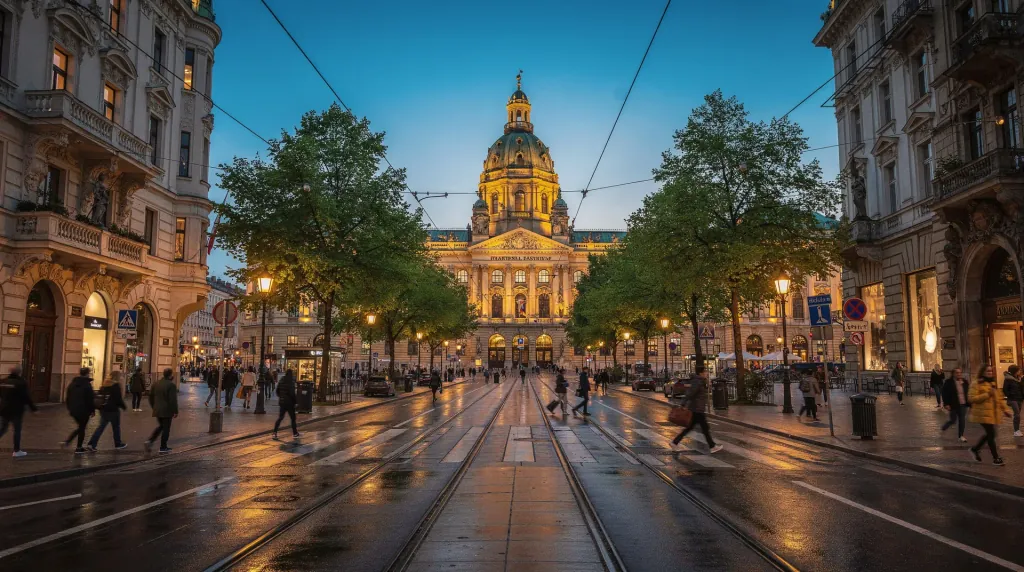
How Václavské náměstí became the civic stage of modern Bohemia
The square was founded in 1348 by Charles IV as the Koňský trh — the Horse Market — the central trading place for his newly established Nové Město (New Town). Charles extended Prague’s footprint dramatically that year, adding the New Town to the existing Staré Město and Malá Strana and requiring settlers to fill it within 18 days on penalty of losing their plots. The Horse Market was not a grandiose civic space; it was a working market, roughly 750 metres long because that was the length needed for the livestock trade.
The square changed names and functions gradually. The Horse Market became Václavské náměstí in 1848, when it was renamed for the country’s patron saint during the revolutionary upheaval of that year. The upper (southeast) end was closed by the Neo-Renaissance National Museum (1890), designed by Josef Schulz on the model of Parisian civic architecture, which transformed the open market into something closer to a formal boulevard.
The 20th century gave the square its emotional weight. On 28 October 1918, Alois Rašín read the declaration of Czechoslovak independence from a balcony overlooking the square. On 15 March 1939, Nazi troops marched up the boulevard during the occupation. On 21 August 1968, Soviet tanks rolled in and a photograph of a young man standing in their path on this street became one of the iconic images of the century.
On 16 January 1969, student Jan Palach set himself on fire at the foot of the square and died three days later; his act of protest against the normalization that followed the occupation made him a national symbol. On 17 November 1989, riot police beat student demonstrators in an adjacent street, and the events that followed 11 days later ended Communist rule.
That is a great deal of 20th-century history for 750 metres of boulevard.
At a glance
| Where | Nové Město, between Muzeum and Můstek metro stations |
| Cost | Square itself free; National Museum around €12 / 300 CZK |
| Time needed | Around 30–45 minutes for a walk-through; add an hour for the National Museum |
| Getting there | Metro Muzeum (A/C) at the top, Můstek (A/B) at the bottom |
| Best time | Early morning or dusk, when it’s quieter and the museum is lit |
What Wenceslas Square is, and what it isn’t
Václavské náměstí disappoints visitors who arrive expecting something like Old Town Square — an intimate historic space surrounded by Gothic and Baroque buildings. It isn’t that. It’s a wide, 750-metre-long commercial boulevard, more Parisian grands boulevards than Medieval square, lined with hotels, department stores, fast-food outlets, and banks occupying some extraordinary early 20th-century buildings.
What it is: the civic centre of Prague’s Nové Město (New Town), established in 1348 by Charles IV as part of his expansion of the city. The square has been the site of every major political event in Prague’s modern history — the 1918 declaration of Czechoslovak independence, the 1938 Munich capitulation protests, the 1968 Soviet occupation protests (including Jan Palach’s self-immolation), and the 1989 Velvet Revolution, when an estimated 250,000 people filled it on the night the Communist government agreed to step down.
That history is real, important, and worth understanding before you walk through it.
What to see on and around Wenceslas Square
The St Wenceslas statue
At the upper (southeast) end of the square, in front of the National Museum, stands the equestrian statue of St Wenceslas (Václav) by Josef Václav Myslbek, completed in 1912. Wenceslas was the 10th-century Duke of Bohemia (murdered by his brother Boleslav, canonized, patron saint of the Czech state). The four figures around the base — Saints Ludmila, Prokop, Vojtěch, and Anežka — are among the finest Czech 19th-century sculptures.
Below the statue, a low stone marks the spot where Jan Palach and Jan Zajíc burned themselves alive in January and February 1969 in protest against the Soviet occupation. It’s easy to miss but significant: flowers and photos accumulate there on anniversaries.
The National Museum (Národní muzeum)
The Neo-Renaissance National Museum (1890, Josef Schulz) closes the upper end of the square as a deliberate focal point. The building itself — its grand façade, the decorated atrium, the ramp of statues — is worth entering for the architecture alone. The permanent collections cover natural history and Czech national history. Entry ~€12 / 300 CZK, or free on the first Monday of each month.
The building was damaged during the 1968 Warsaw Pact invasion (machine-gun marks are still visible on the north façade) and underwent a major renovation completed in 2018. The interiors are in excellent condition.
Old Town tour and National Museum skip-the-line ticketThe Art Nouveau buildings off the square
The buildings directly on Václavské náměstí are mostly early 20th-century commercial architecture — stylistically mixed, with some Art Nouveau and Functionalist gems among the later interventions. Better preserved examples of Prague Art Nouveau are in the side streets:
- Hotel Europa (no. 25) — the most photographed Art Nouveau building on the square; its café interior is now a tourist attraction (overpriced, but genuinely beautiful).
- Palác Lucerna (accessible from Vodičkova or from the square) — a passage arcade built by Václav Havel’s grandfather, home to a cinema, café, ballroom, and the famous upside-down horse sculpture by David Černý (a parody of the Wenceslas equestrian).
- Palác Koruna — corner building with an ornate tower and shopping arcade.
Jan Palach and Jan Zajíc memorial
Beyond the stone at the foot of the Wenceslas statue, look for the small unofficial memorial maintained by civic groups near the upper end of the square. The larger Jan Palach memorial square (Náměstí Jana Palacha) is a separate space near the Faculty of Arts building on the north side of the Old Town — worth combining if you’re walking between Wenceslas Square and the Jewish Quarter.
History note: the Velvet Revolution
On 17 November 1989, a student demonstration that began at Vyšehrad cemetery and moved toward the National Theatre was violently suppressed by riot police. The crackdown sparked a week of escalating mass protests that culminated in Václavské náměstí on the evenings of 24–25 November, when around 250,000 people stood in the square and shook keys as a symbolic gesture of unlocking a new era. On 28 November, the Communist government announced it would relinquish its monopoly on power.
The speed of the transition — 11 days from the initial suppression to the effective end of Communist rule — gave it the name the Velvet Revolution. Václavské náměstí, with the backdrop of the National Museum and the Wenceslas statue, is where that history is anchored.
For the broader Communist and Cold War history of the city:
2-hour Back to Communism walking tour of Prague Prague Communism history and nuclear bunker tour Prague World War II and Communist history tourWhat to see near Wenceslas Square
Museum of Communism (Muzeum komunismu)
Two streets north of the square, at Na Příkopě 10, the Museum of Communism is one of the better political history museums in Prague — thoughtfully curated, with original propaganda, equipment, and personal testimony covering the 1948–1989 period. Not a cheerful place, but genuinely illuminating. Entry ~€12 / 300 CZK:
Prague Museum of Communism entrance ticketFor a guided tour combining the museum with a walking history of Communist Prague:
WWII and Communism history in Prague’s Old Town private tour Prague Cold War and Communism tour with a local historianMucha Museum (Muchovo muzeum)
The Mucha Museum (Kaunický palác, Panská 7) is seven minutes’ walk from the square and houses the most complete collection of Alfons Mucha’s Art Nouveau posters, decorative panels, and personal works. Mucha was born in Moravia in 1860 and died in Prague in 1939; this museum covers his commercial Paris career and his later monumental Slav Epic project. Entry ~€12 / 300 CZK:
Prague Mucha Museum entry ticketPalác Lucerna (Lucerna Palace)
The Lucerna arcade (Lucerna pasáž, entrance on Štěpánská or from Vodičkova) is a covered passage built between 1907 and 1920 by Václav Havel’s grandfather Václav Havel Sr. It contains a cinema (Kino Lucerna, one of the oldest in Prague, still operating), a café (Kavárna Lucerna, good coffee and old-school Czech café atmosphere), and a ballroom used for concerts and events. The famous David Černý sculpture of St Wenceslas on an upside-down horse hangs in the main atrium.
Seasonal notes
Summer: The square is a transit artery year-round but reaches peak pedestrian density in July–August between 11:00 and 19:00. The hotel terraces fill; the street food vendors multiply. The heat radiating from the wide asphalt boulevard is noticeable in high summer.
Christmas: A Christmas market sets up at the upper end of the square near the National Museum, smaller than the Old Town Square market but more easily navigable. The National Museum is lit for the season. Worth a brief detour if you’re already visiting the Old Town Square market.
17 November (Day of Struggle for Freedom and Democracy): The Czech Republic’s annual commemoration of the 1989 Velvet Revolution brings gatherings to both Václavské náměstí and to Vyšehrad cemetery (where students traditionally begin a march that ends here). On this day the square has a specific, non-tourist character worth experiencing.
New Year’s Eve: Václavské náměstí is one of the main gathering points for Prague’s New Year celebrations. The fireworks display is citywide and visible from the upper end of the square. It is extremely crowded; plan your entry and exit routes in advance.
Practical realities
Pickpockets: Wenceslas Square has a higher pickpocket rate than most of central Prague — particularly the lower (northwest) end near the metro station and the area around Tesco. Be aware. The tourist police have a visible presence, which limits it, but crowds create opportunities.
Lower end of the square: The northwest end (around Muzeum metro) was for years associated with nightlife, casinos, and some seedier establishments. It has cleaned up somewhat, but remains the less attractive section of the square. Heading into the side streets here is fine; the main boulevard at night is generally safe.
Currency exchange: The exchange offices directly on Wenceslas Square and around Muzeum metro are almost uniformly predatory — zero commission signs with terrible exchange rates. Use a bank ATM or the exchange services at the train station (Hlavní nádraží) for any currency exchange.
Getting there
Metro: Muzeum station (Lines A and C, green and red, direct interchange) at the upper end; Můstek station (Lines A and B, green and yellow) at the lower end. The two stations are 750 metres apart with the entire square between them.
Tram: Multiple tram lines run along Vodičkova and Ječná parallel to the square. Line 11 stops on Václavské náměstí directly.
Photographer’s note
The most iconic shot — the full length of the square with the National Museum in the background — is taken from near the Můstek end looking uphill, ideally at dusk when the museum is illuminated and the square lights are on. A 50mm equivalent focal length is about right for compression without distortion.
The Lucerna arcade is worth photographing for its Art Nouveau ironwork and the Černý upside-down horse above the atrium.
Wenceslas Square in daily Prague life
Don’t overlook the square’s ordinary function. For most Praguers it’s a transit corridor and shopping street, not a monument — department stores, phone shops, chain cafés, and the Tesco at the lower end sit alongside the historic facades. That everyday commercial layer is part of what disappoints visitors expecting Old Town Square’s postcard prettiness, but it’s also what makes the square feel like a living part of the city rather than a museum piece.
If you’re building a walking route, Wenceslas Square works best as a link between the Old Town and Vinohrady or the New Town museums — not a standalone stop. It fits naturally into a one-day Prague itinerary as the connective walk between the Old Town core and the National Museum end of town. For the fullest 20th-century political context, pair it with the dedicated Velvet Revolution sites walk, which covers Národní třída and other 1989 locations the square alone doesn’t tell you about.
Getting oriented on transit
The Prague metro makes the square trivial to reach from anywhere in the centre — Muzeum station sits right at the upper end, Můstek at the lower end, and both interchange with other lines. Hotels directly on the square trade historic charm for supreme convenience — a fair trade if you value being five minutes from everything.
Frequently asked questions about Wenceslas Square
Is Wenceslas Square a must-see in Prague?
It’s worth including in a walking route between Old Town and Vinohrady or the New Town museums — it’s not a destination by itself. Plan 30–45 minutes to walk its length, see the Wenceslas statue, enter the National Museum, and peer into the Lucerna arcade.
How far is Wenceslas Square from Old Town Square?
About 600 metres walking — 8–10 minutes on foot south from Staroměstské náměstí via Na Příkopě.
What’s the best thing to do near Wenceslas Square?
The Muzeum of Communism is two streets away (Na Příkopě 10) and one of the more thoughtfully curated political history museums in the country. The Mucha Museum (Kaunický palác, Panská 7) is close and worth a visit for Alfons Mucha’s Art Nouveau poster work.
Is Wenceslas Square safe at night?
The square is busier at night than many central European equivalents — it’s surrounded by hotels, restaurants, and bars. Generally safe; apply the same common sense as any European city centre: stay aware of your surroundings in crowds, avoid the seedier establishments at the lower end.
What happened on 17 November 1989?
The date is commemorated annually as the Day of Struggle for Freedom and Democracy (Svátek boje za svobodu a demokracii), a Czech public holiday. Gatherings take place at Václavské náměstí and at Vyšehrad cemetery.
Where is the Jan Palach memorial?
Jan Palach set himself on fire on 16 January 1969 at the foot of the Wenceslas statue, in front of the National Museum. A small stone at the base of the equestrian monument marks the spot. A larger Náměstí Jana Palacha (Jan Palach Square) is located near the Faculty of Arts on the north edge of Old Town, about 15 minutes’ walk. The small Palach memorial near the statue is easy to miss — look for the brass plate flush with the pavement.
Is the National Museum free?
On the first Monday of each month, entry to the National Museum is free. Regular adult admission is approximately €12 / 300 CZK. The combined ticket with an Old Town walking tour is available through GetYourGuide:
Old Town tour and National Museum skip-the-line ticketWhat is the best building on Wenceslas Square architecturally?
Opinion varies, but the Hotel Jalta (no. 45) is a significant piece of 1950s Czechoslovak modernism with a recently revealed Cold War nuclear bunker beneath it (accessible on tours). The Hotel Europa (no. 25) has the most intact Art Nouveau interior publicly accessible. The Palác Koruna (corner of Na Příkopě) has a fine early 20th-century commercial interior.
Are there trams on Wenceslas Square?
No trams run the length of the square itself — this is a pedestrianised boulevard. Tram lines run on the parallel streets of Vodičkova (one block west) and Ječná (two blocks further west). Tram 11 has a stop at the upper end of the square near Muzeum.
Can you walk from Wenceslas Square to Prague Castle?
Yes, but it’s a substantial walk — around 3 km / 40–50 minutes via the Charles Bridge and Malá Strana. Most visitors take the metro (Muzeum to Malostranská, line A) or a tram instead and save the walking for the Castle grounds themselves.
Practical info at a glance
- Address: Václavské náměstí, 110 00 Praha 1
- Opening hours: Square always open; National Museum 10:00–18:00 daily
- Price: Square free; National Museum ~€12 / 300 CZK
- Nearest metro: Muzeum (Lines A and C) at upper end; Můstek (Lines A and B) at lower end
- Length of square: 750 metres (north-south), 60 metres wide