Why Vyšehrad is better than its reputation suggests
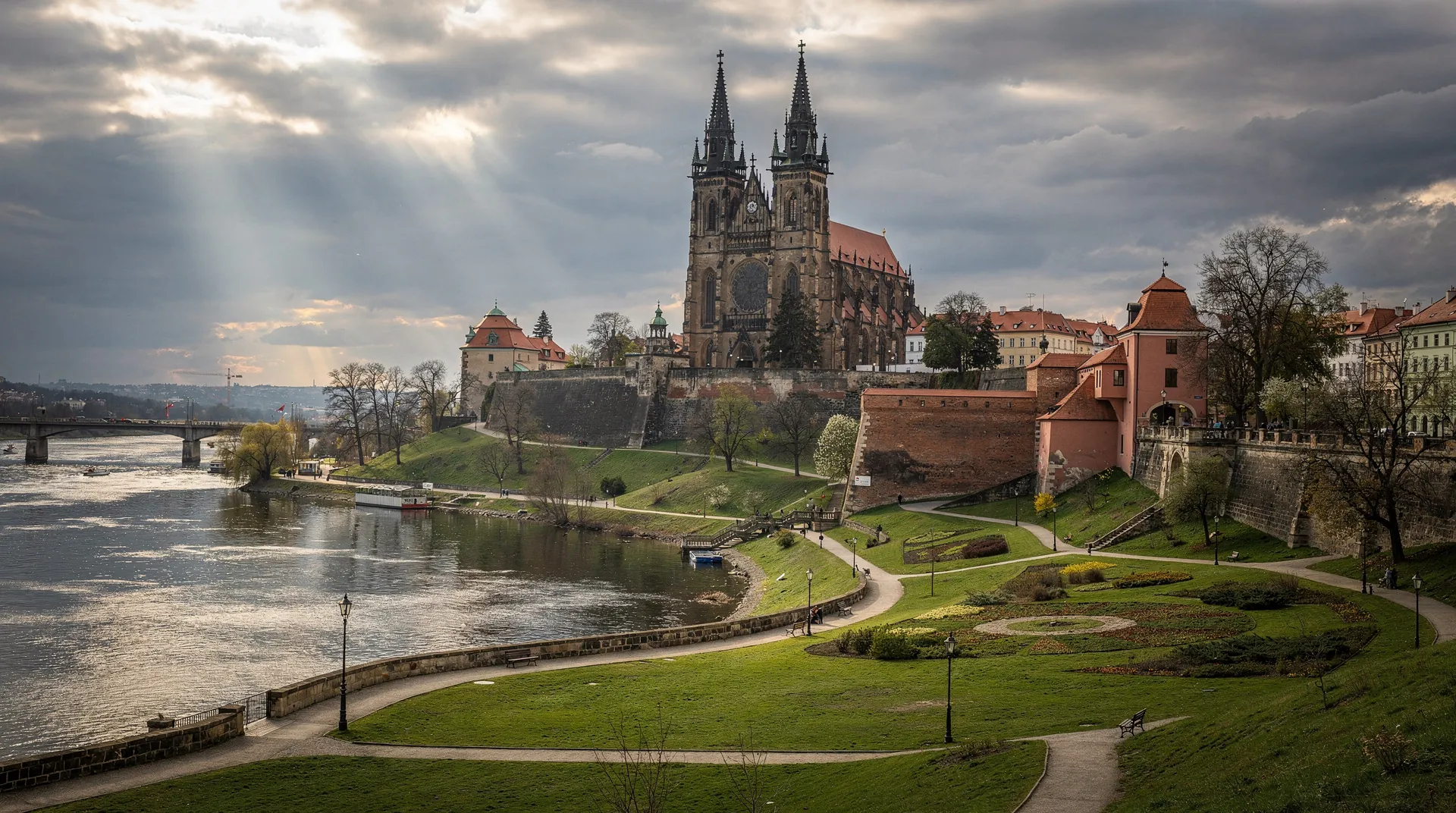
In Prague’s mythology, Vyšehrad came first. The founding legend of the city begins here — on this limestone cliff above the Vltava bend — where Princess Libuše stood and prophesied the founding of a great city. Whether you believe the legend or not, the cliff’s strategic position above the river and its role as an early Přemyslid residence (before Prague Castle became dominant in the 10th century) gives it genuine historical priority over the castle across the river.
Today, Vyšehrad is used by Praguers as a park. Residents from Nové Město and the surrounding neighborhoods walk here at weekends. The cemetery is visited by Czechs paying respects to national figures. The views of the Vltava bend are among the best in the city. And through all of this, almost no tourist groups arrive.
That contrast — the genuine historical significance combined with the complete absence of the tourist infrastructure that attaches itself to such sites — is Vyšehrad’s gift to visitors who find it. You can walk the fortification walls, stand at the edge of the cliff, and watch the river below without anyone offering you a guided group tour or a selfie stick.
| Where | Hilltop above the Vltava, south of Nové Město, edge of Nusle |
| Cost to visit | Grounds, park, and cemetery free; Basilica around €7 (180 CZK), Casemates from around €9 (220 CZK) |
| Time needed | 2–3 hours for the walk and cemetery |
| Getting there | Metro C to Vyšehrad, then an 8-minute uphill walk to the Brick Gate |
| Best time to visit | Weekday mornings before 10 am, or a clear-sky evening for the cliff view |
A walk through Vyšehrad
Allow two to three hours.
Enter through the Brick Gate (Cihlová brána) from Vyšehradská street — the most commonly used entrance, with a small visitor information office. The current fortifications date from the 17th century baroque fortification program, though portions are older. Walk the fortification walls along the southern edge — the views from the bastions over the river and toward the southern city are excellent and rarely photographed.
The Slavín Cemetery (Vyšehradský hřbitov a Slavín) is the neighborhood’s most significant site. It’s a national pantheon modeled partly on Paris’s Père Lachaise — a cemetery for Czech figures of national importance in culture, science, and public life. Bedřich Smetana is buried here. Antonín Dvořák is here. Alfons Mucha. Jan Neruda. Karel Čapek. The Slavín monument at the eastern end contains the collective tomb of other honored figures with a monumental sarcophagus above. The cemetery is small enough to walk in 30 minutes, large enough to repay an hour of attention. Open daily, free entry.
Basilika sv. Petra a Pavla (Basilica of Saints Peter and Paul) stands at the center of the complex — the current neo-Gothic structure dates to the early 20th century, but it sits on foundations going back to the 11th century. The interior has a painted ceiling and some good glass; entry is around €7 (180 CZK).
Walk to the Rotunda sv. Martina — the oldest surviving Romanesque building in Prague (11th century), a tiny round chapel that has survived everything including being used as a gunpowder storage facility in the 18th century. It is entirely humble and entirely remarkable for its age and survival.
At the northeastern corner of the fortifications, the cliff edge gives the best view of the Vltava — you can see the river bending around the city from a perspective that no other vantage point in Prague replicates. On clear days the castle is visible upstream.
The Vyšehrad Park within the fortification walls is a genuine park — benches, lawns, a rose garden. The four large statues of Czech mythological figures (Libuše, Přemysl, Ctirad, Šárka) by sculptor Josef Václav Myslbek stand in the park, technically heroic in scale but somewhat weathered into character.
Prague hidden gems walking tour with local guide (2 h, from €17)Where to eat
Quick lunch
There are very few food options within the Vyšehrad fortification. The Café Citadela near the Basilica is the on-site option — sandwiches and coffee at tourist-facing prices, acceptable for the convenience. Na Vyšehradě restaurant near the main entrance has Czech pub food and outdoor seating in summer at around €8–12 (200–300 CZK) for mains.
For a better meal, walk 15 minutes down the hill to the Náplavka riverside area, where café barges and riverside restaurants offer genuinely good options. Pivo a Párek (Beer and Sausage) at the Náplavka food market on Saturdays is the honest lunchtime choice.
Dinner
Vyšehrad has essentially no evening restaurant scene — it’s a day-visit destination rather than a neighborhood people eat dinner in. The closest good dinner is in Nové Město (15 minutes on foot) or in Smíchov on the other side of the river via the pedestrian bridge. Descend to the river after your visit and follow the Náplavka north into the restaurant concentration around Palacký Square and Rašínovo nábřeží.
Cafes and bakeries
Kavárna Vyšehrad at the entrance of the fortification sells decent coffee to the morning walkers who use the hill as their daily constitutional. For anything more serious, the Náplavka barges serve good coffee to cyclists and walkers along the riverfront.
Where to drink
The beer garden in the park (open summer only) is operated seasonally and serves standard Czech beer at standard prices — the correct thing to do on a warm Saturday afternoon. For a proper beer, descend to Náplavka and one of the riverside establishments.
Where to stay
Vyšehrad has almost no accommodation of its own — it’s not a neighborhood people stay in. The adjacent areas of Nové Město and Nusle have budget hotels. For anyone specifically wanting to base near Vyšehrad, the Corinthia Hotel on Kongresová is the largest hotel in the area — a former communist-era conference hotel renovated to contemporary standards, with excellent views from the upper floors toward the fortress. The metro (Vyšehrad, C line) connects directly to the center in 8 minutes.
Getting here and around
Metro Vyšehrad (C/red line), which also serves the Congress Centre (Kongresové centrum). From the metro exit, walk north and uphill for about 8 minutes to the Brick Gate entrance. Trams 2, 7, 17, and 18 pass along the riverfront below and stop at Výtoň, from which the fortification walls are visible above. Walking from Wenceslas Square: about 20 minutes south along Náplavka and uphill.
Prague Old Town and sights 3-hour walking tour (from €19)Common misses in Vyšehrad
The Rotunda of St Martin is the most overlooked building in Prague by sheer ratio of historical importance to visitor numbers. An 11th-century Romanesque chapel, used as gunpowder storage for 200 years, now restored — and usually empty of visitors. Stand inside it for five minutes.
The cliff edge at the northeast corner of the fortifications — where the brick bastion overlooks the river — is the best free viewpoint in Prague that doesn’t involve climbing a tower. The panorama of the Vltava bend, Nové Město, and the castle in the far distance is complete and entirely uncommercialized.
Smetana’s grave in the Slavín cemetery is modest and often overlooked in favor of the larger Slavín collective monument. It’s in the older, right-hand section of the cemetery, and finding it with the plan at the entrance is part of the experience.
Frequently asked questions about Vyšehrad
Who is buried in the Vyšehrad cemetery?
The Slavín cemetery contains Czech figures of national significance across culture, science, and public life. The most visited graves are Bedřich Smetana (the composer of Má vlast), Antonín Dvořák, Alfons Mucha (the Art Nouveau artist), Jan Neruda (the poet), Karel Čapek (the writer who coined the word “robot”), and Gabriela Preissová. The collective Slavín tomb contains additional figures.
Is Vyšehrad free to visit?
The fortification grounds and the park are free to enter. The Basilica of Saints Peter and Paul charges around €7 (180 CZK). The Casemates (the tunnels inside the fortification walls) charge an entry fee, from 220 CZK. The cemetery is free.
How do I get to Vyšehrad from Old Town Square?
Metro A from Staroměstská, change at Muzeum to line C, one stop to Vyšehrad. Total: about 12 minutes. Alternatively, walk or cycle the Náplavka riverside path south — about 25 minutes on foot, 10 minutes by bike.
What is the legend of Princess Libuše?
According to Czech founding mythology, Princess Libuše — a prophetess — stood on the Vyšehrad cliff and foretold the founding of Prague. She married a ploughman named Přemysl, founding the Přemyslid dynasty that ruled Bohemia for 400 years. The legend is celebrated in Smetana’s opera Libuše and in the Myslbek statues in the park.
Is Vyšehrad good for children?
Yes — the park is spacious, the fortification walls are interesting to walk, and the cliff views are genuinely dramatic without requiring any specific historical knowledge. The casemate tunnels with their surviving siege artillery are particularly effective for children’s imagination.
When is the best time to visit Vyšehrad?
Mornings in spring and autumn, when the light is good and the Czech families who use the park as their morning walk are out. Summer evenings are also excellent — the park stays open until dark and the light on the Basilica is warm from the west. Avoid Sunday afternoons in summer when the park reaches its maximum local density.
Can I combine Vyšehrad with Prague Castle in one day?
Not comfortably — they’re on opposite ends of the historic core and each deserves at least half a day. If you only have one day for castles, Prague Castle has the bigger sights, but Vyšehrad gives you the calmer, less commercial version. Combining Vyšehrad with a Nové Město or Smíchov walk on the same day works much better logistically.
Is Vyšehrad better than Prague Castle for photography?
For crowd-free photography, yes — the cliff-edge viewpoint and the fortification walls rarely have more than a handful of people, unlike the queues at Prague Castle. For grand architecture and interiors, the Castle still wins.
Full day at Vyšehrad: 9 am to 10 pm
9:00 — Take metro C to Vyšehrad station (2 stops from Muzeum). Exit at the Congress Centre and walk north along V Pevnosti street, entering the fortification via the Cihelná brána (Brick Gate). Stop at the small information office to pick up the free site map — useful for navigating the cemetery later.
9:15 — Walk the southern fortification walls clockwise before the site fills. The bastions on the southern and western edges have the best views: the Vltava downstream toward Smíchov, the modern city to the south, and on clear days the Bohemian highlands on the horizon. The walls are free to walk and almost always empty before 10 am.
10:00 — Visit the Rotunda sv. Martina (Rotunda of St Martin) — the oldest surviving Romanesque building in Prague, built in the 11th century. It is entirely humble and entirely remarkable: a round chapel less than 10 meters in diameter that has survived the Hussite wars, the Thirty Years’ War, and 200 years of use as a gunpowder magazine. Entry is free; it is usually unlocked from 9 am in summer.
10:30 — Walk to the Slavín Cemetery (Vyšehradský hřbitov a Slavín). Give yourself a full hour. The cemetery map at the entrance identifies the most visited graves; work your way through the older section (Smetana, Dvořák) into the central rows (Mucha, Čapek, Neruda) and end at the Slavín collective monument at the eastern end. The cemetery is free to enter and maintained to a high standard.
12:00 — The on-site Café Citadela near the Basilica serves sandwiches and coffee at tourist prices — acceptable if you don’t want to descend. For a better lunch, walk 12 minutes down the hill to the Náplavka riverside. On Saturdays, the Náplavka farmers’ market runs along the embankment south of Palacký Bridge — the correct Saturday lunch, combining bread, cheese, grilled sausage (párek), and a glass of something from the wine stalls.
13:30 — Return uphill (10 minutes) or take tram 2 from Výtoň stop back up to the Vyšehrad entrance. Visit the Basilika sv. Petra a Pavla (open 10 am–5:30 or 6 pm April–October, 10 am–5 pm November–March, Sundays from 11 am; €7 / 180 CZK entry) — the neo-Gothic exterior is elaborate; the painted ceiling inside is worth the entry. The church sits on 11th-century foundations; the current structure dates to 1903.
14:30 — Walk to the Vyšehrad Park within the fortification walls. The four large statues of Czech mythological figures by Josef Václav Myslbek — Libuše, Přemysl, Ctirad, Šárka — stand in the park’s main avenue. They were sculpted between 1881 and 1897, originally intended for the Palacký Bridge, and moved here in 1948. Heroic in scale, weathered into something more interesting than monument.
15:30 — Walk to the northeastern corner of the fortifications — the brick bastion overlooking the Vltava bend. This is the best free viewpoint in Prague that doesn’t require climbing a tower. The panorama encompasses the river bending toward Nové Město, the Palacký Bridge below, and Prague Castle visible upstream on clear days. Sit here and stay for a while.
17:00 — Descend via the eastern steps to Náplavka and follow the riverside path north. The late afternoon light on the Vltava from this stretch is some of the best in the city. Café barges serve wine and beer to riverside walkers.
19:00 — Take tram 17 north along the Náplavka to Náměstí Míru in Vinohrady, or metro C from Vyšehrad station to Muzeum, for dinner. The Vyšehrad area has no evening restaurant scene of its own — the nearest good dinner is in Vinohrady (Aromi, Maso a Kobliha) or Nové Město (U Fleků, Brewbar Národní).
Vyšehrad’s daily rhythm
Before 10 am — Ideal visiting time. Czech families and morning walkers use the fortification park as a regular circuit; very few tourists. The Slavín Cemetery is at its most peaceful and atmospheric in morning light.
10 am–1 pm — The site’s busiest period, especially on weekends. Still manageable compared to Prague Castle — no queues, no crowds. Cemetery and Basilica visitors increase.
1–4 pm — After lunch arrivals. Summer weekend afternoons are the most popular; the park reaches what counts as density here (perhaps 200–300 people across the entire site). The cliff-edge viewpoint at the northeast corner remains uncrowded throughout.
4–7 pm — The tourist groups begin to leave. Afternoon light on the southern fortification walls and the Basilica facade. Evening walkers from the surrounding neighborhoods arrive for sunset.
After 7 pm — The fortification closes officially at dusk (gates locked), though the park interior is accessible via the public gates on Soběslavova. Evening in summer: the Basilica is lit from outside, and the cliff-edge view of the city at night is superb. Residents only.
Where to stay near Vyšehrad
Corinthia Hotel Prague — Kongresová 1, Nusle, from €120 / 3000 CZK per night. The largest hotel near Vyšehrad — a renovated former communist-era conference hotel with good upper-floor views toward the fortress. Pros: directly above Vyšehrad metro station, good fitness facilities, city views from the upper floors. Cons: the surrounding Nusle area is anonymous; you’ll need the metro for everything else. The location works specifically well for Vyšehrad morning visits before heading to the center.
Hotel Luník — Londýnská 50, Vinohrady, from €80 / 2000 CZK per night. A reliable Vinohrady mid-range hotel, 20 minutes on foot from Vyšehrad or two metro stops. Pros: genuinely pleasant residential neighborhood location, good bakeries and restaurants nearby. Cons: not walking distance to Vyšehrad in bad weather; the room quality is variable.
Hotel u Kříže — Štefánikova 12, Smíchov, from €70 / 1750 CZK per night. Budget mid-range in Smíchov, 20 minutes on foot from Vyšehrad via the pedestrian footbridge (Lávka Císařský ostrov is not the right bridge — use the Jiráskovo Most or the riverside path). Useful when Nové Město and Vinohrady are sold out.
Food near Vyšehrad
Café Citadela — Inside the fortification, near the Basilica. Open daily 10 am–6 pm (summer), shorter hours in winter. The only on-site option — sandwiches, coffee, ice cream. Tourist pricing but convenient. Coffee €3 / 75 CZK, sandwich €5 / 125 CZK.
Na Vyšehradě — V Pevnosti 11, near the Brick Gate. Open daily 11 am–10 pm. Czech pub food with outdoor seating in summer — goulash, svíčková, fried carp. Mains €8–12 / 200–300 CZK. Better than the Café Citadela; aimed at local walkers rather than tourists.
Náplavka café barges — Rašínovo nábřeží below Vyšehrad, multiple operators. Open daily April–October. The riverside café barges serve coffee, wine, beer, and light food from floating platforms moored to the embankment. Prices are reasonable: coffee €2.80 / 70 CZK, beer €2.20 / 55 CZK. The best lunch setting near Vyšehrad in good weather.
Saturday Náplavka market — Rašínovo nábřeží, Nové Město section, every Saturday 8 am–2 pm, April–November. Bread, cheese, meat, wine, vegetables from Czech producers. Not on the Vyšehrad side of the river but a 15-minute walk or tram 17 ride north — the correct Saturday morning activity if you’re in this part of the city.
Aromi — Mánesova 78, Vinohrady (20 min on foot or 2 metro stops from Vyšehrad). Excellent Italian-Czech restaurant, the best dinner option in the wider area. Dinner mains €18–26 / 450–650 CZK. Book ahead for evenings.
Bars near Vyšehrad
The Náplavka summer bar barges — Below the embankment on Rašínovo nábřeží, open April–October. Multiple floating bars serving Czech lager, wine, and cocktails to riverside walkers. Informal, pleasant, correct afternoon setting after visiting the fortification.
Pivovarský dům — Ječná 15, Nové Město (15 min on foot from Vyšehrad). A microbrewery with unusual Czech beer varieties — coffee stout, banana wheat, nettle lager. Half-litre from €2.50 / 62 CZK. The genuine pub alternative to the Náplavka barge bars.
Bar & Books — Mánesova 59, Vinohrady. Whisky bar in a book-lined room; good cocktails, cigar-friendly, late closing. A possible post-Náplavka destination if you continue north to Vinohrady.
Hidden details at Vyšehrad
The Casemates (Kasematy) — the tunnels inside the fortification walls contain the original Baroque sculpture that stood on Charles Bridge before the originals were moved to the Lapidárium museum. The Charles Bridge statues you see today on the bridge are all 20th-century copies; the originals, or some of them, are here in the Vyšehrad casemates. Entry from €9 / 220 CZK. This context — that the Charles Bridge statues are reproductions — is almost never mentioned in the standard tourist literature.
Karel Čapek’s grave and its irony — Čapek, who died in December 1938 just after the Nazi occupation of the Sudetenland (and before the full occupation — he is thought to have died of exhaustion and grief), is buried in the Slavín cemetery. He coined the word “robot” in his 1920 play R.U.R. and spent his last years warning publicly about fascism. His grave marker is modest; finding it among the cemetery’s more elaborate monuments for composers and artists gives it a different kind of weight.
The northeast cliff bastion’s specific geometry — the brick bastion at the northeastern edge of the fortification is the highest point of the cliff above the river, at approximately 60 meters above the Vltava. The geometry of the river bend from this point — with the island of Císařský ostrov in the middle distance, the Palacký Bridge directly below, and the curve of Nové Město and Vinohrady along the east bank — is a composition that appears in no standard Prague photograph. There is a bench. Use it.
Vyšehrad versus staying elsewhere
| Neighborhood | Distance to Vyšehrad | Price level | Best for |
|---|---|---|---|
| Nové Město | 15–20 min walk | Mid | Central base with easy Vyšehrad access |
| Smíchov | 20 min walk (via footbridge) | Lower-mid | Value, riverside, easy transit |
| Vinohrady | 20 min walk/2 metro stops | Lower | Evening dining after a Vyšehrad day trip |
Practical at a glance
- Metro: Vyšehrad (C, red line)
- Trams: 2, 7, 17, 18 below on the Náplavka; walk uphill 10 min
- Walking time to Old Town Square: 25 min (via Náplavka)
- Walking time to Wenceslas Square: 20 min
- Vibe: National-mythological, parklike, local rather than tourist, calm
- Best for: History, cemetery visits, views, park walking, escaping the center