Strahov’s nine centuries — a monastic timeline
| Where | Hradčany, Strahovské nádvoří 1/132, on the Petřín Hill ridge near Prague Castle |
| Cost | Library ticket around €8 (200 CZK); with photography permit around €10 (250 CZK) |
| Time needed | 30–45 minutes for the library halls; add 30–60 min for the brewery terrace and lunch |
| Getting there | Tram 22 to Pohořelec, then about 5 minutes on foot |
| Best time | Weekday mornings for the quietest visit and best natural light in the halls |
The Strahov Monastery (Strahovský klášter) was founded in 1143 by the Premonstratensian order at the invitation of Prince Vladislav II and Bishop Jindřich Zdík of Olomouc, who had visited the order’s mother house at Prémontré in France and wanted to establish a similar community in Bohemia. The Premonstratensians — named for Prémontré in Champagne, where St Norbert founded the order in 1120 — combine monastic life with active ministry, and the Strahov community quickly became one of the most important intellectual and pastoral centres in Bohemia.
The 12th and 13th centuries established the monastery’s library and scriptorium. The Strahov Gospel Book (Strahovský evangeliář), now the monastery’s most precious manuscript, dates to the 9th century and arrived at Strahov by 1143 or shortly after — possibly brought from the monastery at Lorch. The manuscript is Carolingian in origin and represents one of the oldest surviving books in Bohemia.
Hussite raids in 1420 burned the monastery. The reconstruction over the following century was gradual; the Thirty Years’ War (1618–1648) brought another period of destruction and reconstruction. The current Theological Hall was built in 1671–1679 under Abbot Jan Quentel, incorporating new shelving around the older manuscripts. The more dramatic Philosophical Hall followed in 1782–1794 — an emergency building project to house the library from the dissolved Louka Monastery in Moravia before it could be dispersed.
Emperor Joseph II’s reforms of 1782–1783 dissolved hundreds of monasteries across the Habsburg Empire, particularly those without active educational or pastoral functions. Strahov survived because the community converted its library into a research institution open to scholars — a pragmatic decision that preserved the books and the monastery simultaneously.
The Nazi occupation (1939–1945) saw the monastery used partly as a military facility. Communist nationalisation in 1950 expelled the Premonstratensians and converted the complex into a literary museum. The monks returned in 1990 following the Velvet Revolution, and the brewing tradition — dormant since the 1950 nationalisation — was revived in 2000.
Why Strahov is one of Prague’s genuine surprises
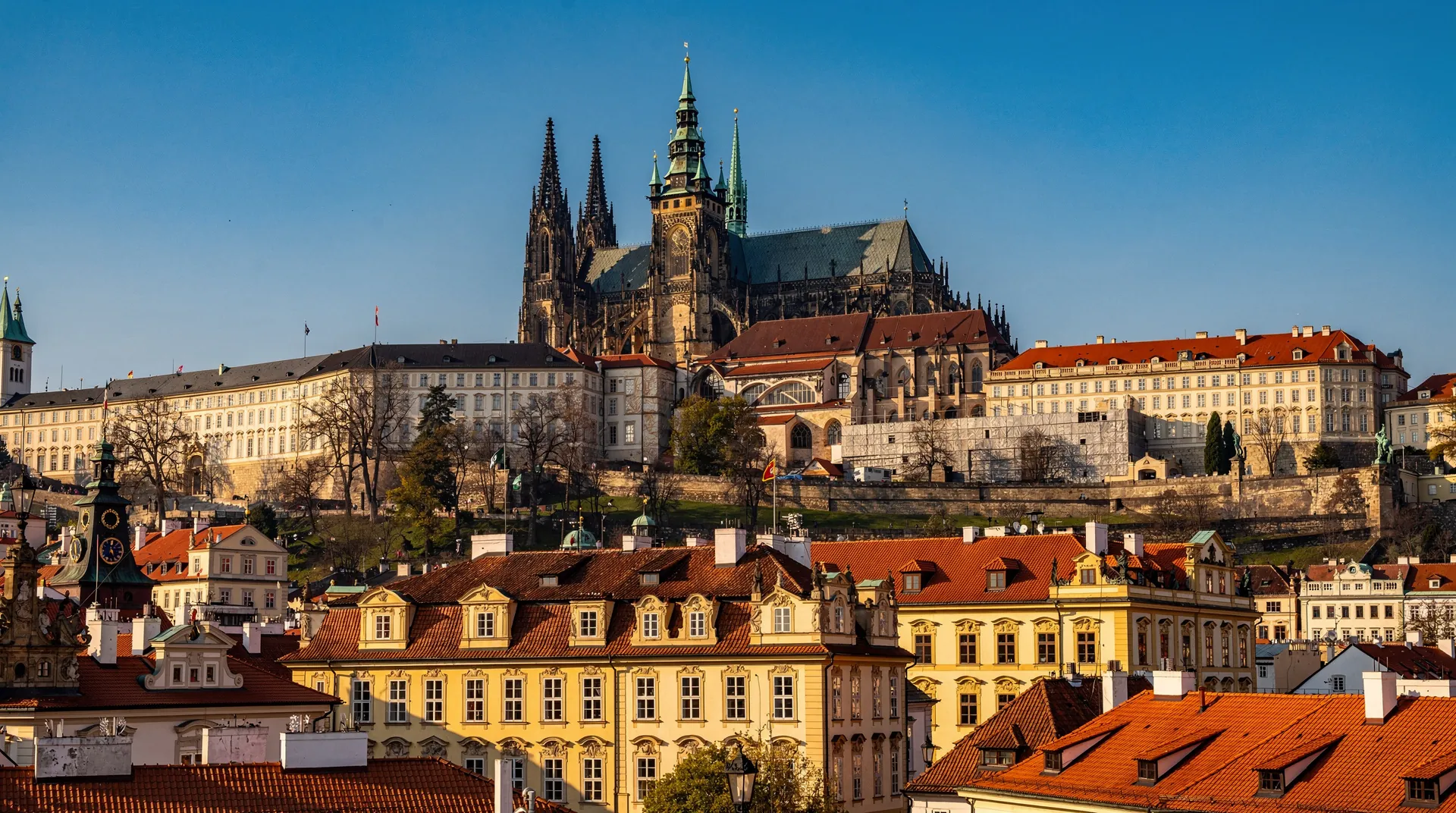
The Strahov Monastery (Strahovský klášter) sits on the shoulder of Petřín Hill, about 15 minutes’ walk from Prague Castle, and most visitors who make it this far are glad they did. It is less crowded than either the Castle or the Old Town, its two Baroque library halls are among the most beautiful rooms in Central Europe, and the on-site monastery brewery serves some of the better beer in Prague.
The monastery was founded in 1143 by Premonstratensian monks and has been in more or less continuous operation — interrupted by Hussite raids, the Thirty Years’ War, Josephine reforms, Nazi occupation, and Communist nationalisation — for nearly 900 years. The Premonstratensians reclaimed it in 1990 and continue to maintain it. The brewing tradition resumed in 2000.
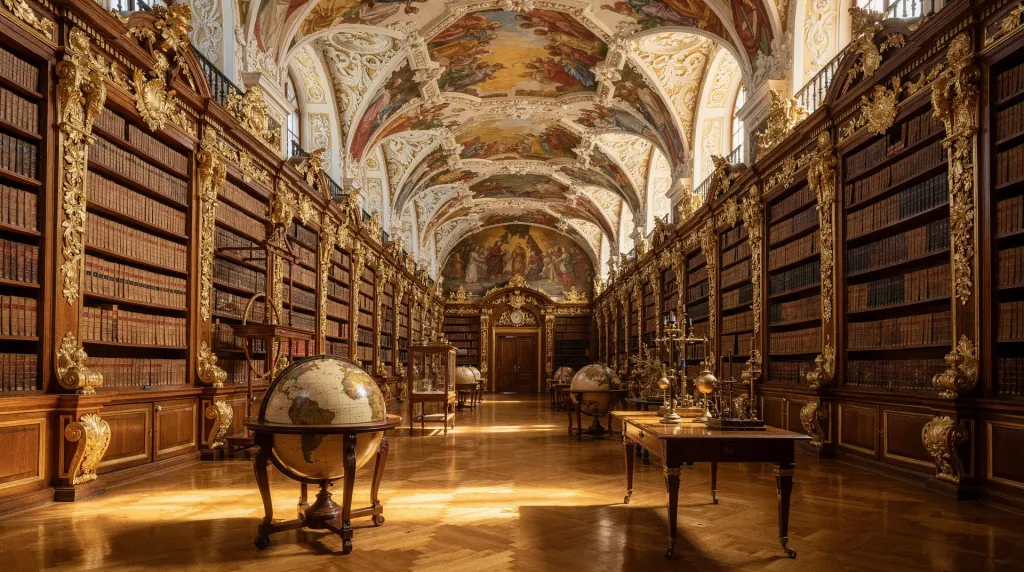
What distinguishes Strahov from a generic monastery visit is the libraries. The Philosophical Hall (built 1794) and the Theological Hall (built 1671–1679) are not merely old rooms with books on shelves — they are complete Baroque gesamtkunstwerks, where frescoed ceilings, gilded woodwork, globes, and the accumulated books exist as a unified aesthetic experience. Standing in the doorway of either hall for the first time is the kind of moment that resets the visual scale of what architecture can do.
The two library halls
Teologický sál — Theological Hall
Built between 1671 and 1679, the Theological Hall is the older and more intimate of the two. Its barrel-vaulted ceiling carries frescoes by Siard Nosecký illustrating themes of wisdom and theological learning. The cedarwood shelving is original, the globes on display were made in the Netherlands in the 17th century (one celestial, one terrestrial), and the collection includes some 18,000 volumes.
The most important document on display (in a specially secured case at the far end) is the Strahov Gospel Book (Strahovský evangeliář), one of the oldest surviving illuminated manuscripts in Bohemia, dating to the 9th century.
Filozofický sál — Philosophical Hall
The Philosophical Hall was constructed in 1794 specifically to accommodate a library acquired from a dissolved monastery at Louka in Moravia. The walnut shelving — too tall for the original building — required an entirely new space to be built around it. The result is a two-storey hall 32 metres long, with curved balconies, and a ceiling fresco by Franz Anton Maulbertsch completed in just six months in 1794, showing the history of human intellectual progress from Adam through the ancient world to the Enlightenment. It is Maulbertsch’s last major work.
The hall holds approximately 50,000 volumes. You cannot enter either hall freely — you view them from the doorway — but the view from the entrance is unobstructed and the halls are not large. Photography is allowed with the photography permit included in the ticket.
The cabinet of curiosities
Between the two library halls, a small room houses a cabinet of natural history curiosities assembled by the monastery over centuries: dried sharks, narwhal tusks, a dodo skull, insects, shells, and natural specimens alongside weapons and objects brought back from distant voyages. It’s brief but surprising — a reminder that the Enlightenment-era monastery was simultaneously a scientific repository.
Tickets and what they include
Standard ticket: ~€8 / 200 CZK
- Entry corridor and views of both library halls
- The cabinet of curiosities
Ticket with photography permit: ~€10 / 250 CZK
- Everything above plus permission to photograph inside
Tickets are purchased at the monastery entrance on Strahovské nádvoří. There is no online advance booking for the library — you simply arrive and buy at the gate. Queues are rare except on peak summer weekend mornings.
Which tour to book
For a guided visit with skip-the-line entry and interpretation of the library halls and monastery complex:
Strahov Monastery and library skip-the-line guided tourFor a comprehensive guided tour of the monastery with context on the history and collections:
Strahov Monastery and library guided tourFor a combination that includes the castle district by walking tour and tram:
Prague Castle grounds and highlights walking tour with tramThe Strahov Brewery (Klášterní pivovar Strahov)
The Strahov Monastery Brewery (founded 1142, revived 2000) occupies the former stables on the southern edge of the monastery courtyard. It produces four core unfiltered beers: Sv. Norbert Světlý (pale lager), Sv. Norbert Tmavý (dark lager), Sv. Norbert IPA, and Sv. Norbert Pšeničné (wheat). They’re unfiltered and served at cellar temperature. Quality is genuine — the dark lager is particularly good.
The brewery restaurant has outdoor seating on the Strahovské nádvoří courtyard, a terrace overlooking the Petřín gardens, and a cosy interior. Meals are Czech standards with a few more ambitious options. Not cheap for Prague (budget €12–18 for a main), but the setting justifies a slight premium.
Tip: If you arrive at Strahov from Prague Castle on foot via the Pohořelec path, the brewery is the first major thing you see as you approach the monastery square. It’s a natural finishing point for a Castle + Strahov morning.
The library’s books — what’s actually on the shelves
The Theological Hall holds approximately 18,000 volumes, primarily theological texts from the 16th–18th centuries. The earliest printed books — incunabula, printed before 1500 — number around 150 and are among the most valuable items in the collection. The cedarwood shelving, with its low curved surfaces and brass fittings, is original to the 1671–1679 construction.
The globes in the Theological Hall are a matched pair made in Amsterdam around 1650 — one celestial (showing the constellations), one terrestrial (showing the known world). The terrestrial globe reflects European geographical knowledge of the mid-17th century: the outline of North America’s east coast is recognisable, the interior and west coast are vague. Australia is present but incomplete.
The Philosophical Hall’s 50,000 volumes include significant collections in natural philosophy, history, and literature. The walnut shelving — designed for the Louka Monastery library and installed in Strahov’s newly built hall in 1794 — was executed to dimensions that determined the size of the entire room. The hall was literally built around the furniture.
Franz Anton Maulbertsch, who painted the ceiling fresco in 1794 at the age of 72, completed it in six months — an extraordinary pace for a fresco of this size and complexity. The fresco shows human intellectual history from Adam through Moses and the ancient world, the Church Fathers, and the Enlightenment thinkers. Maulbertsch was the last great practitioner of Austrian Baroque ceiling painting; the Strahov fresco is his final large-scale work.
Different ways to experience Strahov
Self-guided with ticket
The library ticket is the straightforward approach: arrive, buy at the entrance, and walk the two corridors in your own time. The natural light in both halls is excellent in the morning (east-facing windows catch the early sun). Allow 30–45 minutes for both halls, the curiosity cabinet, and the church.
Skip-the-line guided tour
The guided tour adds interpretation of the Maulbertsch fresco, the manuscript collection, and the monastic history — things that the brief panel descriptions can’t cover adequately:
Strahov Monastery and library skip-the-line guided tour Strahov Monastery and library guided tourCastle district walking tour with tram
Combines Strahov with the Prague Castle area in a single guided session:
Prague Castle grounds and highlights walking tour with tramCastle district combined with private tour
For a private, flexible Hradčany and Strahov experience:
Prague city highlights private walking tourNight tour through the castle district
For visitors who’ve already done the daytime sites and want the illuminated castle district:
Alchemy and mysteries of Prague Castle — walking tour after darkSeasonal notes
Spring and summer: The monastery courtyard and brewery terrace are at their best in the April–September period. The view from the terrace to the northeast is available year-round but the warmth and the clarity of summer days make it most rewarding. The library’s natural light is best from March through October.
Autumn (September–October): The Strahov vineyards on the south slope of the hill produce a small amount of wine in September harvest. The vineyard itself is not open to visitors, but the harvest season is atmospheric in the monastery courtyard.
Winter: The monastery courtyard in winter is quiet and atmospheric — the pale stone buildings against a grey Prague sky. Library hours remain the same year-round. The brewery is open daily and the interior is warm. Winter midmorning (10:00–11:00) is one of the most uncrowded times to visit both the library and the castle complex.
Insider details
Arrive via Pohořelec in the morning: Tram 22 to Pohořelec puts you at the monastery end rather than the castle end of the Hradčany ridge. Walk five minutes east to the monastery, then continue east to the castle afterward — the elevation and views are the same but you face them in the better direction for morning light.
The monastery church and Mozart: The Church of the Assumption (Kostel Nanebevzetí Panny Marie) faces the main courtyard and contains a Baroque organ that Mozart reportedly played during his 1787 Prague visit. No formal documentation survives, but the tradition is firm in Czech musical culture and the organ is the right instrument for the right period. Modest dress is required; entry is free.
The terrace view at 7:00: The brewery terrace facing northeast is open to anyone — you don’t need to enter the monastery or buy a ticket to stand on it. At 7:00 on a clear morning in spring or summer, with the city spread below and nothing but birdsong and the distant sound of trams, it is the quietest and most complete view of Prague available for free.
The cabinet of curiosities: Most visitors stop at the Philosophical Hall doorway and the Theological Hall and miss the small room between them. The narwhal tusk, the dodo skull (one of perhaps 20 in the world), and the case of tropical insects assembled over three centuries deserve at least five minutes of sustained attention. The cabinet is a reminder that the Enlightenment monastery was simultaneously a natural history repository.
The monastery church
The Church of the Assumption of the Virgin Mary (Kostel Nanebevzetí Panny Marie) faces the main courtyard and can be entered briefly during opening hours. The Baroque interior includes a famous 18th-century organ and ceiling frescoes. Mozart reportedly played the organ here in 1787. Modest dress required.
Getting there
Tram: Tram 22 to Pohořelec — the most direct approach. Walk approximately 5 minutes east along Pohořelec street toward the monastery entrance.
On foot from Prague Castle: Exit the Castle via the western gate near Hradčanské náměstí, walk along Loretánská and Pohořelec (about 15 minutes).
On foot from Petřín: Walk north along the top of the hill from the Petřín tower area — about 10 minutes through the gardens.
Funicular + walk: Take the Petřín funicular to the top station, then walk north/northwest along the hilltop path to Strahov — about 15 minutes.
Views from Strahov
The terrace above the monastery courtyard (and the brewery terrace) gives an unobstructed view of Prague’s Old Town, the Cathedral, and — on clear days — the Bohemian Central Highlands. The sight line here is cleaner than from Petřín Tower because you’re looking northeast across the city without the tower structure intervening.
This view is free and often uncrowded, particularly in the morning. It’s the sleeper viewpoint of Prague.
Photographer’s note
The Philosophical Hall interior: use the full frame from the doorway to capture the ceiling fresco, the balconies, and the gilded shelving in a single composition. A wide-angle lens (16–24mm equivalent) is optimal. Natural light enters from windows on both sides; no additional lighting is used inside. The Theological Hall doorway is narrower and the room shallower — a 24–35mm equivalent gives the best balance.
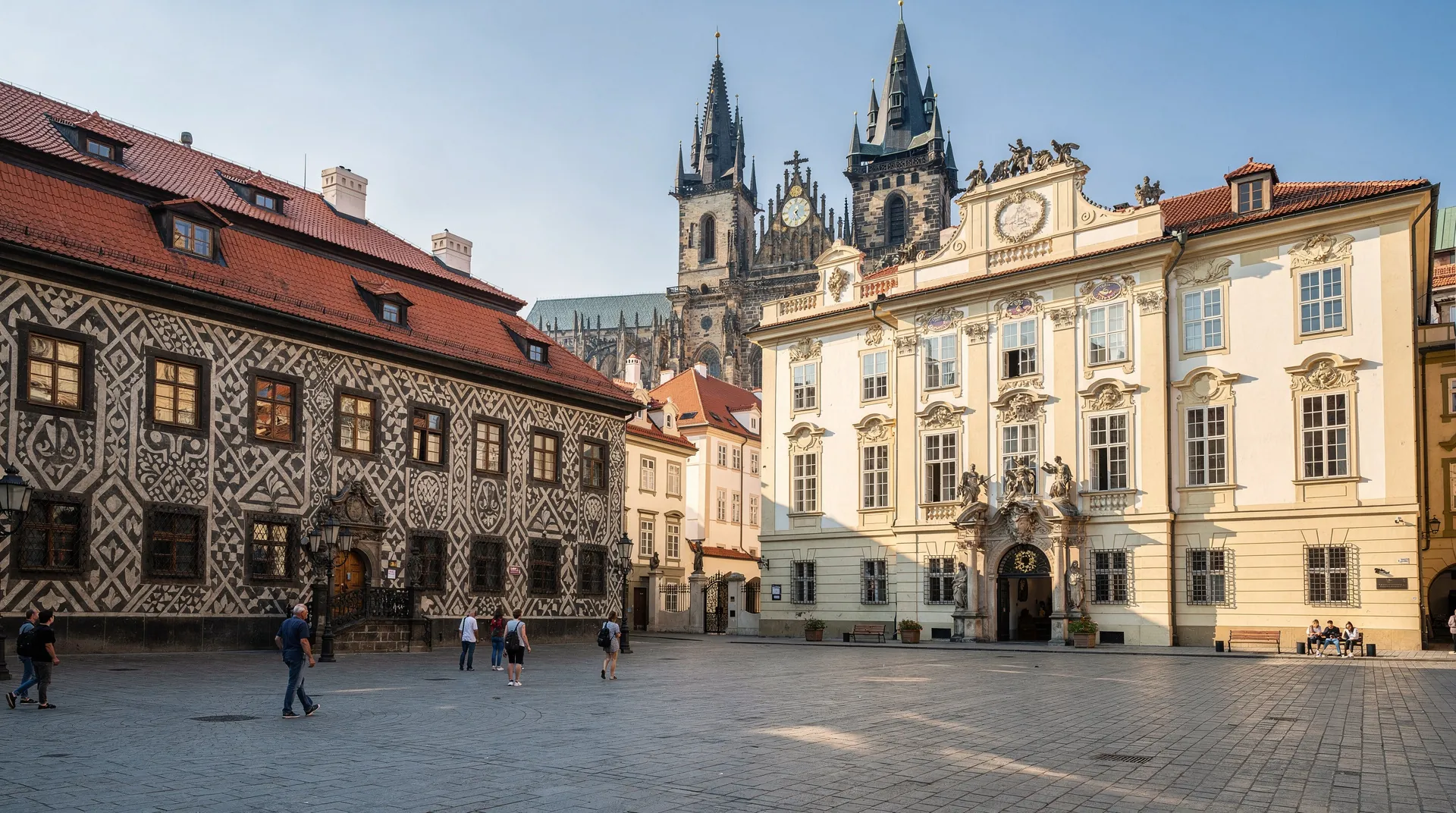
For the exterior: the monastery courtyard at dawn (5:30–7:00 in summer) is entirely empty and the warm stone of the buildings glows in the early light. The Clock Tower above the courtyard entrance makes a useful vertical element.
Frequently asked questions about Strahov Monastery
Is Strahov Monastery worth visiting?
For anyone with interest in architecture, books, history, or European cultural heritage — yes, firmly. The library halls alone are worth the tram journey from the Old Town. Add the brewery for a half-day outing that covers culture and local food.
Can you walk inside the library at Strahov?
No. Both library halls are viewed from the doorways only. The books and shelving are not accessible to visitors. This is a conservation measure that seems reasonable given the age of the materials.
Is the Strahov Monastery brewery good?
It’s one of the better monastery breweries in the country. The beer is unfiltered, served fresh, and the dark lager (Tmavý) in particular is excellent. It’s not the best-value beer in Prague — monastery breweries charge a small premium — but it’s well above average.
Is Strahov crowded?
Compared to Prague Castle or Charles Bridge: no. The monastery courtyard and library entrance occasionally have short queues in high summer (July–August), but nothing approaching the waits at the Castle. Most mornings and all winter it’s comfortably uncrowded.
How do I combine Strahov with Prague Castle?
The standard route: take tram 22 to Pražský hrad, visit the Castle complex (3 hours), exit via the western gates, walk to Strahov (15 minutes), visit the libraries, and finish with lunch at the brewery. This covers the two most important sites on the west bank in a single day.
Is there free entry to anything at Strahov?
The monastery courtyard, the exterior of all buildings, the church (during opening hours), and the exterior view toward Prague are all free. The library corridors require the paid ticket.
Can you buy the monastery’s beer outside the monastery?
The Sv. Norbert beers brewed at Klášterní pivovar Strahov are available exclusively at the monastery brewery restaurant. They are not distributed to supermarkets or external restaurants. This means the only way to drink them is at the monastery itself — which is part of the experience.
Is the Strahov library open on weekends?
Yes. The library halls are open daily (including weekends) from 9:00–12:00 and 13:00–17:00. The two-hour midday closure is a longstanding house rule. Arriving at 9:00 or 13:00 sharp avoids any gap.
Are photographs allowed with a mobile phone?
Photography with a smartphone or camera is included in the €10 / 250 CZK photography permit ticket. If you buy the basic €8 / 200 CZK ticket, you may not photograph inside. The photography permit is worth adding if you have any interest in the halls — the Philosophical Hall ceiling fresco in particular benefits from documentation you can examine later.
Does the Strahov Monastery ticket include the church?
No separate ticket is needed for the church — the Church of the Assumption is free to enter during opening hours (modest dress required), and is not part of the paid library ticket.
Can you buy a combined ticket for Strahov and Prague Castle?
There is no single combined ticket sold at the gate, since the two sites are managed by different administrations (the Castle by the Prague Castle Administration, Strahov by the Premonstratensian order). Some guided tours, including t407287 above, package both sites into one paid itinerary.
What else is near Strahov Monastery?
The Loreto shrine (Loreta, a famous Baroque pilgrimage site with a replica of the Holy House) is 10 minutes’ walk east on Loretánské náměstí. The Schwarzenberg Palace (part of the National Gallery, housing Old Masters) is on Hradčanské náměstí near the castle gate. Petřín Hill’s tower and gardens are accessible from Strahov’s south terrace in about 10 minutes’ walk.
Practical info at a glance
- Address: Strahovské nádvoří 1/132, 118 00 Praha 1
- Library opening hours: 9:00–12:00 and 13:00–17:00 daily
- Library ticket: ~€8 / 200 CZK; with photography permit ~€10 / 250 CZK
- Brewery: Daily 10:00–22:00
- Nearest tram: Pohořelec (tram 22) — 5 min walk
- Official website: strahovskyklaster.cz (monastery); klasterni-pivovar.cz (brewery)