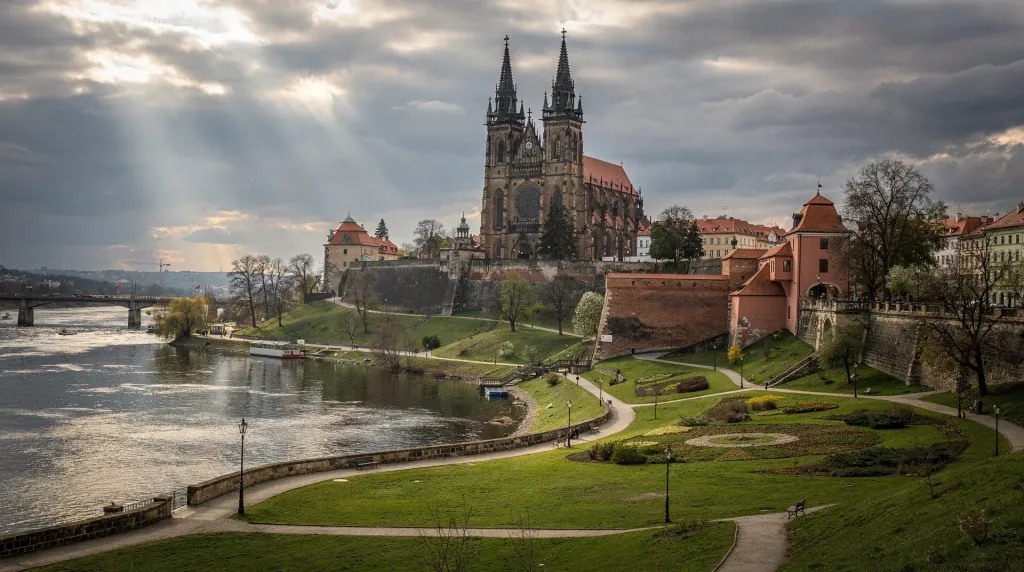
The history of Vyšehrad — myth, dynasty, and national resurrection
At a glance
| Where | Vyšehrad hill, Praha 2, about 3km south of the Old Town |
| Cost | Park and cemetery free; casemates and basilica interior ~€4 / 100 CZK each |
| Time needed | 90 minutes focused; 2.5–3 hours relaxed with basilica |
| Getting there | Metro Vyšehrad (Line C), 5 minutes’ walk |
| Best time | Weekday mornings or summer sunset on the ramparts; September–October for the cemetery |
The written history of Vyšehrad begins in the late 10th century, when the Přemyslid princes established a fortified seat on the rock above the Vltava. For roughly 100 years between the 1070s and 1140s, under Prince Vratislav II (later King of Bohemia) and his immediate successors, Vyšehrad served as the primary royal residence, temporarily eclipsing Prague Castle across the river. Vratislav II’s court, his collegiate chapter (established 1070), and the Romanesque rotundas built during this period gave the rock its enduring historical significance.
The Přemyslid dynasty returned the royal seat to Prague Castle in the mid-12th century. Vyšehrad became a religious and symbolic site, retaining the collegiate chapter and its churches but losing direct political power. The coronation procession of Bohemian kings traditionally began at Vyšehrad and proceeded to Prague Castle — the starting point was a deliberate claim of dynastic continuity with the legendary founding of the Přemyslid line.
The 14th century brought Charles IV’s transformation of the site. He rebuilt the fortifications, established a chapter library that became one of the most important in Bohemia, and promoted the Vyšehrad legends — Libuše’s prophecy, the founding of Prague, the warrior maidens’ war — as foundation myths of the Bohemian state. The 1360 Vyšehrad Codex, an illuminated manuscript, was produced under his patronage.
The 15th century was catastrophic: Hussite forces attacked and largely destroyed the complex in 1420, burning the collegiate church and most of the chapter buildings. The Baroque reconstruction under Habsburgs in the 17th and 18th centuries created the current fortifications and the Church of Saints Peter and Paul, though the church took its current Neo-Gothic form only in 1885–1903.
The 19th-century national revival gave Vyšehrad its modern resonance. The 1869 decision to establish a Slavín cemetery — a burial ground for significant Czech cultural figures — on the Vyšehrad rock was a deliberate claim of national heritage. Bedřich Smetana’s symphonic poem cycle Má vlast (My Homeland, 1874–1879) opens with the Vyšehrad movement — the sound of a legendary bard’s harp above the fortress — and closes with Blaník, the mountain where Wenceslas’s sleeping knights wait to defend Bohemia in its hour of need. This cycle is performed every May at the opening of the Prague Spring music festival, always beginning at Smetana’s grave in Vyšehrad.
Why Vyšehrad is the site most visitors leave out and many regret missing
Vyšehrad — “high castle” in Czech — sits on a rocky promontory above the Vltava about 3km south of the Old Town. It predates Prague Castle as a seat of the Přemyslid dynasty (though the historical record is murky and the legends surrounding it are more vivid than the facts), and its combination of open parkland, dramatic ramparts, a cemetery of national heroes, Romanesque and Gothic architecture, and almost zero tourist infrastructure makes it one of the more honest and affecting sites in the city.
The contrast with the Old Town is sharp. Vyšehrad has no queue at the main gate, no vendor selling Trdelník, no tour buses, and no audio guides in 12 languages. It has a cemetery, a Baroque church with twin spires you can see from Charles Bridge, a Romanesque rotunda from the 11th century, 17th-century Baroque fortifications with underground casemates, and a park where Prague residents picnic with their dogs and watch the sun go down over the river.
It rewards slow visitors. If you arrive expecting a compact museum experience, you might be frustrated. If you arrive prepared to walk, read the tombstone names in the Slavín cemetery, and sit on the rampart walls above the river, you’ll likely leave thinking it was one of the best decisions of your trip.
What to see at Vyšehrad
Vyšehradský hřbitov — the National Cemetery
The Vyšehrad Cemetery is the most important site within the complex and the reason many visitors come. Established in 1869 as a burial place for significant Czech cultural, artistic, and intellectual figures, it contains the graves of Antonín Dvořák, Bedřich Smetana, Alfons Mucha, Jan Neruda, Karel Čapek (though Čapek requested a simple grave elsewhere; his family is here), Max Švabinský, and dozens of other artists, composers, writers, and scientists.
The Slavín (Pantheon) at the eastern end of the cemetery is a collective tomb designed by Antonín Wiehl (1893) and holds approximately 50 figures considered too important for individual graves. The Slavín monument is deliberately theatrical — a stone sarcophagus flanked by weeping allegories, under a canopy of a resurrected Bohemia. It’s impressive and sincere.
Entry to the cemetery is free. Walking it properly, reading names, takes 30–45 minutes.
Bazilika sv. Petra a Pavla
The Basilica of Saints Peter and Paul (its current Neo-Gothic form dates to 1885–1903, rebuilt from an earlier Romanesque structure) dominates the Vyšehrad skyline with its twin spires. The interior is painted in a dense late 19th-century Neo-Gothic and Art Nouveau style, with frescoes covering most surfaces. It’s busy but not overwhelming, and the overall effect is more decorative than solemn. Entry to the basilica interior is ~€4 / 100 CZK.
Rotunda sv. Martina
The Rotunda of St Martin (11th century) is the oldest Romanesque building in Prague and one of the oldest surviving structures in Bohemia. A small cylindrical chapel, about 8 metres in diameter, it’s been a gunpowder store, a chapel, and a military storage facility over the centuries and is still used for occasional masses. The exterior is more interesting than the tiny interior (not always open). Visiting it is a brief detour worth taking for the sheer age of the thing.
The Baroque fortifications and casemates
The Baroque brick fortifications built in the 1650s–1720s wrap around the promontory and provide the best elevated walks at Vyšehrad — the ramparts above the river give views of the Vltava south toward the Podolí embankment and north toward the New Town. The underground casemates (tunnel system under the fortifications) can be visited with a guided tour (included in the Vyšehrad visitor ticket, ~€4 / 100 CZK). The casemates house several large Baroque statues from the original Charles Bridge (replaced by replicas on the bridge in the 20th century).
Leopoldova brána and the main fortification entrance
The Leopoldova gate (1670s) on the north side is the main formal entrance and one of the finest Baroque military gates in Central Europe. Two niches hold allegorical reliefs of Czech fortresses. It’s easy to walk past without noticing — don’t.
Free vs. paid at Vyšehrad
Free:
- The entire fortification park and rampart walks
- Vyšehrad Cemetery
- Exterior of all buildings
- Views over the Vltava
Paid (~€4 / 100 CZK):
- Basilica of Sts Peter and Paul interior
- Casemates and gallery (includes original Charles Bridge statues)
The free version of Vyšehrad is excellent. The paid additions are worth it for the statues in the casemates (genuinely impressive in their underground setting) and the basilica interior.
The Slavín Cemetery in detail
The Vyšehrad Cemetery was established in 1869 on the grounds of the collegiate chapter. The original plan was modest — a quiet burial space for figures of cultural significance adjacent to the basilica. By the early 20th century it had become a national institution.
Key graves to find:
- Antonín Dvořák (1841–1904): The composer’s grave, in the northern section, is one of the most visited. The tombstone shows a bronze relief portrait by sculptor Ladislav Šaloun (who also created the Jan Hus monument in Old Town Square). Dvořák died in Prague; his funeral was a national event.
- Bedřich Smetana (1824–1884): The father of Czech classical music is buried near the south wall, his grave suitably facing the direction of the Vltava he immortalised in Má vlast. He died deaf and mentally ill; the inscription on his grave is from Má vlast.
- Alfons Mucha (1860–1939): The Art Nouveau master, born in Moravia, died in Prague under Nazi occupation.
His grave is in the main alley. The family tomb is modest relative to his fame.
- Jan Neruda (1834–1891): The Czech realist poet and journalist is buried here, as is his near-contemporary Jaroslav Seifert (1901–1986), the only Czech Nobel laureate in literature (1984).
- The Slavín collective tomb (Pantheon, 1893): At the eastern end of the cemetery, this Art Nouveau–Gothic structure designed by Antonín Wiehl holds approximately 50 figures buried collectively. The inscription reads “Ačkoliv zemřeli, ještě mluví” — “Though they are dead, they still speak.” The figures buried here include painter Mikoláš Aleš, sculptor Josef Václav Myslbek (who created the Wenceslas equestrian), and writer Jaroslav Vrchlický.
Visiting tip: Entry is free; a printed map of grave locations is available at the cemetery entrance. Allow 30–45 minutes to walk it properly. The paths between graves are narrow and uneven — comfortable flat shoes are advisable.
Different ways to experience Vyšehrad
Self-guided visit
The site is well-signed in Czech and English, and the combination of open-air ramparts, free cemetery, and optional paid interior visits makes it flexible for any length of visit. The free version (cemetery, ramparts, exteriors) is excellent; the paid casemates add the original Charles Bridge statues.
Prague highlights walking tour
For a broader city tour that often includes or contextualises Vyšehrad:
Prague highlights walking tour Prague city highlights walking tourHidden gems tour
For visitors who specifically want to see Vyšehrad and other lesser-known Prague sites with a local guide:
Prague hidden gems walking tour with local guide Prague hidden gems — all inclusiveSeasonal notes
May (Prague Spring Festival): The Prague Spring music festival opens every May 12 with a procession from the Smetana Hall to Vyšehrad cemetery, where the cycle begins with Má vlast. Attendance at the ceremony on 12 May is possible and deeply Czech — it’s worth going for the atmosphere even without a festival ticket.
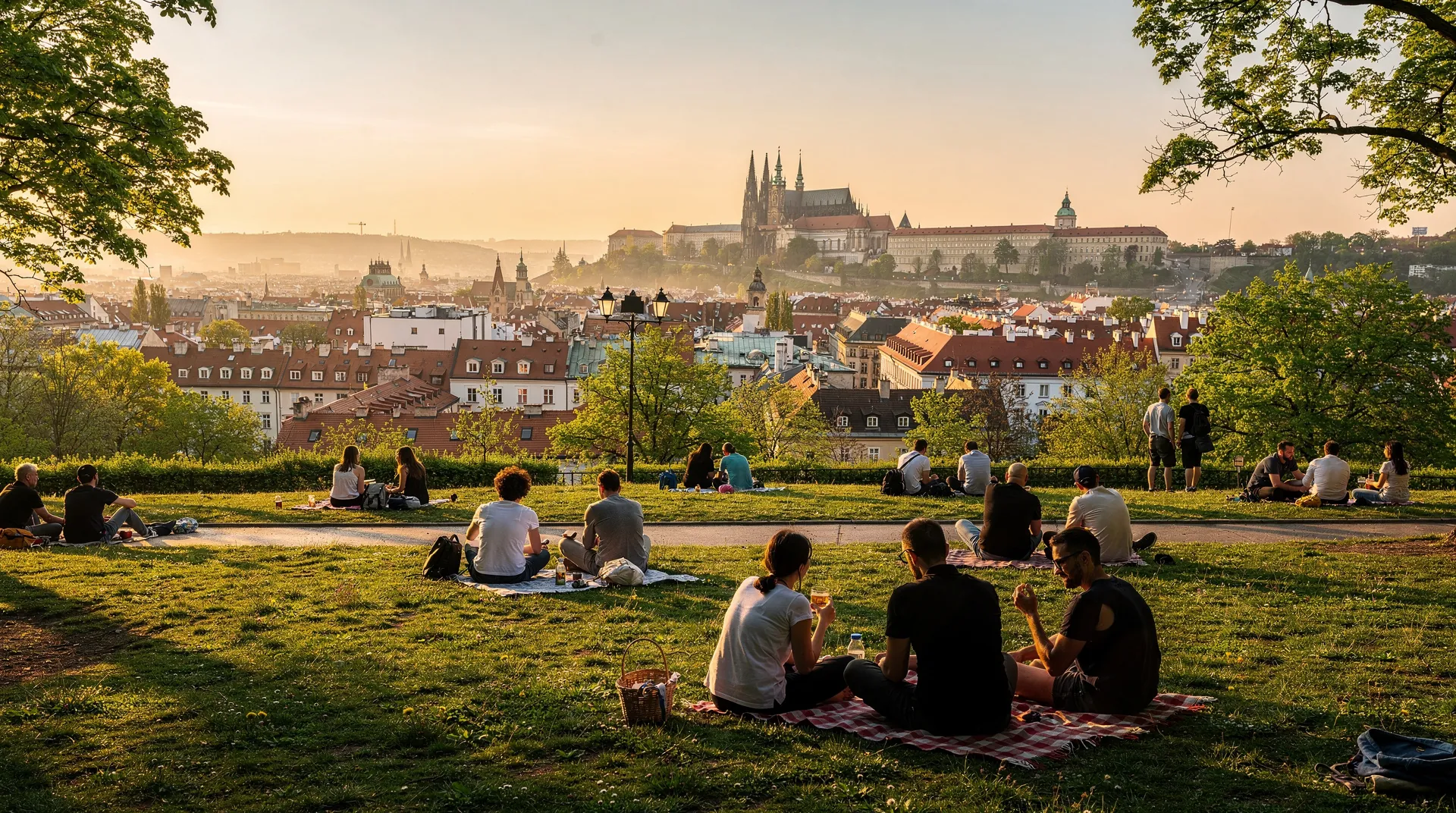
Summer: The fortification ramparts above the river catch the late-afternoon sun and face west, making them an excellent sunset viewpoint. The grass on the rampart walls fills with picnickers and dog-walkers from about 17:00. Bring something to sit on.
Autumn: The cemetery in autumn — fallen leaves between the graves, low light between the old trees — is one of the more atmosphere-rich experiences in Prague. September–October is the best season for visiting the cemetery itself.
17 November: Students traditionally begin the Velvet Revolution commemorative march at Vyšehrad cemetery before proceeding to Wenceslas Square. Worth being present for the ceremony even if you don’t walk the whole route.
Insider details
The original Charles Bridge statues: The casemates under the fortifications hold a collection of the original 17th–18th century Baroque statues from Charles Bridge, replaced by copies on the bridge itself in the 20th century. Seeing these in their underground context is viscerally different from seeing the bridge replicas in open air — the scale, the damage, the texture of the original stone are all more present. Don’t skip this if you’ve paid the entry fee.
The Leopoldova gate: Entering from the north (the main metro approach), the Baroque gate from the 1670s is the most architecturally significant element of the approach. Two niches on the inside of the gate hold allegorical reliefs of Czech fortresses. Most visitors walk straight through it without looking up.
The café in the casemates: The monastery of the Collegiate Chapter has a small café in the courtyard (open in summer) that is almost entirely unknown to international visitors. Coffee, beer, and simple food in a courtyard where the collegiate chapter has met for 900 years. Prices are local.
The riverfront viewpoint below: The walk down from Vyšehrad to the Rašínovo nábřeží embankment below — via the steps from the brick gate — gives the best view of the Vyšehrad cliff face and the 1905 railway bridge. Most visitors leave by the metro; this approach turns the departure into an experience.
Tours that include Vyšehrad
For a guided walking tour that takes you to Vyšehrad’s highlights with historical context:
Prague hidden gems walking tour with local guideFor an alternative, off-the-beaten-track Prague experience:
Prague alternative walking tourFor an evening panoramic views tour that often includes Vyšehrad:
Panoramic views of Prague evening walking tourGetting there
Metro: Vyšehrad (Line C, red) — exit the station and walk north along V Pevnosti or up the rampart steps. The fortress gate is about 5 minutes’ walk from the metro. This is the easiest approach.
Tram: Trams 7, 14, or 18 to Albertov or Výtoň. From Výtoň (on the Vltava embankment), climb the steps up to the fortifications — a more scenic approach with river views, about 10 minutes.
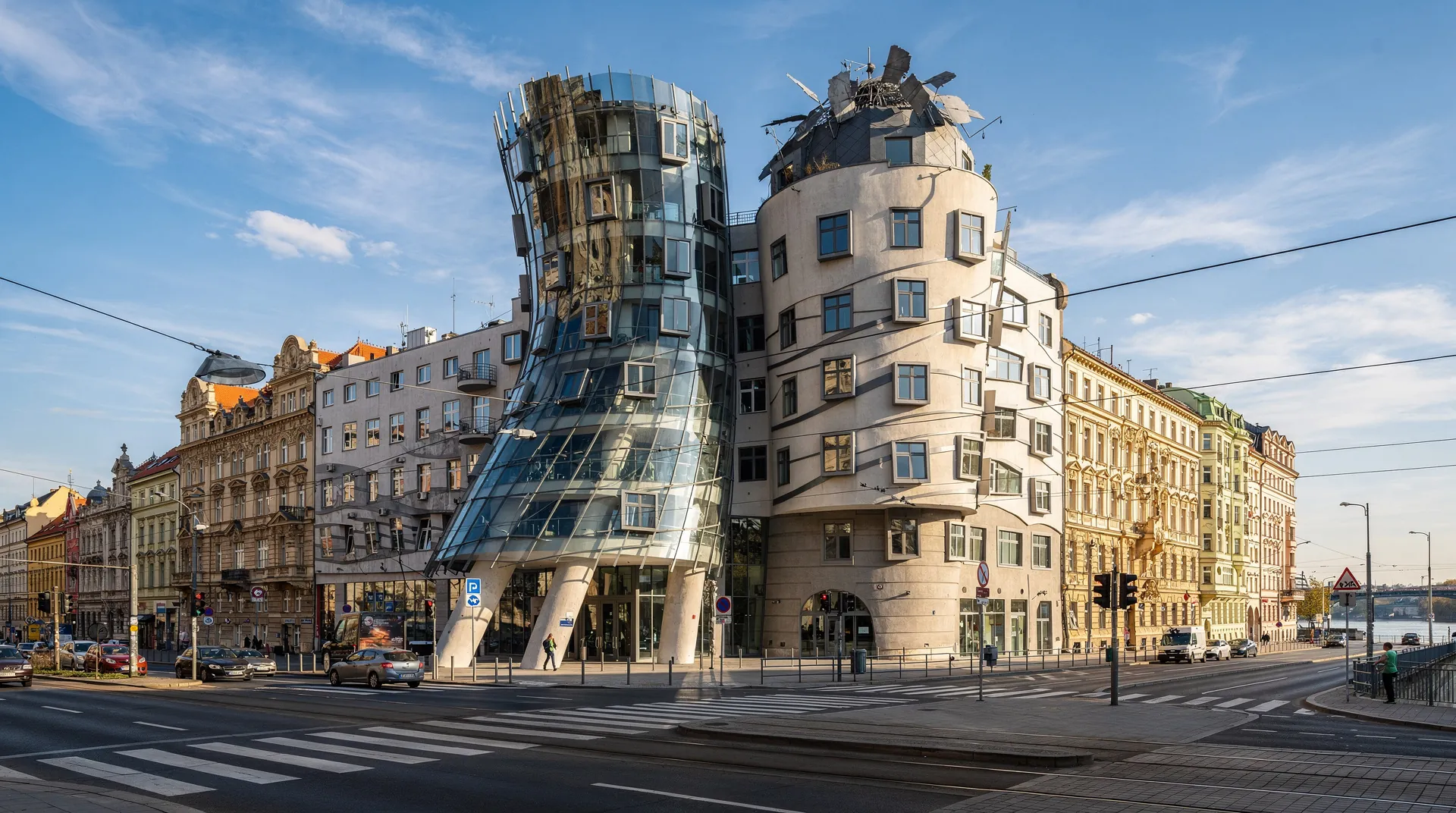
On foot from the Dancing House: The Dancing House (Tančící dům) is about 1km north on the Rašínovo nábřeží embankment. Walk south along the river, then up to Vyšehrad — a pleasant 15-minute walk.
Photographer’s note
The most dramatic exterior shot is from the Vltava embankment below — the cliff face, Baroque walls, and twin basilica spires above the river. The Vyšehrad railway bridge (1905, Gothic Revival arch design) in the foreground makes an excellent compositional element.
Inside the cemetery, morning light (before 9:00 in summer) gives long shadows between the grave monuments and less contrast than midday. The Slavín tomb at the back is lit from the west and photographs best in afternoon light.
How Vyšehrad fits with the rest of your Prague itinerary
Vyšehrad rewards travellers who have already covered Prague Castle and want a quieter counterpart — same “fortress on a hill above the river” concept, completely different atmosphere and crowd level. If you’re staying near Vinohrady, Vyšehrad is a natural half-day extension: walkable or a short tram ride, and it bookends nicely with an evening back in the neighbourhood’s café and restaurant scene. Combining it with the Dancing House along the river embankment (about 15 minutes on foot) is one of the more pleasant riverside walks in the city and avoids retracing your steps through the crowded centre.
For anyone building a themed history day, Vyšehrad’s Hussite-era myth-making pairs naturally with the very different — but equally deliberate — use of history and monument-building at Vítkov Memorial across the city: one 19th-century national revival cemetery, one 20th-century communist mausoleum failure, both using architecture to construct a national story. For a free elevated view without the ramparts, Petřín Hill is the standard comparison point, though its lookout tower requires a ticket while Vyšehrad’s ramparts are entirely free.
Frequently asked questions about Vyšehrad
Is Vyšehrad free to visit?
The park, ramparts, and cemetery are free. The basilica interior and casemates have a small fee (~€4 / 100 CZK each or combined). There is no main gate entry fee.
How long does a visit to Vyšehrad take?
A focused visit — ramparts, cemetery, casemates — takes about 90 minutes. A relaxed half-morning with the basilica and time to sit on the walls is 2.5–3 hours.
Is Vyšehrad good for children?
The open ramparts and park are excellent for energetic children. The casemates (underground tunnels) fascinate many children. The cemetery is fine for older children with historical interest; perhaps less engaging for very young ones.
Is the Vyšehrad Legend historically accurate?
The medieval legends of Vyšehrad — Princess Libuše prophesying the founding of Prague, the warrior maidens’ war, the founding of the Přemyslid dynasty — are mythological rather than historical. They derive from the 12th-century chronicle of Kosmas and were heavily romanticised in 19th-century Czech nationalist culture. Smetana’s opera cycle Má vlast (My Homeland) includes Vyšehrad and Libuše as its first two symphonic poems.
Can you see the Dancing House from Vyšehrad?
The Dancing House is about 1km north on the embankment and visible from the ramparts on clear days. It’s an easy walk combining both sites in a single afternoon.
Why is Vyšehrad less visited than Prague Castle?
Mostly location (it requires a metro journey south of the main tourist area) and marketing (Prague Castle is the obvious flagship, Vyšehrad is rarely featured in tour packages). This works in your favour as a visitor.
When is the Prague Spring festival’s opening ceremony at Vyšehrad?
Every year on 12 May, the festival opens with a ceremony at Smetana’s grave in the Vyšehrad cemetery, followed by a concert in the Smetana Hall with Má vlast on the programme. The ceremony at the grave is public and free. Tickets for the Smetana Hall concert sell out months in advance.
Is Vyšehrad good for a picnic?
Excellent. The rampart walks and the open parkland between the basilica and the cemetery are among the nicest places to eat outdoors in Prague. The Casemates café has takeaway, and there’s a small kiosk near the basilica in summer. The grassland on the west-facing ramparts is where locals spread blankets in the afternoon.
Can I combine Vyšehrad with the Dancing House in one afternoon?
Yes — an easy 15-minute walk along the Rašínovo nábřeží embankment connects the two sites. From Vyšehrad metro, walk north along the river. This is one of the quieter embankment stretches in Prague, lined with early 20th-century apartment buildings and local cafés. The route passes under the 1905 railway bridge.
Is Vyšehrad better than Prague Castle?
They’re not really comparable — Prague Castle is the essential, larger, and more crowded historical complex; Vyšehrad is smaller, quieter, and more about atmosphere and the cemetery of Czech cultural figures. Most visitors should do both if time allows rather than choosing one over the other.
Do I need a full day for Vyšehrad?
No — a half-morning (2.5–3 hours including the basilica) is generous. It combines easily with a riverside walk to the Dancing House or an afternoon in Vinohrady, so it rarely needs to occupy a whole day.
Practical info at a glance
- Address: V Pevnosti 159/5b, 128 00 Praha 2
- Park and cemetery: Always open; free
- Casemates: 10:00–18:00 (Apr–Oct); 10:00–17:00 (Nov–Mar); ~€4 / 100 CZK
- Basilica interior: ~€4 / 100 CZK
- Nearest metro: Vyšehrad (Line C, red) — 5 minutes’ walk
- Official website: praha-vysehrad.cz