At a glance
| Where | Jiráskovo náměstí 6, Nové Město, on the Rašínovo nábřeží embankment |
| Cost | Exterior free; Glass Bar = price of a drink (around €5–7); gallery around €9 |
| Time needed | 20–45 minutes for exterior and rooftop; up to 1.5 hours with the gallery and a meal |
| Getting there | Tram 14, 17, or 21 to Jiráskovo náměstí; around 15 minutes on foot from Vyšehrad or from Národní třída |
| Best time | Morning (8:00–11:00) for exterior photography; 17:00–21:00 for the rooftop bar view |
Why Tančící dům was controversial — and why it isn’t anymore
When the Nationale-Nederlanden Building was unveiled in 1996, it was one of the more publicised architectural controversies in post-Communist Central Europe. Critics objected on several grounds: that a deconstructivist glass tower had no place among the historicist facades of the Rašínovo nábřeží; that the commission bypassed Prague’s established local architects in favour of an international star architect; and that the building represented a capitulation to Western architectural fashion at a moment when Czech national identity was still being renegotiated after 40 years of Communism.
Václav Havel, who had lived across the street since 1968 and remained a resident of the apartment building at Rašínovo nábřeží 78 until his death in 2011, actively supported the project from the beginning. For Havel, the building represented exactly the kind of cosmopolitan, Western-oriented, culture-embracing future he wanted for post-Communist Czechoslovakia and then the Czech Republic. He reportedly nicknamed it “Ginger and Fred” after seeing the model — Fred Astaire (the more rigid concrete tower) holding Ginger Rogers (the flexible, swirling glass structure) in the classic dance pose.
Vlado Milunič, the Croatian-Czech architect who initiated the design, had been working with Havel informally since the 1980s on ideas for the empty plot (the neighbouring building had been destroyed in an American bombing raid on 14 February 1945, mistaking Prague for Dresden). The commission came through after 1989. Milunič brought Gehry in as his international partner, and the design they developed together drew on Gehry’s established interest in movement and sculptural form — the curves relate to the same vocabulary Gehry used at the Guggenheim Bilbao, completed the following year.
Prague’s architectural establishment largely came to terms with it. The Czech Republic issued a commemorative stamp featuring Tančící dům in 2000. It appears in almost every architectural guidebook to the city. The controversy has become, in retrospect, one of the more interesting post-1989 cultural debates.
The Dancing House in context
Tančící dům stands on the corner of Rašínovo nábřeží (Rašín Embankment) and Jiráskovo náměstí, about 1km north of Vyšehrad and 1.5km south of the Old Town. Designed by Croatian-Czech architect Vlado Milunič and Frank Gehry, it was built in 1992–1996 on a plot that had been empty since the neighbouring building was destroyed by an American bombing raid in February 1945.
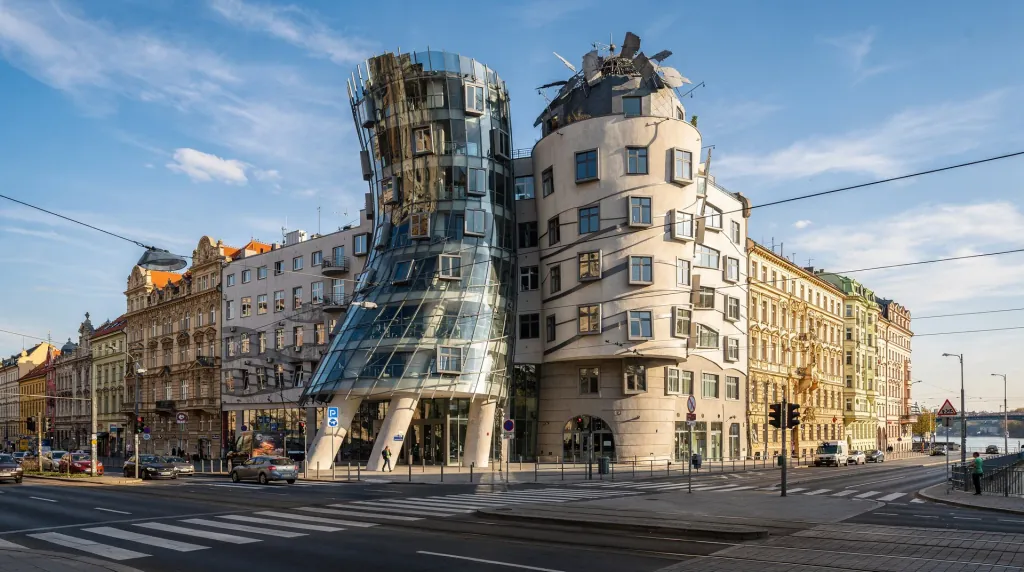
The building is genuinely striking — the twisted glass tower (the “dancer”) leans against and wraps around a more solid concrete tower (the “partner”), in an unmistakable reference to Fred Astaire and Ginger Rogers, which gave the building its unofficial name. It caused significant controversy in Prague when built. President Václav Havel, who lived across the street, supported it; architectural conservatives and Czech nationalists protested it. Today it’s a beloved city landmark and the most photographed modern building in the country.
The Dancing House does not require a long visit. It is a 20–30 minute stop on a walk along the Vltava embankment — see it, photograph it, go up to the rooftop bar for a drink, move on. There is no collection, no permanent exhibition worth lingering in, no reason to spend more than an hour here unless you specifically want to eat at the rooftop restaurant.
What to do at the Dancing House
See it from outside (free)
The best exterior shot is from directly across the street — stand on Rašínovo nábřeží embankment and shoot toward the corner, with the older neighbouring buildings providing contrast. Morning light from the east is good; late afternoon light from the west (behind the building from this angle) creates a more silhouetted effect. Alternatively, from the Vltava promenade a few metres further north, you can see the curved glass tower against the sky.
The building is taller than it appears in most photographs — 8 storeys — and the glass panels of the dancing tower catch light differently at different times of day.
The Glass Bar rooftop (recommended)
The rooftop Glass Bar on the top floor (accessible by lift through the hotel lobby) has a panoramic terrace looking north toward the Old Town, Petřín Hill, and Vyšehrad to the south. Drinks are priced at hotel rates (a beer is roughly €5–7 / 130–180 CZK). There is no entry fee — the cost is whatever you order.
The view is not as elevated as Petřín or the Castle, but it’s one of the better mid-range perspectives of the river and the embankment. Worth 30 minutes in the afternoon or at dusk.
The gallery
The Tančící dům Gallery occupies several floors and shows temporary contemporary art exhibitions. Entry ~€9 / 230 CZK. Quality varies significantly depending on the current show; check what’s on before paying.
Architecture and neighbours
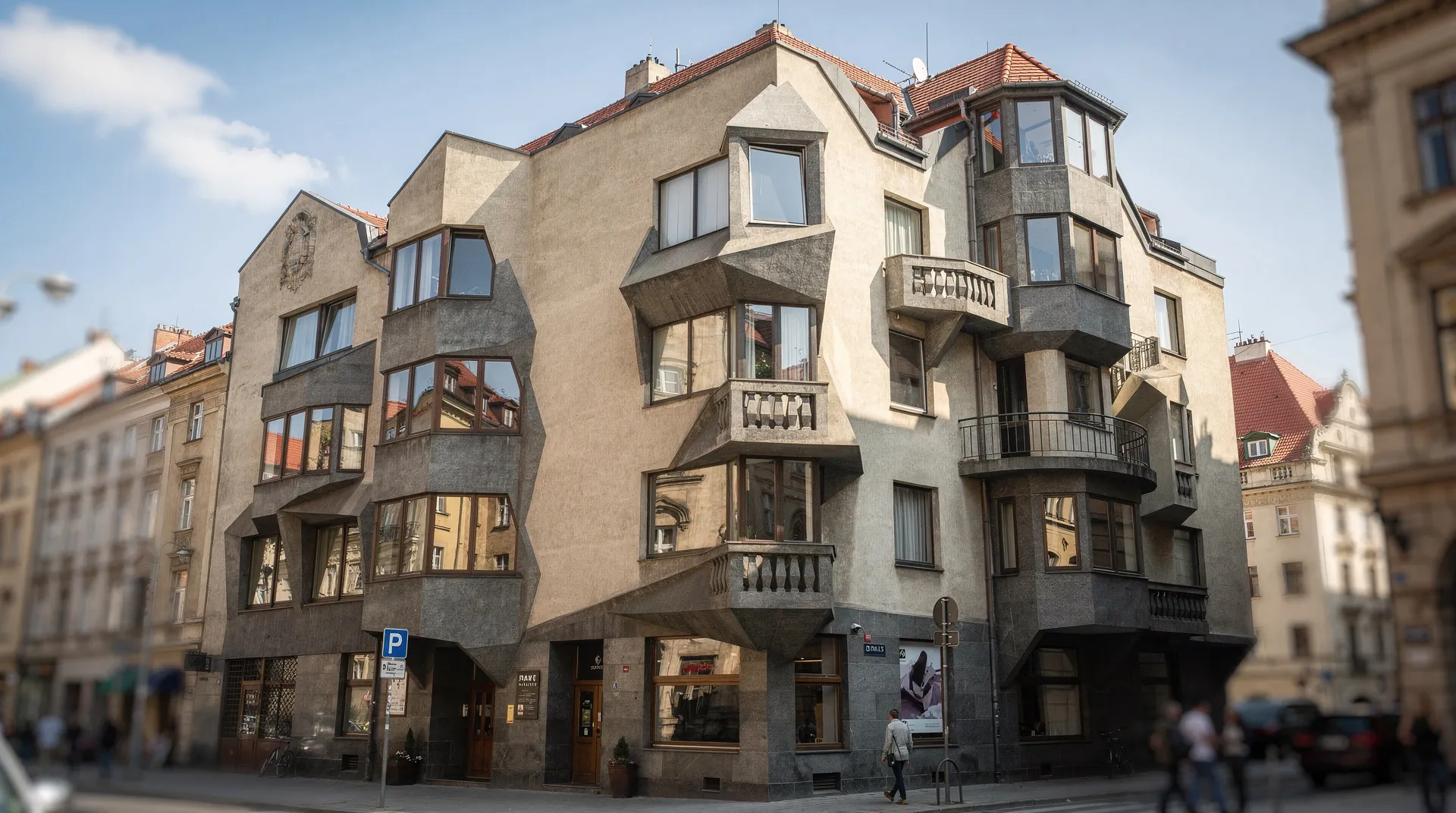
The building sits between two late 19th-century/early 20th-century apartment blocks, which was intentional — the contrast between the deconstructivist glass-and-concrete and the ornate facades of the Historicist neighbours is part of the composition. Looking at the Dancing House from the street, you see this collision of styles directly.
The Rašínovo nábřeží embankment running north and south from the building is itself worth a walk — the riverside promenade between Jiráskův most and Palacký bridge is quieter than the tourist-heavy embankments near the Old Town, lined with early 20th-century apartment buildings and local cafés.
For a broader tour of Prague’s architectural highlights — Art Nouveau, Cubism, and Functionalism as well as modern buildings:
Prague private Cubism and Art Nouveau walking tour Prague Art Nouveau walking tourFor a broader alternative Prague tour that often includes the embankment and non-standard sights:
Prague alternative walking tourGetting there
Tram: Lines 14, 17, or 21 to Jiráskovo náměstí. The building is immediately visible from the tram stop.
On foot from the Old Town: Walk south along the Vltava embankment (Rašínovo nábřeží) from Národní třída — about 15 minutes.
On foot from Vyšehrad metro: Walk north along the embankment from the Vyšehrad metro exit — about 15 minutes.
On foot from Wenceslas Square: Walk west along Rašínovo, approximately 20 minutes.
Different ways to experience the Dancing House and the embankment
Self-guided — exterior, rooftop, onward walk
Most visits follow the same pattern: see the exterior (15 minutes), go up to the Glass Bar (30 minutes), continue north or south along the embankment. This covers the essentials without any booking.
Architecture-focused walking tours
For visitors specifically interested in Prague’s 20th-century and contemporary architecture, two tours cover the broader context well:
Prague private Cubism and Art Nouveau walking tour Prague Art Nouveau walking tourOff-the-beaten-track tours
For visitors who want the Dancing House in the context of Prague’s non-standard architecture and lesser-known sites:
Prague alternative walking tour Prague hidden gems — all inclusiveCity highlights tour
For a broader introduction to Prague that contextualises the Dancing House within the city’s overall story:
Prague top sights and historic centre introduction tourSeasonal notes and timing
Morning light (east-facing): The glass tower’s curved surface faces roughly northeast. Morning sun (8:00–11:00) hits the glass panels directly and the reflections change by the minute as the sun rises. This is the best window for exterior photography.
Midday: The harsh overhead light flattens the curved glass and loses the depth of the façade. Photographers generally avoid midday. Good light returns around 16:00 when the sun moves further west and the tower’s silhouette sharpens.
Evening and night: The Glass Bar’s best hours are 17:00–21:00 when the city transitions from daylight to the evening lights. The view north toward the Old Town and Petřín is at its warmest in this window. After 21:00 the bar continues until 23:00 and the river view at night is attractive in a different register.
Winter: The embankment walk between Jiráskův most and the Dancing House is quieter and often foggy in winter. The fog on the Vltava is particularly striking from the Glass Bar terrace on overcast December or January days. The building looks best in grey weather — the glass tower stands out against a pale sky more than in harsh summer sunlight.
Insider details
The Havel apartment building across the street: The building directly across Rašínovo nábřeží from the Dancing House (no. 78) is where Václav Havel lived for most of his adult life, from 1968 until his death in 2011. There is no official memorial or plaque visible from the street beyond a small notice at the entrance. He watched the Dancing House being built from his windows.
The Palacký monument one block south: František Palacký (1798–1876) was the leading historian of the 19th-century Czech national revival, whose multi-volume history of Bohemia effectively shaped Czech national identity. The 1912 monument by Stanislav Sucharda on Palackého náměstí is enormous — Palacký in the centre, surrounded by allegorical figures of Hussite warriors, scholars, and figures of Czech history on multiple levels. It’s dramatically large and almost completely ignored by international visitors, despite being one of the finest Art Nouveau public sculptures in Europe.
The embankment café below: The river-level promenade below the Dancing House has a seasonal riverside café (Náplavka, the general term for the riverbank promenade) about 5 minutes’ walk north. In summer, the Náplavka between Palacký bridge and Jiráskův most fills with outdoor cafés, food trucks, and local life from Thursday evenings through the weekend.
The gallery check: The Tančící dům Gallery changes exhibitions every few months. The quality range is wide — some shows are genuinely strong contemporary art, others are commercial. Check the gallery website (galerietancicidum.cz) before paying the €9 / 230 CZK entry. If the current exhibition doesn’t interest you, the rooftop is free with a drink.
Dancing House vs the other embankment stops
The Dancing House sits on a stretch of riverbank with several other short, free stops worth weighing against it if your time is limited:
| Stop | Time needed | Cost | Best for |
|---|---|---|---|
| Dancing House exterior + rooftop | 30–45 min | Free + price of a drink | Modern architecture, a river view without climbing a hill |
| Vyšehrad | 60–90 min | Free (grounds) | History, clifftop views, far fewer tourists |
| Náplavka riverside promenade | Flexible | Free (cafés extra) | Local life, weekend food trucks, a relaxed walk |
| Charles Bridge | 30–60 min | Free | The essential Prague postcard shot |
If you’re walking the embankment south to north, the natural order is Vyšehrad first, then the Dancing House, then Náplavka, finishing at Charles Bridge — roughly a half-day at an easy pace.
Combining the Dancing House with nearby sights
The ideal embankment walk: Start at the Jiráskův most bridge (tram stop), cross to the west bank, continue north to Charles Bridge and Malá Strana. Or walk south from the Dancing House along the embankment to Vyšehrad — 15 minutes with river views the whole way.
Palacký Square (Palackého náměstí): One block south of the Dancing House, this square features a massive 1912 monument to Czech historian František Palacký, flanked by allegorical figures of the Hussite period. Dramatically large and virtually unknown to international visitors.
Photographer’s note
The best compositions:
- From the Vltava riverbank, shooting across the water at roughly 45° to catch the full curve of the glass tower against the embankment buildings.
- From directly below the curved tower, looking up — the lattice of glass panels against the sky.
- From across the street at street level, showing the Dancing House corner against the Historicist neighbours on both sides — the visual contrast that is the building’s primary statement.
Avoid shooting in harsh midday sun when the glass glare is extreme. Overcast days give the most even light across the façade.
Frequently asked questions about the Dancing House
Who designed the Dancing House?
The building was designed by Vlado Milunič (Czech-Croatian architect, based in Prague) in collaboration with Frank Gehry (the American architect known for the Guggenheim Bilbao and Walt Disney Concert Hall). The commission was unusual — Milunič initiated the design and brought Gehry in as a joint partner.
When was the Dancing House built?
Construction ran from 1992 to 1996. The building was inaugurated in 1996 and was officially named Nationale-Nederlanden Building after its first major tenant.
What is the building used for?
The building is a commercial office and hotel building. The upper floors host the Dancing House Hotel and the Glass Bar. Lower floors are office spaces. The gallery occupies middle floors.
Is the Dancing House controversial in Prague?
It was controversial when built. Today it is generally embraced and regarded as one of Prague’s architectural highlights. The debate has shifted: most objections now come from architects who feel Gehry’s design overwhelms the historical embankment streetscape, but public sentiment is largely positive.
How long should I spend at the Dancing House?
30–45 minutes for the exterior and rooftop bar. Up to 1.5 hours if you visit the gallery and have a meal at the rooftop restaurant.
Is the Dancing House on any walking tour?
Most architecture-themed tours of Prague include it. Several of the general city tours also pass through the embankment area. A dedicated architecture tour of Prague is the best way to contextualize it within the city’s broader built environment.
What is the best time of year to visit the Dancing House?
The building looks its best in spring and autumn, when the overcast light is softer and the glass tower’s reflections are more interesting than in harsh summer sun. Winter fog on the Vltava creates atmospheric conditions that make the exterior photography more compelling. Summer is the most crowded but offers the longest Glass Bar opening hours.
Is there disabled access to the Glass Bar?
Yes. The lift in the hotel lobby goes to the rooftop bar level. The entrance on Rašínovo nábřeží has step-free access into the lobby. The gallery is not wheelchair accessible until further notice.
Can you eat a full meal at the Dancing House?
The Glass Bar serves drinks and light food (snacks, sharing plates). The Dancing House Hotel has a more formal restaurant on lower floors. For the rooftop experience on a budget, a beer or coffee covers your time at the terrace tables. A full meal there runs €25–40 per person, comparable to hotel-grade dining elsewhere in the city.
Is the Dancing House Hotel worth staying in?
The hotel occupies the upper floors of the building. It’s a boutique property with distinctive rooms (the glass tower rooms are curved) and the location on the quiet embankment is good. Rates are mid-to-upper range for Prague (€150–250/night). If architectural character and a quiet embankment location matter to you, it’s worth considering. For central location relative to the Old Town, other hotels closer to Staré Město may be more convenient.
Is the Dancing House worth a special trip, or only if you’re passing by?
Honestly, only if you’re passing by or specifically care about modern architecture. It’s a genuine highlight of the embankment walk between Vyšehrad and Charles Bridge, but it doesn’t justify a dedicated cross-town trip on its own the way Prague Castle or Old Town does.
Practical info at a glance
- Address: Jiráskovo náměstí 1981/6, 120 00 Praha 2
- Opening hours: Exterior always visible; Glass Bar rooftop 10:00–23:00; gallery 9:00–20:00
- Price: Exterior free; Glass Bar (drink purchase required, ~€5–7 / 130–180 CZK); gallery ~€9 / 230 CZK
- Nearest tram: Jiráskovo náměstí (trams 14, 17, 21)
- Website: dancing-house.cz (hotel); galerietancicidum.cz (gallery)