Why Klementinum belongs on the shortlist
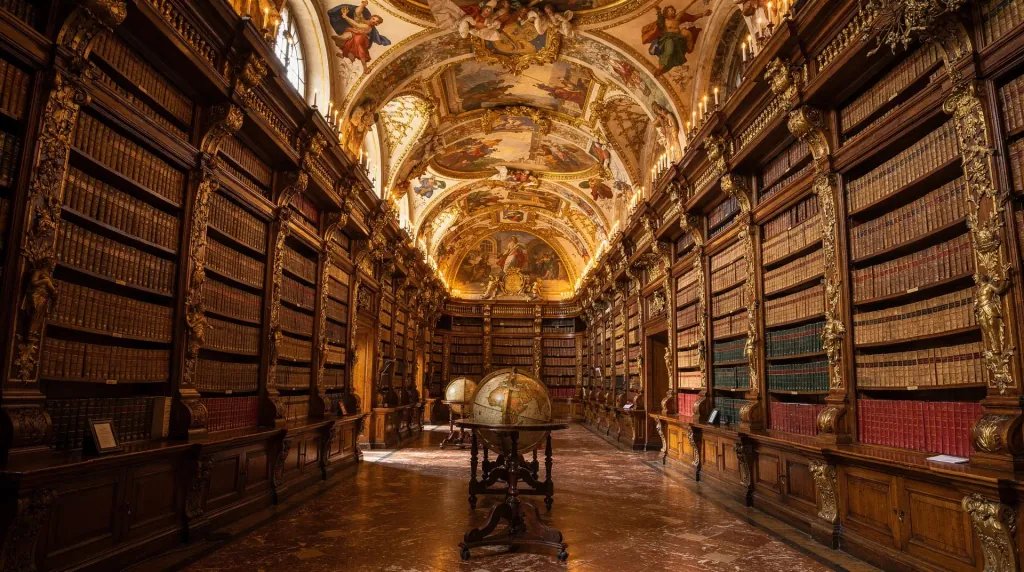
The Klementinum is one of the most architecturally significant complexes in central Europe and most visitors to Prague either skip it entirely or know it only from the single photograph of the Baroque library hall that circulates endlessly online. That photograph, for once, is not misleading: the room really does look like that. But there’s considerably more to the site than one exceptional room.
Built by the Jesuits over the course of the 17th and 18th centuries on the site of a Dominican monastery, the Klementinum complex covers 2 hectares in the heart of Staré Město — second in size only to Prague Castle among Prague’s monumental complexes. It houses the Czech National Library, an Astronomical Tower that has tracked meteorological data since 1775, and a Mirror Chapel where concerts have been held since the 18th century. The guided tour of the historic halls is the best-curated 50 minutes you can spend in Prague’s Old Town.
Worth it if you enjoy architecture, books, or music. Worth skipping if none of those apply and you’re simply ticking boxes.
| Where | Mariánské náměstí 5, Staré Město, between Charles Bridge and Old Town Square |
| Cost | Guided tour around €12 / 300 CZK adult; Mirror Chapel concerts from around €18 |
| Time needed | 50 minutes for the tour, plus 20 minutes for the Tower and Chapel |
| Getting there | 3-minute walk from Charles Bridge; 6 minutes from the Astronomical Clock; metro Staroměstská (Line A) |
| Best time to visit | Morning tour slots (10:00–11:00) for smaller groups |
The story of the Klementinum
The Jesuits arrived in Prague in 1556, invited by Ferdinand I to spearhead the Counter-Reformation in Bohemia. They were given a Dominican monastery near Charles Bridge and proceeded to build around and over it for the next 200 years. The project included a university (one of the oldest in central Europe, later merged with Charles University), a church (St Clement’s, now the Chapel of Mirrors), a new church (St Salvator, facing Křižovnické náměstí), an observatory, a library, a gymnasium, and a printing house.
Work on the Baroque Library Hall began in 1722. The ceiling was painted by Jan Hiebel between 1722 and 1727 with allegories of the Arts and Sciences. The walnut-wood gallery bookcases were fitted with their original books — many still in place — and surmounted by a collection of globes (terrestrial and celestial, made in Bohemia in the 18th century) that now serve as one of the hall’s defining visual elements.
The Jesuits were expelled from the Habsburg Empire in 1773. The complex was taken over by the Czech University and eventually became the home of the Czech National Library, which it remains today. The historic Baroque halls were opened to the public as a UNESCO-listed heritage site.
The Astronomical Tower, rising 68 metres above the complex, has been used for meteorological and astronomical observation since 1752. The famous Prague meteorological series — one of the longest continuous weather records in the world — began here. A rooster weather vane on the tower roof is mentioned in 18th-century city records.
What to see on site
The Baroque Library Hall
The centrepiece of any visit. The hall is approximately 30 metres long, two storeys high, lined with original 18th-century bookcases containing over 20,000 volumes — mostly theology, philosophy, and science from the Jesuit period. The ceiling fresco by Hiebel depicts allegorical figures representing the disciplines of knowledge, supported by painted architectural trompe-l’oeil arches. The wooden gallery running at first-floor level around the room is original, as are the iron railings.
The globes displayed on top of the bookcases are Baroque astronomical instruments — their presence in a library space was standard for Jesuit institutions of the period, which treated science and theology as complementary rather than competing. The hall was never just a library; it was a demonstration that knowledge had a physical home.
The Astronomical Tower
Access via the guided tour only. The tower offers a 360-degree view of central Prague from a height of approximately 68 metres — comparable to Petřín Tower but in the heart of the Old Town rather than on the hill. The view encompasses Chrám sv. Víta (St Vitus Cathedral), the rooftops of Staré Město, and the curve of the Vltava in both directions. The meteorological instruments on the terrace are partly original 18th-century equipment.
The climb involves narrow spiral staircases; not recommended for those with mobility difficulties or claustrophobia.
The Mirror Chapel (Zrcadlová kaple)
Originally Klementinum’s private chapel, the Mirror Chapel has been used for concerts since the Jesuit period. The interior is entirely covered in mirrors and frescoes — an 18th-century interior design that aims for a sense of infinite reflected space. Mozart reportedly performed here during his Prague visits in 1787. The chapel today hosts regular classical concerts, primarily Vivaldi and Baroque repertoire, which are booked separately from the architectural tour.
Tickets, timings, and price
Guided tour of the historic halls (2026 prices):
- Adult: ~€12 / 300 CZK
- Reduced: ~€9 / 225 CZK
- Children under 6: free
- Duration: approximately 50 minutes
- Tours run daily, in English and Czech (German and French on request for groups)
- Opening hours: 10:00–18:00 (April–October); 10:00–17:30 (November–March)
- Book online or at the entrance on Mariánské náměstí
Mirror Chapel concerts:
- Prices range from ~€18 (450 CZK) to ~€35 (875 CZK) depending on programme
- Evening events, typically 18:00 or 20:00 start
- Separate booking from the architectural tour
Allow 50 minutes for the tour, plus 20 minutes for the Chapel and Tower views.
Which tour or ticket to book
For the standard guided tour of the Baroque Library Hall and Astronomical Tower:
Klementinum Library and Astronomical Tower guided tourFor a classical concert in the Mirror Chapel (the most immersive Klementinum experience):
Klementinum Mirror Chapel classical music concertFor an alternative Mirror Chapel concert with a specific Vivaldi Four Seasons programme:
Prague Vivaldi Four Seasons at the Mirror ChapelFor a classical concert entry ticket for the Mirror Chapel (standard programme):
Classical concert at the Mirror Chapel, KlementinumFor a Mozart Requiem performance at St Salvator Church within the Klementinum complex:
Mozart’s Requiem at St Salvator Church, KlementinumHow to get there
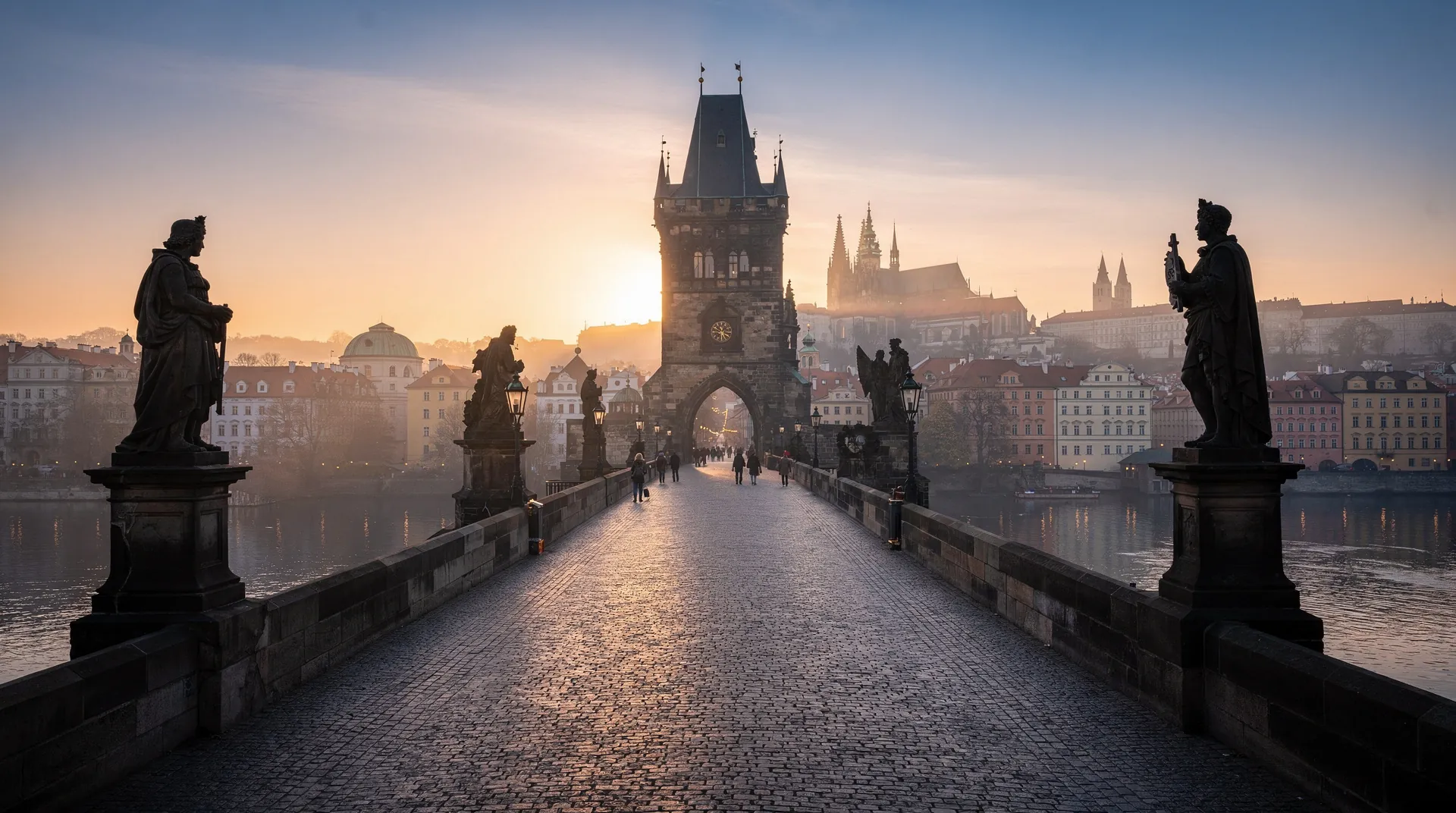
On foot from Charles Bridge: Exit the bridge on the Old Town side (Staré Město) and turn left (north) along Křižovnické náměstí. The facade of St Salvator Church marks the western entrance to the Klementinum complex. The tour entrance is on Mariánské náměstí on the north side — a 3-minute walk from the bridge.
On foot from Old Town Square: Walk west along Karlova (the historic Royal Route). The Klementinum forms the entire south side of the street for several blocks. The entrance is on the left as you approach Charles Bridge. About 6 minutes on foot.
Metro: Staroměstská (Line A, green) — 5 minutes on foot.
Photographer’s note
Photography inside the Baroque Library Hall is permitted on guided tours. The challenge is the light: the hall is lit primarily by artificial warm lighting, and the only natural light enters from small windows near the ceiling. An ISO of 2000–3200 is typically needed without flash (flash is not permitted). The key composition is from the centre of the hall, shooting along the length of the room toward the far wall, with the globe-topped bookcases on both sides creating a natural leading line.
The Astronomical Tower platform is excellent for photography but the windows are small and protected by wire mesh, which limits camera angles significantly. A smartphone fits through the mesh more easily than a DSLR lens.
For the Mirror Chapel concerts, photography is generally not permitted during performances.
The Jesuit intellectual tradition and what it means for the building
The Klementinum was not merely a place of worship — it was a total institution. Jesuit education in the 17th century was among the most rigorous in Europe: classical languages, rhetoric, philosophy, theology, mathematics, and the natural sciences were all part of the curriculum. The combination of a library, an observatory, a university, a printing house, and several churches in a single complex was a deliberate demonstration that the Jesuits understood knowledge as unified — science and theology as complementary aspects of a single truth.
This explains the globes in the library. Baroque terrestrial and celestial globes were standard equipment in Jesuit educational institutions — not decorations but scientific instruments and teaching aids. The globes in the Klementinum library (manufactured in Bohemia in the early 18th century) are among the best-preserved examples of their kind in Central Europe. Their presence in a room full of theological volumes is not a contradiction; it’s the Jesuit programme in miniature.
The printing house operated by the Jesuits at the Klementinum was responsible for a substantial proportion of Czech-language books published in the 17th and 18th centuries. After the Jesuit expulsion in 1773, the printing operations passed to the Czech University and eventually became part of the Czech National Library’s publishing apparatus. The continuity of institutional function across 250 years is part of what makes the building remarkable.
The Astronomical Tower’s meteorological record
The Prague meteorological series begun at the Klementinum’s Astronomical Tower in 1775 is one of the longest continuous instrumental weather records in the world. Daily temperature, precipitation, pressure, and wind observations have been recorded without interruption for nearly 250 years. The series predates almost all other comparable European records and is used by climate scientists as a baseline for measuring long-term climate trends in Central Europe.
The original instruments — some of which are displayed on the tower terrace — were calibrated to contemporary European meteorological standards. The temperature record shows warming trends consistent with global data sets; the precipitation data shows increased variability. Prague’s urban heat island effect is visible in the record from the late 19th century onward.
From a visitor’s perspective, the meteorological instruments on the terrace are a secondary attraction compared to the view. But knowing that this tower has been reading the same thermometer for 250 years adds a particular quality to standing on it.
What Mozart played in the Mirror Chapel — and what he actually performed in Prague
The claim that Mozart performed in the Mirror Chapel is repeated in many Prague guidebooks. The historical record is more nuanced.
Mozart visited Prague three times: in January 1787, in October 1787 (to conduct the premiere of Don Giovanni at the Estates Theatre), and in September 1791 (to conduct La Clemenza di Tito). During the January 1787 visit, he was entertained extensively by Prague’s aristocracy and musical community, and performed at various private gatherings. Whether the Klementinum Mirror Chapel was among them is unverified in contemporaneous sources — the attribution appears in later 19th-century accounts and may be apocryphal.
What is certain is that Mozart was astonished by Prague’s musical culture. His often-quoted remark “My Praguers understand me” (in German: “Meine Prager verstehen mich”) refers to the enthusiastic reception of his music in a city where he felt more appreciated than in Vienna. The performances at the Klementinum — whether verified or not — fit the pattern of his Prague activities.
The current Mirror Chapel concert programme uses this connection, verified or otherwise, as contextual marketing. The concerts themselves — Vivaldi, Handel, Baroque repertoire generally — are real and well-performed. The Mozart connection is ambient rather than documentary.
Frequently asked questions about the Klementinum
Is the Klementinum tour worth the entrance fee?
Yes. The Baroque Library Hall is not a reconstructed room or a modern interpretation — it is an intact 18th-century working space with original books, furniture, and globes. That’s genuinely rare anywhere in Europe.
How long does the Klementinum tour take?
The guided tour runs approximately 50 minutes. There is no self-guided option — you must join a tour group.
Is the Klementinum the national library?
Yes. The Czech National Library (Národní knihovna ČR) occupies the Klementinum complex. The Baroque halls are a heritage section; the working library uses modern storage and reading rooms in the same complex.
Can you visit the Klementinum without a tour?
No. Access to the historic halls — the Library, the Tower, the Mirror Chapel — is only by guided tour or concert ticket. The complex is not open for independent wandering.
Are the Mirror Chapel concerts good value?
Yes. The chapel is a small, intimate venue (approximately 100 seats) with excellent acoustics and one of the most spectacular interiors in the city. Programme quality varies by operator; the Vivaldi Four Seasons concerts are reliably well-performed.
Is the Klementinum accessible for visitors with disabilities?
The Astronomical Tower is not accessible (narrow spiral stairs). The Baroque Library Hall tour is partially accessible on the ground floor. Contact the Klementinum directly for specific arrangements.
What’s the difference between the library tour and a concert?
They are entirely separate experiences. The tour (daytime) focuses on the architecture and history of the halls. A concert is an evening event held in the Mirror Chapel. You can do both on the same day if timing allows.
The Klementinum as part of a Staré Město walking day
The Klementinum’s position — on the axis between Old Town Square and Charles Bridge, on the Karlova street (the historic Royal Route) — means it fits naturally into any Old Town walking day. Two useful route structures:
Morning circuit (3 hours): Start at Old Town Square (Staroměstské náměstí). Walk the square, see the Astronomical Clock, and climb the Old Town Hall Tower if you haven’t. Walk west on Karlova to the Klementinum entrance on Mariánské náměstí. Join the 10:00 guided tour. After the tour, continue west on Karlova to Charles Bridge. Walk the bridge to Malá Strana, explore the bridge towers, then return across the bridge.
Combined with a Mirror Chapel concert (evening): Attend the afternoon or morning guided tour (roughly 10:00–13:00), then have the afternoon in Old Town. Return to the Klementinum for the evening Mirror Chapel concert (typically 18:00 or 20:00). This requires buying two separate tickets but creates a full architectural-and-musical experience of the building.
The Klementinum is approximately 7 minutes’ walk from Old Town Square and 3 minutes from Charles Bridge. It’s easy to visit as part of a route between the two.
The Czech National Library and its collections
The Národní knihovna ČR (Czech National Library), headquartered at the Klementinum, is one of the major research libraries of Central Europe. The collection totals approximately 8 million volumes, including significant holdings in medieval manuscripts, early printed books (incunabula), and materials from the Jesuit period.
The public does not have access to the main library stacks, but the reading rooms are open to researchers with accreditation (free registration). The library’s digitisation programme has made a significant portion of the historic holdings available online at kramerius.nkp.cz — including high-resolution scans of illuminated manuscripts and early printed books that are physically held in the Klementinum’s conservation archive.
The historic globes displayed in the Baroque Library Hall are part of the National Library’s scientific instrument collection. The celestial globe (showing the star positions as known in the early 18th century) and the terrestrial globe (showing world geography as mapped at the same date, with significant lacunae in the Americas and Asia) are Bohemian-made instruments of the highest quality for their period.
Pairing Klementinum with the rest of Staré Město
The Klementinum sits on the historic Royal Route linking Old Town Square to Charles Bridge, which makes it easy to combine with the Astronomical Clock and a bridge walk in a single morning. If you’re building a full Staré Město day or a longer 3-day Prague itinerary, slot the Klementinum tour between the two anchor sights rather than as a separate outing.
Practical info at a glance
- Address: Mariánské náměstí 5, 110 00 Praha 1
- Opening hours: Daily 10:00–18:00 (Apr–Oct); 10:00–17:30 (Nov–Mar)
- Price: Tour ~€12 / 300 CZK; concerts from ~€18
- Nearest metro: Staroměstská (Line A) — 5 min walk
- Official website: nkp.cz (Czech National Library)