Why the Lennon Wall earns its place on any Prague itinerary
The Lennon Wall is one of those rare tourist spots that actually lives up to the hype, but for reasons most visitors don’t expect. It isn’t particularly large — roughly 30 metres of plaster on a perimeter wall of the Knights of Malta garden — and Prague has far more technically impressive street art. What makes it compelling is the weight of what it represents: spontaneous, repeated, officially-suppressed political expression in a city that spent four decades under a regime that punished that sort of thing severely.
The wall is worth your time if you care about Cold War history, the Velvet Revolution, or simply want to understand how an image of a Beatle became a symbol of resistance in central Europe. It’s worth skipping the crowds (arrive early) but it would be a shame to skip the wall entirely.
| At a glance | |
|---|---|
| Where | Velkopřevorské náměstí, Malá Strana, a short walk from Charles Bridge |
| Cost | Free, always |
| Time needed | Around 15–30 minutes |
| Getting there | On foot from Charles Bridge (~5 min); tram 12/20/22 to Hellichova |
| Best time | Early morning (07:00–09:00) in summer, or shoulder-season weekday mornings |
The story behind the wall
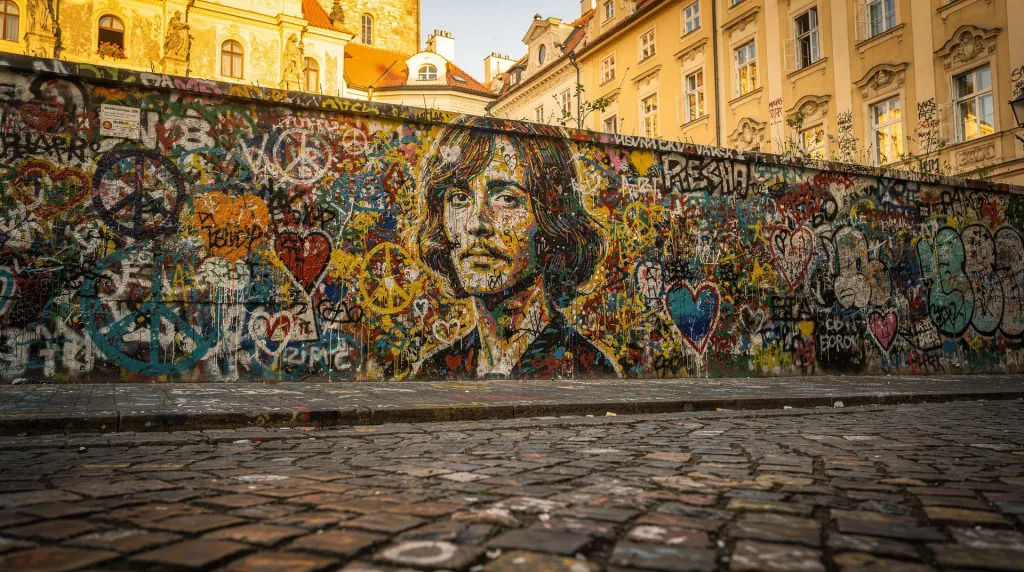
John Lennon was shot dead in New York on 8 December 1980. Weeks later, in a country where Western rock music was officially frowned upon and public political dissent was illegal, an unknown person painted a portrait of Lennon on a garden wall in Malá Strana, on Velkopřevorské náměstí. Below the portrait appeared lyrics from Lennon’s songs — Imagine, Give Peace a Chance — and messages about freedom and peace. The wall, which belonged to the French Embassy (the garden is part of the Maltese Knights’ property, historically adjacent to French diplomatic premises), became an instant lightning rod.
Throughout the 1980s, the Czechoslovak secret police — the StB — regularly whitewashed the wall. Within days or weeks, new messages and portraits would reappear. Young Czechs began using the wall as a proxy for everything they couldn’t say publicly: protests against the communist government, solidarity with the Solidarity movement in Poland, expressions of longing for Western culture and political freedom. The regime called the participants “Lennonists” — a portmanteau of Lennon and Leninists, used derisively — and periodically detained people for painting there.
After the Velvet Revolution of November 1989, the wall officially lost its forbidden quality. But rather than fading into irrelevance, it gained a new one: memorial, palimpsest, living document. Tourists began adding their own layers, and the wall became a continuous conversation between visitors from around the world and the Czech people who still use it to mark anniversaries and events. The portrait of Lennon is repainted regularly; the face you see today may have been added in the last few months. In 2016 the Knights of Malta, who own the wall, asked the Lennon Wall community to paint it entirely white in protest at the commercialisation of the site — which prompted an immediate community repaint within 24 hours.
What to see on site
The wall itself fills the garden-side of Velkopřevorské náměstí, a small cobbled square in the heart of Malá Strana. The central panel, roughly at eye level and slightly left of centre, usually features the most recent Lennon portrait — typically showing him in his wire-rimmed glasses, peace signs nearby. The area around it accumulates layers of contributions: individual messages, flags, song quotes, local political statements, love declarations, and occasionally whole murals that get painted over within weeks.
Look for the French inscription “Liberté, Egalité, Fraternité” that sometimes appears as an ironic nod to the wall’s location next to the French diplomatic quarter. The Knights of Malta cross motif appears in a few corner panels as a reminder of the wall’s ownership. On the ground in front of the wall, chalked messages frequently appear and disappear.
The best photograph of the full wall is taken from the far end of the square, stepping back to fit the entire length in frame. In morning light (before 09:00 in summer), the eastern-facing wall is well-lit and empty of selfie-takers. At noon on a July day, the square can feel like a small concert venue — shoulder-to-shoulder tourists, a guitarist or two, occasional street vendors.
Spend 15–20 minutes here. Read the messages rather than just photographing the surface. The weight of the place accumulates through details, not spectacle.
Tickets, timings, and price
The Lennon Wall is entirely free and accessible 24 hours a day, seven days a week, 365 days a year. There is no gate, no ticket booth, and no admission of any kind. The square is public space.
Best times to visit:
- Early morning (07:00–09:00) in summer: the wall is almost empty, the light is excellent, and you can read the inscriptions without being jostled.
- Weekday mornings in the shoulder season (April, May, September, October): manageable crowds, mild weather.
- Avoid midday in July and August unless crowds don’t bother you.
Budget 15–30 minutes, slightly more if you’re a photographer or want to read the messages carefully.
There is no official website for the Lennon Wall. It is simply a wall.
Which tour to book nearby
The Lennon Wall sits at the southern end of Malá Strana, a few minutes’ walk from Charles Bridge and Kampa Island. It fits naturally into any walking tour of the left bank. The most relevant options from the GYG catalog:
For a focused walk through the streets of Malá Strana and along Charles Bridge:
Charles Bridge and Lesser Town walking tourFor a wider walk through the alternative, less-touristy corners of Prague that goes beyond the standard itinerary:
Prague alternative walking tourFor a local guide who takes you to genuinely off-the-beaten-path spots, including hidden Malá Strana courtyards:
Prague hidden gems walking tour with local guideHow to get there
On foot from Charles Bridge: Cross Karlův most and turn immediately left (south) onto Říční. Walk along the river towards Kampa Island, then turn right into Malá Strana backstreets. Velkopřevorské náměstí is about 400 metres from the bridge — a 5-minute walk.
Tram: Take tram 12, 20, or 22 to the Hellichova stop in Malá Strana, then walk 350 metres northeast into Újezd and through to Velkopřevorské náměstí.
Metro: The nearest station is Malostranská (Line A, green), about 12 minutes on foot via Josefská and Lázeňská streets through Malá Strana.
The wall is on Google Maps as “John Lennon Wall” — the pin is accurate.
Photographer’s note
The ideal shot of the entire wall requires standing at the entrance to the square from Maltézské náměstí, roughly 20 metres back from the wall’s left edge, at an angle of about 30 degrees. This gives a slight perspective that shows the full depth of layers and colour without distortion.
For a portrait-style shot of the Lennon face panel, shoot in the first hour after sunrise in summer when the light rakes the surface from the east and the textures of the painted plaster are visible. Avoid flat midday light — it flattens the layers and makes the colours look washed out.
If you visit in winter, the lack of crowds and the possibility of snow on the cobbles in front of the wall can produce striking images. Prague winters are not reliably snowy, but when they are, Velkopřevorské náměstí is one of the most photogenic spots in the city.
One insider note: on John Lennon’s birthday (9 October) and the anniversary of his death (8 December), local musicians and activists gather at the wall for informal commemorations. These are unannounced events but easy to find if you’re in the neighbourhood.
Frequently asked questions about the Lennon Wall
Is the Lennon Wall worth visiting?
Yes, particularly if you have any interest in Cold War history or the Velvet Revolution. As a piece of street art it’s interesting; as a piece of living political history it’s genuinely moving. Allow 20 minutes and arrive early.
How long do you need at the Lennon Wall?
Fifteen to twenty minutes is plenty for most visitors. Photographers and those who want to read the inscriptions carefully may want 30–40 minutes.
Is the Lennon Wall free?
Completely free, 24 hours a day. No ticket, no reservation, no donation requested.
Is the Lennon Wall open year-round?
It is a wall on a public square. It is always accessible, in all weather, at all hours.
Can I add my own graffiti to the Lennon Wall?
Technically the wall is private property (owned by the Knights of Malta), and the situation regarding public contributions is ambiguous. In practice, people do add messages and small drawings, and this has been tolerated for decades as part of the wall’s character. Avoid covering existing artwork or large painted murals, and use small-format contributions if you choose to participate.
Where exactly is the Lennon Wall?
Velkopřevorské náměstí (Grand Priory Square), Malá Strana, Praha 1. It is the wall running along the Knights of Malta garden, facing the square. Google Maps shows it accurately.
Is the Lennon Wall close to Charles Bridge?
About 400 metres on foot — a 5-minute walk. It fits naturally into a route that combines the bridge, Kampa Island, and Malá Strana.
Why does the wall keep getting repainted?
Because people keep painting on it. That’s always been the point. The layers of paint — some estimates put the total depth at several centimetres — are part of the object’s history.
What else is nearby if I only have 30 minutes?
Combine the wall with a walk onto Kampa Island (2 minutes away) and a stroll across Charles Bridge (5 minutes) — the three together make a compact, free half-hour circuit through the best of Malá Strana’s riverside.
Is the Lennon Wall suitable for kids?
Yes — it’s an open-air public square with no admission, no queues, and no fragile exhibits, making it one of the easier sights in Prague to bring young children to. There’s little shade, so plan around the hottest midday hours in summer.
The broader Malá Strana walk: how to fit the Lennon Wall into a half-day
The Lennon Wall works best as part of a Malá Strana walking circuit rather than an isolated destination. The natural sequence:
Start at Charles Bridge (Karlův most) — cross from the Old Town side and descend into Malá Strana via the bridge tower steps. Turn immediately left (south) onto the riverside path toward Kampa Island. Walk the length of Kampa’s Čertovka canal (the narrow waterway nicknamed the Venice of Prague), cross the small footbridge at the southern end, and emerge on Říční. Head west through the backstreets — Všehrdova, then south into the Knights of Malta neighbourhood — to Maltézské náměstí. The Lennon Wall is one square further south at Velkopřevorské náměstí.
From the wall, continue west past the French Embassy gate and turn north on Prokopská to return through the heart of Malá Strana: the baroque palaces, the Czech Senate gardens, and the back route up to Petřín hill if you have energy for the climb. Total circuit approximately 2.5 km; budget 90 minutes including stops.
This route avoids the worst crowds on Mostecká and Nerudova (the tourist-dense main arteries of Malá Strana) and takes you through streets that are genuinely part of the neighbourhood rather than corridors between monuments.
The music connection: what Lennon actually meant in Czechoslovakia
It’s worth spending a moment on why John Lennon specifically — rather than, say, Bob Dylan or the Rolling Stones — became the symbol chosen by young Czechs in the 1980s.
Western rock music was not uniformly banned in communist Czechoslovakia. The policy shifted over the decades: the late 1960s were relatively permissive, the 1970s normalisation under Gustáv Husák introduced stricter controls, the 1980s were uneven. The Beatles had a devoted following from the early 1960s. Their music circulated through samizdat recordings — tapes copied illegally and passed hand to hand — and via Radio Free Europe, which broadcast Western music regularly.
What made Lennon distinctively symbolic was the combination of Imagine’s explicit political content (a vision of a world without borders, religion, or possessions — each of which was ironic in a state that controlled all three), his anti-Vietnam War activism, and the visceral simplicity of the message. You didn’t need to understand English to respond to the music emotionally. And after his murder in December 1980, the memorial impulse was natural: there was no official channel for grief, so an unofficial one appeared.
The StB (Státní bezpečnost, the Czechoslovak secret police) categorised “Lennonism” as a symptom of Western influence and social deviance. Detaining someone for painting on the wall was typically done under catch-all public order offences rather than explicit political charges — a common tactic that allowed prosecution without acknowledging the political content of the act. The people who painted here in the 1980s knew the risk. Most took it anyway.
Nearby: what else to see in the Velkopřevorské náměstí area
The square itself has several points of interest beyond the wall:
Maltézské náměstí (Knights of Malta Square): The adjacent square, one block north, is quieter and has some of the best preserved Baroque palace facades in Malá Strana. The Church of Our Lady Under the Chain (Kostel Panny Marie pod řetězem), the oldest church in Malá Strana, faces the square. Its unfinished facade — construction was abandoned in 1389 and never resumed — is an involuntary monument to interrupted projects.
The French Embassy: The wall belongs to the Knights of Malta property complex, which abuts the French diplomatic mission. The French tricolour flying above the wall in certain photographs is from the Embassy building. The relationship between this deeply French-adjacent monument and French revolutionary rhetoric (Liberté, Égalité, Fraternité) occasionally appears in the graffiti.
Café Lounge: On Platnéřská, a few minutes’ walk north, is a café popular with local architects and designers. One of the better places in Malá Strana for a morning coffee without tourist markup.
Hergetova Cihelna: Along the Vltava embankment north of Kampa, a riverside restaurant with a good view of Charles Bridge from the water side. Moderate prices, reliable food.
What happens when someone paints over the wall
The wall is effectively in a state of continuous negotiation between multiple parties: the Knights of Malta as property owners, the Prague city administration, various street art communities, individual visitors with spray cans, and the occasional political group using the wall for messaging.
Large-scale whitewashing happens periodically. In 2016, the most dramatic instance: students from the Prague Academy of Fine Arts whitewashed the entire wall in protest at what they called the wall’s “McDonaldization” — the reduction of a genuine political act to a selfie background. The whitewash lasted approximately 24 hours before it was repainted. The event was filmed, argued about, and eventually added to the wall’s own mythology.
More routinely, sections of the wall are periodically painted over by visitors adding new messages, or by street artists covering previous work with new pieces. The wall at any given moment is probably 3–6 months old in its current visible state, with earlier layers sealed underneath. Estimates of the total accumulated paint depth run to several centimetres.
Practical info at a glance
- Address: Velkopřevorské náměstí, Malá Strana, 118 00 Praha 1
- Opening hours: Always accessible, 24/7
- Price: Free
- Nearest tram: Hellichova (trams 12, 20, 22) — 4 min walk
- Nearest metro: Malostranská (Line A) — 12 min walk
- Official website: None — it’s a public wall