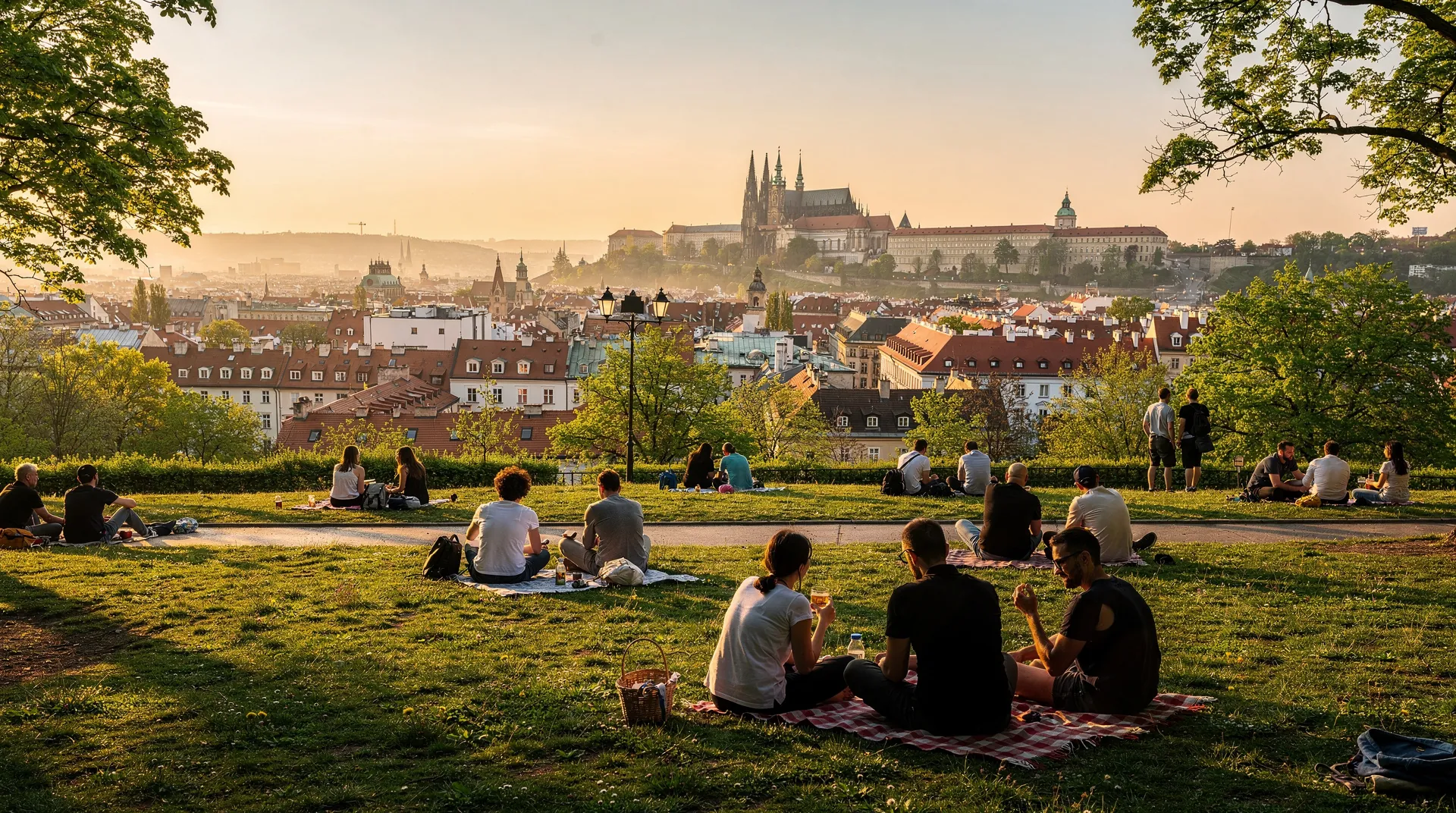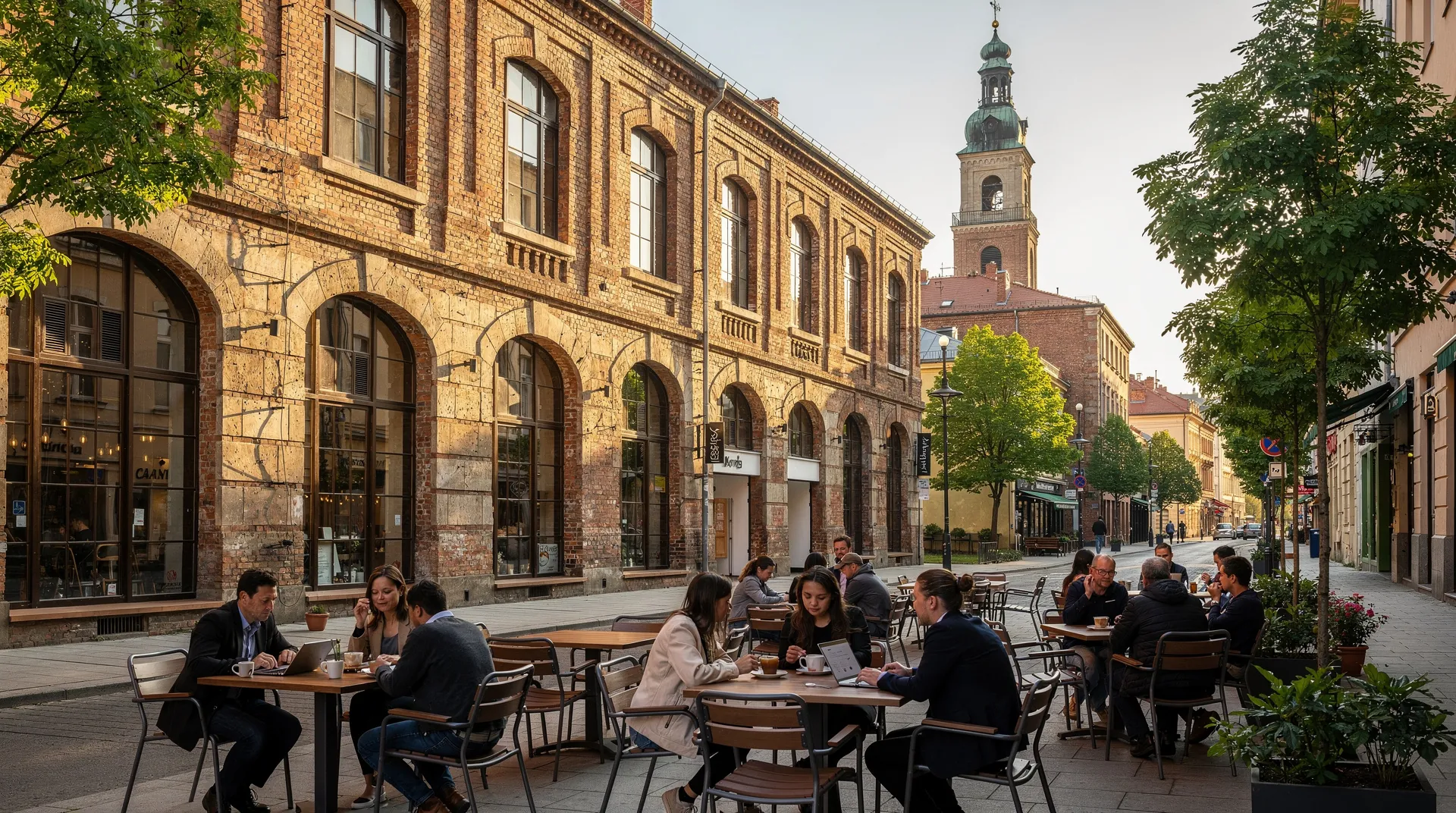
What Žižkov is and why it matters
Žižkov is the neighborhood that Prague’s guidebooks treat as an afterthought and that many Praguers treat as home. Named after Jan Žižka — the one-eyed Hussite military leader whose equestrian statue on Vítkov Hill is reportedly the largest bronze equestrian statue in the world — the district has always had a combative identity. It was historically a working-class neighborhood of laborers, and it developed a proud independence from the smarter districts across the valley.
The statistic that Žižkov uses as a calling card: more pubs per square kilometer than any other place on earth. Whether this is precisely true is unverifiable, but a five-minute walk through the neighborhood makes the claim feel plausible. The bars are low-ceilinged, often unnamed from the outside, and serve excellent Czech lager at prices that feel like time travel compared to the Old Town.
What Žižkov is today is in transition. The 2000s and 2010s brought gentrification pressure from neighboring Vinohrady, and some streets near the border have cleaned up considerably. But the core of the neighborhood — the area around Seifertova, Prokopovo náměstí, and the pub streets radiating off Žižkovo náměstí — remains fundamentally Žižkov: cheap, loud, skeptical of pretension, and in possession of the best unpretentious bar culture in Prague.
| Where | East of Vinohrady, uphill from the main train station |
| Cost to visit | Free to walk; a half-litre beer runs around €1.80–2.50 |
| Time needed | Half a day for the TV Tower, Vítkov Hill, and Olšany Cemeteries |
| Getting there | Metro A to Jiřího z Poděbrad or Flora; TV Tower is a 10–12 min walk from either |
| Best time to visit | Late afternoon into evening, when the pubs fill up |
A walk through Žižkov
This walk takes about two hours if you resist the temptation to stop at each pub, longer if you don’t.
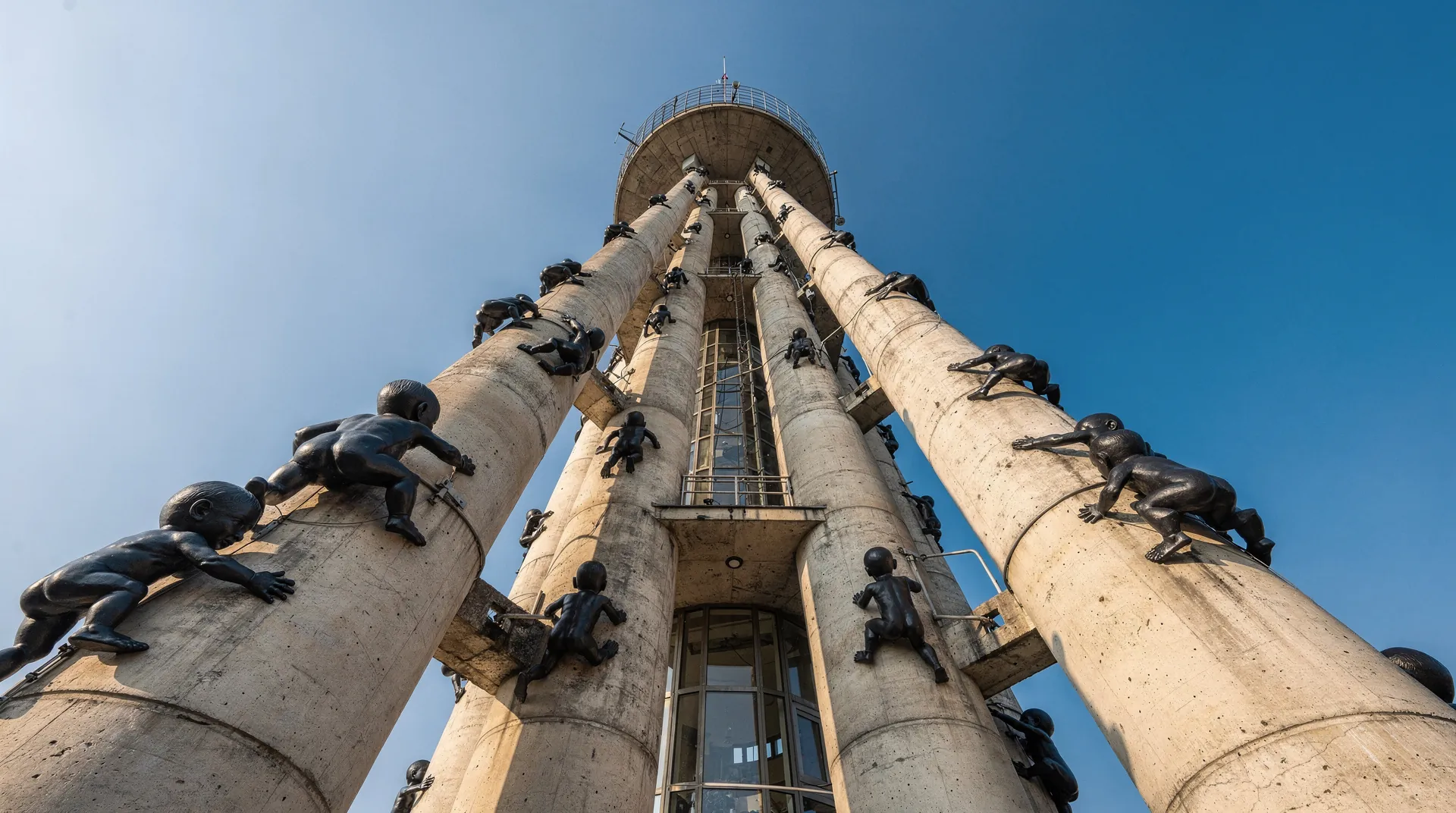
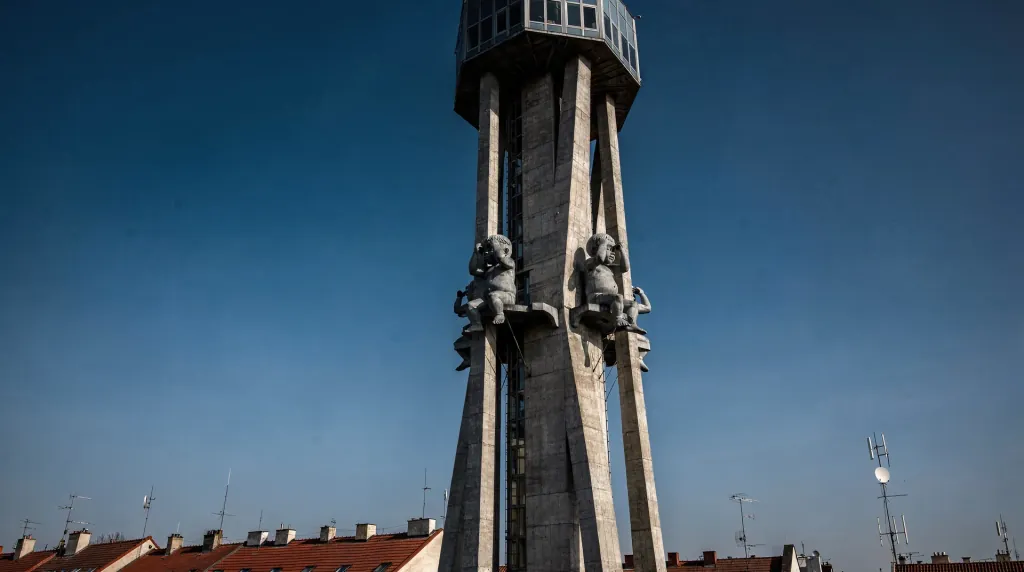
Start at the Žižkov Television Tower (Žižkovský televizní vysílač) on Mahlerovy sady. Built between 1985 and 1992 under the communist government, the TV Tower is one of the most divisive buildings in Czech architecture — admired by some, despised by others, and impossible to ignore at 216 meters. The David Černý sculptures of giant babies crawling up the tower’s pylons are the neighborhood’s most photographed element and among the strangest public art installations in Europe. There is a pod-hotel inside (One Room Hotel) and a restaurant at the observation level — the panoramic view from up here shows you Prague from the east, which reveals the city’s topography in ways the castle view doesn’t.
Walk north toward Vítkov Hill and the Žižkův pomník — the equestrian statue of Jan Žižka. The scale of both the statue (9 meters tall, 16.5 tons) and the granite mausoleum behind it is disorienting, especially since most visitors arrive expecting a park viewpoint and encounter instead a monument on the scale of a Soviet war memorial (which the mausoleum later became — it housed Klement Gottwald’s embalmed body for years). The hill itself is a legitimate viewpoint over the city from the east.
Walk back south through Žižkovo náměstí — the main neighborhood square, completely unspectacular and exactly right. This is where the market stalls set up and where the bar doors open to the street in summer.
Follow Seifertova west toward the Olšanské hřbitovy (Olšany Cemeteries) — the largest cemetery in Prague, where Franz Kafka is buried (grave is signposted from the main entrance). The cemetery is enormous, atmospheric, and genuinely interesting to walk through as a cross-section of Czech history in headstones.
Alternative Prague walking tour — off the tourist trail (2 h, from €14)Where to eat
Quick lunch
Pastva on Blanická (technically on the Vinohrady border) serves excellent Czech-influenced lunches with seasonal ingredients at €8–12 (200–300 CZK). In the core of Žižkov, Srpen on Seifertova is a Czech gastropub that serves better-than-pub food at pub prices — the roast duck and svíčková are worth the trip.
Dinner
Mujt on Seifertova is an izakaya-style bar that took over a former pub and kept the prices without keeping the philosophy — Japanese-Czech fusion small plates, €8–14 (200–350 CZK), standing or perched at the bar. Cobra on Sladkovského náměstí has been doing slow-cooked meats and natural wine in a former communist-era dive bar; one of the more interesting dinner tables in Prague outside the center. U Sadu on Škroupovo náměstí is the neighborhood’s traditional landmark — a pub that’s been on this corner since 1897, serving Czech food without apology.
Cafes and bakeries
Kavárna Liberál near the TV Tower is a socialist-era café that maintained its original furniture and turned it into an ironic-affectionate neighborhood institution — coffee at prices that would embarrass Old Town and a cake selection that outperforms everything. Black Milk near Prokopovo náměstí is the neighborhood’s third-wave coffee spot with proper barista technique.
Where to drink
This is where Žižkov earns its reputation. U Vystřelenýho oka (At the Shot-Out Eye — a Žižka reference) on U Božích bojovníků is the neighborhood’s most famous dive bar, with outdoor seating, cheap Kozel, and the city’s most mixed crowd of students, punks, artists, and people who’ve been drinking here since the 1990s. Bukowski’s Bar on Bořivojova is a different register: serious cocktails in a velvet-and-book interior, the neighborhood’s cocktail bar for those who want both quality and Žižkov prices. Bar U Holanů on Blanická is a neighborhood pub that has refused to modernize and is better for it.
Prague pub crawl with unlimited drinks and club entry (from €25)Where to stay
Žižkov is a genuine budget neighborhood — accommodation here is substantially cheaper than in Vinohrady or Nové Město for comparable quality. The main caveat is that the area around Seifertova can be noisy at night (pub culture, not crime). The Hotel Bílý Lev and several guesthouses near the TV Tower are reliable and central. Hostels exist in good numbers. For anyone who wants value over prestige address, Žižkov is the honest choice. Walking to Old Town takes 25 minutes or take the metro from Jiřího z Poděbrad (three stops to Staroměstská).
Getting here and around
Metro Jiřího z Poděbrad (A/green line) is at the western edge of the neighborhood. Flora (A line) is in the middle. From Jiřího z Poděbrad, it’s a 10-minute walk to the TV Tower. Trams 5, 9, 15, and 26 run along Seifertova and Vinohradská, connecting the neighborhood to the center. No direct metro stop near the TV Tower — it’s a 12-minute walk from Jiřího z Poděbrad or take tram 11 to Lipanská.
Common misses in Žižkov
Prokopovo náměstí is a small square in the middle of the neighborhood that feels completely untouched by the tourism industry — surrounded by neighborhood pubs and a small park where people actually sit. It doesn’t appear in travel guides and that’s exactly the point.
The Jewish Cemetery on Izraelská (separate from the famous Josefov cemetery) is where Franz Kafka is actually buried — the gravestone is modest and the cemetery small, but it’s a pilgrimage site for literary visitors who know to come here rather than the Josefov cemetery.
Vítkov Hill at night from the far side of the Žižka statue offers a view of Prague’s eastern neighborhoods that no tourist photograph captures — the city spreading out into the valley with the TV Tower blinking red in the middle distance.
Frequently asked questions about Žižkov
Is Žižkov safe?
Yes, it’s safe. It has a rough reputation that is largely historical and partly self-cultivated. The neighborhood has poverty and it shows, but violent crime toward tourists is not a feature. Standard urban precautions apply: don’t flash expensive items in quiet side streets late at night.
Why does the Žižkov TV Tower have babies crawling on it?
The giant crawling babies were installed by artist David Černý in 2000 and were made permanent in 2001. Černý has given various explanations, including that they represent the “dehumanization of children” in a technological society. They are now so associated with the tower that it’s difficult to imagine the structure without them.
What is the Žižkov film culture?
The neighborhood has historically supported underground cinema culture — the Kino Aero on Biskupcova is Prague’s best repertory cinema, showing arthouse and classic films in original languages with subtitles. It’s the best place in the city to watch a film if you live here.
How cheap is drinking in Žižkov compared to Old Town?
Significantly. A half-litre of draft Czech lager in a Žižkov pub costs around €1.80–2.50 (45–65 CZK). The equivalent in an Old Town tourist pub is €4–6 (100–150 CZK). The beer is often the same brand or better.
Is Žižkov good for families?
It’s not the obvious family destination — the pub density and nighttime noise factor it toward adults. That said, Riegrovy sady park is adjacent (technically Vinohrady), the TV Tower is genuinely fascinating for children, and the Olšany Cemeteries are quietly educational. For accommodation with families, adjacent Vinohrady is probably a better base.
How does Žižkov compare to Vinohrady for nightlife?
Both border each other, but the character is different: Vinohrady has wine bars and a curated café scene, while Žižkov has genuine dive-bar density and lower prices. If you want a polished evening, stay in Vinohrady and walk over for a Žižkov pub crawl. If you want the real thing from your doorstep, base here.
Is Žižkov walkable to Karlín?
Yes, roughly 20 minutes on foot, mostly downhill, or a short tram ride. Karlín is worth combining with a Žižkov evening if you want a contrast — modern, riverside, and considerably quieter after dark.
Full day in Žižkov: 9am to 10pm
9:30 — Start at the Žižkov Television Tower (Mahlerovy sady). Take the lift to the observation deck (€14 / 350 CZK) for the best view of Prague from the east — you see the city’s topography in a way the castle view doesn’t give you. The David Černý babies are most striking from the park below at ground level. 11:00 — Walk north up the hill to Vítkov Hill and the Žižkův pomník — the equestrian statue of Jan Žižka. This is the largest bronze equestrian statue in the world (9 metres tall, 16.5 tons).
The mausoleum behind it housed Klement Gottwald’s embalmed body for years. The hill is a good viewpoint over the eastern city. 12:30 — Lunch at Srpen (Seifertova) — Czech gastropub with better-than-pub food at pub prices. Or Pastva (Blanická, at the Vinohrady border). 14:00 — Walk to the Olšanské hřbitovy (Olšany Cemeteries) via Seifertova — Franz Kafka’s grave is here (signposted from the main entrance on Vinohradská).
The cemetery is enormous and genuinely atmospheric. Allow 45 minutes. 15:30 — Communism and Bunker Tour (t22927) if you want to understand the neighbourhood’s post-1948 character — the tour covers communist-era Prague including the nuclear bunker under Žižkov, finishing with a 1970s-style canteen lunch (timing may require booking the afternoon slot).
17:30 — Walk down to Prokopovo náměstí — the quintessential Žižkov neighbourhood square, surrounded by local pubs and a small park where nobody takes photographs. 19:00 — Dinner at U Sadu (Škroupovo náměstí, traditional Czech pub, goulash and dark lager since 1897) or Cobra (natural wine and slow-cooked meats). 21:00 — U Vystřelenýho oka (U Božích bojovníků) for the neighbourhood’s most famous pub experience — cheap Kozel, outdoor seating, the most authentically mixed crowd in any Prague bar.
Local daily rhythm in Žižkov
07:00–09:00 — Quieter than most Prague neighbourhoods. Seifertova has morning commuters. The pubs are all shut. A few bakeries open early.
09:00–12:00 — The neighbourhood functions as a residential area. The TV Tower observation deck begins its tourist day. The Olšany Cemetery is best at this quiet time.
12:00–18:00 — Lunch service at the gastropubs and restaurants. The TV Tower and the Žižka statue are the daytime tourist draws.
18:00–22:00 — The neighbourhood activates. The pubs fill from 18:00. The bar terraces on warm evenings are where Žižkov actually happens — tables extended onto pavements, doors propped open, the city’s most genuine pub-culture hours.
22:00–02:00 — Prague’s pub capital at work. U Vystřelenýho oka, Bukowski’s, U Holanů. The bars don’t have a 23:00 curfew feel; many stay lively until 02:00.
Where to stay in Žižkov
Hotel Flora (Vinohradská 121) — large mid-range hotel on the main arterial road, reliable and consistent. From €70 / 1750 CZK per night. Pros: good metro access, consistent quality. Cons: on a busy road, no neighbourhood character.
Hotel Bílý Lev (Cimburkova 18) — small hotel in the quieter residential part of Žižkov. From €65 / 1625 CZK. Pros: neighbourhood authenticity, affordable. Cons: walk to metro.
Hostel One Prague (Cimburkova 8) — the best-run budget hostel in Žižkov, with social activities and a strong community atmosphere. Dorms from €15 / 375 CZK. Pros: social, very affordable, well-managed. Cons: hostel format.
5 specific food and drink recommendations
Srpen — Seifertova 16. Czech gastropub, mains €8–14 / 200–350 CZK. Better-than-expected food at pub prices. Roast duck and svíčková are the orders.
U Sadu — Škroupovo náměstí 7. Traditional pub since 1897, mains €6–10 / 150–250 CZK. The neighbourhood’s oldest reliable institution. Goulash, dark lager, no frills.
Cobra — Sladkovského náměstí 1. Natural wine and slow-cooked meats, mains €10–16 / 250–400 CZK. One of the most interesting restaurant tables in Prague outside the tourist centre.
U Vystřelenýho oka — U Božích bojovníků 3. Dive bar. Half-litre beer €2 / 50 CZK. The neighbourhood’s most famous pub, the most genuinely mixed crowd in any Prague bar.
Kavárna Liberál — near the TV Tower, Mahlerovo náměstí area. Coffee €2–3 / 50–75 CZK, cake €2–4 / 50–100 CZK. Socialist-era furniture lovingly preserved, prices that embarrass Old Town.
Hidden details in Žižkov
The Jewish Cemetery on Izraelská — separate from the famous Josefov cemetery, this is where Franz Kafka is actually buried. The gravestone is modest, white, and inscribed simply. The cemetery is small (the New Jewish Cemetery) and quiet. Kafka’s grave is in section 21, row 21. Literary pilgrims often don’t know it’s here rather than at Josefov.
The Prokopovo náměstí time warp. The square at the intersection of Blanická and Mánesova (Žižkov side) has been unchanged since the 1970s in all the ways that matter: the neighbourhood pub at its corner, the painted wall advertisements, the mature trees, the bench alignment. No one has improved it or themed it.
Vítkov Hill’s Hussite mural. Inside the entrance hall of the Žižka mausoleum (the large granite building behind the statue), an enormous mosaic depicting the Hussite wars runs along the walls. It is communist-era monumental art of genuine quality — dramatic, large-scale, and accessible free of charge when the building is open.
Communism and Bunker Tour with 70s Canteen Lunch — covers communist Prague’s monuments and the nuclear bunker under Žižkov; the best way to understand the neighbourhood’s political and architectural history.
Žižkov versus the other budget-friendly bases
| Neighborhood | Distance to center | Price level | Best for |
|---|---|---|---|
| Žižkov (here) | 15–25 min | Lowest | Budget travelers, pub culture |
| Vinohrady | 12–20 min | Lower-mid | Café culture with more polish |
| Smíchov | 15–20 min | Lower-mid | Riverside, transit hub |
| Karlín | 15 min | Mid | Modern, family-friendly |
Practical at a glance
- Metro: Jiřího z Poděbrad (A), Flora (A), Hlavní nádraží (C, edge of district)
- Trams: 5, 9, 11, 15, 26 through Seifertova and Vinohradská
- Walking time to Old Town Square: 25 min
- Walking time to Wenceslas Square: 15 min
- Vibe: Working-class, pub-dense, scrappy, authentic, increasingly mixed
- Best for: Budget travelers, beer culture, alternative nightlife, the TV Tower