At a glance
| Where | Mahlerovy sady, Žižkov (no direct metro) |
| Cost | Observation deck around €10 / 250 CZK adult |
| Time needed | Around 45–60 minutes for the deck; longer with the restaurant |
| Getting there | Tram 11 to Lipanská, then a 10-minute walk; or taxi/Bolt from the centre |
| Best time | Weekday morning for the emptiest deck; sunset for photography |
Why the Žižkov Tower provokes strong opinions and earns a visit
No building in Prague generates as consistent a reaction as the Žižkov Television Tower. Built between 1985 and 1992 — straddling the fall of communism, which gives it an interesting biographical status — it stands 216 metres above one of Prague’s most interesting working-class districts and dominates the eastern skyline with an architectural vocabulary that makes no concessions to its surroundings. Three concrete pylons, futuristic pods, an external skin that in certain lights looks like polished industrial machinery.
The tower is the work of Václav Aulický and Jiří Kozák. It was designed in the 1970s as a combined television transmission tower and communist prestige project, begun in 1985, completed after the Velvet Revolution in 1992. Detractors call it the ugliest building in Prague. Its defenders argue that its honest brutalism is more interesting than the picturesque historicism of the centre, and that the observation deck gives the only properly panoramic view of the city that isn’t biased toward the left bank.
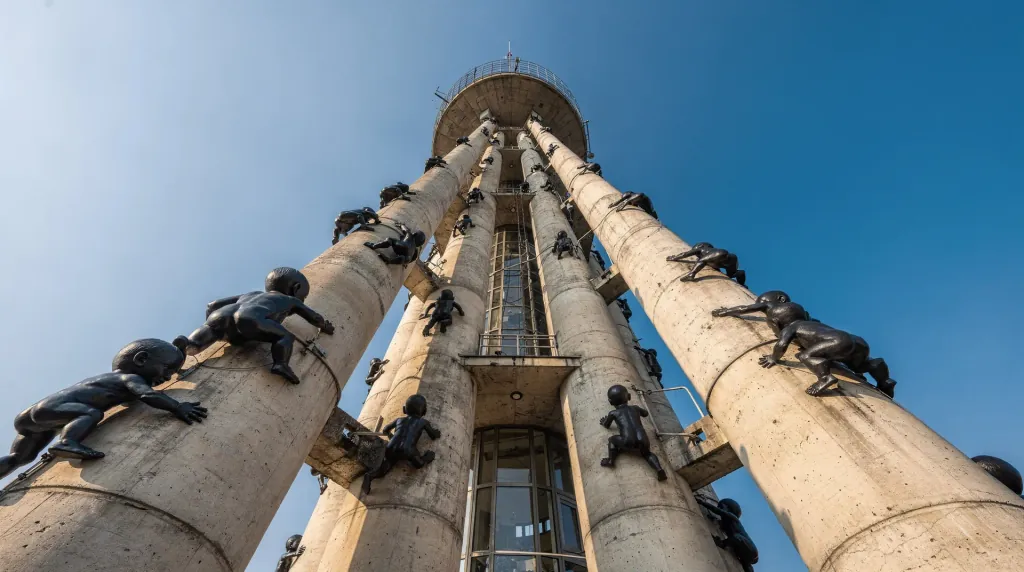
The decisive move came in 2000, when artist David Černý installed ten large bronze figures of crawling babies on the pylons. The figures, each approximately 1 metre long with a barcode slot where the face should be, are visible from the street below and transform the tower from an eyesore into something more ambiguous. They are one of the most distinctive pieces of public art in the city and entirely characteristic of Černý’s approach: provoking discomfort through familiar forms (a baby crawling) combined with something that denies humanity (the barcode face).
The story of the tower and its neighbourhood
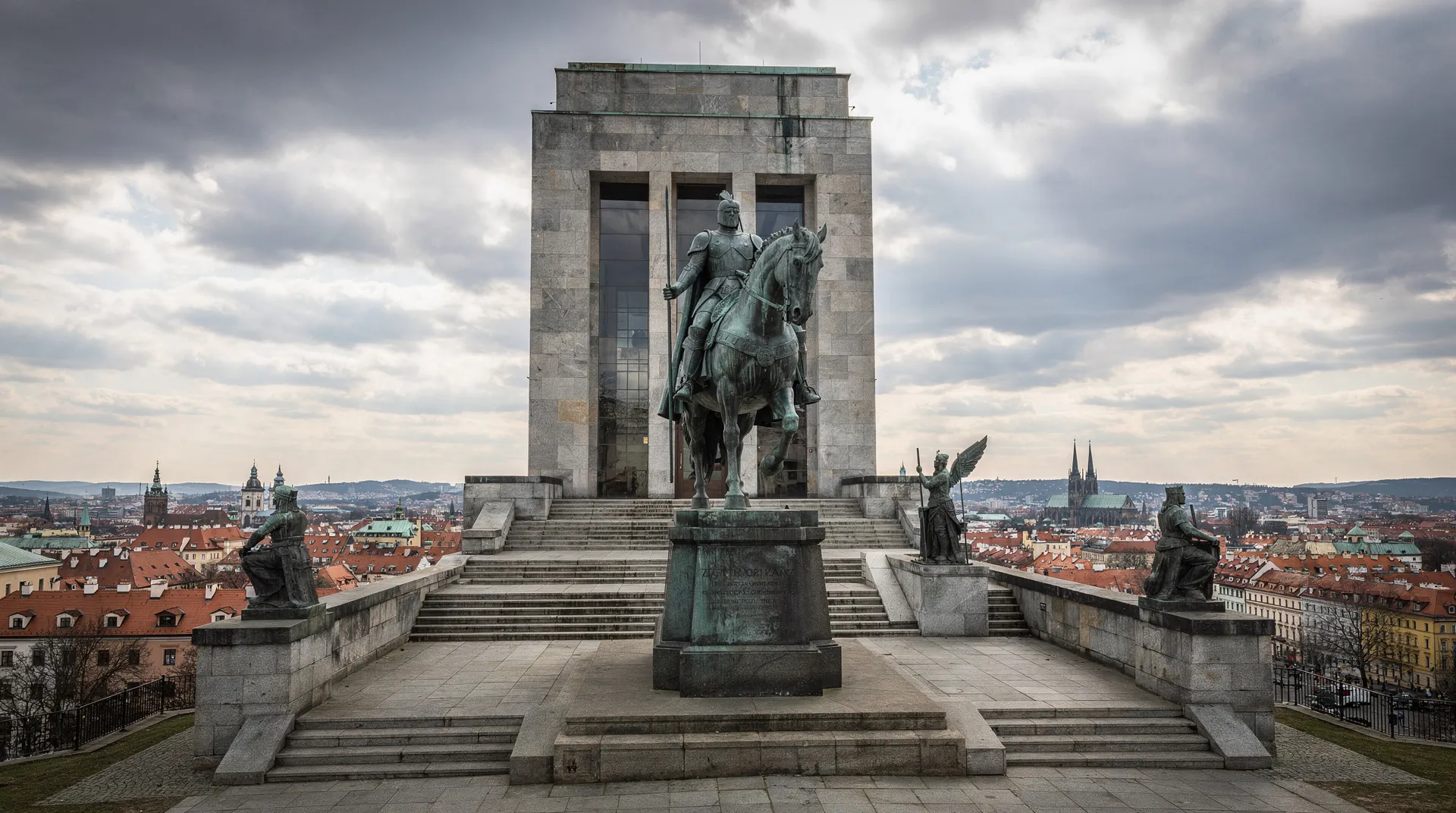
The tower stands in Mahlerovy sady (Mahler Gardens), a small park in the Žižkov district named for composer Gustav Mahler. Žižkov itself is named for the Hussite military commander Jan Žižka, whose equestrian statue on the Vítkov hill (visible from the tower) is the largest bronze equestrian statue in the world.
Žižkov was an independent city until its incorporation into Prague in 1922 and retains a distinctive character: denser, more working-class, with a tradition of political nonconformism that stretches from the Hussite period through the communist era and into the present. The neighbourhood around the tower — particularly the Vinohrady–Žižkov border along Seifertova and Žižkovská — has the highest density of pubs per capita of any neighbourhood in Prague, a statistic that appears in Czech tourism literature without embarrassment.
The tower’s construction required the demolition of part of a Jewish cemetery in Mahlerovy sady. The remaining graves were preserved and the cemetery section is visible from the park.
What to see and do at the tower
The observation deck (93 metres)
The primary visitor attraction is the observation deck at approximately 93 metres above ground. Access is by high-speed lift (approximately 30 seconds). The deck is enclosed with large windows on all sides and a small external terrace. The view from this height is genuinely 360-degree and covers:
- West: The entire Old Town and Malá Strana skyline, Prague Castle, Petřín hill
- North: Vinohrady, Žižkov, Vítkov hill with the Jan Žižka equestrian statue
- East and south: Nusle valley, the Nusle Bridge (one of the longest in Central Europe), outer Prague districts
The observation deck is less crowded than Petřín Tower because it’s off the main tourist route. On a weekday morning it’s possible to have the entire deck to yourself for 20 minutes.
The David Černý crawling babies
The ten crawling baby figures are fixed to the external pylons of the tower and visible from the park below. They are not accessible by touch from the ground — too high up — but several are visible at close range from the observation deck level, and looking down from the deck at the figures below provides a uniquely vertiginous perspective.
Three additional babies from the same series are installed in Kampa Park in Malá Strana.
The one-room hotel
One of the pods on the tower’s mid-section has been converted into a luxury single-room hotel — essentially a cabin with a panoramic view at approximately 66 metres altitude. The room is marketed as a unique experience and is booked well in advance. Not relevant to most visitors but worth knowing.
The restaurant (Oblaca)
The restaurant Oblaca (“Clouds”) on the upper section of the tower serves Czech and international cuisine at a price point appropriate to its altitude. Dinner reservations recommended; the restaurant is open for lunch and dinner. The sunset view from the restaurant level is spectacular.
Tickets, timings, and price
Observation deck (2026 estimates):
- Adult: ~€10 / 250 CZK
- Children 6–15: ~€6 / 150 CZK
- Children under 6: free
- Opening hours: Daily 9:00–24:00 (last admission 23:30)
- No advance booking required for general observation; the tower rarely queues
Restaurant Oblaca:
- Dinner reservations recommended; book online at towerpark.cz
Allow 45–60 minutes for the observation deck visit including lift travel.
Which tour to book nearby
The Žižkov Tower sits in a district associated with Prague’s communist history and its current alternative character. The most contextually relevant tours are communist history walks that cover Žižkov and the wider eastern districts:
For a communism and nuclear bunker guided tour — the Žižkov district has strong communist-era associations:
Prague: Communism and Bunker Tour with 70s Canteen LunchFor the communism history and nuclear bunker tour (different operator):
Prague communism history and nuclear bunker guided tourFor a World War II and communist history tour covering Prague’s 20th-century political sites:
Prague World War II and communist history tourFor a cold war and communism tour with a local historian:
Prague Cold War and communism tour with a local historianHow to get there
Tram: Tram 11 runs through Žižkov and stops at Lipanská, approximately 10 minutes’ walk from the tower. Alternatively, trams 5, 9, or 26 to Husinecká, then walk east about 12 minutes.
Metro: No direct metro to the tower. The closest metro stations are Jiřího z Poděbrad (Line A, green) on the Vinohrady side — 15 minutes’ walk east through Vinohrady — or Florenc (Lines B and C) — 20 minutes’ walk north through Žižkov.
Walking from the centre: The tower is about 2.5 km east of Old Town Square — 30–35 minutes on foot via Seifertova, a pleasant enough walk through Žižkov’s streets.
Taxi/Uber: 10 minutes from the city centre; reasonable option given the tower’s off-metro location.
Photographer’s note
The tower itself is best photographed from the south, from Mahlerovy sady park below, in the morning when the pylons catch low eastern light. A wide-angle lens (24mm or wider) is needed to capture the full height.
From the observation deck, a 35mm lens is adequate for most city shots. The best compositions look west toward the castle and Old Town skyline in afternoon light. Sunrise from the tower (it opens at 09:00) gives excellent warm light on the Old Town spires.
The crawling babies are most effectively photographed from below, looking up at the underside of a figure crawling up the pylon surface. The scale — approximately 1 metre per figure on a pylon that is 200+ metres tall — creates a disorienting perspective that is hard to convey in a telephoto shot.
David Černý: who he is and why Prague keeps commissioning him
David Černý (born 1967) is the most prominent Czech visual artist of his generation and the most controversial. His career began in 1991 when he painted a Soviet T-34 tank — preserved as a war memorial in Prague 6 — pink. He was arrested, the tank was repainted green, and then sympathetic members of the Czech Parliament painted it pink again in solidarity. The tank was eventually removed; Černý’s career was launched.
What makes Černý interesting is his consistent focus on scale, public space, and provocation-through-familiarity. His most successful works use recognisable objects or figures — a baby, a horse, a Communist-era tank — and subject them to a single disorienting transformation (giant scale, wrong colour, inverted orientation, wrong facial expression) that forces a second look. The technique is simple; the effect depends entirely on placement and scale.
In Prague, his works include:
- The Crawling Babies (Žižkov TV Tower, 2000; Kampa Park; one at the House of Art in Brno): The tower babies are the largest and most visible installation.
- Wenceslas on a Dead Horse (Palác Lucerna, 1999): The upside-down equestrian monument, a direct comment on the statue at the top of Wenceslas Square.
- Entropa (2009): A mosaic of EU member states that caused a diplomatic incident when it was installed in the EU Council building in Brussels — each country’s panel was a satirical stereotype. The Bulgarian government demanded an apology; Černý admitted he had fabricated the credentials of an international team of artists (the work was actually his alone).
- Man Hanging Out (Husova Street, Old Town): A figure of Sigmund Freud hanging by one hand from a beam above the street.
The Žižkov Tower babies are arguably his most visible work globally and the one most integrated into an architectural context. Photographed against the concrete pylons, the barcode faces become more unsettling the more you look at them.
Žižkov as a neighbourhood: pubs, character, and how to spend time here
Žižkov has the highest density of pubs per capita in Prague — a claim that appears in Czech tourism materials as a point of pride rather than a warning. The neighbourhood’s working-class history (it was an independent industrial city until 1922 and voted consistently left-wing throughout the First Republic) produced a pub culture that has proved remarkably durable.
The pubs around the tower and along Seifertova and Žižkovská tend toward the traditional: dark wood, no-frills food (svíčková, guláš, fried cheese with tartar sauce), draft Pilsner Urquell or Bernard at prices that are 20–30% lower than Old Town equivalents. The Akropolis venue (Kubelíkova 27) doubles as a music club and was Prague’s alternative culture hub in the 1990s and 2000s.
For a visit combining the tower observation deck and neighbourhood character: arrive at the tower around 09:30 (when it opens, crowds are minimal), spend 45 minutes on the deck, then walk south through Žižkov streets to a local pub for lunch. The contrast between the 216-metre brutalist tower and the 19th-century low-rise pub neighbourhood below provides its own commentary.
The Žižkov TV Tower in relation to other Prague viewpoints
Prague has several observation points, each with a different character:
Petřín Tower (Petřínská rozhledna): An Eiffel Tower replica on Petřín hill, 60 metres above the hill’s summit. The most popular viewpoint for tourists. Gives a view across the Old Town from the west but is far from the city’s east. Queues in summer.
Old Town Hall Tower: The Astronomical Clock tower, 69 metres. Directly in Old Town Square. The most central viewpoint but surrounded by other buildings, limiting the 360-degree effect.
Letná Terrace: Not a tower but a hilltop panorama. The best free view of central Prague.
Žižkov TV Tower (Žižkovská televizní věž): 93 metres of observation deck on a structure 216 metres tall, in the east. The unique aspect is that you can see the Old Town skyline from the side rather than from within it — a different compositional relationship that shows the city’s topography more clearly.
For serious photography, a sequence of Letná (free, best for the Old Town face-on view), Žižkov tower (best for the panoramic 360 and for the Old Town seen from the east), and Petřín (best for the Malá Strana and Hradčany slope view) covers the main angles.
Combining the tower with the rest of Žižkov and Communist history
The tower is a natural anchor for a wider look at Prague’s 20th-century history. It sits a short walk from the Vítkov Memorial, the Socialist-era mausoleum-turned-museum on the hill above Žižkov, and both feature as stops on the dedicated communist-era Prague walk, which traces the regime’s physical legacy across the city. If you’re in the neighbourhood, the Žižkov district guide covers the pub culture and streets around the tower in more depth than fits here.
For travellers building a broader itinerary, the tower pairs naturally with a half-day in Vinohrady — walkable from the tower — and works well alongside the Wenceslas Square history stops if you want a single day themed around 20th-century Prague.
Frequently asked questions about the Žižkov TV Tower
Is the Žižkov TV Tower observation deck worth it?
Yes if you want a panorama of Prague from the east — you see the city from a completely different angle than Petřín or Letná. The lack of crowds is a significant advantage. The brutalist architecture is either a draw or a reason to avoid it, depending on your taste.
What are the David Černý babies?
Ten large bronze crawling infant figures installed on the tower’s exterior pylons in 2000 by Czech artist David Černý. Each figure has a barcode slot instead of a face. Three additional figures from the same series are in Kampa Park. The figures are one of the most distinctive public art installations in Prague.
Is the Žižkov Tower the tallest structure in Prague?
Yes — 216 metres, making it by far the tallest structure in the city. The next tallest is significantly shorter.
Can you eat at the Žižkov Tower?
Yes — restaurant Oblaca operates on the tower. Dinner with a view is the primary restaurant experience. Book in advance, particularly for weekend evenings.
Is the Žižkov Tower communist architecture?
Yes and no. It was designed and begun under communism in the 1980s but completed after the Velvet Revolution in 1992. The design reflects late-communist modernism; its completion under a democratic government gives it an ambiguous status.
How long does a visit to the observation deck take?
30–45 minutes is comfortable. The lift is fast; the deck itself is not large; most visitors spend 20–30 minutes on the observation level and 10–15 minutes in the small visitor area.
Is the Žižkov TV Tower better than Petřín Tower?
They show different things, so “better” depends on what you want. Petřín gives a classic postcard view over the Old Town and Malá Strana and is easier to reach; Žižkov gives a less crowded, 360-degree view including the eastern districts most tourists never see. If you only have time for one and want the iconic shot, choose Petřín; if you want fewer crowds and a different perspective, choose Žižkov.
The one-room hotel: should you book it?
One of the pods on the tower’s mid-section (at approximately 66 metres) has been converted into a single luxury hotel room called “One Room Hotel.” The room is approximately 30 square metres with panoramic windows on three sides, a double bed, and hotel-grade furnishings. Price: approximately €300–500 per night depending on season.
The booking experience is genuinely unusual: you check in at the tower lobby, take the lift to the pod level, and sleep at 66 metres above Žižkov. The view at night — the city spread below, aircraft warning lights blinking above — is unlike any other hotel room in Prague.
Whether it’s worth the premium depends on your priorities. The room itself is well-appointed but compact. The check-in and service systems are less smooth than at a full-service hotel. The experience of the room — waking up above a city, with no other building at the same height visible through the windows — is memorable.
Available via the tower website (towerpark.cz) and via standard hotel booking platforms. Advance booking of 2–3 months is typically needed for preferred dates.
Getting to Žižkov: the micro-logistics
Žižkov is Prague’s most difficult major district to access by public transport from the centre — it has no direct metro connection, and the tram network in the area requires some navigation. Practical options:
By tram from Náměstí Republiky: Tram 11 runs east from Náměstí Republiky (metro B) through Žižkov’s main arteries. The stop closest to the tower is Lipanská — take tram 11 east (toward Spojovací). Approximately 15 minutes total including the 10-minute walk from the stop.
By tram from Vinohrady: Trams 11, 13 from I. P. Pavlova (metro A/C) run along Seifertova on the Žižkov–Vinohrady border. The stop Mahlerovy sady is the most direct for the tower.
By foot from Florenc metro (B/C): Walk east along Seifertova for approximately 20 minutes. A flat route through unremarkable but authentic Prague streets.
By Bolt/Uber: The most practical option. 10–12 minutes from Old Town Square; approximately €5–8.
The lack of direct metro access is one of the reasons the tower is undervisited relative to its quality as an observation deck. It’s accessible — just not as instantly accessible as Petřín (tram 22) or Old Town Hall Tower (walk from anywhere).
Practical info at a glance
- Address: Mahlerovy sady 1, 130 00 Praha 3 (Žižkov)
- Opening hours: Daily 9:00–24:00
- Price: Adult ~€10 / 250 CZK; children 6–15 ~€6 / 150 CZK
- Nearest tram: Lipanská (tram 11) — 10 min walk
- Nearest metro: Jiřího z Poděbrad (Line A) — 15 min walk
- Official website: towerpark.cz