At a glance
| Where | Starts at the Old-New Synagogue (Josefov), ends at St. Vitus Cathedral (Prague Castle) |
| Cost | Individual site tickets add up to roughly €60–80 / CZK 1,500–2,000 for the full circuit; walking the exteriors is free |
| Time needed | Around 3–4 hours including the castle uphill approach |
| Getting there | Metro Staroměstská (line A) to start; Metro Malostranská (line A) plus tram or a 25-minute walk to finish |
| Best time | Year-round; tram 22 to Pražský hrad avoids the castle-hill climb if mobility is a concern |
Why Prague preserved its Gothic heritage
Most European cities had their medieval cores destroyed — by fire, by war, by the systematic urban renewal of the 18th and 19th centuries. Prague survived all three with unusual completeness. The city was not heavily bombed in WWII; the Baroque urban renewal of the 17th–18th centuries added to the medieval structure rather than demolishing it; and the Communist period’s general reluctance to fund large-scale demolition inadvertently preserved what remained.
The result is a city where Gothic and Romanesque buildings stand not as isolated monuments but as continuous fabric: streets where medieval walls are built into Baroque facades, churches that have been rebuilt and extended over five centuries, a castle complex that contains 900 years of architectural history within one fortified hill. This walk isolates the Gothic strand of that fabric.
The walk, stop by stop
Stop 1: Old-New Synagogue (Staronová synagoga)
Červená 2, Josefov | Metro: Staroměstská (line A)
Begin at the oldest Gothic secular building still in use in Prague. The Old-New Synagogue was built in approximately 1270 in Early Gothic style — the same architectural vocabulary as contemporary Dominican and Franciscan churches in Bohemia, but applied to the Jewish liturgical programme. Twin naves with ribbed vaults, the original Gothic gables, and brick construction make it architecturally distinctive from the stone Gothic churches around it.
The date 1270 means this building was standing when Prague Castle’s St. Vitus Cathedral had not yet been begun (construction started 1344). It predates Charles Bridge by nearly 100 years. In terms of sheer age among still-functioning buildings in Prague, the Old-New Synagogue is the starting point.
Entry: included in the single Jewish Museum ticket (CZK 600, ≈ €24). Allow 20 minutes.
Stop 2: Týn Church — Church of Our Lady before Týn
Staroměstské náměstí, Staré Město | Metro: Staroměstská (line A)
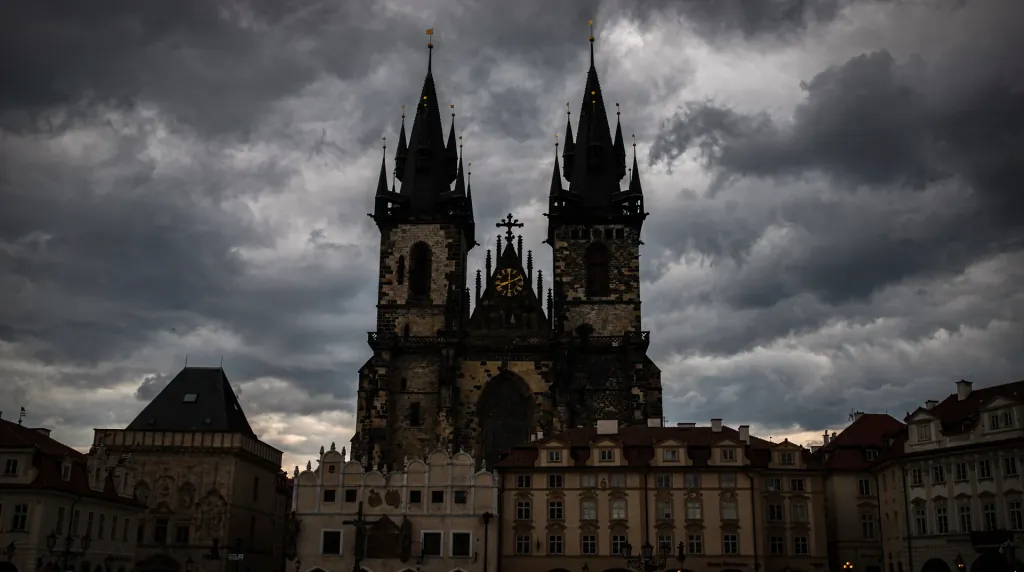
The twin towers of Týn Church are the defining Gothic silhouette of the Prague skyline — visible from the river, from the castle, from most of the city. The church was begun in the 14th century and its towers completed by 1511; the interior is a High Gothic nave with original Gothic tracery windows and furnishings accumulated over four centuries.
The church is also the burial site of the Danish astronomer Tycho Brahe (1546–1601), who worked at Rudolf II’s court and died in Prague. His tombstone, with a portrait effigy in red marble, is in the north nave.
The Týn Church is accessed from the Týn courtyard (Týnský dvůr) through a narrow archway from the square — follow the tourists. The interior is open Tuesday to Saturday 10am–1pm and 3pm–5pm; free entry for viewing, small charge for the tower.
Allow 30 minutes.
Stop 3: Old Town Hall and Astronomical Clock
Staroměstské náměstí 1, Staré Město | Metro: Staroměstská (line A)
The Old Town Hall is a composite Gothic building accumulated over the 14th and 15th centuries. The tower (1364) is the city’s original civic monument; the Astronomical Clock (Orloj), installed in 1410 and rebuilt in 1490, is the oldest astronomical clock still functioning in the world. The mechanical figures — Death ringing the bell, the Apostles parading through their windows, the Turkish figure wagging his head — perform every hour on the hour from 9am to 9pm.
The Old Town Hall Tower observation platform gives the best view of the Gothic rooflines around the square. Entry to tower: €14 (CZK 355). The tower is also the entry point for the Old Town underground — a network of medieval passages and Gothic cellars beneath the square, accessible on guided tours.
Allow 20–30 minutes.
Stop 4: House at the Stone Bell (Dům U Kamenného zvonu)
Staroměstské náměstí 13, Staré Město
The Stone Bell House is the architectural discovery of this walk. Hidden beneath a Baroque facade for centuries, restoration in the 1980s revealed the original Gothic structure — a 14th-century tower house with an extraordinary carved entrance portal and Gothic rooms. The carved stone bell that gives the building its name is mounted on the corner at street level. The building now functions as a gallery space; temporary exhibitions in the original Gothic interior are usually excellent.
Admission: €6–8 (CZK 150–200) depending on current exhibition. Allow 20 minutes.
Stop 5: Powder Gate (Prašná brána)
Náměstí Republiky, Staré Město | Metro: Náměstí Republiky (line B)
The Powder Gate (1475) was one of the original 13 gates of the Old Town. It was begun as a ceremonial gate by King Vladislaus II but abandoned during the Hussite troubles and only completed in 1886 in its current form. The Gothic carved decoration on the upper section is exceptionally fine — comparable in quality to the best contemporary European Gothic work.
Entry to the tower: €10 (CZK 250). The view along Celetná Street from the tower gallery gives the royal route perspective: this was the entry point for coronation processions coming from the Old Town into the town beyond.
Allow 15 minutes.
Stop 6: Convent of St. Agnes of Bohemia
U Milosrdných 17, Josefov | Metro: Náměstí Republiky (line B)
St. Agnes’s Convent (Anežský klášter) is the oldest Gothic complex in Bohemia, founded in 1234 by St. Agnes of Bohemia (canonised 1989 — notably, during the Velvet Revolution). The convent complex includes two Gothic churches, a royal mausoleum, and cloisters in Early Gothic French-influenced style. It now houses the National Gallery’s permanent collection of medieval Czech art — the ideal continuation of the Gothic walk for anyone interested in painting and sculpture alongside architecture.
Admission: €8 (CZK 200). Allow 30–45 minutes.
Stop 7: Charles Bridge (Karlův most)
Karlův most | Metro: Staroměstská (line A)
Charles Bridge, begun by Charles IV in 1357 on a Gothic master plan by Peter Parler (the same architect who designed St. Vitus Cathedral’s choir), is 516 metres of sandstone over 16 arches. The 30 Baroque statues added in the 17th–18th centuries are chronologically out of place on the Gothic structure, but they have become inseparable from its identity.
Walk across. The Gothic bridge towers at both ends — the Old Town tower (1380) and the Lesser Town towers (1464) — are both open for climbing. The Old Town tower is considered one of the finest Gothic towers in Central Europe. The view from the top encompasses the river, the bridge, and the castle in a single composition.
Old Town Bridge Tower entry: €10 (CZK 250). Allow 20–30 minutes.
Stop 8: St. Vitus Cathedral (Katedrála sv. Víta)
Prague Castle | Metro: Malostranská (line A) + tram or 25-min walk
The walk ends at the apex: St. Vitus Cathedral, begun in 1344 by Charles IV with French Gothic master Matthew of Arras and continued after his death in 1352 by the young German master Peter Parler. Parler’s contribution — the choir, the triforium with its portrait busts, the Golden Gate with mosaic, and the South Tower — is among the greatest individual contributions to Gothic architecture in Europe.
The cathedral is 124 metres long and the nave vault reaches 33 metres. The Golden Gate mosaic of the Last Judgment (1371) is the largest medieval mosaic north of the Alps. The Wenceslas Chapel contains the tomb of St. Wenceslas and walls covered in semi-precious stones. The Alfons Mucha stained-glass window is the most brilliant single piece of glass in the building.
Entry: Prague Castle circuit ticket (€15–25 / CZK 380–630). Allow 45–60 minutes.
Saving money on the ticket circuit
This walk has more paid stops than most on this site, and the tickets do not stack automatically into a discount. If budget matters, prioritise: St. Vitus Cathedral (Prague Castle tickets) as non-negotiable, then choose between the Old Town Hall Tower and Powder Gate for a view (both cost similarly, so pick whichever queue is shorter on the day) rather than paying for both. Some sites are covered by broader passes — check combined tickets before buying each one separately, since the savings can be meaningful across a full day of Gothic sightseeing.
How this walk fits with Prague’s other historical layers
Gothic Prague overlaps geographically with two other self-guided walks on this site, and it’s worth knowing how they differ before deciding whether to combine them:
| Walk | Focus | Shares stops with this walk? |
|---|---|---|
| Jewish heritage | Josefov synagogues and the Old Jewish Cemetery | Yes — the Old-New Synagogue opens both walks |
| Kafka trail | Kafka’s life and haunts | Partially — same Josefov streets, different buildings |
| Art Nouveau walk | 1895–1912 decorative architecture | No — different era, mostly New Town |
Because the Jewish heritage walk and this one both start at the Old-New Synagogue in Josefov, a natural itinerary is to do the Jewish heritage walk’s six synagogues first, then branch into this walk’s Old Town Square stops and finish at Prague Castle — though that makes for a very long single day, so most visitors split it across two mornings instead.
Practical info
- Start: Old-New Synagogue, Červená 2, Metro: Staroměstská (line A)
- End: St. Vitus Cathedral, Prague Castle, Metro: Malostranská (line A) + tram/walk
- Duration: 3–4 hours
- Distance: approximately 5 km (3.1 miles) plus the castle uphill approach
- Indoor vs outdoor: many interior stops (synagogue, Týn, Old Town Hall, Stone Bell House, St. Vitus); several are free entry; Prague Castle requires a ticket
- Season: year-round; Gothic interiors are independent of weather; the cathedral’s stained glass is best in morning light (east-facing choir) and afternoon light (south nave)
- Accessibility: the Old Town route is flat and accessible; Prague Castle involves significant uphill; tram 22 to Pražský hrad stop eliminates the castle climb
Questions about Gothic Prague
When was Gothic architecture used in Prague?
The main Gothic period in Prague runs from approximately 1230 (St. Agnes’s Convent) through the 15th century. The reign of Charles IV (1346–1378) was the great Gothic moment — St. Vitus, Charles Bridge, the Charles University, and Karlštejn Castle were all initiated in this period. The Hussite wars (1419–1434) interrupted construction; the Late Gothic continued through the 15th century.
Who was Peter Parler?
Peter Parler (1333–1399) was a Swabian-born Gothic architect who became the master builder of Prague under Charles IV. He completed the choir of St. Vitus Cathedral and designed its innovative net vaulting, the Old Town Bridge Tower, parts of Charles Bridge, and the Cathedral of St. Bartholomew in Kolín. His family workshop dominated Central European Gothic for three generations.
What is the difference between Early Gothic and High Gothic in Prague?
Early Gothic (13th century): pointed arches, ribbed vaults, relatively simple and austere — Old-New Synagogue, St. Agnes’s Convent. High Gothic (14th–15th century): elaborate tracery, soaring nave heights, sculptural decoration, flying buttresses — St. Vitus Cathedral, Týn Church, Charles Bridge towers. Peter Parler’s work represents the highest point of the High Gothic period in Central Europe.
Can I climb the St. Vitus Cathedral south tower?
Yes, with a Prague Castle ticket. The south tower offers the best view of the castle complex and the city. It involves approximately 300 steps; there is no lift.
Is the Old Town underground accessible?
Yes, through guided tours that depart from the Old Town Hall. The underground passages and Gothic cellars beneath the Old Town square are a separate ticketed experience (€12–15 / CZK 300–380) and take approximately 1 hour.
Is Gothic Prague worth doing if I’ve already seen Prague Castle and Charles Bridge?
Yes, if you want the fuller story — the castle and bridge are the two most famous stops on this walk, but the Old-New Synagogue, St. Agnes’s Convent, and the Stone Bell House add context most first-time visitors miss entirely. Doing the full walk on a return trip, or on day two or three of a longer stay, tends to land better than trying to absorb all eight stops on day one.
How does this walk compare to just visiting Prague Castle on its own?
A standalone Prague Castle visit covers St. Vitus Cathedral, the Old Royal Palace, Golden Lane, and St. George’s within the castle grounds, but skips the Old Town Gothic sites entirely. This walk uses the castle as the finale of a wider medieval narrative rather than treating it in isolation — better if you want the history in sequence, less efficient if you only have a couple of hours and want the castle alone.
Go deeper
Prague: Royal Castle, St. Vitus, and Golden Lane tour with tickets — a guided tour of the Gothic core of Prague Castle including St. Vitus Cathedral.
Charles Bridge and Lesser Town walking tour — a guided walk through the Gothic and Baroque layers of the bridge and lesser town.