At a glance
| Where | Starts at the Kafka Museum in Malá Strana, ends at the New Jewish Cemetery in Žižkov |
| Cost | Museum around €12 / CZK 300; rest of the walk is free (street-level stops) |
| Time needed | Around 3–3.5 hours including the museum |
| Getting there | Metro Malostranská (line A) to start; Metro Želivského (line A) at the end |
| Best time | Year-round; the New Jewish Cemetery feels most atmospheric on an overcast autumn afternoon |
A man who could not leave the city he could not escape
Franz Kafka wrote about bureaucratic labyrinths, metamorphosis, and unexplained guilt — themes that feel universal but were rooted in a very specific place and identity. He was a German-speaking Jew in a Czech-speaking city under Habsburg rule, later the Czech Republic. He wrote in the language of the empire’s administration but lived in the language of the street. He was never fully inside any of the three communities that shaped him, and his fiction has the quality of someone pressing their face against glass.
“Prague doesn’t let you go,” he wrote in a letter to Oskar Pollak. “This little mother has claws.” He never escaped. He worked as an insurance lawyer at the Workers’ Accident Insurance Institute while writing at night. His books were published in tiny editions; he was not famous in his lifetime. He asked his friend Max Brod to burn the manuscripts after his death. Brod did not. We have The Trial, The Castle, The Metamorphosis, Amerika, and the diaries because Brod refused.
This walk traces the physical Prague of Kafka’s life — not a literary theme park but the actual streets and buildings where his daily life took place. Several of the buildings still stand.
The walk, stop by stop
Stop 1: Franz Kafka Museum
Cihelná 2b, Malá Strana | Metro: Malostranská (line A)
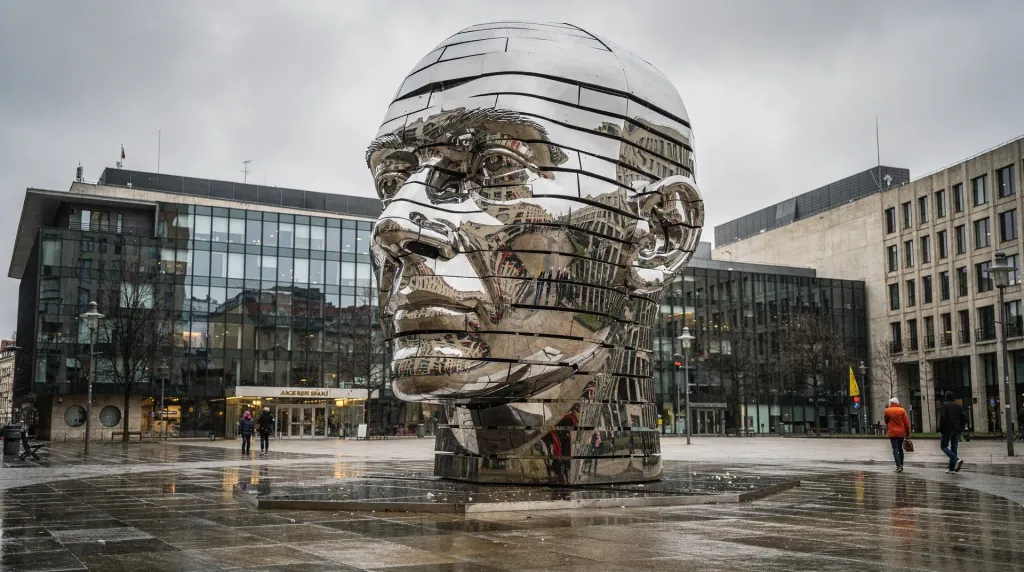
Start in Malá Strana, across the river from where Kafka was born. The Kafka Museum is a well-designed permanent exhibition in a converted factory building with a view of the Charles Bridge. The exhibition is atmospheric rather than academic: dimly lit rooms, original letters, photographs, and manuscripts, plus installations designed to evoke the psychological texture of Kafka’s fiction — the bureaucratic maze, the labyrinth, the surveillance machine.
Admission: €12 (CZK 300). Allow 60–75 minutes. Outside the entrance, David Černý’s sculpture of two bronze figures urinating into a pool shaped like the Czech Republic — a deliberately provocative work that Kafka himself would either have hated or admired, possibly both.
Stop 2: Charles Bridge
Karlův most | Metro: Staroměstská (line A)
Cross the Charles Bridge. Kafka crossed it daily. He wrote about the bridge often — it appears in his diaries as a landscape of routine, not a monument. Walk slowly and consider: he crossed it to reach his insurance office, his rented rooms, his cafes. A landscape of administrative necessity, not romantic beauty.
Allow 15 minutes.
Stop 3: Birth site — Nám. Franze Kafky
Náměstí Franze Kafky 3, Josefov | Metro: Staroměstská (line A)
The house where Kafka was born on 3 July 1883 no longer stands — it was demolished and replaced with a simpler structure. A small bust of Kafka marks the corner of Nám. Franze Kafky (the square was named for him in 2000) and Kaprova Street. The site is steps from the Old-New Synagogue; the Jewish Quarter is the context for Kafka’s birth and childhood.
Allow 5 minutes.
Stop 4: House at the Minute (Dům U Minuty)
Staroměstské náměstí 2, Staré Město | Adjacent to Old Town Hall
Kafka’s family moved several times in his childhood; the House at the Minute — the richly graffitied Renaissance building on Old Town Square, beside the Old Town Hall — was one of their residences from 1889 to 1896. The graffiti on its facade (late 16th century, restored) depicts allegorical figures and scenes. The house is now used as offices; no public interior access.
Allow 5–10 minutes exterior.
Stop 5: Old Town Square
Staroměstské náměstí | Metro: Staroměstská (line A)
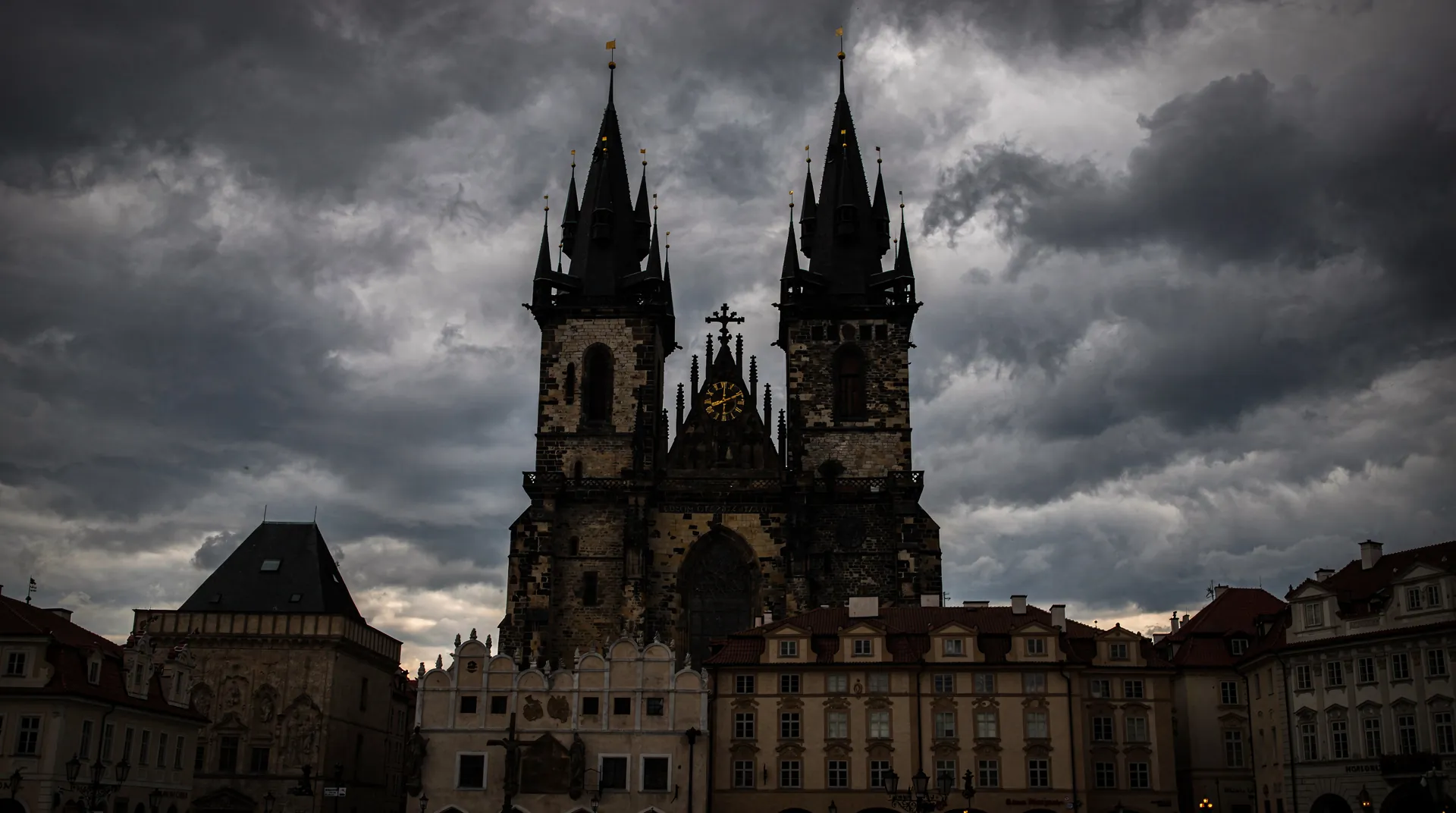
The central square of Kafka’s childhood and adult life. He sat in the cafes around it; he watched the Astronomical Clock; he attended the German gymnasium nearby. The square’s architecture is Gothic-to-Baroque (see the Gothic Prague walk), but for the Kafka Trail it is a site of biographical density: the square appears in his diaries and letters as a continuous backdrop to an ordinary Prague life that was somehow also the material for extraordinarily strange fiction.
Allow 10 minutes.
Stop 6: Workers’ Accident Insurance Institute
Na Příkopě 20, Nové Město | Metro: Náměstí Republiky (line B)
Kafka worked here from 1908 to 1922. The building on Na Příkopě (the main commercial street) is now occupied by a bank; a small plaque marks Kafka’s workplace. He worked here from 8am to 2pm, which left his afternoons free — he often slept and then wrote through the night. The work was real insurance law (industrial accidents, workplace injuries, appeals) and it gave him a direct view of how bureaucratic power crushes individual lives.
Allow 5 minutes exterior.
Stop 7: Café Louvre and the German Bohemian literary cafes
Národní 20, Nové Město | Metro: Národní třída (line B)
Kafka’s literary circle — Max Brod, Franz Werfel, Egon Erwin Kisch — met in the German-language cafes of the New Town. The Café Louvre on Národní was the most important. It survives as a restaurant; the Art Nouveau interior is intact. Kafka was a regular here and read manuscripts aloud at meetings of the Prague Circle, a loose grouping of German-Jewish intellectuals who were producing some of the finest German prose of the early 20th century while living in a Czech-speaking city.
Allow 15 minutes for coffee.
Stop 8: New Jewish Cemetery — Kafka’s grave
Izraelská 1, Žižkov | Metro: Želivského (line A)
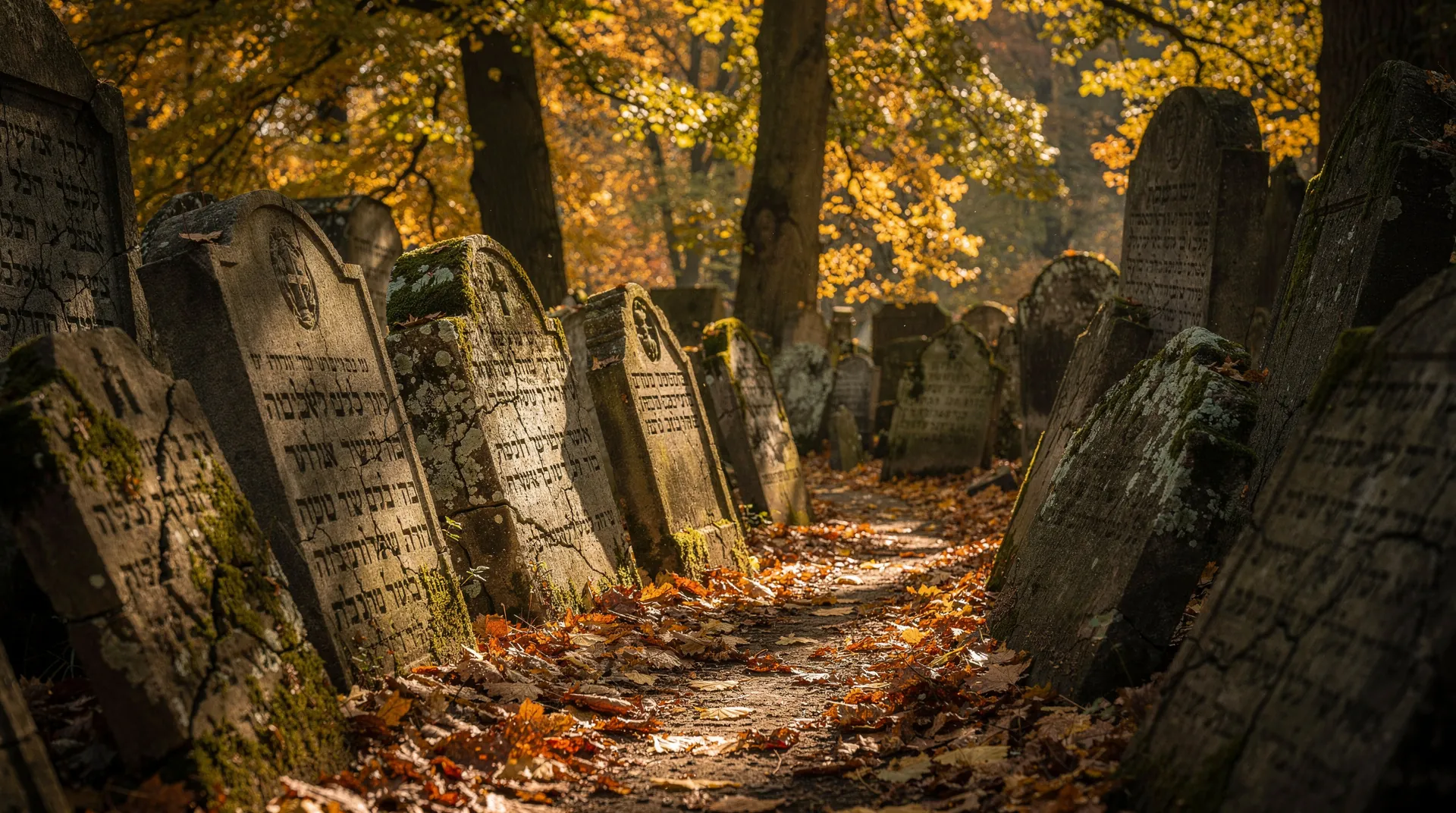
The walk ends 3 km east of the centre at the New Jewish Cemetery in Žižkov. Kafka died on 3 June 1924, age 40, of tuberculosis complicated by laryngeal tuberculosis that made it impossible to eat. He is buried in section 21 of this large, formal cemetery. His grave is the most-visited in the cemetery; visitors leave pebbles and messages following Jewish tradition. His parents are buried with him.
The cemetery is open Sunday to Thursday 9am–5pm, Friday until 3pm, closed Saturday. Free entry. Allow 20 minutes.
Practical info
- Start: Franz Kafka Museum, Cihelná 2b, Metro: Malostranská (line A)
- End: New Jewish Cemetery, Izraelská 1, Metro: Želivského (line A)
- Duration: 3–3.5 hours including museum
- Distance: approximately 6 km (3.7 miles) plus metro to cemetery
- Indoor vs outdoor: Kafka Museum and Café Louvre are indoor; all other stops are exterior/street-level
- Season: year-round; the New Jewish Cemetery is most atmospheric in autumn
- Accessibility: fully accessible route; Kafka Museum has lift access
Pairing the Kafka Trail with the rest of Josefov
The birthplace stop sits inside the historic Jewish Quarter, and Stop 3 is a few steps from the Jewish heritage walk, which covers the synagogues and the Old Jewish Cemetery in far more depth than this trail does. If you only have time for one Jewish-history walk, do that one; if Kafka is your specific interest, this trail’s brief pass through Josefov is enough context, and you can add the fuller walk on a second day. The Gothic Prague walk also crosses Old Town Square (Stop 5 here), so the two trails share some geography without duplicating content — Gothic Prague looks at the architecture, this one looks at the biography.
For visitors also doing the Mucha trail or the Velvet Revolution sites walk, all three self-guided routes start or pass through Nové Město or Staré Město, so it’s realistic to combine the Kafka Trail with one other short walk in a single day if you start early. See the 4-day Prague itinerary for a full day-by-day plan that fits several theme walks alongside the major sights.
Kafka’s Prague versus the tourist Prague
Several stops on this trail — Old Town Square, Charles Bridge — are also the busiest tourist sites in the city. The trick to experiencing them “as Kafka” rather than as a tourist checklist item is timing: cross Charles Bridge at or near dawn, before the tour groups and the Astronomical Clock hourly crowds build up, and the daily-commute quality Kafka wrote about becomes legible again. The Workers’ Accident Insurance Institute (Stop 6) and Café Louvre (Stop 7) are outside the main tourist flow and rarely crowded at any hour.
Questions about Kafka’s Prague
Did Kafka write in Czech or German?
German. Kafka was part of Prague’s German-speaking Jewish bourgeoisie — a minority within a minority. The Czech-speaking majority, the German-speaking minority (which included Jews and ethnic Germans), and the official Habsburg administrative language were all present in his daily life. He wrote in German, lived in Czech, and thought in both.
Where did Kafka write The Trial and The Castle?
Various rented rooms and apartments in Prague, primarily in the Old Town and around the Malá Strana. He lived for a period in a tiny alley house in Prague Castle’s Golden Lane (Zlatá ulička 22) — now a bookshop. The Castle that Kafka describes in his novel of that name is often interpreted as based on Prague Castle, which dominated his view from childhood.
Was Kafka famous during his lifetime?
No. He published a handful of short stories and The Metamorphosis (1915) in small literary magazines and a limited print run. The Trial, The Castle, and Amerika were all published posthumously by Max Brod. His fame grew through the 1930s and 1940s as his work was translated and the concept of “Kafkaesque” — absurd, impersonal, threatening bureaucratic power — entered the wider vocabulary.
What language is the Kafka Museum in?
English and Czech. All text panels are bilingual. The admission includes access to the permanent exhibition and temporary exhibitions; audio guides are available in several languages.
Can I visit the Golden Lane house in Prague Castle?
Yes. Zlatá ulička 22 in Prague Castle (the house Kafka rented from his sister Ottla) is now a small bookshop and is accessible with a Prague Castle circuit B ticket. It is tiny — one room — but the building is original.
Is the Kafka Trail suitable for a first-time visitor with limited time?
It works best as a half-day add-on rather than a priority for a first, short trip. If you only have 1–2 days in Prague, prioritise Prague Castle, Charles Bridge, and Old Town before adding this trail — see the 1-day or 2-day itineraries. With 3+ days, the Kafka Trail is a rewarding lower-key half-day.
Go deeper
Prague: tickets for the Franz Kafka Museum — skip the queue with pre-booked entry.
Prague: Kafka Museum entry ticket — direct entry ticket for the permanent exhibition.