At a glance
| Where | Starts at Municipal House (Náměstí Republiky), ends at Main Station |
| Cost | Free to walk; Municipal House guided tour around €15–18 / 380–455 CZK |
| Time needed | Around 2.5–3.5 hours |
| Getting there | Metro Náměstí Republiky (line B) to start; Hlavní nádraží (line C) to finish |
| Best time | Any season; late afternoon light suits the exterior photography |
Why Art Nouveau matters more in Prague than anywhere else
Vienna had the Secession. Paris had Hector Guimard and the métro. Brussels had Victor Horta. But Prague had all of this and something rarer: a political dimension. In the years around 1900, Czech Art Nouveau was not merely a decorative style — it was a national assertion. The buildings you are about to walk past were built by a Czech bourgeoisie expressing its cultural confidence under Habsburg rule. The Municipal House is not just the finest Art Nouveau building in Central Europe; it is a monument to Czech nationhood, every mosaic and fresco a statement of identity.
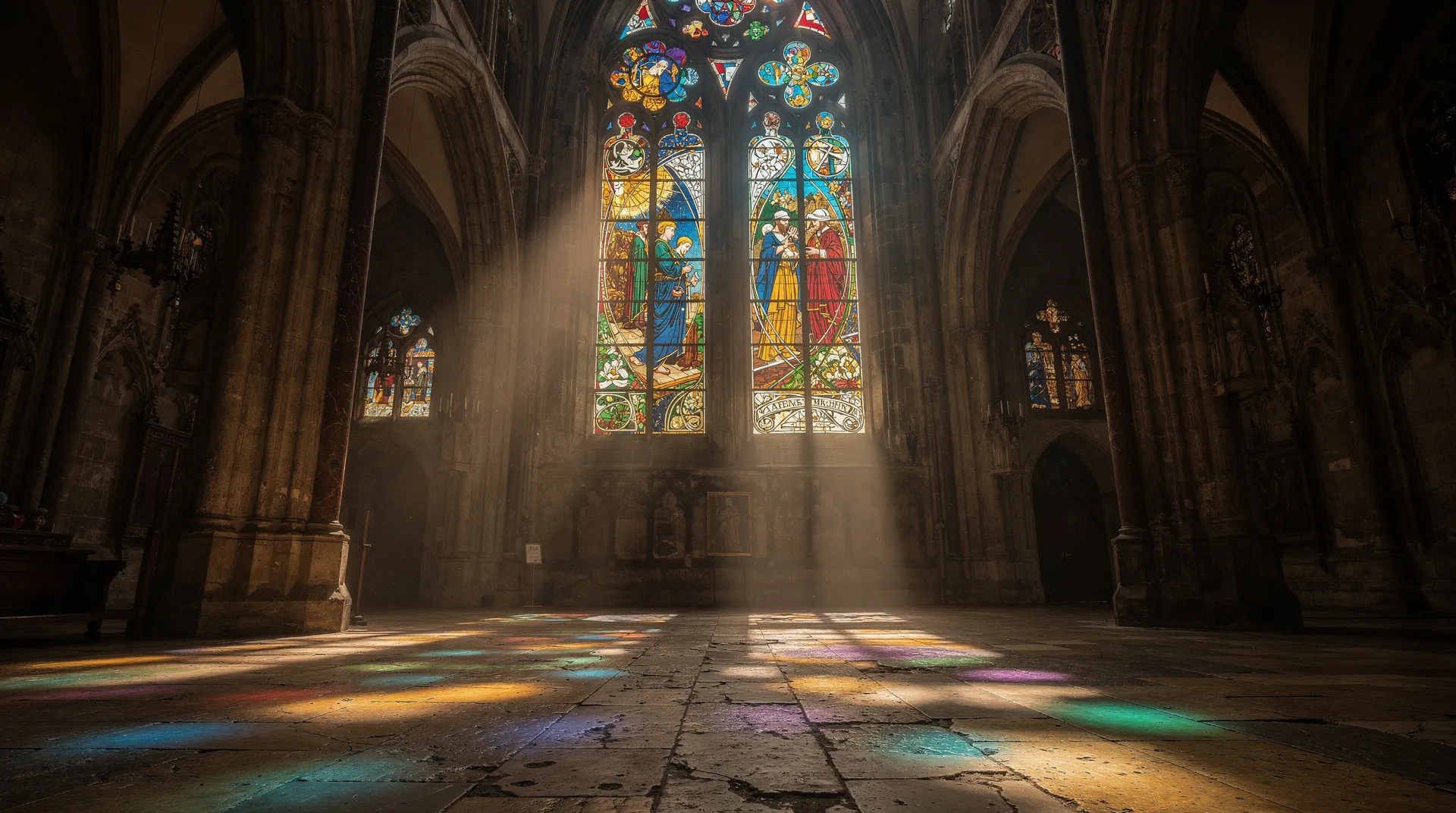
Alfons Mucha was the defining figure: a Moravian artist who made his name in Paris decorating Sarah Bernhardt’s theatre posters and became the visual vocabulary of an age. He came home to Prague and put his work on the biggest canvas available — the stained glass of St. Vitus Cathedral, the Mayor’s Room of the Municipal House, and eventually the 20-canvas Slav Epic.
This walk covers the Art Nouveau buildings of central Prague — the ones visible from the street and several with interiors you can enter. Allow 2.5 hours at a minimum; 3.5 hours if you enter the Municipal House on a guided tour.
The walk, stop by stop
Stop 1: Municipal House (Obecní dům)
Náměstí Republiky 5 | Metro: Náměstí Republiky (line B)
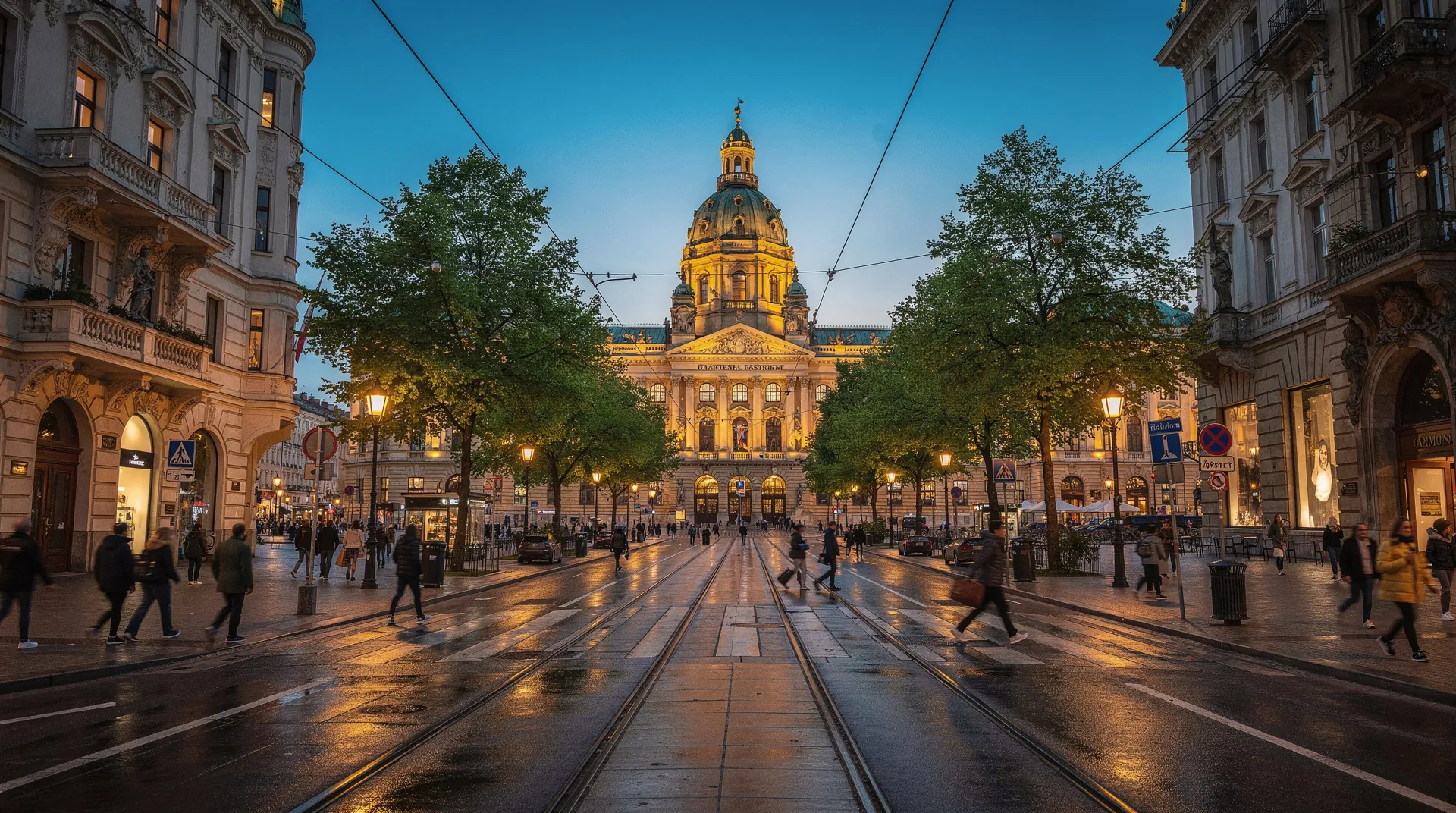
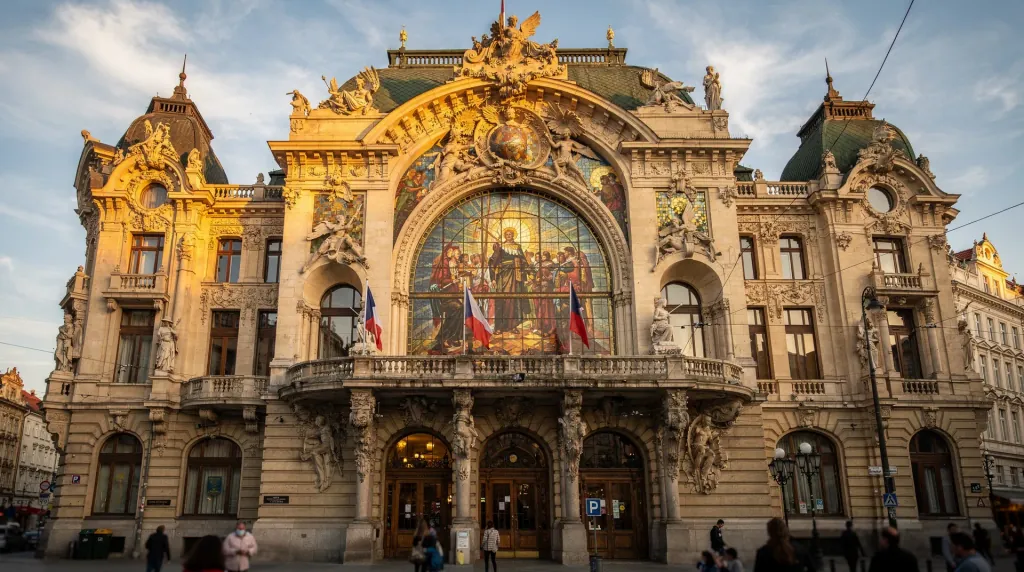
Start here and spend time here. The Municipal House (completed 1912) is the apex of Czech Art Nouveau: a collaboration between architect Antonín Balšánek, painter Alfons Mucha, sculptor Ladislav Šaloun, and a dozen other Czech artists. The exterior facade features Mucha’s mosaic “Homage to Prague” above the main entrance — a seated allegorical figure of Bohemia flanked by Czech history. The hemispherical glass canopy over the cafe entrance is the most-photographed detail.
Inside: Smetana Hall (the concert hall) has a glass cupola and gilded Art Nouveau reliefs. The Mayor’s Room is painted entirely by Mucha with allegories of Slavic unity. The French Restaurant in the basement is a working Art Nouveau interior with stained glass partitions. Admission to the interior: guided tours available, €15–18 (CZK 380–455). The cafe and restaurant are accessible without a tour.
What to look for: On the facade, count the caryatids (female supporting figures) and look for the allegorical Czech lands represented in the mosaics.
Allow 20–45 minutes.
Stop 2: Powder Gate (Prašná brána) and Celetná Street
Náměstí Republiky, Celetná 36
Walk through the Powder Gate — a Gothic tower that pre-dates the Art Nouveau buildings around it by 400 years and gives them a dramatic context. Celetná Street behind it was the Royal Way, Prague’s coronation route. The street itself has Baroque and Rococo facades but look for the occasional Art Nouveau window surround or decorative panel inserted into older structures — Prague architects were working in layers.
The house at Celetná 34 (the Black Madonna building) is Cubist, not Art Nouveau — you will see it again on the Cubist Prague walk. Note the stylistic difference: Art Nouveau uses flowing organic lines; Cubism uses angular fractured planes.
Allow 10 minutes in transit.
Stop 3: Hotel Paříž (Paris Hotel)
U Obecního domu 1, Staré Město | Adjacent to the Municipal House
The Paris Hotel was built in 1907 by Jan Vejrych in a Gothic Revival style that incorporates Art Nouveau decorative elements — a common Prague hybrid. The Café de Paris inside was refurbished to its original specification; the dining room’s stained-glass ceiling and wrought-iron details are worth seeing. The building is often overlooked in favour of the Municipal House next door, which is a mistake.
Allow 10 minutes.
Stop 4: Grand Hotel Europa, Wenceslas Square
Václavské náměstí 25, Nové Město | Metro: Muzeum (lines A+C)
Walk south through the Old Town to Wenceslas Square — about 10 minutes from the Municipal House. The Grand Hotel Europa (built 1905, by architect Bedřich Bendelmayer) is the most complete Art Nouveau facade on the square and one of the best in the city. The exterior is a layered composition of female figures, floral reliefs, and gilded ornament. The interior — cafe and dining room — is an intact Art Nouveau space of extraordinary quality: curved wooden furniture, ceramic wall tiles, stained glass screens. The hotel is currently undergoing renovation stages; check current access status.
Allow 15 minutes exterior; more if interior is accessible.
Stop 5: Topic Building and Wenceslas Square facades
Václavské náměstí 9
Wenceslas Square is a textbook example of Prague’s architectural stratification: Art Nouveau buildings sit between Historicist predecessors and Communist-era insertions, with contemporary glass buildings at the edges. The Topic Building (no. 9) has a fine Art Nouveau facade with characteristic curved window frames. Continue down the square looking for Art Nouveau details — decorative railings, ceramic tiles, carved stonework — embedded in the commercial frontages.
Allow 15 minutes.
Stop 6: Lucerna Arcade
Štěpánská 61, Nové Město | Off Wenceslas Square
The Lucerna is not a pure Art Nouveau building — it was built between 1907 and 1921 in a transitional style — but it contains one of the most extraordinary commercial interiors in Prague. The arcade (pasáž) is a covered shopping gallery with a glass roof, a cinema, a ballroom, and several cafes. The Václav Havel family built it; Havel himself owned it. The famous upside-down equestrian statue of King Wenceslas (by artist David Černý, hanging from the ceiling) is here — a sardonic commentary on Czech political heroes.
Allow 15 minutes.
Stop 7: St Wenceslas Church, Vinohrady
Náměstí Míru, Vinohrady | Metro: Náměstí Míru (line A)
From the Lucerna, take the metro or walk 15 minutes east to Náměstí Míru in Vinohrady. This neighbourhood, developed in the 1880s–1910s, contains the densest concentration of Art Nouveau apartment buildings in Prague. The church of St. Wenceslas on the square is Neo-Gothic, but the apartment buildings around the square and on streets running east — Mánesova, Blanická, Italská — are a textbook of Prague Secession architecture. Walk 5–10 minutes in any direction from the square.
Allow 20 minutes.
Stop 8: Main Station — Fantova kavárna (Hlavní nádraží)
Wilsonova 8, Nové Město | Metro: Hlavní nádraží (line C)
The walk ends at Prague’s Main Station, built 1901–1909 by Josef Fanta in pure Art Nouveau style. The original station hall — the Fantova kavárna — is the part to find: take the stairs from the main concourse up to the dome room, a sweeping oval space with Art Nouveau ironwork, mosaic floors, and the most underappreciated interior in Prague. Few tourists ever go upstairs; the cafe operates in the original dome hall.
Allow 15 minutes. The metro is one level below, and you are done.
Fit for more
The Municipal House guided tour (90 minutes) gives access to rooms not otherwise open — the Mayor’s Room, the Smetana Hall balcony, and the Assembly Hall where Czechoslovakia’s independence was declared in 1918. Worth booking separately.
The Mucha Trail walk connects to this one at the Municipal House and continues to the Mucha Museum and St. Vitus Cathedral stained glass — see the dedicated Mucha Trail guide.
Practical info
- Start: Municipal House (Obecní dům), Náměstí Republiky, Metro: Náměstí Republiky (line B)
- End: Main Station (Hlavní nádraží), Metro: Hlavní nádraží (line C)
- Duration: 2.5–3.5 hours
- Distance: approximately 4 km (2.5 miles)
- Indoor vs outdoor: mostly outdoor; stops 1 (Municipal House interior), 3 (Hotel Paříž cafe), 4 (Grand Hotel Europa), and 8 (Fantova kavárna) are indoor with no admission charge except Municipal House tour
- Season: excellent year-round; summer light is ideal for exterior photography; the interiors are consistent regardless of weather
- Accessibility: Wenceslas Square and the main route are fully accessible. The Main Station dome hall requires a staircase; no lift access to the Fantova kavárna
Questions about Art Nouveau Prague
What is the difference between Art Nouveau and Secession?
They are the same movement with different names. “Art Nouveau” is the French term; “Secession” (Sezession) is the Austro-Hungarian term used in Vienna and Prague. The Prague version leans slightly more toward the Viennese Secession (Josef Hoffmann, Otto Wagner) than toward the French/Belgian style — more geometric discipline, slightly less floral excess.
Who was Alfons Mucha?
Alfons Mucha (1860–1939) was a Czech artist from Moravia who became famous in Paris for his decorative posters — primarily for Sarah Bernhardt’s theatre productions — and whose style defined Art Nouveau internationally. He returned to Bohemia and spent the last 20 years of his life creating the Slav Epic (20 monumental paintings on Slavic history) and contributing to the Municipal House interiors. His Prague work is more austere and monumental than his Parisian period.
Can I see Mucha’s work in Prague without paying for the Mucha Museum?
Yes. The stained-glass window in St. Vitus Cathedral (Chapel of the Archbishop) is accessible with a Prague Castle ticket. The Mayor’s Room mosaics on the exterior of the Municipal House are free to view from the street.
How long does the Municipal House tour take?
Guided interior tours last approximately 50–70 minutes. They run daily at set times; English-language tours are available. Advance booking is advisable for weekend visits.
Is the Grand Hotel Europa open?
The hotel portion is under long-term renovation as of 2026. The Art Nouveau cafe and ground floor may be accessible — check current status at the venue. The facade is always viewable from Wenceslas Square.
What other Art Nouveau cities are worth comparing to Prague?
Vienna (Otto Wagner’s metro stations and Secession building), Brussels (Victor Horta’s town houses), and Nancy in France (the Baccarat glassworks and Art Nouveau museum). Prague is unique in having Art Nouveau in the civic scale — a concert hall, a railway station — rather than primarily private houses.
If you’re short on time: which stops to prioritise
| Priority | Stop | Why |
|---|---|---|
| Essential | Municipal House (Stop 1) | The finest Art Nouveau building in Central Europe; skip nothing else if pressed |
| Essential | Grand Hotel Europa (Stop 4) | The most complete facade on Wenceslas Square |
| High | Main Station dome hall (Stop 8) | Most tourists never see it; genuinely underrated |
| Medium | Vinohrady apartment blocks (Stop 7) | Best if you enjoy residential architecture, skippable if short on time |
| Medium | Lucerna Arcade (Stop 6) | Worth it mainly for the Černý sculpture and atmosphere |
| Lower | Powder Gate / Hotel Paříž (Stops 2–3) | Quick look on the way, not worth a special detour |
With only 90 minutes, do Stops 1, 4, and 8 and skip the rest — that covers the three unmissable buildings.
For deeper Mucha context beyond what this walk covers, the Mucha Museum holds the artist’s Paris-era posters and Slav Epic studies. This walk also slots naturally into a weekend in Prague itinerary as a half-day activity.
Can I do this walk in under two hours?
Yes, if you cut to the three essential stops: Municipal House, Grand Hotel Europa, and the Main Station dome hall. That shortened version takes around 75–90 minutes including transit between stops, though you’ll miss the Vinohrady apartment blocks and the Lucerna Arcade detail.
Go deeper
Prague Art Nouveau tour — a guided Art Nouveau walking tour of the Municipal House area and Wenceslas Square with a specialist guide.
Prague: private Cubism and Art Nouveau walking tour — a private guided walk combining both movements, good for architecture enthusiasts who want to cover both in one session.