At a glance
| Where | Josefov, between the Old-New Synagogue and the Spanish Synagogue |
| Cost | Single ticket €24 / CZK 600 for all six sites |
| Time needed | Around 3–4 hours for all six sites |
| Getting there | Metro Staroměstská (line A) at both ends |
| Best time | Weekdays; closed Saturdays and Jewish holidays, so plan around that first |
The oldest living Jewish community in Central Europe
The Prague Jewish community is documented from the 10th century — among the oldest in Europe. For most of that history, it occupied a defined ghetto: the area now called Josefov (named after Emperor Josef II, who granted Jews civic rights in 1782) was the world’s Jews lived, worshipped, buried their dead, and conducted a self-governing community life under conditions ranging from tolerance to active persecution.
The ghetto survived the Habsburg era, partial demolition in the 1890s urban renewal, and the Nazi occupation — paradoxically, partly because the Nazis planned to preserve it as a museum to an exterminated race. They brought Jewish artefacts from across Bohemia and Moravia to Prague for that purpose. The synagogues and cemetery survived precisely because they were catalogued as relics.
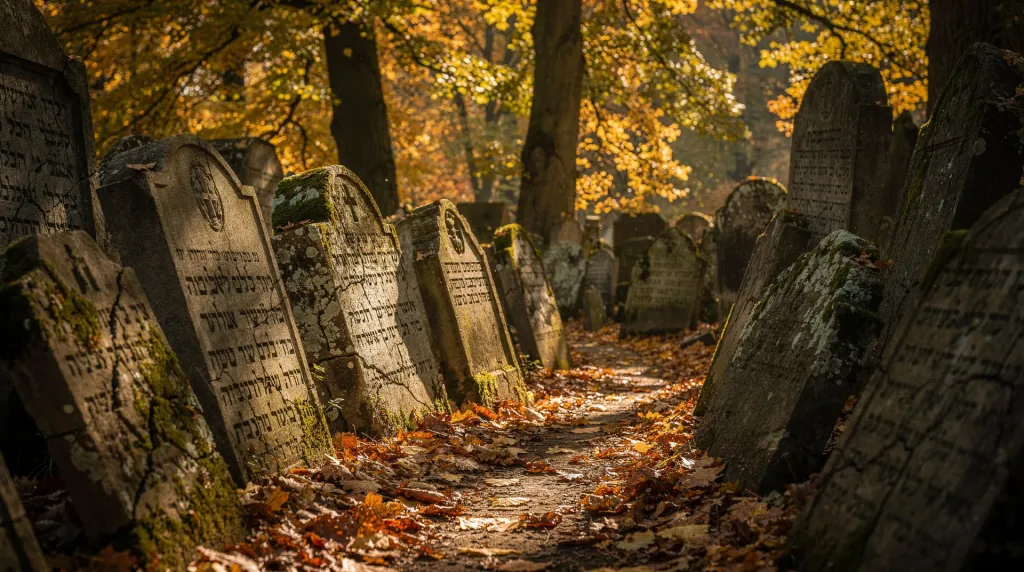
What remains is the most significant Jewish heritage site in Central Europe. The Old Jewish Cemetery alone — 100,000 people buried in 12 layers over 500 years, with headstones jutting at every angle — is one of the most affecting historical spaces in Europe. The six synagogues each tell a different chapter of the community’s history.
Tickets and opening hours
Jewish Museum single ticket (covers Maisel Synagogue, Pinkas Synagogue, Old Jewish Cemetery, Klausen Synagogue, Ceremonial Hall, Spanish Synagogue and the Old-New Synagogue): €24 adults / €16 students under 26 / €8 children 7–15 (CZK 600 / 400 / 200); free for children up to 6. Valid for 3 opening days. Available at ticket offices at Maisel Synagogue and the Spanish Synagogue.
Old-New Synagogue: included in the single ticket, no separate ticket or supplement. The only active synagogue in the circuit.
Prague Visitor Pass and Prague CoolPass: free entry (one visit per site).
Opening hours: Sunday to Friday, 9am–7pm (May–August), 9am–6pm (April, September to 17 October), 9am–4:30pm (18 October–March; 24 December until 2pm; 1 January from 11am). Tickets sold until 30 minutes before closing. Closed Saturdays and Jewish holidays.
The walk, stop by stop
Stop 1: Old-New Synagogue (Staronová synagoga)
Červená 2, Josefov | Metro: Staroměstská (line A)
The oldest functioning synagogue in Europe, dating to approximately 1270. The name is misleading — “Old-New” likely derives from the Hebrew “al tenai” (on condition), a reference to the legend that the synagogue was built on condition it would be demolished when the Third Temple was rebuilt in Jerusalem. The architecture is Early Gothic: twin naves, brick ribbed vaults, the original Gothic gables still intact. The interior has been in continuous use as a synagogue since the 13th century — the same liturgical function, in the same room, for 750 years.
The Golem legend is attached to this building: Rabbi Judah Loew ben Bezalel (the Maharal, 1525–1609) reportedly created the Golem — a humanoid figure of clay animated by a shem (parchment inscribed with the divine name) to protect the ghetto against persecution. The Golem’s remains are said to rest in the attic, which has been sealed for centuries. Whether this is historical or legend is, in a meaningful sense, beside the point: the story is part of the building.
Allow 20–30 minutes.
Stop 2: Maisel Synagogue
Maiselova 10, Josefov | Adjacent
Built in 1592 by Mordechai Maisel, the Mayor of the Jewish Town under Rudolf II, the Maisel Synagogue is now used as the Museum of Jewish History in Bohemia and Moravia. The original Renaissance building burned in the ghetto fire of 1689 and was rebuilt in Neo-Gothic style in 1893–1905. The exhibition covers Jewish settlement in Bohemia and Moravia from the 10th century through the Enlightenment, with outstanding silverware, textiles, and ceremonial objects.
Allow 30 minutes.
Stop 3: Pinkas Synagogue and the Old Jewish Cemetery
Široka 3, Josefov
The Pinkas Synagogue is the second most important memorial space in Prague after the cemetery. Built in the 16th century, it contains the names of 77,297 Bohemian and Moravian Jewish Holocaust victims inscribed on its interior walls — every name known to the archivists, arranged by community, in the handwriting of artists who worked from 1954 to 1960 before the Communist government whitewashed the walls in 1968. They were restored between 1992 and 1996 after the Velvet Revolution. Walking through the space means walking through 77,297 individual losses. The impact is not diminished by knowing the statistics.
The Old Jewish Cemetery is reached through the Pinkas Synagogue. It was used between approximately 1439 and 1787; during that period, 100,000 people were buried within its walls in up to 12 layers because the ghetto could not expand. The density of headstones — Gothic, Renaissance, Baroque, the newer ones leaning on the older ones — creates a visual field that is unlike any other cemetery in the world. The most visited grave is that of Rabbi Loew (died 1609), where visitors still place pebbles and written prayers.
Allow 60 minutes (Pinkas Synagogue + cemetery).
Stop 4: Klausen Synagogue and Ceremonial Hall
U Starého hřbitova 3, Josefov
The Klausen Synagogue (1694) and adjacent Ceremonial Hall (1906) complete the cemetery complex. The Klausen’s interior is Baroque; it houses an exhibition on Jewish traditions and the life cycle from birth to death. The Ceremonial Hall was used by the Prague Burial Society and contains drawings by children from the Terezín concentration camp — another layer of the 20th century added to the medieval complex.
Allow 30 minutes.
Stop 5: Jewish Town Hall (Radnice)
Maiselova 18, Josefov | Near the Old-New Synagogue
The Jewish Town Hall is not part of the museum circuit (no entry to visitors) but its exterior detail is worth stopping for. The building has two clock faces: one with Hebrew numerals running anti-clockwise (because Hebrew reads right-to-left), one with standard numerals. The two clock faces are the most visible reminder that the Jewish community operated as a semi-autonomous jurisdiction within Prague — with its own government, calendar, and administrative conventions.
Allow 5 minutes exterior.
Stop 6: Spanish Synagogue (Španělská synagoga)
Vězeňská 1, Josefov
The walk ends at the most visually spectacular of the six synagogues. Built in 1868 on the site of the oldest Jewish prayer house in Prague (destroyed in the 1689 fire), the Spanish Synagogue was designed in full Moorish Revival style — multicoloured stucco geometric patterns covering every surface, gilded ornament, a rose window, and horseshoe arches throughout. The name refers to the Sephardic Jewish refugees from Spain who settled in Prague after the 1492 expulsion.
The Spanish Synagogue now houses an exhibition on Jewish history from the Enlightenment through the Holocaust and Communist period. Its musical function continues: evening classical concerts are held here regularly. The combination of exhibition content and architectural beauty makes it the strongest single-room experience in Josefov.
Allow 30 minutes.
Fit for more
Franz Kafka was born in Josefov (Nám. Franze Kafky, adjacent to the Old-New Synagogue) and spent his entire life in the buildings ringing the Jewish Quarter. The Kafka Trail walk begins a few metres from this walk’s starting point.
Pacing the six sites so it doesn’t blur together
The natural failure mode of this walk is treating six synagogues as one undifferentiated block of history by the fourth stop. It helps to think of them in three pairs rather than six equal units: the Old-New Synagogue and Maisel Synagogue (medieval origins and Renaissance-era community life), Pinkas Synagogue and the Old Jewish Cemetery (the emotional core — Holocaust memorial and 500 years of burials), and the Klausen Synagogue/Ceremonial Hall and Spanish Synagogue (Baroque and 19th-century Moorish Revival bookends). Slowing down at the cemetery and Pinkas Synagogue is worth more than rushing to fit in all six with equal time.
Continuing the history beyond Josefov
Josefov’s Jewish history connects directly to two other threads on this site. Franz Kafka, born a few metres from the Old-New Synagogue, is covered in the Kafka trail walk, which starts almost at this walk’s first stop and explores the same Josefov streets from a literary angle. The 20th-century chapter — deportation, the Nazi occupation’s cataloguing project, and the community’s near-total destruction — connects forward to the Communist-era Prague walk, which picks up the postwar decades.
For the medieval architecture specifically (the Old-New Synagogue is Early Gothic), the Gothic Prague walk shares this exact starting point and can be combined as two consecutive mornings rather than one long day. Josefov itself sits inside Staré Město, a short walk from Old Town Square if you want to extend the day into more conventional sightseeing afterward.
Practical info
- Start: Old-New Synagogue, Červená 2, Metro: Staroměstská (line A)
- End: Spanish Synagogue, Vězeňská 1 (same Metro station)
- Duration: 3–4 hours for all six sites
- Ticket: one single ticket covers all six sites, Old-New Synagogue included; buy at the ticket offices on Maiselova on arrival
- Closed: Saturdays and Jewish holidays — check the Jewish Museum website (jewishmuseum.cz) before visiting
- Indoor vs outdoor: all six sites are interior spaces except the Old Jewish Cemetery (outdoor but covered by the single ticket)
- Season: year-round; the Old Jewish Cemetery is most atmospheric in late autumn and winter when the trees are bare
- Accessibility: all synagogues are ground-floor accessible; the Old Jewish Cemetery has uneven gravel paths
Questions about Prague’s Jewish Quarter
How many Jewish people live in Prague today?
Approximately 2,000–4,000 people identify as Jewish in Prague, out of a pre-WWII community of approximately 120,000 in Bohemia and Moravia. The Holocaust killed roughly 80,000 Czech Jews; emigration further reduced the post-war community.
Was the Josefov ghetto always a separate area?
Yes, from approximately the 12th century until 1848, when Jews in the Habsburg Empire received civil rights and the ghetto became legally optional. The physical ghetto (mandatory residence) ended in the 1848 reforms; the area remained predominantly Jewish through cultural continuity. The 1890s urban renewal demolished most of the historic ghetto buildings; what remains are the synagogues, cemetery, and Town Hall.
Who is the Maharal — Rabbi Loew?
Rabbi Judah Loew ben Bezalel (c. 1525–1609) was the Chief Rabbi of Prague, a major Jewish philosopher, and the subject of the Golem legend. He was a contemporary of Rudolf II and reportedly met the Emperor in private audience — unusual for a Jewish leader of the period. His tomb in the Old Jewish Cemetery is the most visited site in Josefov.
What happened to Prague’s Jewish community under the Nazis?
The Nazis occupied Czechoslovakia in March 1939. From 1941, Czech Jews were systematically deported to Terezín (a transit ghetto 60km north of Prague) and from there to the death camps. Of approximately 118,000 Czech Jews, around 80,000 were killed. Prague’s famous Jewish sites survived because the Nazis planned to preserve them as a museum to the exterminated race — the logic is deeply troubling, but it is why the synagogues exist today.
Can I attend a Shabbat service at the Old-New Synagogue?
The Old-New Synagogue holds regular services. Visitors are welcome to attend services but should dress modestly (head covering for men is required; scarves provided). Service times vary — check with the synagogue directly. Services are conducted in Hebrew.
Is the Jewish heritage walk appropriate for children?
The Old-New Synagogue and Spanish Synagogue’s architecture usually engages children well, but the Pinkas Synagogue’s Holocaust memorial and the cemetery are heavy material for younger kids. Many families do a shortened version — Old-New Synagogue and Spanish Synagogue only — and save the full six-site circuit, including Pinkas, for older children or a separate adult visit.
What should I do if I only have half a day for Josefov?
Prioritise the Old-New Synagogue, the Pinkas Synagogue and Old Jewish Cemetery together, and the Spanish Synagogue — that trio covers the oldest building, the most significant memorial space, and the most visually striking interior. The Maisel Synagogue and Klausen Synagogue/Ceremonial Hall are the first to cut if time is short, and can be added on a return visit alongside the Gothic Prague walk, which starts at the same synagogue.
Go deeper
Prague: Jewish Quarter walking tour with admission tickets — a guided walk through all six sites with a specialist guide who provides historical and religious context.
Prague: synagogues and Jewish Quarter private walking tour — private tour of Josefov with an expert local guide.