At a glance
| Where | Starts at the Mucha Museum (Nové Město), ends at Veletržní Palace (Holešovice) |
| Cost | Museum around €12; Municipal House guided tour around €15–18; Prague Castle ticket €15–20; Slav Epic around €8 |
| Time needed | Around 4–5 hours for all five stops |
| Getting there | Metro Náměstí Republiky (line B) to start; Metro Vltavská (line C) or tram at the end |
| Best time | Year-round; visit St. Vitus Cathedral in the morning for the best light through the window |
The artist who came home to paint the biggest canvas of his life
Alfons Mucha spent the 1890s in Paris and became the defining visual voice of Art Nouveau — his poster of Sarah Bernhardt made his name overnight in 1895, and the “Mucha style” (flowing female figures, floral borders, delicate palette, decorative typography) became internationally synonymous with the movement.
But Mucha was not French. He was Czech, born in Ivančice in Moravia in 1860, and his fame always had a secondary context: he was an artist using the language of international Art Nouveau to express specifically Slavic themes. He returned to Prague in 1910 to work on what he considered his life’s purpose — the Slav Epic, a cycle of 20 monumental canvases (the largest exceeding 600 square metres of painted surface) depicting the history and mythology of the Slavic peoples.
Mucha’s Prague is scattered across the city. This trail collects it into a coherent sequence.
The walk, stop by stop
Stop 1: Mucha Museum
Panská 7, Nové Město | Metro: Náměstí Republiky (line B)
Start at the dedicated museum in the Baroque Kounický Palace off Wenceslas Square. The Mucha Museum is privately run and focuses on the Paris period: original Art Nouveau posters, pastel studies, photographs (Mucha was an enthusiastic photographer who documented his studio and models), jewellery designs, and the decorative panels that made him famous. The collection is intimate — about 100 works — and provides an essential grounding in Mucha’s visual language before you encounter his larger public works.
Admission: €12 (CZK 300). Allow 45–60 minutes.
Stop 2: Municipal House — Mayor’s Room and exterior
Náměstí Republiky 5, Nové Město | Metro: Náměstí Republiky (line B)
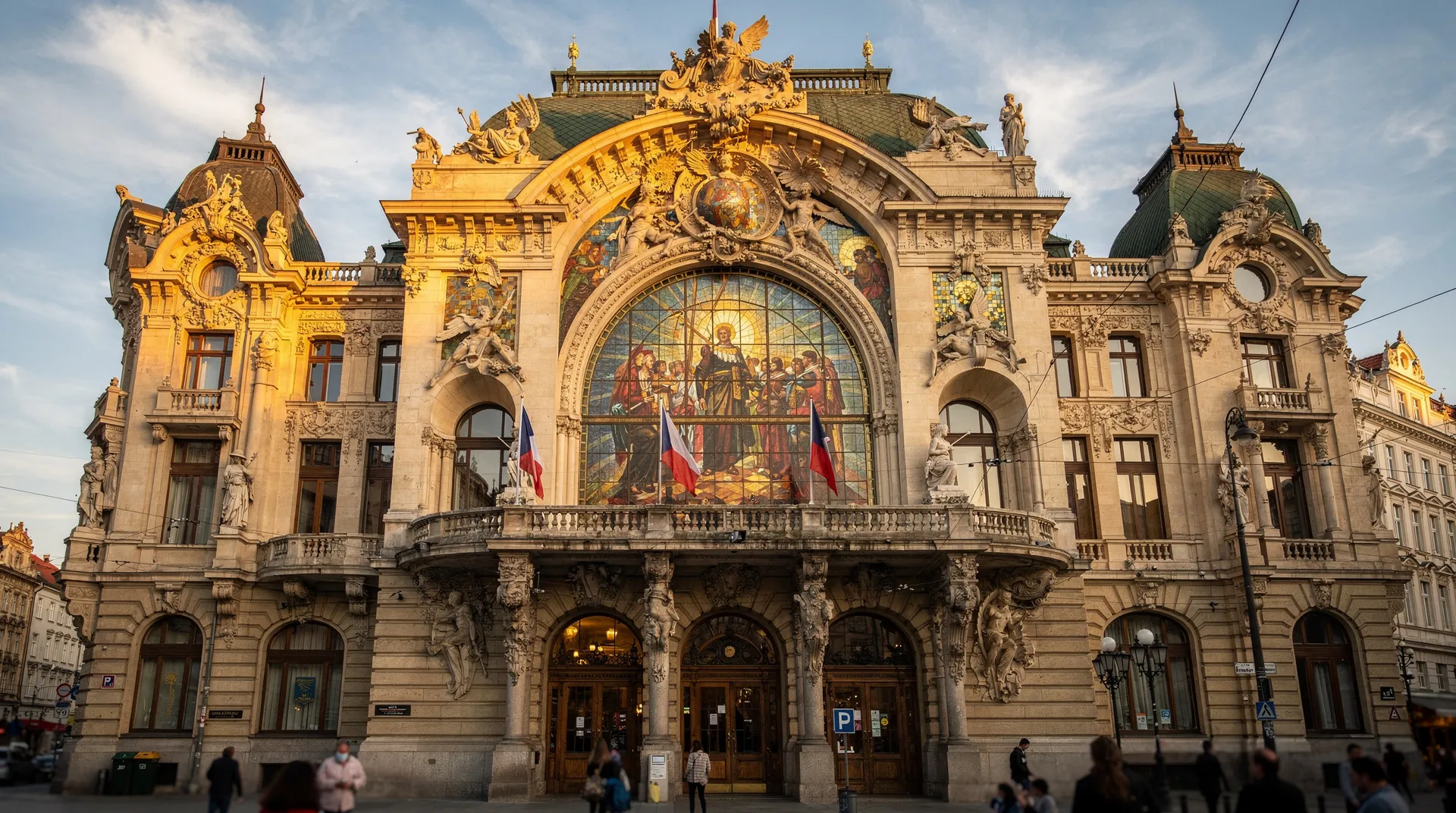
Five minutes’ walk from the museum, the Municipal House (Obecní dům) contains Mucha’s most public work in Prague. The main facade features his mosaic “Homage to Prague” above the central arch — an allegorical composition of Bohemia enthroned between History and Future, created in 1911. The figures have the characteristic Mucha qualities: idealized, classically-draped, with art nouveau botanical borders.
The Mayor’s Room (Primátorský sál) inside the building is entirely painted by Mucha in an allegorical programme of Slavic virtue — the eight spandrel paintings depicting Czech civic ideals, the ceiling panels, and the decorative borders are all his work. This room is only accessible on a guided tour of the building (€15–18 / CZK 380–455). It is worth booking separately.
Allow 30–45 minutes exterior; 90 minutes with interior tour.
Stop 3: St. Vitus Cathedral — Archbishop’s Chapel window
Katedrála sv. Víta, Prague Castle | Metro: Malostranská (line A) + tram or 25-min walk
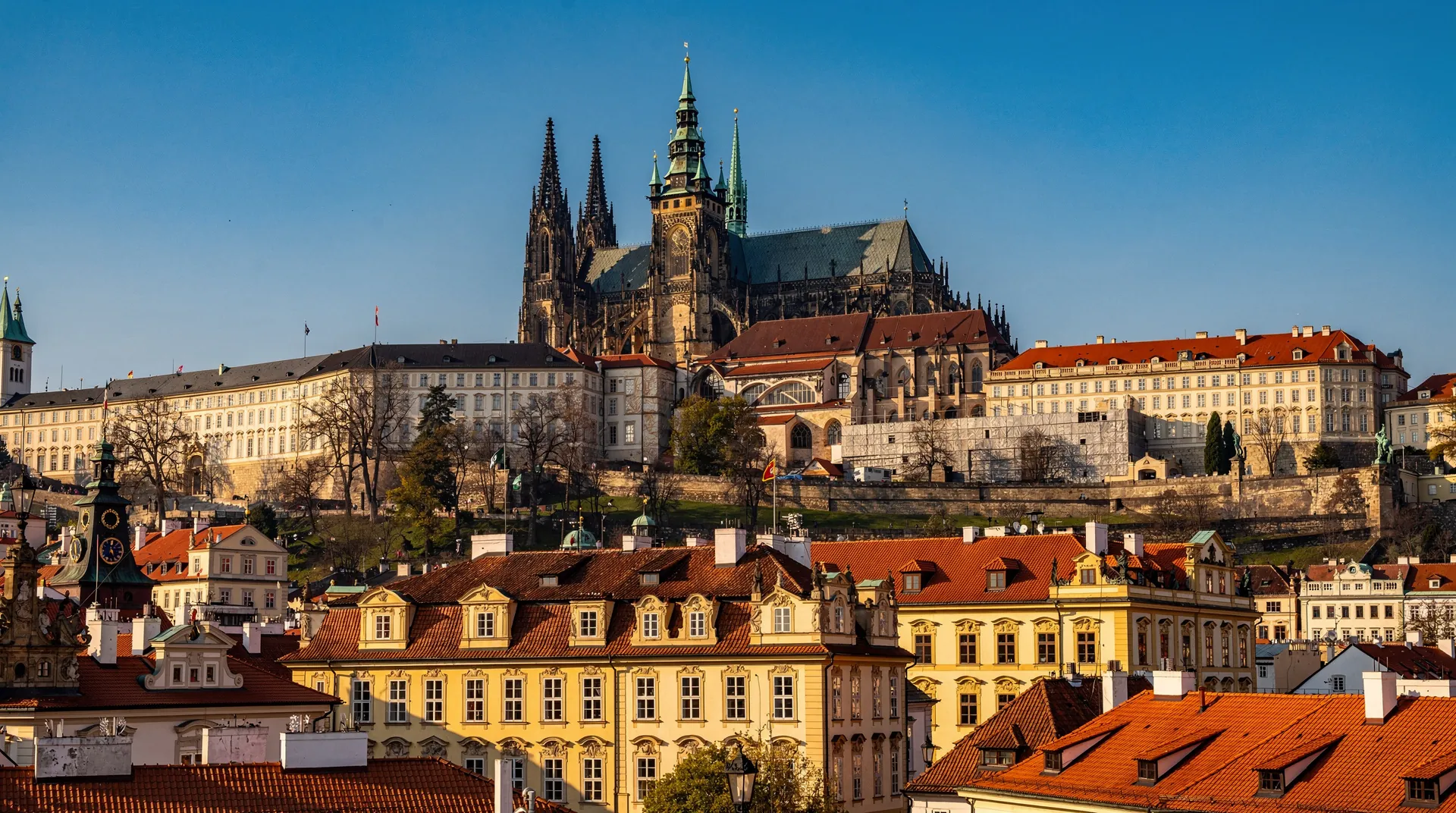
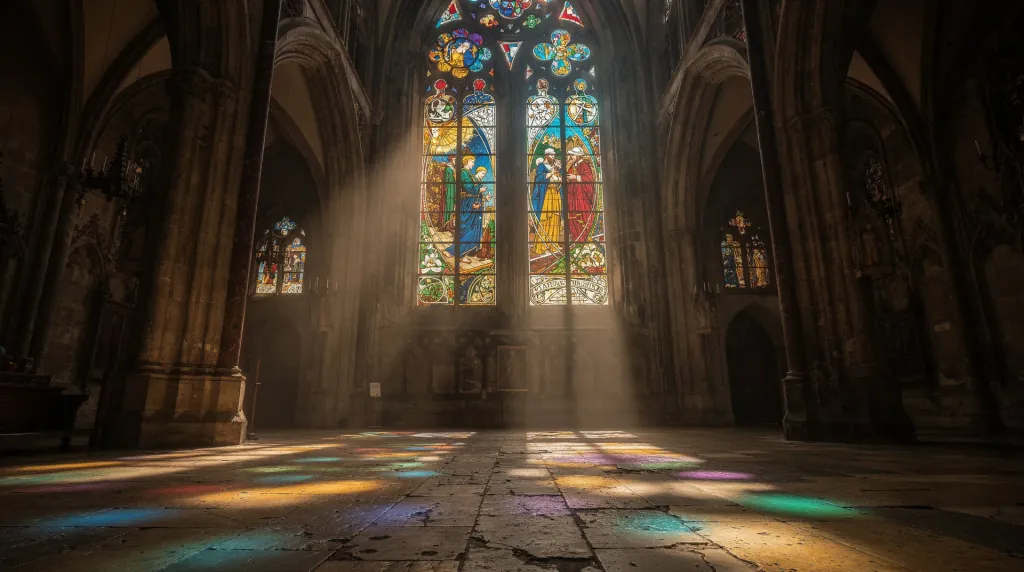
The stained-glass window in the Archbishop’s Chapel of St. Vitus Cathedral is Mucha’s most visited work in Prague and among the most beautiful stained-glass compositions in Europe. It was commissioned in 1931 — Mucha was 70 — and depicts scenes from the lives of St. Cyril and St. Methodius, the 9th-century missionaries who created the Glagolitic alphabet and evangelized the Slavic peoples. The scale is monumental; the technique — Mucha designed the cartoon, a glassworks executed it — retains all the flowing line and colour mastery of his earlier work but in a medium completely different from paint or print.
The window is visible from the nave with a Prague Castle ticket (circuit A or B, €15–20 / CZK 380–505). The Cathedral itself is free to enter for a brief look from the entrance; the full interior including the Mucha window requires a ticket.
Allow 30–45 minutes.
Stop 4: Municipal Library — Clam-Gallas Palace area
Husova 20, Staré Město | Metro: Staroměstská (line A)
On your return from Prague Castle, pass through the Old Town and note the building at Husova 20 — the Clam-Gallas Palace, one of Prague’s finest Baroque buildings, not Mucha-related but part of the architectural context. The Staré Město district around here connects the Kafka and Mucha trails — Kafka’s birthplace is 5 minutes north; the Kafka Museum is across the river.
Allow 10 minutes en route.
Stop 5: Veletržní Palace — National Gallery, Slav Epic
Dukelských hrdinů 47, Holešovice | Metro: Vltavská (line C) + 10-min walk, or tram 1/8/12
The walk ends at the National Gallery’s Veletržní Palace — a 1920s Functionalist trade-fair building that now houses the Czech modern art collection. The Slav Epic occupies the entire atrium: 20 massive canvases depicting episodes from Slavic history and mythology, from prehistoric times through the Hussite period and the Slavic linguistic revival. The largest canvas (Apotheosis of the Slavs) is approximately 6 x 8 metres.
The Slav Epic is Mucha’s statement about the purpose of his entire artistic life — not decoration, not commercial Art Nouveau, but a monumental historical programme in the tradition of history painting. Reactions vary: some visitors find the scale overwhelming; some find the allegorical programme obscure; some find it one of the most extraordinary things in Central European art. Go with no preconception.
Admission: €8 (CZK 200) for the Slav Epic; full Veletržní Palace ticket €14 (CZK 355). Allow 60 minutes.
Practical info
- Start: Mucha Museum, Panská 7, Metro: Náměstí Republiky (line B)
- End: Veletržní Palace, Dukelských hrdinů 47, Holešovice, Metro: Vltavská (line C)
- Duration: 4–5 hours for all stops including St. Vitus and Slav Epic
- Distance: approximately 6 km (3.7 miles), with tram/metro sections
- Indoor vs outdoor: all five stops are primarily interior (museums, cathedral, concert hall)
- Season: year-round; St. Vitus Cathedral window is best in morning light from the south
- Accessibility: all venues are accessible; Veletržní Palace has lifts; Prague Castle requires uphill tram or walk
Comparing the four Mucha sites
Not every stop suits every visitor equally. Here’s how they compare if you need to cut the trail short:
| Site | What you see | Cost | Best for |
|---|---|---|---|
| Mucha Museum | Paris-period posters, photographs, jewellery designs | around €12 | First-time visitors who need the visual grounding |
| Municipal House | Exterior mosaic + Mayor’s Room (guided tour only) | Free exterior; €15–18 guided tour | Art Nouveau architecture fans |
| Prague Castle (St. Vitus window) | Archbishop’s Chapel stained glass | €15–20 castle circuit ticket | Anyone already visiting the Castle |
| Veletržní Palace | The Slav Epic (20 monumental canvases) | around €8 | Visitors who want Mucha’s own view of his life’s purpose |
If you can only do two, pair the Mucha Museum (context) with either the Municipal House (if you’re in the Old Town area) or the Slav Epic (if you want the single most powerful Mucha experience in the city).
Fitting the Mucha Trail around Prague Castle
Stop 3 requires a trip up to Prague Castle, which is also the setting for most of Prague’s other major sights — see the Prague Castle guide for the full circuit options and ticket prices. Because the castle stop sits in the middle of this walk geographically, many visitors split the trail across two visits: museum and Municipal House on one day, then the St. Vitus window and Veletržní Palace added onto a separate castle-focused day. Either approach works; just don’t try to rush the castle stop, since circuit tickets involve a security queue and the window itself is easy to miss if you’re moving fast through the nave.
Questions about Alfons Mucha
Was Mucha a Czech or French artist?
He was Czech by nationality and identity, internationally famous through his Paris career. He regarded himself primarily as a Czech artist with a Slavic mission; his Paris Art Nouveau commercial work was the means to fund his later Czech historical project (the Slav Epic). He returned to Czechoslovakia after independence in 1918 and spent the rest of his life in Prague.
What happened to Mucha under the Nazis?
Mucha was 78 when the Nazis occupied Czechoslovakia in March 1939. He was immediately arrested by the Gestapo — his pan-Slavic, Czech nationalist art made him a political target. He was released after questioning but died three months later, on 14 July 1939, of pneumonia complicated by his brief imprisonment. He was buried at Vyšehrad cemetery.
Is the Mucha Museum worth visiting if I have limited time?
Yes if you have 45 minutes and are seeing the Municipal House and St. Vitus Cathedral as part of the same day. The museum’s Paris-period collection provides essential visual context; without it, the Municipal House mosaics and St. Vitus window are beautiful but unexplained.
Can I see the Slav Epic at the Mucha Museum?
No. The Slav Epic is too large to fit in the Mucha Museum — the canvases require the industrial space of Veletržní Palace. The Mucha Museum shows photographs and documentary material about the Slav Epic project, but the paintings themselves are in Holešovice.
Where is Mucha buried?
At Vyšehrad cemetery, in the Slavín monument — the collective mausoleum of Czech cultural figures, where Dvořák, Smetana, and other national figures are also interred. The Dvořák Trail walk ends at Vyšehrad.
Do I need to book the Municipal House Mayor’s Room tour in advance?
Yes, especially in summer. The Mayor’s Room is only accessible on a scheduled guided tour of the building (limited group sizes), and popular time slots can fill up a day or more ahead. Booking online before you arrive in Prague avoids disappointment.
Go deeper
Prague: Mucha Museum entry ticket — skip the queue with a pre-booked ticket for the permanent collection.
Prague Art Nouveau tour — a guided walk that includes the Municipal House exterior and Art Nouveau context for Mucha’s Czech work.