At a glance
| Where | 15 spots across Old Town, Malá Strana, Žižkov, and Vyšehrad |
| Cost | Most viewpoints are free; a few ticketed towers run around €10–14 |
| Time needed | Around 2–3 hours to cover 3–4 spots properly in one session |
| Getting there | Central spots are walkable from Old Town Square and Charles Bridge; Vyšehrad and Žižkov need a short tram or metro ride |
| Best time | Sunrise (roughly 5:00–6:30am in summer) or the hour before sunset — avoid the flat midday light |
Why Prague photographs so well
Prague resisted demolition, aerial bombing, and the postwar concrete housing schemes that gutted most Central European city centres. The result is an intact, densely layered medieval-to-Art Nouveau cityscape where Gothic towers, Baroque domes, and ornate 19th-century facades coexist within a few hundred metres of each other — all compressed into a river bend that frames almost any shot.
The Vltava is wide enough to create reflections and river-level drama but narrow enough to see across clearly. The city’s natural topography (two castle hills, a broad river valley, surrounding park ridges) creates multiple natural viewpoints from which the skyline resolves into something close to a film set.
There are two golden hours here, not one. The summer sunrise over the Vltava from the Letná plateau at around 5:30am is extraordinary. The late afternoon light raking across the terracotta rooftops from Petřín or Strahov is equally compelling. Both require effort — arriving early or staying late — but both reward it.
The 15 best photo spots in Prague
1. Charles Bridge (Karlův most) at sunrise
Address: Karlův most, connecting Old Town and Malá Strana Best time: 5:00–7:00am (summer); 6:30–8:30am (winter) Access: Free, 24 hours Expected crowds: Near-empty before 7am in summer, busy from 8am onwards
Charles Bridge is among the most photographed structures in Europe, and the challenge is not finding a composition — it is finding one that does not look like every other photograph taken from the same spot. The answer is timing. Before 7am on a summer morning, the bridge is occupied by perhaps a dozen other photographers, a few dog walkers, and the occasional fisherman below. The 30 Baroque statues lining the bridge are lit by low raking light that turns the stone from grey-beige to gold. The castle behind floats in soft haze.
Composition tips: Frame the bridge in three-quarter view from the Old Town approach (from the Křížovnické náměstí plaza, looking west). This creates a strong leading line through the statues toward the distant Malá Strana towers. Alternatively, descend to the riverbank below the bridge (accessible via the steps at either end) for the classic arch-and-reflection shot. A wide angle (24–35mm equivalent) handles the full bridge width.
2. Letná beer garden terrace
Address: Letenské sady (Letná Park), Praha 7 Best time: 1–2 hours before sunset Access: Free. The terrace is part of Letná Park. Take tram to Letná stop. Expected crowds: Moderate. The park is popular but large.
The Letná terrace sits roughly 60 metres above the Vltava at the apex of the river bend. The view takes in Charles Bridge, the Old Town roofscape, the castle behind, and both river embankments stretching south. In the late afternoon, the light hits the terracotta roofs from the west and makes the entire cityscape glow.
This is also one of the few viewpoints with a bar on site — the Letná Beer Garden (Letňanský pivovar) serves Pilsner Urquell and Gambrinus at outdoor tables overlooking the panorama. A cold beer while watching the light change over the city is a specific Prague pleasure.
Composition: Stand at the eastern edge of the terrace (just past the metronome installation). A 35–50mm equivalent gives the most natural perspective on the bridge and castle combination. For telephoto compression of the rooftops, use 85mm or longer.
3. Strahov Monastery viewpoint
Address: Strahovské nádvoří, Praha 1 (above Malá Strana) Best time: Sunrise or late afternoon Access: Free (viewpoint). Monastery library tickets are separate. Expected crowds: Low in morning, moderate afternoon
The terrace immediately in front of Strahov Monastery faces east across the entire city. From here you see: Prague Castle from the side (not the front approach), the green dome of St. Nicholas Church in Malá Strana, the Old Town skyline, Vinohrady hills behind, and on clear days the TV tower in Žižkov. It is one of the most complete panoramas in Prague and significantly less visited than Petřín Tower (directly below) or the Old Town Hall Tower.
The monastery gardens further west offer additional interesting angles on the castle complex from an unusual elevation and direction.
4. Old Town Hall Tower
Address: Staroměstské náměstí 1, Praha 1 Best time: Opens at 9am; go as early as possible or at closing time Access: Ticket required — approximately €14 (350 CZK; book via t209055 or t29853 on GYG to skip queues) Expected crowds: High year-round; long queues in summer without pre-booking
Looking down from the tower at Old Town Square below is one of the classic “you need to be there” photographs of Prague. The pastel Baroque facades of the houses surrounding the square, the Gothic Týn Church rising behind them, the clusters of umbrellas and tourists below — it is a genuinely unusual urban photograph because the scale and density of the architecture is compressed into something that looks almost like a diorama.
Bring a wide-angle for the full square view. The tower also offers views toward the castle (northwest), the Powder Gate (east), and the Vltava river bend (north).
5. Petřín Lookout Tower
Address: Seminářská zahrada, Praha 1 (Petřín Hill) Best time: Clear morning or afternoon. Avoid hazy midday. Access: Ticket required — approximately €10 (250 CZK) for the tower (t405222). The funicular ride up is separate. Expected crowds: High in summer, moderate other seasons
Petřín Tower is Prague’s miniature Eiffel Tower — built in 1891 for the Prague Jubilee Exhibition. At 60 metres, standing on the already elevated Petřín Hill (318m above sea level), the observation deck commands perhaps the broadest panoramic view of the city.
Photography note: Shoot from the platform looking northeast toward Old Town for the Castle-to-Old Town alignment. On very clear days (typically after rain or in winter), you can see as far as the Říp hill in Bohemia.
6. Vyšehrad clifftops above the Vltava
Address: V Pevnosti, Praha 2 (Vyšehrad fortress) Best time: Late afternoon or sunset Access: Free (clifftop gardens). Specific buildings have separate tickets. Expected crowds: Low. This is perhaps the most underused great viewpoint in Prague.
Vyšehrad is the second castle hill of Prague, standing on dramatic limestone cliffs above the southern reach of the Vltava. The view northeast from the clifftop gardens takes in a sweeping river bend with Nusle Valley behind it. No Charles Bridge, no castle — but the city’s south bank architecture stretching toward the New Town, reflected in the Vltava at golden hour, is genuinely beautiful.
The site is also very photogenic internally: the twin spires of the Basilica of St. Peter and Paul, the Romanesque rotunda of St. Martin, and the Slavín cemetery (where Dvořák, Mucha, and Smetana are buried) all photograph well.
7. Dancing House (Tančící dům) and its rooftop bar
Address: Jiráskovo náměstí 6, Praha 2 Best time: Any (rooftop bar: check opening hours, typically afternoon–evening) Access: Street-level free. Rooftop Glass Bar has minimum consumption. Expected crowds: Moderate street level; low rooftop
The Dancing House (designed by Frank Gehry and Vladimír Milunič, completed 1996) is the most discussed piece of contemporary architecture in Prague. Its deconstructivist form — nicknamed “Ginger and Fred” — is best photographed from the pedestrian side street (Na Rybníčku) at mid-distance, where the whole building resolves into its dancer metaphor. The rooftop bar offers a unique upriver view toward the Old Town and Charles Bridge.
Composition: A 50–70mm equivalent eliminates perspective distortion and shows the building’s actual proportions. Shoot slightly underexposed in harsh light — the building’s curved surfaces blow out easily.
8. Žižkov TV Tower with the Babies installation
Address: Mahlerovy sady 1, Praha 3 (Žižkov) Best time: Blue hour (15–20 minutes after sunset) for the tower lights Access: Viewing platform ticket approximately €14 (350 CZK; t485609 for context). Street-level is free. Expected crowds: Low-moderate
The Žižkov TV Tower (1992) is Prague’s most divisive building — voted “ugliest building in the world” and also one of the most original. The 216-metre structure is crawled with 10 oversized bronze babies by sculptor David Černý, their faceless forms moving vertically up and down the concrete surface. Street-level photography of the babies at close range requires a wide-angle lens and a near-vertical shooting angle.
From the observation deck at 93 metres, the view is complete 360 degrees. Žižkov itself (a traditionally working-class neighbourhood now undergoing gentrification) photographs well from this height at blue hour.
9. Josefov — the Art Nouveau synagogue facades
Address: Maiselova and Pařížská streets, Praha 1 Best time: Early morning (8–9am) when the light is front-lit and streets are quiet Access: Free (street photography). Jewish Quarter museum tickets are separate. Expected crowds: Low in morning, high midday–afternoon
The Josefov quarter contains six operating synagogues and the Old Jewish Cemetery — a concentration of Jewish heritage unique in Central Europe. The Maisel Synagogue, the Spanish Synagogue (Španělská synagoga with its extraordinary Moorish interior), and the Pinkas Synagogue all have remarkable facades.
Note: Photography is permitted on the streets around the synagogues. Inside certain buildings (particularly the Old Jewish Cemetery), photography restrictions apply — read the signage carefully and respect them.
10. John Lennon Wall — but smarter
Address: Velkopřevorské náměstí, Praha 1 (Malá Strana) Best time: Very early morning (7–8am) or evening after 6pm Access: Free, 24 hours Expected crowds: High midday; low early morning and late evening
The John Lennon Wall is perpetually being repainted, which means it always looks different — and always looks slightly chaotic. The photographic challenge is the crowds of people photographing it (which appear in every midday shot), the flat north-facing light that leaves it shadowed for most of the day, and the narrow street that limits wide-angle options.
The solution is early morning. At 7am, the wall is sometimes empty. The light at this time comes from the south and over the building behind you — it is diffuse and even. Shoot square-on at 24–35mm for the full composition, or close in on specific painted details for abstract work.
11. Vltava river from Střelecký ostrov (Archer’s Island)
Address: Střelecký ostrov, Praha 1 (river island below the Legion Bridge) Best time: Sunset or blue hour Access: Free, pedestrian access via bridge from the New Town embankment Expected crowds: Very low
Střelecký ostrov is a small river island on the western bank of the Vltava, accessible by foot from the Jiráskovo and Legií bridges. From the northern tip of the island, looking northeast, you have: both river banks, Charles Bridge in the distance, and the castle above. Crucially, you are shooting from river level with the water in the immediate foreground. At blue hour, the bridge lights and castle illumination reflect in the still water.
This is one of the least-photographed great viewpoints in central Prague — not because it is difficult to reach but because most visitors simply do not know it exists.
12. Nerudova street ascending to the castle
Address: Nerudova ulice, Praha 1 (Malá Strana) Best time: Early morning or late afternoon for the light on the facades Access: Free, public street Expected crowds: Moderate during the day; low early morning
Nerudova is the steep cobbled street that climbs from Malá Strana to Prague Castle. It is lined with 17th and 18th-century townhouses, each with a distinctive sign above the door (the double eagle, the golden key, the black eagle — Prague houses were identified by symbols before street numbers). It is one of the most architectural streets in Central Europe and photographs well at almost any time of day.
For the ascending perspective shot (looking up the street toward the castle towers visible at the top), shoot in landscape from mid-street with a 24–35mm wide angle. The vertical lines of the buildings converge dramatically.
13. Klementinum reflection pool and library
Address: Mariánské náměstí 5, Praha 1 (Old Town) Best time: During tour hours (tickets required for interior) Access: Library and mirror chapel: tickets via t444999 or t498025 Expected crowds: Moderate (guided tours limit numbers)
The Klementinum Baroque library hall is one of the most photographed interiors in Europe — a vaulted library with a fresco ceiling, dark wood cases, and globes. Photography is permitted during guided visits. The astronomy tower above offers a rooftop view of Old Town that is different from all the others.
The Mirror Chapel inside Klementinum also hosts classical music concerts (see t498025) — a very specific combination of exceptional acoustic environment and extraordinary space.
14. Vítkov hill and the Žižka equestrian statue
Address: U Památníku, Praha 3 (Žižkov) Best time: Late afternoon, facing west Access: Free (hilltop). National Memorial building has separate tickets. Expected crowds: Very low
The Žižkov National Memorial sits on Vítkov hill, crowned by the largest equestrian bronze statue in the world — Jan Žižka, the 15th-century Hussite military commander who never lost a battle. The statue is extraordinary in scale (9 metres high, 750 tonnes) and almost nobody visits it. The view from the hill looking west over Žižkov toward the Old Town is unusual, slightly elevated, and very clear of tourists.
Shoot the statue from below, looking up, for its full scale. The horse and rider against Prague Castle in the background requires careful positioning (roughly 150 metres southeast of the statue base, shooting on a 200mm+ equivalent).
15. Prague Castle at blue hour from across the river
Address: Best view from the Novotného lávka footbridge or the Rudolfinum terrace steps, Praha 1 Best time: 15–30 minutes after sunset Access: Free (street level) Expected crowds: Moderate near the bridge; low from less-obvious points
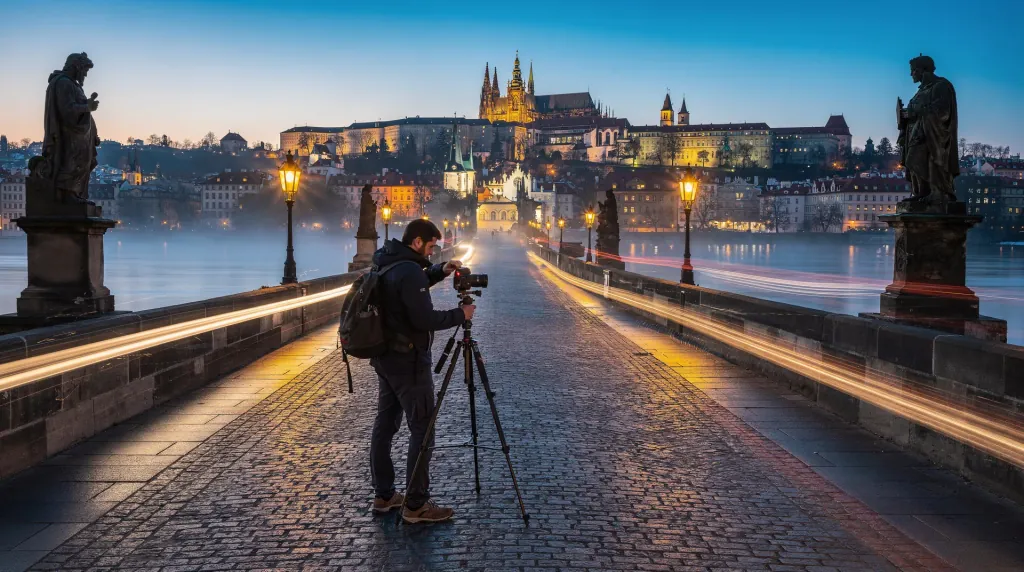
The classic postcard shot of Prague — castle and bridge reflected in the Vltava — requires being on the east bank, looking west, at blue hour when the castle illumination turns on but the sky still holds colour. The Novotného lávka footbridge (just north of Charles Bridge, east bank) provides the standard angle. For a slightly less used perspective, the quay in front of the Rudolfinum (Alšovo nábřeží) is 200 metres north and shoots the castle from a slightly different elevation.
Use a tripod (or stabilise on a railing) — exposure times of 2–5 seconds at base ISO are needed at blue hour. Tripods are permitted at these street-level locations.
Which viewpoint should you actually choose?
With 15 options, most visitors only have time for a handful. This table compares the spots that matter most if you can only pick 3–4:
| Viewpoint | Crowd level | Ticket needed | Best for |
|---|---|---|---|
| Charles Bridge at sunrise | Low before 7am, packed after | None | The single iconic Prague shot |
| Letná terrace | Moderate, large park | None | Full skyline + a beer while you wait for the light |
| Vyšehrad clifftops | Very low | None | Underused river-bend view, no crowds to edit out |
| Strahov viewpoint | Low morning, moderate afternoon | None (viewpoint only) | Complete panorama without the Petřín crowds |
| Old Town Hall Tower | High year-round | Around €14 | The classic square-from-above shot |
| Petřín Lookout Tower | High in summer | Around €10 + funicular | Broadest single panorama in the city |
| Žižkov TV Tower deck | Low-moderate | Around €14 | 360° view + the Babies sculptures at street level |
If you only do one thing: sunrise on Charles Bridge, then walk 15 minutes to Střelecký ostrov or the Letná terrace before the light gets hard.
Planning a photo walk instead of chasing single spots
Rather than treating this as a checklist, most photographers get better results linking 2–3 spots that share a light window. A useful sunrise sequence: start on Charles Bridge before 6am, walk north along the embankment to Střelecký ostrov for the river-level reflection shot, then climb to the Letná terrace as the sun clears the rooftops — you get three different compositions of the same skyline in under two hours, all in the same golden light. For sunset, the reverse works: Strahov or Petřín first, then descend toward Malá Strana and the Prague Castle approach for blue hour.
Weather matters more than most guides admit. Overcast days flatten every one of these shots — the raking light is the whole point. Check the forecast the night before and be willing to swap your plan; a clear morning two days later beats a grey one on schedule.
Photography etiquette in Prague
Jewish cemetery: Photography is prohibited inside the Old Jewish Cemetery (Starý židovský hřbitov). The graves are sacred burial ground, not a scenic backdrop. The prohibition is strictly enforced by staff. Photography of the exterior and the cemetery seen through the fence is permitted.
Church interiors: Most Prague churches permit photography without flash. Some charge a small fee (20–50 CZK). Masses in progress mean no photography — wait outside or visit at a non-liturgical time.
Klementinum and Strahov libraries: Photography is permitted during guided visits but not during concerts or private events. Follow the guide’s specific instructions.
Tripods in the Old Town: No specific legal restriction on street tripods in Prague, but during peak hours the narrow streets make large tripods an obstruction and operators may ask you to move. Early morning is the practical solution.
Drones: Commercial and recreational drone use in central Prague is heavily restricted. The Hradčany air corridor and national monument zones are effectively no-fly. Apply for permits well in advance or face significant fines. This is enforced.
People: Czech privacy law (GDPR implementation) restricts the use of clearly identifiable photographs of individuals taken without consent for commercial purposes. Street photography for personal use is generally fine; publishing photographs with identifiable faces commercially requires consent.
Gear notes
Phone versus dedicated camera: For most of the shots on this list, a modern smartphone with a capable night mode (iPhone 15 Pro, Samsung S24 Ultra, Google Pixel 9 Pro) produces excellent results at dawn and blue hour. The limitations show in extreme low light (very dark streets) and when you need significant telephoto reach.
The one thing that matters more than camera: Being at the right place at the right time. A phone at 5:45am on Charles Bridge produces a better photograph than a full-frame camera at 10:30am with 200 tourists in frame.
Useful kit beyond the camera: A small flexible tripod (Joby GorillaPod style) that fits in a daypack. A UV filter to protect the front element on cobblestones (Prague’s stones are hard on dropped lenses). A small cleaning cloth — the stone walls and railings used for stabilisation are dusty.
Book a photography-focused tour
Private Prague Sunrise Photoshoot + Walking Tour — A professional photographer takes you to the best spots at the golden hour window. Includes composition coaching and post-session image review. For serious photographers who want location knowledge with technical guidance.
Prague: Professional Photoshoot (1h / 30 / 15 min) — If you want to be in the photographs rather than behind the camera. A professional photographer takes portraits of you at Prague’s most photogenic locations. Multiple duration options.
Alchemy and Mysteries of Prague Castle Walking Tour (after dark) — Night photography context. The castle district and Old Town at night with an expert guide — the illuminated castle and empty streets create very different photographic opportunities from daytime. Useful for learning the best night-shooting locations with someone who knows the access points.
Frequently asked questions about photography in Prague
What is the best time of day for photography in Prague?
The blue hour (15–20 minutes after sunset) and the golden hour around sunrise are the standard answers — correct but worth qualifying. In summer, sunrise in Prague is around 5:00–5:30am, which means being on Charles Bridge at 4:45am if you want the empty bridge shots. Most people find the evening blue hour more practical (around 9:00–9:30pm in June–July).
Is photography free at Prague Castle?
Photography of the castle exterior and grounds is free. Inside specific buildings — St. Vitus Cathedral, the Old Royal Palace, Golden Lane — there are photography policies that vary by building. Most permit phone photography; some restrict tripods and professional equipment. Signs are posted at each entrance. Photography during the changing of the guard is permitted from a distance.
Do I need a photography permit for commercial shoots in Prague?
For personal and editorial use, no permit is required for street photography. Commercial photo shoots in public spaces technically require a permit from Prague City Hall if they involve professional equipment and crew. Individual travel photographers shooting for personal portfolios are generally not stopped. In national monument zones (Prague Castle grounds), a permit is required for professional commercial shoots with lights and crew.
Where can I photograph Prague at night without a tripod?
The Charles Bridge approach (Křížovnické náměstí) has wide stone railings at waist height that are ideal for stabilising a camera or phone. The Letná terrace wall serves similarly. The Vltava embankments have stone parapets. With modern night modes, these stabilisation points produce sharp images without a tripod.
What are the best Prague photo spots in winter?
January and February are underrated for photography. Snow on the Gothic spires and Baroque rooftops transforms the city. Crowds are minimal. The blue hour arrives early (around 4:30pm) and the castle illumination creates dramatic contrast with snow-covered grounds. The Christmas market location (Old Town Square, late November to early January) is one of the most photogenic winter markets in Europe.
Can I photograph inside the Klementinum library?
Yes, during guided tours. The library is not open for self-guided access — all visits are guided, and tickets are required. GYG tour t444999 (Klementinum Library and Astronomical Tower) includes photography during the visit.
Do I need a wide-angle lens for Prague photography?
It helps but isn’t essential. A 24–35mm equivalent (or a phone’s standard wide lens) covers most of the compositions on this list — Charles Bridge, Old Town Square from the tower, Nerudova street. A phone’s built-in ultra-wide is genuinely useful for the tighter spots like the John Lennon Wall. A telephoto is more situational, mainly useful for the Vítkov statue or rooftop compression shots.
Is drone photography allowed at these viewpoints?
No, not without a permit, and in most cases not at all. Central Prague — including the Castle district, Vyšehrad, and most of the historic core — sits inside restricted or no-fly airspace. Treat every spot on this list as a no-drone zone unless you have confirmed otherwise with Czech aviation authorities in advance.