What a vintage car tour in Prague actually feels like
At a glance
| Where | Departures from Old Town Square and Malá Strana |
| Cost | Around €35–180 depending on duration and private vs. shared |
| Time needed | 45 minutes to a full day (Karlštejn option) |
| Getting there | Walk to the departure point confirmed in your booking |
| Best time | May, June, September for open-top comfort; book ahead for morning golden-hour slots |
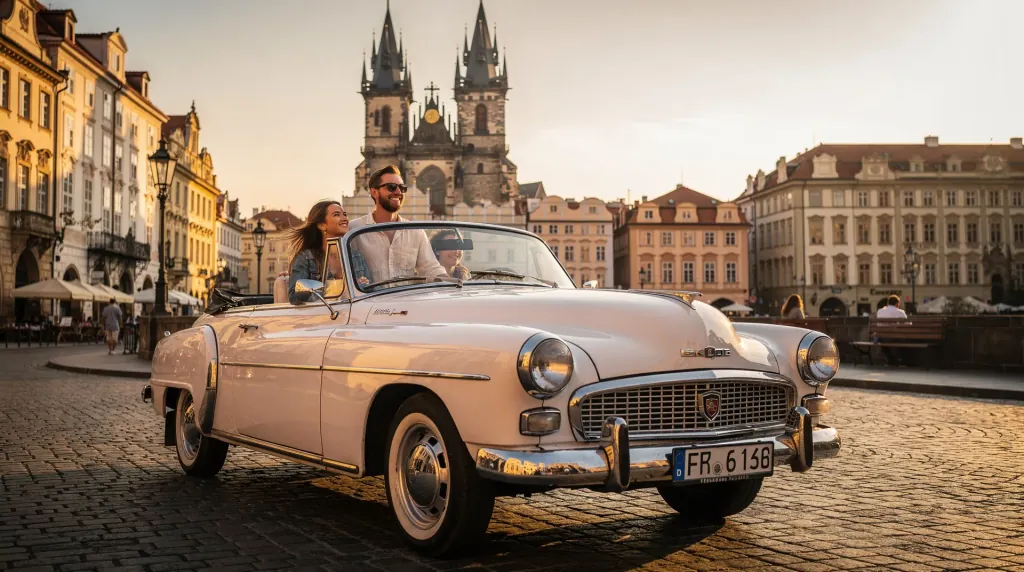
There is something specifically Prague about arriving at Prague Castle in a cream or burgundy Škoda 1203 van from the 1970s. The communism-era vehicles that serve as the backbone of most Prague vintage car operations were built in Czech factories, driven through these same streets for decades, and restored to near-showroom condition by operators who clearly love them. They are not random props — they are local history you can sit inside.
The practical experience: you are collected (or walk to a central departure point), given a brief orientation by a driver-guide, and driven through the city at a pace that is fast enough to cover ground but slow enough to absorb it. Most vehicles hold 3–6 passengers in the rear, with an open top or fold-down canvas roof. Commentary is live from the driver, usually in English with German, French and Spanish options available depending on the operator.
Who this works for: couples wanting something more cinematic than a walking tour, families with young children who cannot sustain 4 hours on foot, older travellers with mobility limitations, groups of friends who want a shared experience with built-in photo opportunities. Who should skip it: travellers who want deep historical detail (the commentary in a moving car is necessarily surface-level), people who are carsick easily (the Old Town cobblestones are a real consideration).
The verdict before we go further: vintage car tours in Prague are genuinely good value for their category. They are not cheap, but compared to equivalent experiences in Rome or Vienna, the Prague operators are competitive and the vehicles are better maintained than most.
The main operators and vehicle types
Škoda 1203 vans and wagons
The Škoda 1203 is the most common vehicle type in Prague’s vintage car tour market. Built from 1968 to 1981 at the AVIA factory in Prague, it was used as everything from ambulances to postal vans. Restored versions now carry tourists in cream, red, green, and beige liveries. The rear bench seating holds 4–6 people, and the roof rolls back for open-air photography.
Škoda Felicia and 110R
Some operators offer more elegant vintage Škodas — the 1960s Felicia convertible (genuinely beautiful, rarer) or the sporty 110R coupe. These typically hold only 2–3 passengers and are priced as premium options.
Tatra 603
A handful of operators use the Tatra 603, the Czechoslovak Communist-era executive limousine used by party officials. Rear-engined, smooth-riding, with a distinctive three-headlight front. A niche choice but deeply atmospheric for anyone interested in Cold War history.
Retro-style car tours to Karlštejn
One specialist offering worth noting: t193892 (“Prague: Fairytale Karlštejn Castle in Retro-Style Car”) takes a vintage vehicle out of the city entirely, driving through the Bohemian countryside to Karlštejn Castle — a 14th-century fortress in the hills above the Berounka river. This is a day trip, not a city circuit. Price is higher (€120–180 for 1–2 people) but you get an extraordinary combination of castle visit and scenic driving.
The routes — what each covers
1-hour city circuit
The most common entry-level option. Covers Old Town Square (Staroměstské náměstí), crosses Charles Bridge (cannot drive on it — drops at the approach), loops through Malá Strana, climbs to the castle district, and returns via Nerudova street. Enough to see the essential sights from a moving vehicle. Good for: very limited time, older travellers, families with young children. t602584 (1-hour, shared), t468580 (1-hour, private up to 6 people).
1.5-hour extended circuit
Adds Vyšehrad (the other castle hill, south of the New Town), Wenceslas Square, and the riverside embankment to the standard circuit. More complete overview of the city. The sweet spot for most visitors. t144546 (1.5h group tour — the “flagship” listing), t466789 (1.5h private, up to 6).
2-hour grand tour
Includes Žižkov TV Tower, the Vinohrady neighbourhood, and extended time at each stop. Best for people who want to combine a vehicle tour with walking at specific points (the driver drops and waits). t468611 (2h private, up to 6).
Private Old Town circuit
Shorter (45–60 min) but entirely focused on the Old Town and Josefov (Jewish Quarter). Good for architecture lovers who want to see the Art Nouveau and Gothic facades without fighting pedestrian crowds on foot. t510509 (“Prague: Old Town Private Vintage Car Tour”).
3-hour combined tour with walking
A hybrid format: vintage car transfers between key points with a guide-led walking section at Prague Castle and Charles Bridge. The best of both worlds, but at a significantly higher price point. t65996 (“Prague: 3-Hour Vintage Car Ride and Walking Tour”). Price: €90–120 per person.
Karlštejn day trip by retro car
See above. t193892. A specialist departure — book well in advance in summer.
Which tour for which traveller
Romantic couple on a long weekend: The 1.5h private tour (t466789) is exactly right. You have the vehicle to yourselves, the driver focuses on your interests, and you get 90 minutes of rolling through one of Europe’s most beautiful cities in a vehicle that photographs magnificently.
Family with children under 10: The 1-hour shared tour (t602584). Children are reliably delighted by the Škoda. The 1-hour length is appropriate for shorter attention spans.
Group of 6 adults: The 1.5h or 2h private option fills the vehicle and brings the per-person cost down to €25–35. At that price it is cheaper than a walking tour.
History and Cold War enthusiasts: Specifically ask for a Tatra 603 or a standard Škoda with a driver who will talk about communist-era Prague. The reputable operators (check review histories) know this angle well.
First visit with 2 full days: Do the car tour on day one to get spatial orientation, then spend day two exploring on foot with context.
Price 2026 comparison
| Tour | Duration | Format | EUR |
|---|---|---|---|
| t602584 — 1h vintage car | 1h | Shared / small group | €35–50 |
| t468580 — 1h private (up to 6) | 1h | Private | €90–130 total |
| t144546 — 1.5h group | 1.5h | Small group | €60–80 pp |
| t466789 — 1.5h private (up to 6) | 1.5h | Private | €120–160 total |
| t468611 — 2h private (up to 6) | 2h | Private | €150–200 total |
| t510509 — Old Town private | 45–60min | Private | €80–110 total |
| t65996 — 3h car + walking | 3h | Small group | €90–120 pp |
| t193892 — Karlštejn retro car | Full day | Private / small group | €120–180 pp |
Per-person cost on private tours drops significantly when the vehicle is full. A couple on the 2h private option pays €75–100 each; a group of 6 pays €25–35 each.
Photography tips from a vintage car
The open-top Škoda creates shooting conditions you cannot replicate from a walking tour. A few practical notes:
- Bring a wide-angle lens or use your phone’s ultrawide mode. The car seats position you low relative to the facades, which is unusual and creates interesting perspectives.
- Shoot into the turns, not parallel to the road. When the car rounds a corner in Old Town, the converging medieval facades make for exceptional architectural shots.
- The Malá Strana section is the money shot. The combination of Baroque palaces, cobbled lanes, and the castle above is what most people associate with “old Prague” and it photographs best from a moving car at the right pace.
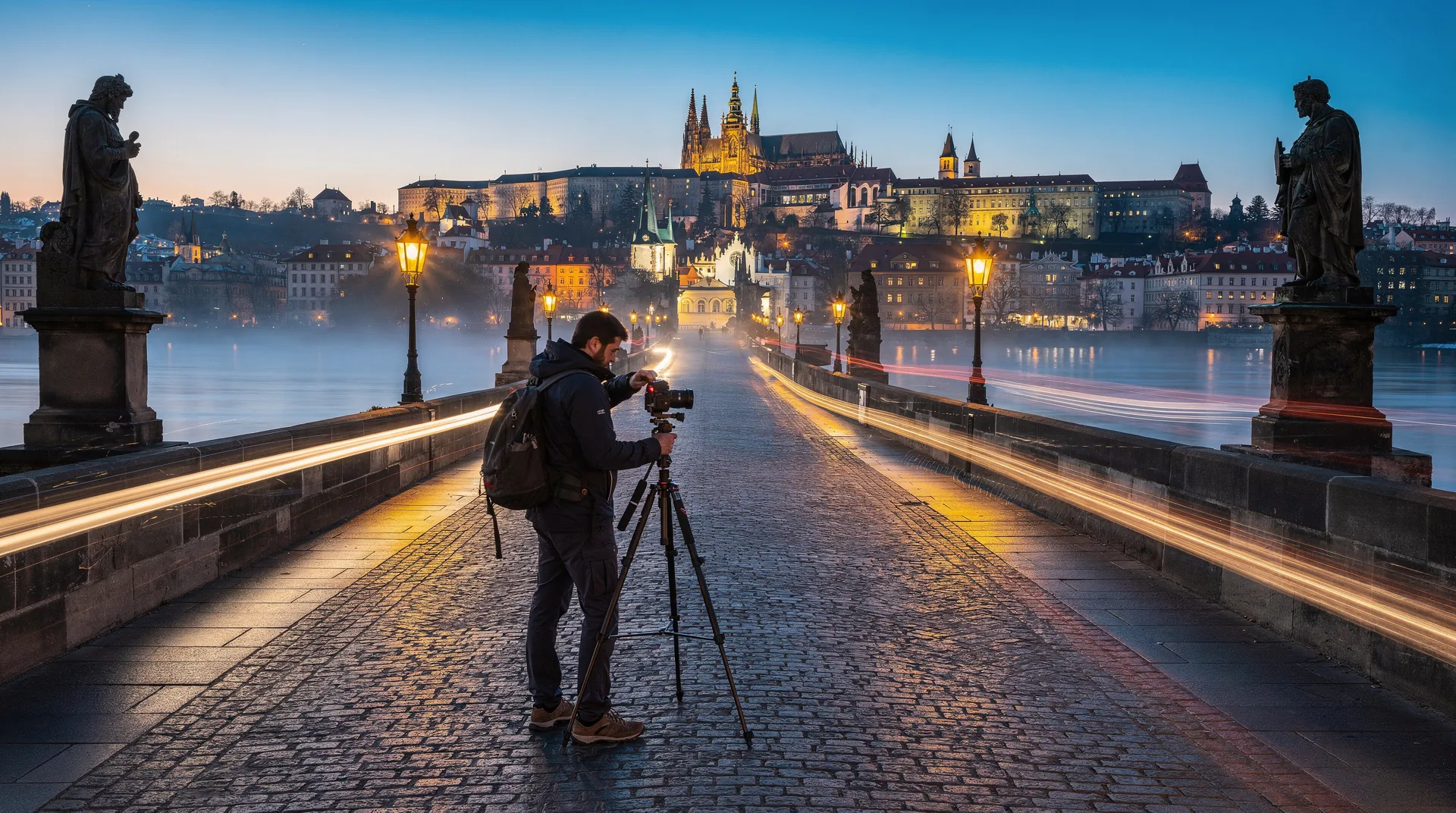
- Golden hour (7–9am or 6–8pm in summer) is transformative. Several operators offer early-morning departures. At 7am, the Old Town is almost empty and the light is warm and raking.
Book a vintage car tour
Prague: 1.5-Hour Vintage Car Tour — The best overall option for first-timers. Small group, good commentary, covers all the key sights. The benchmark tour in this category.
Prague: 1-Hour Vintage Car Tour — Entry-level option. Good for limited time or travellers who want a taste of the experience without committing to 1.5 hours.
Prague: 1-Hour Private Tour in Vintage Car (up to 6) — Private format. Ideal for families or groups of 4–6 where the per-person cost becomes competitive.
Prague: 90-Minute Private Tour in Vintage Car (up to 6) — The sweet spot for couples and groups. 90 minutes is enough to cover the full city without the tour feeling rushed.
Prague: 3-Hour Vintage Car Ride and Walking Tour — Combined car and walking format. Best for people who want vehicle transportation between stops but also want to walk inside the castle grounds and cross Charles Bridge on foot.
Prague: Fairytale Karlštejn Castle in Retro-Style Car — Day trip by vintage vehicle to Karlštejn Castle. A genuinely unusual combination of scenic country driving and Gothic castle. Book well in advance.
Frequently asked questions about Prague vintage car tours
How many people fit in a vintage car?
The Škoda 1203 vans take 4–6 people in the rear. Convertible models (Felicia, 110R) hold 2–3 passengers. The Tatra 603 typically holds 3–4. Private bookings always specify the maximum capacity in the tour description.
Are vintage car tours good for people with mobility issues?
Better than walking tours, yes. The main challenge is stepping in and out of a vehicle that sits relatively low. Most operators can help with boarding. If you use a wheelchair or walking frame, contact the operator directly before booking — some have vehicles with easier access.
Do the cars have seatbelts?
Most do. Czech road law requires seatbelts for all passengers, and reputable operators comply. Open-top vehicles at low city speeds are not considered high-risk, but the seatbelt should still be used.
Can I request a specific vehicle type?
Some operators take requests; others do not guarantee a specific model. If a Tatra 603 or a specific Škoda model is important to you, email the operator directly after booking and ask. Avoid operators who make guarantees they cannot keep.
Is the commentary live or pre-recorded?
For the individual-tour formats (t144546, t466789, etc.), the driver-guide provides live commentary in your language. For some group departures during high season, audio guides or printed notes supplement live commentary. Check the specific listing.
What is the best time of year for a vintage car tour?
May, June and September are ideal — warm, reasonable daylight hours, and less oppressive heat than July–August (open-top cars get genuinely hot in full summer sun). November–February works fine but the open-top is cold; many operators switch to enclosed vehicles seasonally.
Is tipping expected?
Yes, 100–200 CZK (€4–8) per couple or per head is standard for a good driver-guide. Cash only for tips — do not ask to add it to a card.
Can a vintage car tour cross Charles Bridge?
No — vehicles cannot drive onto Charles Bridge, which is pedestrian-only. Tours drop you at the approach or drive alongside the river so you can see it, but crossing on foot separately (see the Charles Bridge guide) is still worthwhile.
Do vintage car tours run in the rain?
Most operators continue in light rain with the canvas roof up; a few reschedule in heavy rain. Confirm the operator’s weather policy at booking, especially for open-top convertible models.
The streets you cover and why they matter
Understanding the route in advance helps you photograph it better and appreciate what you are seeing. Here are the key sections of a standard 1.5-hour vintage car circuit.
Dlouhá and Štefánikova: Wide New Town and Old Town thoroughfares where the car can maintain a comfortable speed. The Art Nouveau apartment facades along Dlouhá are worth looking up from the back seat.
Nerudova ulice (Neruda Street): The steep cobbled approach to Prague Castle is one of the most photographed streets in the city. At car pace — slow, stopping occasionally — you see the 17th and 18th-century house signs (the double eagle, the three fiddles, the two suns) that served as addresses before street numbers. The guide knows the stories behind each one.
Malostranské náměstí: The main square of Malá Strana, dominated by the Baroque St. Nicholas Church. The car circles or passes through — at this pace you see the full proportions of the church facade without the usual problem of being too close on foot.
Pražský hrad outer approach: Cars cannot drive inside the castle courtyards, but the outer approach via Hradčanské náměstí (the aristocratic square before the castle gates) gives a perspective on the Archbishop’s Palace, the Schwarzenberg Palace, and the castle gate itself that is very different from the tourist pedestrian approach.
Josefov (Jewish Quarter): On many circuits, the car passes along Pařížská — Prague’s luxury shopping boulevard built on the site of the demolished medieval ghetto in the 1890s. The contrast between the Art Nouveau grandeur of the street and the Gothic-Renaissance synagogues that survived demolition is visible from the car window.
Nábřeží (River embankment): The Vltava embankment south of the Old Town gives a straight-line view of both castle and bridge simultaneously — the canonical postcard composition. At car speed you see it for 30–40 seconds before the route turns inland again. Worth a photograph if you have your phone ready.
What makes a vintage car tour different from a bus tour
The scale difference is the entire point. A hop-on hop-off bus holds 60–80 people, sits 3–4 metres above street level, and moves through the city on set bus routes. A Škoda 1203 holds 4–6 people, sits 1.5 metres above the ground, and goes down streets no bus ever sees.
This creates a fundamentally different experience of the architecture. Prague’s Old Town was not designed to be viewed from height or from inside a large vehicle. The Baroque and Gothic facades were built for human-scale streets where the viewer stands roughly where you sit in the back of a Škoda — close, at eye level with the lower storeys, looking up at an angle. This is how the buildings were meant to be seen.
The intimacy is also social. In a group of 4–5 people in a small car, the driver-guide is speaking to you specifically rather than broadcasting to a coach full of strangers. Questions are answered properly rather than acknowledged and moved on from. If something interests you — a building, a story, a question about communist-era Prague or the 1968 invasion — there is space to follow it.
Booking logistics and what to expect
Most vintage car tour operators are based in the Old Town or Malá Strana. Exact departure points are confirmed in your GYG booking confirmation. Common departure areas: near the Powder Gate (Prašná brána) for Škoda 1203 operators, near Malostranské náměstí for some Malá Strana-based operators.
Bring: your booking confirmation (on phone is fine), photo ID for the driver’s records, and a fully charged phone for photos. Cash for the tip at the end.
The driver-guide will typically offer to stop at specific points for photography. If you see something you want to capture, ask — most drivers are happy to pull over briefly if traffic allows. Do not try to photograph while leaning out of the vehicle at speed.
The communist-era vehicle as historical object
The Škoda 1203 is not just transport — it is an artefact. Understanding what these vehicles meant in Czechoslovakia deepens the experience of riding in one.
Produced from 1968 to 1981, the Škoda 1203 was designed as a multi-purpose vehicle for the planned economy. It served as ambulance, postal van, fire service support vehicle, and passenger transport for collective farms. Its production was managed by centralised state planning — which meant that design changed very slowly (the basic form was barely modified over 13 years) and quality control varied unpredictably.
Drivers of the era report that the vehicles were unreliable in cold weather, slow on hills (the 1203’s 1.2-litre engine produced 47 horsepower), and prone to rust in Prague’s wet winters. The restoration work that converts them to tourist use involves replacing most mechanical components, repainting, and reupholstering — the shell and structure remain original.
The experience of riding in a beautifully restored 1203 through streets it would have driven in its working life is specific to Prague in a way that a generic vintage car experience is not. A vintage Fiat in Rome or a VW Beetle in Berlin are period vehicles but not place-specific vehicles. The Škoda 1203 is of Prague in a way that the city’s history made it.
Some driver-guides — particularly older ones — remember riding in these vehicles as children or during mandatory national service. These personal histories surface in good private tours; they do not in shared group formats. Another reason private booking is worth considering if you have an interest in Czech 20th-century history.
How a vintage car tour compares to other ways of seeing Prague
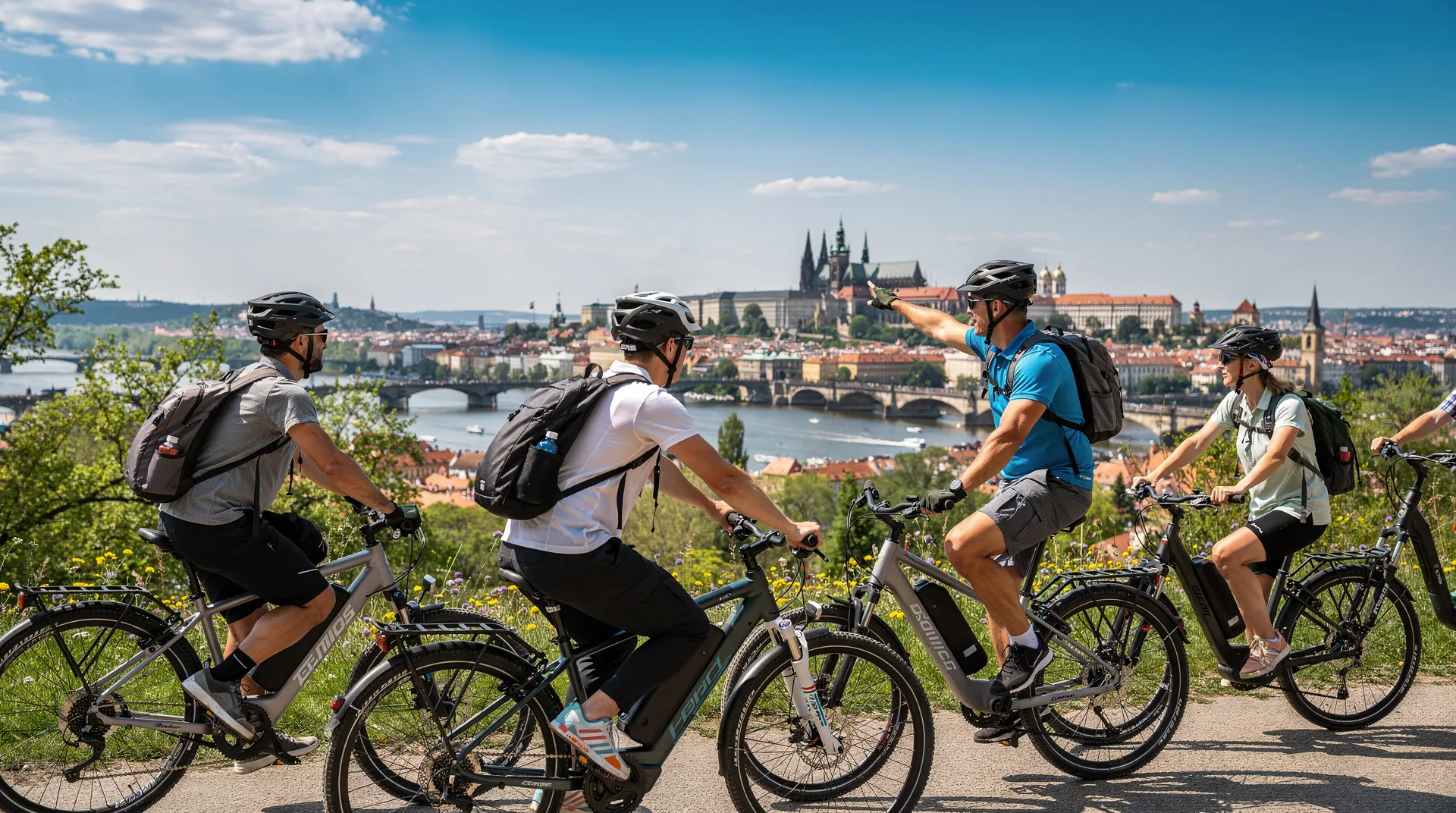
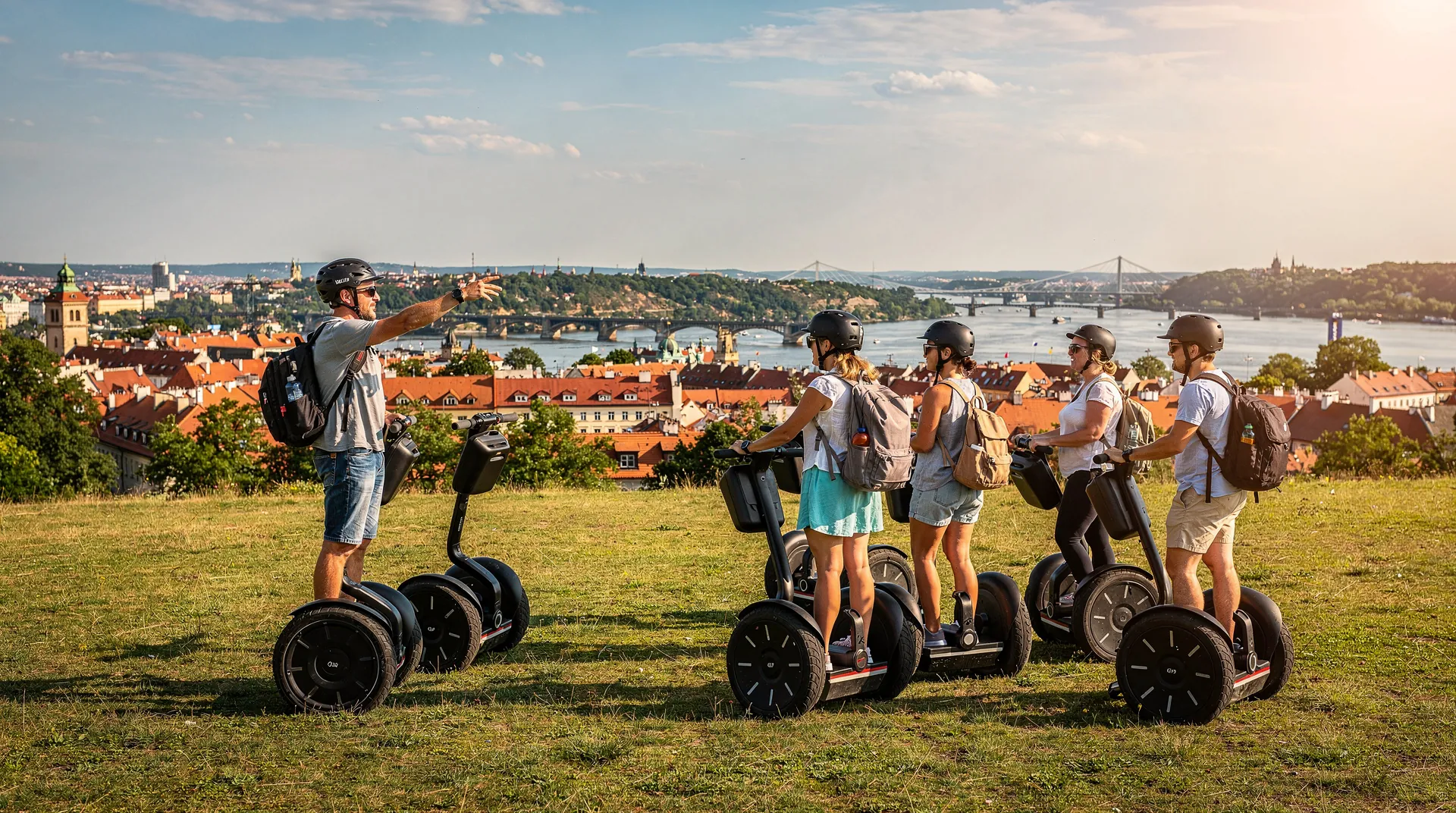
If you’re deciding between a vintage car tour and an e-bike tour or a Segway tour, the trade-off is mainly about effort versus intimacy. A vintage car keeps you seated and photographed constantly but limits you to roads (no bridges, no pedestrian squares up close); an e-bike gets you into Old Town’s pedestrian core and along the riverside cycle paths that pass near Troja Chateau, at the cost of some physical effort.
For a route through the Old Town’s medieval core specifically, comparing photo results against our best photo spots guide is useful — several of the classic vantage points (the Malá Strana approach, the castle gate square) are also stops on the standard 1.5-hour car circuit.
Couples weighing a vintage car tour against a river cruise should note the atmosphere is different rather than better or worse — a car tour is architecture-focused and mobile, while a boat trip (see the dinner cruises guide) is slower and river-focused. Neither replaces walking the Charles Bridge on foot, which no vehicle tour crosses.
Getting the most from the driver-guide relationship
The driver-guide dynamic in a Prague vintage car tour is specific: the driver cannot face you while driving, which means the conversational format is different from a face-to-face walking guide. The best driver-guides use the in-vehicle speaker system for broad historical commentary and save the conversational content for stops. Here is how to get more from the experience:
Ask questions at stops. The brief stops at Malostranské náměstí, the castle approach, and the riverside are the right moments for specific questions.
Request the communist-era angle early. If you are interested in life under communism — what these vehicles meant, what Nerudova street looked like in 1975, what happened to private property after 1948 — say so at the start. A good guide will recalibrate the commentary.
Note the building signs in Malá Strana. The house signs on Nerudova and the surrounding streets are one of Prague’s underrated visual details. Ask the driver to point them out — they often know the history of specific signs that most tourists walk past without noticing.