What segway tours are actually like in Prague
| Where | Departures from Old Town / Malá Strana, routes toward Prague Castle and Strahov Monastery |
| Cost | Around €40–90 depending on route and duration |
| Time needed | 2–4 hours including mandatory training |
| Getting there | Meet at the operator’s Old Town or Malá Strana pickup point (details on booking confirmation) |
| Best time | Spring (Apr–May) and autumn (Sep–Oct) for comfortable temperatures; early morning departures in July–August |
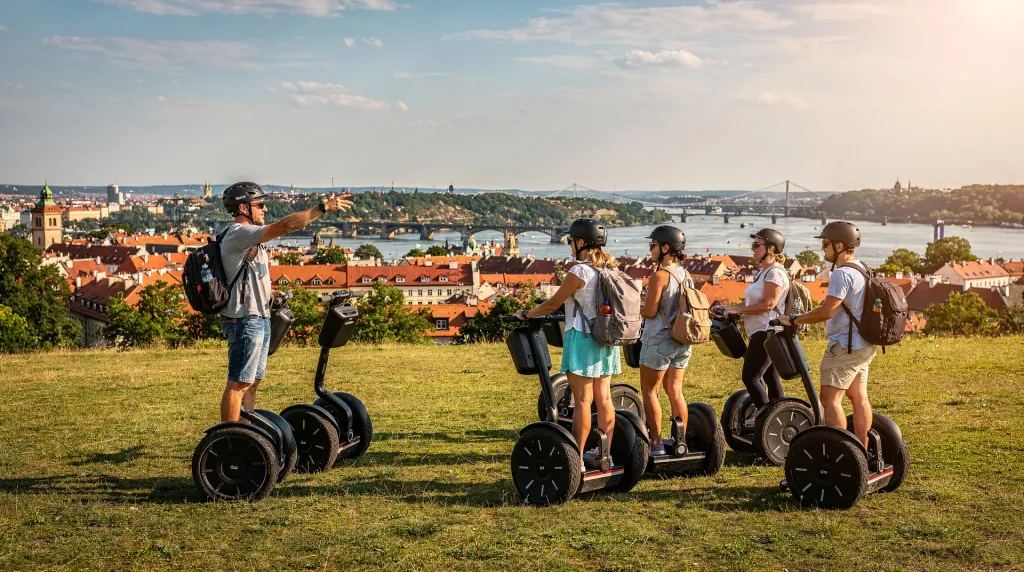
A segway is not a passive experience. Unlike a bus tour where you sit and watch, or a vintage car where someone else drives, a segway requires active balance and steering. That said, it takes most adults about 15–20 minutes to become genuinely comfortable — the learning curve is real but shallow. By the end of the first half-hour, most participants are maneuvering confidently through Old Town lanes and barely thinking about the mechanics.
What makes Prague specifically good for segways? The combination of car-free zones in the historical centre, the contrast of smooth riverside embankments and atmospheric cobbled streets, and the fact that the guide can stay with the group at a pace that allows for stops and explanation. You are not watching Prague from behind glass — you are in it, at head height, at the pace of a fast walk.
The honest caveats: segways are banned from Charles Bridge (you will approach it, photograph it, but not cross on the machine). The main cobbled streets of Old Town are manageable at moderate speed but are uncomfortable at high speed — guides pace this appropriately. Segways are not suitable for people with significant balance issues, recent knee or ankle injuries, or those who are pregnant.
The main routes
Segway sightseeing live-guided tour (the standard circuit)
t171330 — “Prague: Segway Sightseeing Live-Guided Tour”. This is the core offering: a 2–3 hour guided segway tour through Old Town, across the riverside, through Malá Strana, and up towards the castle district. The live guide format means commentary adapts to the group’s pace and questions. Price: approximately €45–55 per person, including training, equipment and insurance.
This is the recommended starting point for first-timers. The route is well-established and balances coverage with manageability.
Monasteries and parks tour (the atmospheric option)
t87935 — “Prague: Monasteries and Parks Segway Tour with a Local Guide”. A 3-hour circuit with a strong emphasis on the quieter, green parts of Prague that most tourists miss: the Strahov Monastery plateau, the gardens above Malá Strana, and Letná Park. Less crowded than the Old Town circuits, more contemplative, and genuinely beautiful in spring and autumn.
This is the tour for people who have already seen the major sights and want to explore the city’s texture rather than its monuments.
Castle and monastery segway tour
t190319 — “Prague: Castle and Monastery Segway Tour”. Focuses the route on Prague Castle and the Strahov Monastery complex. You circle the castle grounds, approach from the west via the monastery gardens, and end with views across the entire city from the Petřín hillside. Duration: approximately 2.5–3 hours. Price: €50–65.
Castle district segway tour
t161817 — “Prague: Castle District Segway Tour”. A shorter, more focused option (2–2.5 hours) specifically for the Hradčany neighbourhood and castle surroundings. Good for travellers who have already done the Old Town on foot and want to explore the western bank.
Combined segway and e-scooter tour (the active option)
t85002 — “Prague: 4 Hours Grand City Tour by Segway and E-Scooter” and t85149 (“Prague Highlights: Segway and E-Scooter Tour with Taxi Pick-Up”). These hybrid formats split the tour: one section by segway, one section by e-scooter. The e-scooter legs allow faster movement across open embankment paths and park roads, while the segway sections handle the narrower historical streets. Duration: 3.5–4 hours. Price: €75–90.
Monasteries mini-group with taxi transfer
t84777 — “Prague: Segway Tour + Taxi Transfer and Monasteries Mini-Group”. Adds a taxi segment to cover ground that a segway cannot access practically (long road sections or fast traffic areas). The format results in a comprehensive 3-hour tour that covers Strahov, the castle, and the Malá Strana gardens. Small group only (max 6). Price: €65–80.
Which route for which traveller
First-time visitor, 2–4 days in Prague: Start with t171330 (standard sightseeing tour). It gives a complete overview and the live guide explains the context you will use during the rest of your stay.
Active traveller who has already done Old Town on foot: t87935 (Monasteries and Parks). The green Prague beyond the tourist core is underrated, and this route specifically accesses areas that are difficult or unpleasant to walk.
History-focused traveller interested in the castle: t190319 (Castle and Monastery) or t161817 (Castle District). The castle grounds look different from a segway — lower than a bike, more flexible than a car, faster than walking.
Group of 4+ friends who want a long active day: t85002 or t85149 (Segway + E-Scooter combo). Four hours covers a large portion of the city and the format variety prevents the single-mode monotony that can set in on longer tours.
Traveller with limited time (2–3 hours only): t161817 (Castle District, 2–2.5h) or t171330 (standard, 2h version). Both provide meaningful coverage within the time constraint.
What to expect during training
All operators run a mandatory training session before the tour departs. This is not a formality — it is genuinely useful, and experienced guides will hold the group at this stage if anyone is not ready.
Typical training sequence: start standing on the segway without moving (getting used to the balance point), lean forward gently to move, lean back to brake, practice turning in an open space. Total time: 15–30 minutes. This is included in the tour duration in most listings.
Practical notes for training: wear flat shoes with good grip. Do not arrive having just eaten a large meal. Loosen your knees slightly — rigid legs make balance harder, not easier. If you are nervous, tell the guide — they have seen it before and will spend extra time with you.
Rules, restrictions, and what to wear
Weight limit: Most segways in Prague have a maximum rider weight of 100–120 kg. Check the specific listing if this applies to your group.
Age limit: Minimum age is typically 12–16 years depending on the operator, with parental consent required for under-18s.
Medical restrictions: Do not join a segway tour if you have a balance disorder, have had a recent inner ear infection, are in the first trimester of pregnancy, or have a recent ankle, knee, or hip injury.
Footwear: Closed, flat shoes. No heels, sandals, or very loose trainers.
Clothing: Comfortable, non-restrictive. Avoid long skirts or wide-leg trousers that could catch in the wheel housing. A light jacket is recommended — the embankment in particular catches wind.
Helmets: Provided and required by all reputable operators. Some also provide gloves.
Rain: Light rain is manageable (most segways handle damp cobblestones well at tour pace). Operators cancel in heavy rain or thunderstorms. The GYG cancellation policy specifies the threshold.
Price 2026 comparison
| Tour | Duration | Format | EUR per person |
|---|---|---|---|
| t171330 — Segway sightseeing | 2–3h | Small group | €45–55 |
| t87935 — Monasteries + parks | 3h | Small group | €50–65 |
| t190319 — Castle + monastery | 2.5–3h | Small group | €50–65 |
| t161817 — Castle district | 2–2.5h | Small group | €40–55 |
| t85002 — Segway + e-scooter (4h) | 4h | Small group | €75–90 |
| t85149 — Segway + e-scooter (taxi) | 3–3.5h | Small group | €70–85 |
| t84777 — Monasteries + taxi | 3h | Mini-group | €65–80 |
Segway vs e-bike — which is better for Prague?
This depends on your preferences, not an objective answer. A comparison:
Segway advantages: No pedalling whatsoever. Very stable at low speeds. Can handle narrow passages an e-bike struggles with. Better for people who are not confident cyclists but are comfortable with balance challenges.
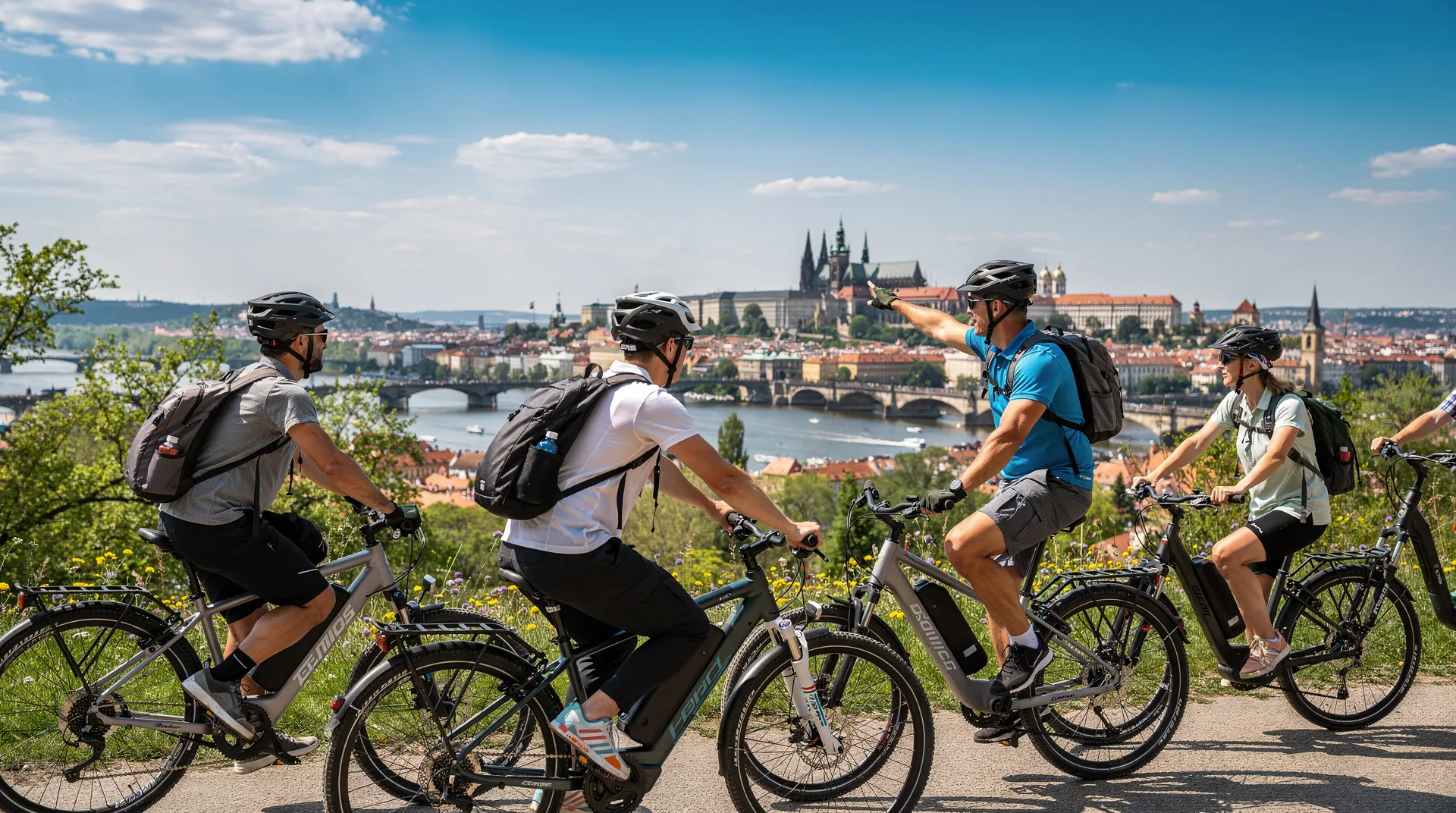
E-bike advantages: More natural body position (sitting, not standing). Can cover longer distances. More flexibility for self-guided extensions. Easier to dismount and walk alongside in pedestrian zones.
The verdict: If you cycle at home even occasionally, the e-bike gives more freedom and slightly better value. If you have not been on a bike in years, the segway’s simplicity is actually easier to master. Both are vastly superior to a bus tour for anyone who wants to be in the city rather than viewing it.
Book a segway tour
Prague: Segway Sightseeing Live-Guided Tour — The most accessible starting point. Live guide, 2–3 hours, covers Old Town and riverside. Good for first-timers of any age.
Prague: Monasteries and Parks Segway Tour with a Local Guide — For the green, quieter Prague. Strahov, Letná, and the gardens above Malá Strana. The best option for repeat visitors.
Prague: Castle and Monastery Segway Tour — Castle-focused circuit. Best combined with a self-guided walk inside the castle grounds (buy your ticket separately).
Prague: Castle District Segway Tour — Shorter and more focused. Good for a half-morning when you have a specific afternoon activity planned.
Prague: 4 Hours Grand City Tour by Segway and E-Scooter — The long-form active option. Four hours, two vehicle types, large city coverage. For travellers who want to be thoroughly exhausted (in a good way) by lunchtime.
Frequently asked questions about Prague segway tours
Do I need to know how to ride a bike to do a segway tour?
No. A segway uses forward-backward lean rather than pedalling. The balance skill required is different from cycling. Most non-cyclists adapt quickly. The mandatory training session exists specifically for this reason.
Is there a minimum age for Prague segway tours?
Most operators set the minimum at 12 years old with a parent or guardian present. Some operators require 16. Check the specific listing. There is no upper age limit beyond general fitness and balance ability.
Can I do a segway tour with a bad knee?
It depends on the severity. Segways do not require bending the knee deeply. If you can stand for 2–3 hours without significant pain, you can likely manage a segway tour. If you have had recent surgery or acute inflammation, wait until you have recovered fully.
How many people are in a segway tour group?
Standard group sizes are 6–10 participants. Mini-group tours (t84777) are capped at 6. Private tours are available from most operators at a premium.
Are Prague segways electric?
Yes. All commercial segways are self-balancing electric vehicles (Segway PT or equivalent). They charge overnight and have enough battery for a full day of tours with no range concern for a 2–4 hour circuit.
What happens at Prague Castle on a segway tour?
Segways are not permitted inside Prague Castle’s interior courtyards during peak visiting hours. Tours approach, photograph, and circle the outer castle district. If you want to go inside the castle, this is done on foot separately — your guide will advise on ticket options.
Is tipping included or expected?
Not included. 100–200 CZK (€4–8) per person for a good guide is the local standard. Have cash ready at the end of the tour.
What should I do if I’m scared of falling?
Tell the guide before the training session starts — reputable operators are used to nervous first-timers and will spend extra time with you at low speed in an open area before joining the group. Wearing the provided helmet and keeping knees slightly bent (not locked) also reduces both the risk and the fear.
Can I bring a backpack or bag on a segway tour?
A small, secured backpack worn on both shoulders is generally fine; loose bags, large suitcases, or anything carried in one hand are not, since you need both hands free to hold the segway’s handlebar. Ask the operator in advance if you plan to carry camera equipment.
Segway tours and the neighbourhoods you cover
Part of the value of a guided segway tour is that it accesses a mix of street types that walking tours never prioritise and bus tours cannot reach. Here is what you actually see on a typical Prague segway circuit.
The riverside embankment (Rašínovo and Smetanovo nábřeží): The long straight stretch of embankment south of the Old Town is perfect segway terrain — smooth, wide, relatively traffic-free, with continuous views of the Vltava and the castle above the opposite bank. Most tours spend 15–20 minutes here. The Castle reflection in the river at golden hour is the best free photography moment in Prague, and you are positioned at exactly the right height on a segway to capture it.
Malá Strana and the palace gardens: The Baroque neighbourhood between Charles Bridge and the castle has a network of lanes and terraced gardens that are difficult to navigate efficiently on foot. On a segway, the guide can cover the Valdštejnská zahrada (Wallenstein Garden), Vojanovy sady, and the approach to Nerudova in a continuous circuit that would take 45 minutes on foot.
Letná Park: The plateau above the north bank is the most exhilarating section of any tour that includes it. The path from the Hanavský pavilion to the Letná beer garden runs along the edge of the cliff above the Vltava — open, fast, and with uninterrupted views to the south. On a segway at the guide’s preferred cruising speed (around 12 km/h), this section takes about 8–10 minutes and feels genuinely impressive.
Strahov Monastery plateau: The 12th-century monastery sits on the western hill above Malá Strana, approached via quiet residential lanes that most tourists never walk. The front terrace faces east across the entire city. The segway tour approach — from the south, via the monastery vineyards — is one of the routes that justifies the “with a local guide” aspect of these tours.
The guide’s role on a segway tour
The guide on a segway tour has a harder job than a walking tour guide. They are simultaneously:
- Managing the group’s safety at a vehicle speed of 10–15 km/h through pedestrian areas
- Communicating historical and cultural context (via Bluetooth speaker, hand signals, and voice)
- Judging when to stop versus when to keep moving based on traffic and group cohesion
- Navigating routes that balance interest with safety
Good segway guides have typically been doing this for several seasons and know the city well. They know exactly which cobblestone sections to approach slowly, which junctions to cross only when clear, and which viewpoints repay a 5-minute stop versus a 2-minute stop.
The reviews on each GYG listing are the best indicator of guide quality. Look for reviews that mention the guide by name (consistency indicator), reference specific knowledge shared during the tour, and comment on how the guide handled different pace levels within the group.
After the tour: what to do next
Prague’s segway tours typically end near where they began — Old Town or Malá Strana departure points. Two natural post-tour options:
Beer at the Letná beer garden: If the tour passed through Letná, the garden is a logical stop. Accessible on foot from the plateau or by tram (Letná stop on lines 1, 8, 25, 26). Pilsner Urquell on tap, plastic cups, benches overlooking the river, no pretension.
Walk the castle independently: If the tour covered the castle exterior, this is the natural time to buy a castle ticket and explore the interior — you already have the spatial orientation from the segway circuit, which means the interior routes make more sense than they would on a cold arrival.
Malá Strana coffee: Café Savoy (Vítězná 5) and Café Louvre (Národní 22) are the two most serious coffee houses within range of the standard tour endpoint. Both serve excellent Czech coffee culture alongside proper cake.
Seasonal considerations for Prague segway tours
Spring and autumn: The most comfortable seasons for segway tours. April–May and September–October bring temperatures of 10–18°C, light wind, and manageable crowds. The parks along the route (Letná, Stromovka, Riegrovy sady) are in blossom or autumn colour. Tours run daily with full slot availability.
Summer: July and August are hot. At segway speed (10–15 km/h) the wind assists, but direct sun on the open Letná plateau and the embankment can be punishing by midday. Morning departures (8–10am) are significantly more comfortable than afternoon. Crowds are highest and advance booking is most important.
Winter: Several operators reduce their winter programme. November–March tours are available but slots are fewer, and you need proper cold-weather preparation — the wind at segway speed at 5°C feels much colder than standing still at the same temperature. Some operators switch to a shorter winter circuit that reduces exposed embankment time. The payoff is an almost empty Old Town and Malá Strana — a genuinely different atmosphere.
Segway tour safety record in Prague
Prague’s segway tour industry has operated for over 15 years and has a generally good safety record at the commercial operator level. The risks are real but managed: segways at city tour speeds (6–15 km/h) cause minor injuries (scrapes, bruises) from low-speed falls on cobblestones in the rare cases where riders lose balance. Helmets are the primary injury mitigation.
Serious accidents have occurred in Prague (as they have in every segway tour city) almost exclusively from riders who ignored guide instructions, tried to exceed safe speed, or used segways while impaired. Following the guide’s pace, wearing the helmet, and not attempting manoeuvres beyond what the guide demonstrates eliminates almost all risk.
Operators carrying passengers on GYG are required to have public liability insurance. Confirm this when booking if it is a concern.
Combining segway and photography
Several spots on the standard segway circuit are exceptional photography locations, and the segway guide can position you at the right spot at the right time. Practical notes:
Keep the phone accessible but secured. A lanyard or dedicated phone pocket prevents accidental drops at speed. Do not attempt to take photos while actively moving on the segway — do it at designated stops.
The embankment section: Face west for the castle reflection shot if the light is right. Morning tours (east light on the castle) and late afternoon tours (west light on the river) both work; midday is the worst.
Letná terrace: The guide typically stops here for 5–8 minutes. The view from the terrace edge is one of the best in the city. Wide-angle on a phone gets the full panorama; zoom in on the Charles Bridge + Castle alignment for a stronger composition.