Why the Loreta rewards a short detour
The Loreta rarely appears on the standard Prague itinerary, which puts it in an interesting position: it’s a significant Baroque monument — one of the most important pilgrimage sites in Bohemia — that you can visit on a Tuesday morning with perhaps 20 other people in the entire complex. That kind of quiet access is increasingly rare in central Prague.
It’s worth the detour if you’re already at Prague Castle (the Loreta is a 5-minute walk from the castle’s Hradčany square), if you have any interest in Baroque art or Catholic pilgrimage culture, or if you simply want to see the Diamond Monstrance — one of the most extravagantly jewelled liturgical objects in Europe. It’s worth skipping if you’re pressed for time and the castle has already used your morning; it’s a supplementary sight, not a headline attraction.
| At a glance | |
|---|---|
| Where | Loretánské náměstí 7, Hradčany, 5 min from Prague Castle |
| Cost | Around €7 / 180 CZK adult; ~€5 / 125 CZK reduced |
| Time needed | Around 45–60 minutes |
| Getting there | Tram 22/23 to Pohořelec, then a short walk; or on foot from the castle’s western gate |
| Best time | Weekday mornings, and arrive on the hour for the carillon |
The story of the Loreta
The Loreta was built as a replica of the Casa Santa — the Santa Casa, or Holy House — of Loreto in Italy. According to Catholic tradition, the Santa Casa is the house from Nazareth where the Virgin Mary received the Annunciation, miraculously transported by angels to the Italian hill town of Loreto in 1294. The Prague version was commissioned in 1626 by Kateřina Benigna of Lobkowicz, a member of one of Bohemia’s most powerful Catholic families, as part of the post-Battle of White Mountain (1620) Catholic re-evangelisation of Bohemia.
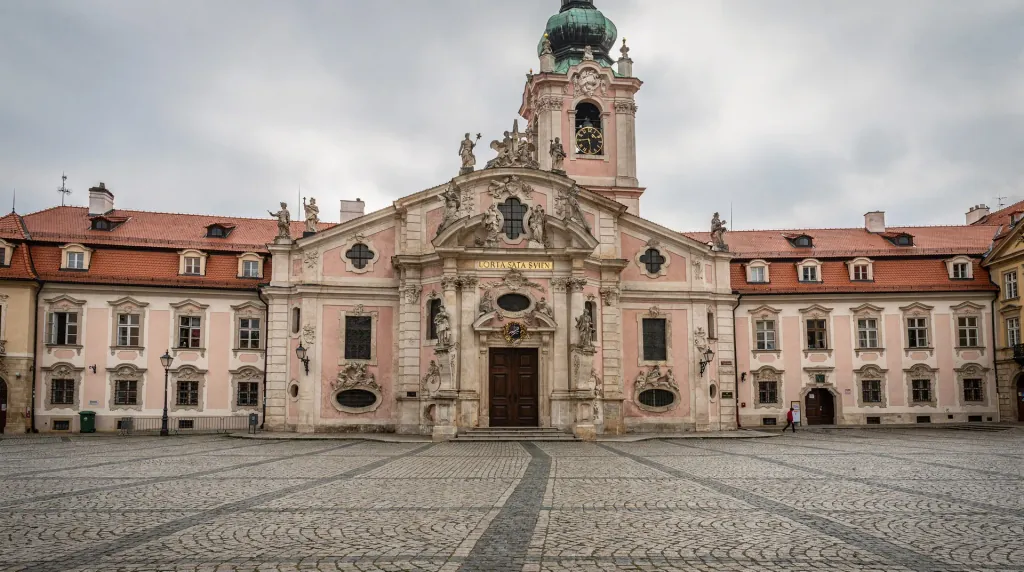
The original Santa Casa replica was enclosed by a cloister beginning in 1631 and expanded through the 17th century. The main church of the Nativity of Our Lord was added in 1734–1735. The facade facing Loretánské náměstí, with its distinctive tower housing the famous 27-bell carillon, was built in 1721. The whole complex was funded by aristocratic donors competing to demonstrate their Counter-Reformation piety.
The pilgrimage tradition associated with the Loreta was intense in the 17th and 18th centuries. The route from the Old Town to Hradčany, culminating at the Loreta, was one of the most-travelled pilgrimage paths in Bohemia. Indulgences were granted; miraculous healings were reported; a steady stream of donors funded the treasury with jewelled vestments, reliquaries, and monstrances.
That treasury — particularly the Diamond Monstrance donated in 1699 by Countess Ludmila Eva Františka of Kolowrat — is the reason the Loreta is still visited today.
What to see on site
The Casa Santa
The heart of the complex is the replica of the Santa Casa — a small brick structure (roughly 12 by 5 metres) standing in the centre of the arcaded cloister. The exterior is decorated with relief scenes from the life of the Virgin Mary. The interior, darkened and intimate, contains a 17th-century black statue of the Madonna of Loreto (a copy of the Italian original) and votive offerings accumulated over centuries. The cloister surrounding it is painted with scenes from the lives of the saints and lined with small chapels.
The Church of the Nativity of Our Lord
The main church, accessed from the cloister, is a fully-fledged Baroque church with an unusually complete interior — altarpieces, ceiling frescoes, carved pews, and two side chapels. The main altarpiece depicting the Nativity is attributed to the Baroque painter Václav Vavřinec Reiner. The scale is modest by Baroque standards (the church is not large) but the decorative programme is cohesive.
The treasury (Loretánský poklad)
The treasury, displayed in rooms above the cloister arcade, is the collection of liturgical objects donated to the Loreta over the centuries. The outstanding piece is the Diamond Monstrance, commissioned in 1699. The object is approximately 90 centimetres tall and set with 6,222 diamonds. The monstrance was designed by Johann Bernhard Fischer von Erlach (or his school) and made by Viennese goldsmiths. It is not a subtle object — it was intended to be an overwhelming visual statement of faith and aristocratic wealth.
The rest of the treasury includes chalices, reliquaries, monstrances, and embroidered vestments from the 17th and 18th centuries. The collection is not enormous but the quality of the major pieces is high.
The carillon
The tower above the facade houses 27 bells cast in Amsterdam in 1694. The carillon plays an automated melody at the top of each hour — a Marian hymn, “We Greet You a Thousand Times.” The bells are audible from the square in front of the Loreta and from much of the surrounding Hradčany neighbourhood. The sound, particularly in the cooler half of the year when the square is quiet, is one of Prague’s better acoustic experiences.
Tickets, timings, and price
Entrance (2026 estimates):
- Adult: ~€7 / 180 CZK
- Reduced (students, seniors): ~€5 / 125 CZK
- Children under 6: free
- Opening hours: Tuesday–Sunday 10:00–17:00; closed Mondays
- Last entry 30 minutes before closing
- No advance booking required; tickets at the door
Allow 45–60 minutes for a visit combining the Santa Casa, the church, the treasury, and the cloister walkways.
Which tour to book nearby
The Loreta sits in Hradčany, directly adjacent to Prague Castle. Several castle-area tours pass through or near the Loreta, and some specifically include it:
For a Castle grounds and Hradčany walking tour that covers the district around the castle including the Loreta square:
Prague Castle grounds and Hradčany highlights walking tourFor a comprehensive castle tour that gives context for the entire Hradčany district:
Prague Royal Castle, St Vitus, and Golden Lane tour with ticketsFor a local guide who covers the hidden corners of Prague including less-visited Hradčany landmarks:
Prague hidden gems walking tour with local guideHow to get there
Tram: Take tram 22 or 23 to Pohořelec stop in Hradčany. Walk 300 metres east along Pohořelec to Loretánské náměstí. The Loreta facade is directly visible from the end of the street.
On foot from Prague Castle: Exit the castle through the western (Pohořelec) gate and walk 3 minutes west to Loretánské náměstí. This is the natural route if you’re combining a castle visit with the Loreta.
Metro + tram: Malostranská (Line A) + tram 22 to Pohořelec — about 20 minutes total from Wenceslas Square.
Photographer’s note
The Loreta’s Baroque facade is best photographed in the morning, when the light falls on the clock tower from the east. The square in front is small and the full facade is difficult to capture in a single frame without a wide-angle lens. A good alternative is to photograph the detail: the carillon bells visible through the tower windows, the Virgin Mary relief over the entrance, or the courtyard arcade from ground level looking up toward the frescoes.
Inside the treasury, photography is permitted but conditions are difficult — cases are strongly lit against dark backgrounds, which causes exposure issues for the surroundings. For the Diamond Monstrance, a close-up shot focusing on a single section of the stonework works better than trying to capture the full object.
The Counter-Reformation and why there are so many Loretas
The Prague Loreta is one of approximately 50 Casa Santa replicas built in Bohemia in the 17th century. Understanding why requires some context about the Counter-Reformation.
The Battle of White Mountain (Bitva na Bílé hoře) on 8 November 1620 was a decisive defeat for the Protestant Bohemian Estates — and the beginning of forcible re-Catholicisation of Bohemia by the Habsburg-backed Catholic Church. The campaign involved the exile of Protestant nobles, the banning of non-Catholic religious practice, the replacement of Protestant clergy, and an intensive programme of church-building and pilgrimage promotion designed to give Catholic practice a physical presence throughout Bohemia.
The Loreta became a central element of this programme. Building replicas of the Casa Santa — the most intimate and personal of Catholic holy sites, associated with the Virgin Mary’s domestic life rather than with institutional power — was a strategy for creating accessible local pilgrimage sites that could replace the banned Protestant worship with something immediate and tangible. The Habsburgs funded the campaign; aristocratic families competed to sponsor Loreta chapels on their estates.
The result was a network of Marian shrines across Bohemia and Moravia, all pointing symbolically toward Loreto in Italy and, through it, to the universal Catholic Church. The Prague Loreta, as the most prominent, functioned as the apex of this network.
The Diamond Monstrance: materials, provenance, and value
The Diamond Monstrance (Diamantová monstrance) deserves a more detailed treatment than most guidebook entries provide.
The object was commissioned in 1699 by Countess Ludmila Eva Františka of Kolowrat-Liebsteinsky, from a design attributed to the Viennese architect Johann Bernhard Fischer von Erlach (or his studio). The actual fabrication was done by Viennese goldsmiths — the names recorded in the workshop accounts are Matthias Stegner and Johann Köchl.
The monstrance is set with 6,222 diamonds weighing approximately 12 carats in total, along with rubies and other stones. The structural material is gilded silver. The overall height is approximately 90 cm. The central aperture — the lunule, where the consecrated host is displayed during adoration — is framed by a radiating sunburst of diamonds that gives the object its visual climax.
The monstrance was created as a demonstration of Kolowrat family piety and wealth, following the practice of competitive aristocratic donation that funded the Loreta treasury. Its value today is primarily historical — the stones are relatively small individually, but the object as a unified creation is irreplaceable. Insurance valuations, when cited in press reports about the Loreta, typically run to tens of millions of euros; the number is speculative since the object is not for sale and never has been.
The Loreta in the context of Hradčany’s other monuments
The Hradčany district, immediately west of Prague Castle, concentrates several major monuments within a 15-minute walk. Understanding the Loreta in this context:
Prague Castle (Pražský hrad): The seat of Czech political and religious power for 1,000 years. St Vitus Cathedral is the main reason most visitors come to Hradčany. The Castle is 5 minutes’ walk east of the Loreta.
Strahov Monastery (Strahovský klášter): A Premonstratensian monastery established in 1143, with a library that rivals the Klementinum’s Baroque hall in beauty. About 5 minutes west of the Loreta on foot.
Černínský palác (Černín Palace): The massive Baroque palace facing the Loreta across Loretánské náměstí, now the Czech Ministry of Foreign Affairs. Closed to the public.
The logical Hradčany sequence is: Castle (morning, 2–3 hours), lunch on Hradčany square, Loreta (45 minutes), Strahov (45 minutes). This covers the cultural arc of the district without rushing any element.
Frequently asked questions about the Loreta
Is the Loreta different from other Prague churches?
Yes. It’s a pilgrimage complex rather than a parish or cathedral church, and the layout — Casa Santa in the centre of a cloister, surrounded by chapels and topped by a treasury — is unique in Prague. The atmosphere is quieter and more contemplative than most tourist sites.
How long does a Loreta visit take?
Allow 45–60 minutes to see the Santa Casa, main church, cloister, and treasury. If you arrive on the hour to hear the carillon, add 5 minutes.
Is the Loreta close to Strahov Monastery?
Yes — about 5 minutes’ walk west along Pohořelec. The natural combination is Prague Castle, then the Loreta, then Strahov Monastery, covering the entire Hradčany cultural strip in a single half-day.
Is the Loreta open on Mondays?
No — the Loreta is closed every Monday. Plan accordingly if visiting in the castle district.
What is the Diamond Monstrance and why is it significant?
A monstrance is a liturgical vessel used to display the consecrated host in Catholic worship. The Diamond Monstrance (Diamantová monstrance) at the Loreta is one of the most elaborate ever created — set with 6,222 diamonds and approximately 90 cm tall. It was made in Vienna in 1699 and represents the peak of Baroque goldsmith work. Its value is primarily historical and aesthetic rather than financial.
Can you hear the carillon from outside?
Yes. The carillon plays at the top of every hour and is clearly audible from Loretánské náměstí. If you’re in the area, you don’t need to enter to hear it.
How does the Loreta compare to Prague Castle for a first-time visitor?
They serve different purposes: Prague Castle is the headline sight — St Vitus Cathedral, the Old Royal Palace, Golden Lane — and needs 2–3 hours minimum. The Loreta is a quieter, smaller-scale add-on best done straight after, when the castle crowds have already worn you down and a calmer 45 minutes is welcome.
The carillon’s bells: history and what they play
The 27-bell carillon in the Loreta tower is one of the oldest functioning carillons in Central Europe. The bells were cast in Amsterdam by Claude Fremy in 1694 — a significant commission, since the best bell-founding in the 17th century was done in the Low Countries, and importing a full carillon set from Amsterdam to Bohemia was a considerable expense.
Each bell in the carillon is tuned to a specific pitch, and the automated mechanism (updated in the 18th century and again in the 20th century) plays a Marian hymn — “Tisíckrát pozdravujeme tebe” (We Greet You a Thousand Times) — at the beginning of each hour. The melody is simple enough to be recognisable across the square from 50 metres.
The carillon was restored in the 1990s. The automatic mechanism plays the hourly melody; a manually played carillon concert programme is occasionally offered (check loreta.cz for dates). The bells range in size from approximately 20 cm diameter (the highest-pitched) to approximately 80 cm (the lowest in the diatonic set). Total weight of all 27 bells is approximately 1,200 kg.
The Loreta carillon is frequently cited alongside the Litoměřice and Kroměříž carillons as one of the three most significant historic carillons in the Czech Republic.
The Loreta compared to other Prague churches: how it’s different
Prague has an extraordinary density of Baroque churches — the Counter-Reformation building campaign produced dozens of them in the 17th and 18th centuries. Most are functioning parish churches, used for regular masses, and accessible free of charge at limited hours. The Loreta is different in character from most of them.
The difference from a cathedral (Katedrála sv. Víta, St Vitus): St Vitus is a Gothic cathedral of national significance, the seat of the Prague archdiocese, used for state ceremonies and royal burials. The Loreta is a pilgrimage complex with a different devotional programme — more intimate, focused on the Virgin Mary rather than the broader episcopal function.
The difference from a Jesuit church (Chrám sv. Mikuláše, St Nicholas): St Nicholas in Malá Strana is the most impressive Baroque church interior in Prague — a vast, overwhelming decorative programme with ceiling frescoes by Johann Lukas Kracker and a Baroque organ. The Loreta’s main church (the Nativity of Our Lord) is smaller and less visually overwhelming, but the surrounding pilgrimage complex gives it a different purpose.
The difference from Strahov Monastery: Strahov is a functioning monastery with a famous library and a gallery of Czech paintings. The Loreta is not a monastic institution; it’s a pilgrimage complex run by the Capuchin order. The two are complementary rather than competing.
For a visitor who wants to understand the full spectrum of Prague’s religious architecture, the Loreta fills a specific niche — the Counter-Reformation pilgrimage tradition — that is not covered by the cathedral or the parish churches.
Practical info at a glance
- Address: Loretánské náměstí 7, 118 00 Praha 1
- Opening hours: Tue–Sun 10:00–17:00; closed Monday
- Price: Adult ~€7 / 180 CZK; reduced ~€5 / 125 CZK
- Nearest tram: Pohořelec (tram 22, 23) — 5 min walk
- Nearest metro: Malostranská (Line A) — then tram 22 to Pohořelec
- Official website: loreta.cz