At a glance
| Where | Panská 7, Nové Město |
| Cost | Around €11 / 280 CZK adult; ~€8 / 200 CZK reduced |
| Time needed | 45–60 minutes; 90 minutes for enthusiasts |
| Getting there | Metro B to Náměstí Republiky, then 5 minutes on foot |
| Best time | Any time — the museum rarely queues; mornings are quietest |
Why Alfons Mucha matters and what this museum actually shows
Alfons Mucha (1860–1939) is one of the most commercially successful visual artists in history, and also one of the most misunderstood. Most people know his work without knowing his name — the Art Nouveau posters of Sarah Bernhardt, the decorative panels of women surrounded by flowers and Byzantine ornament, the style that defined a visual era and has been reproduced on posters, bags, and calendars ever since. The Mucha Museum exists to restore context to work that has been treated as decoration so often that its seriousness has been obscured.
The museum is compact: approximately 100 pieces in a single-floor space in a Baroque palace near Náměstí Republiky. It covers the full arc of Mucha’s career, from his early commercial work in Paris to the monumental nationalist paintings of the Slav Epic cycle (exhibited elsewhere in Prague) to his final years in occupied Czechoslovakia, when he was interrogated by the Gestapo and died shortly after.
Worth visiting if Art Nouveau interests you, or if you’ve been to Municipal House and want to see more of the man who painted the Lord Mayor’s Hall. Not a must-see for general visitors who don’t have a particular interest in the period.
The story of Alfons Mucha
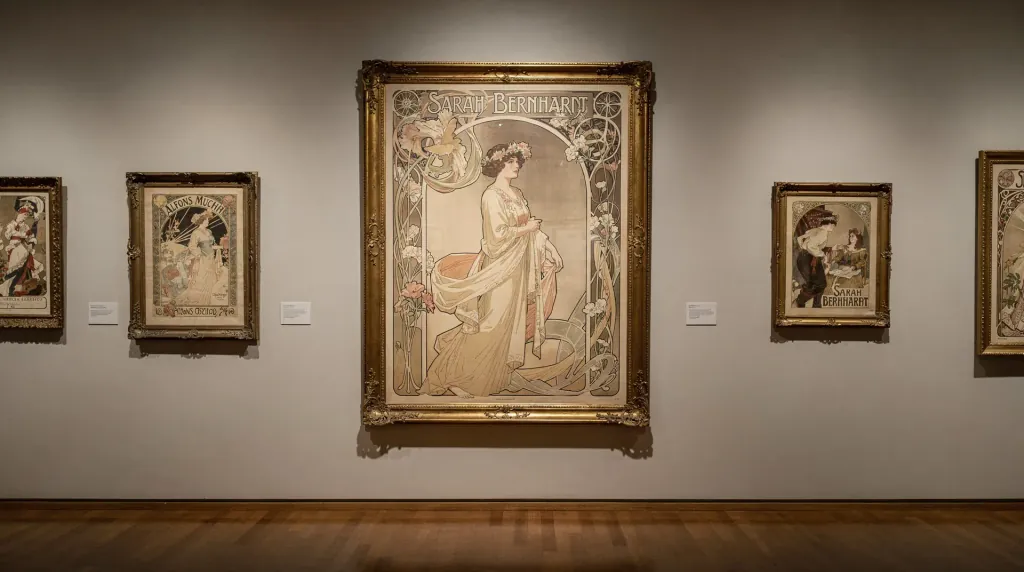
Mucha was born in Ivančice, Moravia, in 1860. He studied painting in Vienna, Munich, and Paris, arriving in the French capital in 1887. The break came on a winter evening in 1894, when the theatrical printer Lemercier needed emergency artwork for a Sarah Bernhardt production of Gismonda — the regular artist was unavailable, and Mucha was the only artist in the workshop. The resulting poster — a tall vertical composition with Bernhardt’s face at top, her full figure in Byzantine-style robes below, surrounded by floral ornament — launched his career overnight. Bernhardt, notoriously difficult to please, immediately signed a six-year contract for Mucha to produce all her promotional materials.
The Paris decade (roughly 1895–1904) produced the work Mucha is most famous for: the series of posters for Bernhardt’s plays, the decorative panels (The Seasons, The Flowers, The Arts), the magazine covers, the luxury goods advertising. These works defined Art Nouveau’s visual vocabulary: sinuous line, flat colour fields, Byzantine decoration, female figures whose hair and robes blend with the surrounding ornament. They were reproduced in mass editions and distributed across Europe. Mucha became wealthy and famous.
But Mucha himself considered this phase of his career a commercial detour from his real ambition. He was a Czech nationalist who believed that his true vocation was to create a monumental artistic work celebrating the Slavic peoples. In 1910 he returned to Bohemia and spent the next 18 years painting the Slav Epic — a cycle of 20 large-scale canvases (the largest measuring 8 by 6 metres) depicting moments from Slavic mythology and history. The cycle was donated to the Czech nation and is currently displayed in Prague’s Veletržní palác (Trade Fair Palace, part of the National Gallery system).
In 1939, days after the Nazi occupation of Czechoslovakia began, the 78-year-old Mucha was arrested by the Gestapo and interrogated for several days. He was released but his health deteriorated rapidly. He died in Prague on 14 July 1939.
What to see in the museum
The permanent collection is displayed in a single floor of the Baroque Kaunický Palace. The layout is roughly chronological and thematic, covering:
Commercial poster work: The Paris period posters, including several original Sarah Bernhardt lithographs. These are the pieces most visitors come to see. The original lithographs are considerably more impressive than reproductions — the colour registration, the paper quality, and the sheer size of some pieces cannot be conveyed digitally.
Decorative panels and prints: The Four Seasons series, the Precious Stones, the Times of the Day — the decorative works intended for middle-class domestic interiors. The difference in tone from the theatre posters is instructive: these are more contemplative, less theatrically dynamic, and show Mucha’s interest in symbolism and spirituality.
Photographs and documentary material: The museum holds a significant collection of photographs taken in Mucha’s Paris studio, showing his models and his working methods. These contextualise the paintings considerably — you can see the poses Mucha used, the costumes, the props. A short documentary film on the life and work is shown in a small screening room.
Jewellery and objects: Mucha designed jewellery for the Paris goldsmith Georges Fouquet. A selection of pieces, including the famous serpent bracelet designed for Sarah Bernhardt, is displayed in cases near the poster collection.
Late work and the Slav Epic: Reproductions of key canvases from the Slav Epic cycle are displayed with explanatory text. The originals are not here — they are in the National Gallery collection at Veletržní palác, accessible via a separate ticket.
Tickets, timings, and price
Entrance (2026 estimates):
- Adult: ~€11 / 280 CZK
- Reduced (students, seniors): ~€8 / 200 CZK
- Children under 10: free
- Opening hours: Daily 10:00–18:00; last entry 17:30
- No advance booking typically required; the museum is small enough that queues are rare except on rainy summer days
Allow 45–60 minutes for a comfortable visit. Mucha enthusiasts may want 75–90 minutes.
For the Slav Epic: This is in the National Gallery’s Veletržní palác, not the Mucha Museum. Separate ticket required (approximately €8 / 200 CZK for the gallery).
Which tour or ticket to book
For a direct entry ticket to the Mucha Museum:
Prague Mucha Museum entry ticketFor a guided Art Nouveau walking tour of Prague that provides the architectural and historical context for Mucha’s work:
Prague Art Nouveau walking tourFor a private Cubism and Art Nouveau walking tour combining the museum district with Prague’s broader Art Nouveau heritage:
Prague private Cubism and Art Nouveau walking tourFor a broader introduction to Prague’s historic centre and its architectural highlights:
Prague top sights and historic centre introduction tourHow to get there
Metro: Náměstí Republiky (Line B, yellow) — walk south on Celetná, then turn right onto Panská. About 5 minutes from the metro exit.
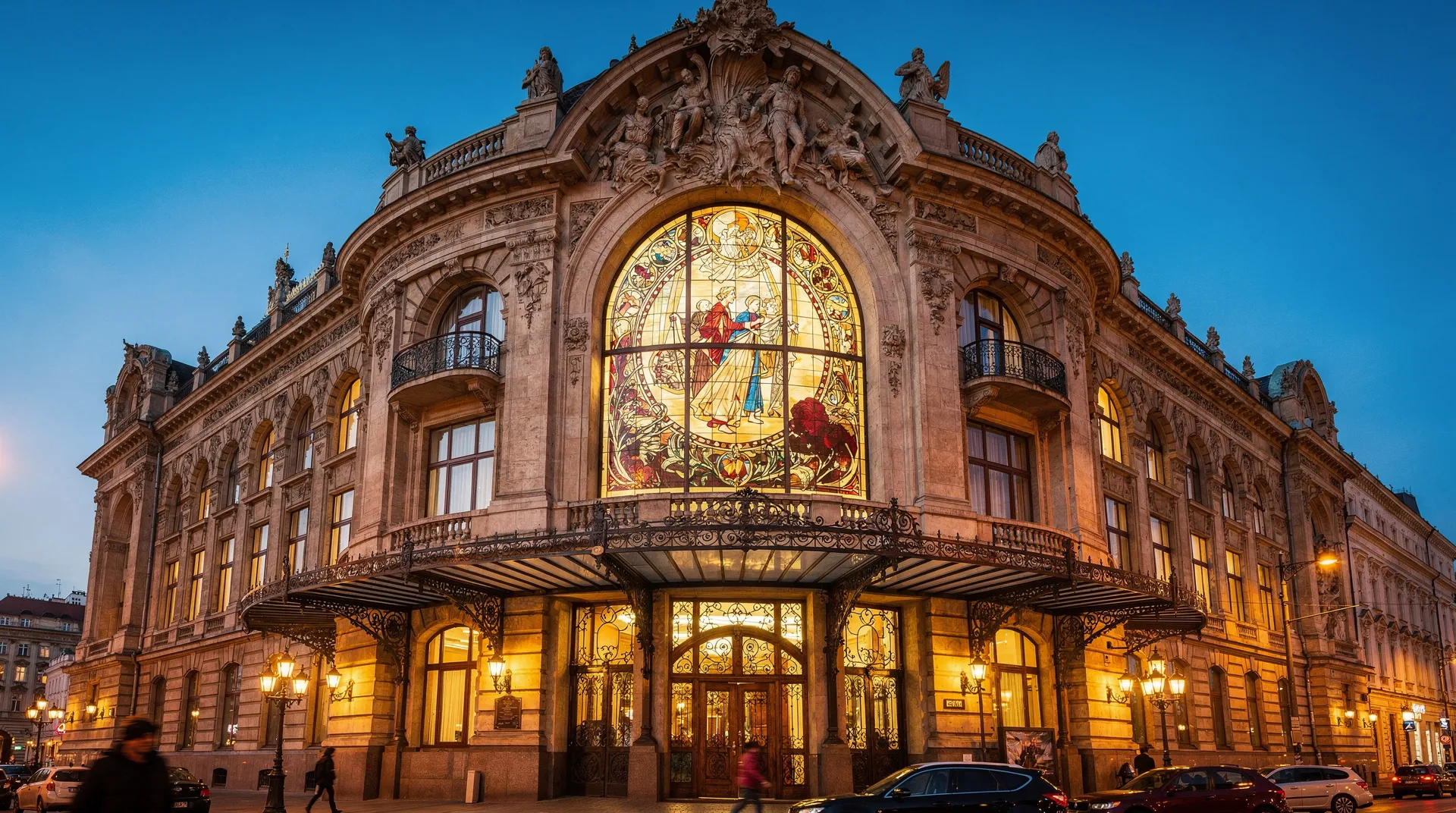
On foot from Municipal House: Municipal House is on Náměstí Republiky, a 5-minute walk. This combination — Municipal House (including the Lord Mayor’s Hall, Mucha’s decorative masterwork) followed by the Mucha Museum — makes an excellent half-day Mucha itinerary.
On foot from Old Town Square: Walk east on Celetná approximately 4 minutes, then turn right on Jakubská and right again on Panská. About 7 minutes on foot.
Photographer’s note
Photography inside the Mucha Museum is permitted without flash. The lighting is relatively good for the poster displays — warm but controlled. The challenge is avoiding reflections in the glass cases covering some of the larger prints.
The most photographed pieces — the Sarah Bernhardt Gismonda and Médée posters — are displayed at eye level and relatively well-lit. A polarising filter helps with the reflections if you’re shooting with a camera.
The courtyard of Kaunický Palace (accessed through the entrance) is a pleasant Baroque courtyard and makes for a good wide-angle shot of the building’s architecture if the museum itself is too crowded for comfortable photography.
Mucha’s Paris period in context: why the posters are significant
Mucha’s Paris posters are not just pretty pictures. They represent a specific technological and cultural moment: the lithographic poster as mass-communication medium, coinciding with the rapid growth of Parisian consumer culture and celebrity culture in the 1890s.
The theatrical poster had existed before Mucha, but his design for the Gismonda (1894) fundamentally changed the idiom. Where previous theatrical advertising used conventional framing, bold text, and straightforward illustration, Mucha’s composition was vertical (tall enough to fill a door), decorative in a way that blurred the line between fine art and advertising, and featured Bernhardt’s face and name as design elements rather than labels. The poster was designed to be seen from a distance and at close range simultaneously — a challenge that lithographic printing could now meet with colour registration of sufficient precision.
The six-year contract with Bernhardt that followed made Mucha the most commissioned theatrical poster artist in Paris. His studio produced designs for Lorenzaccio, La Samaritaine, Médée, La Dame aux Camélias, and Hamlet. Each poster was available in limited runs for collectors as well as in mass-production print runs for street posting — one of the first examples of artist prints marketed to consumers alongside commercial applications.
The decorative panels that followed — The Seasons, The Arts, The Months, The Precious Stones — were designed explicitly for domestic purchase. Priced for middle-class budgets, printed in editions of thousands, they were the first deliberately mass-market fine art products. Mucha was, in this respect, decades ahead of the art-print market that became standard in the 20th century.
Mucha’s nationalism: the Slav Epic and its contested legacy
The Slav Epic (Slovanská epopej) is the work that Mucha himself considered central to his artistic identity, and it is the work most Mucha visitors in Prague never see. The 20-canvas cycle — painted between 1910 and 1928 on linen panels of extraordinary scale (the largest measures 8 by 6 metres) — depicts episodes from Slavic history and mythology: the dawn of Slavic civilisation, the introduction of the Slavic liturgy, Jan Hus at the Council of Constance, the abolition of serfdom, and others.
The cycle was donated to the Czech nation in 1928 with the stipulation that it be permanently displayed in Prague. The condition was not fulfilled for most of the 20th century — the cycle spent decades in storage or in temporary exhibitions outside Prague. It is currently displayed at the National Gallery’s Veletržní palác (Trade Fair Palace) in Holešovice, accessible by tram from the centre.
The Slav Epic has been controversial since completion. Contemporary critics found the nationalist programme heavy-handed; the sheer scale made the paintings difficult to display; and the post-1989 art world has complicated views on monumental nationalist painting in general. The current exhibition at Veletržní palác gives the paintings adequate space for the first time in decades, and the experience of standing in front of the largest canvas is genuinely overwhelming in a way that reproductions cannot communicate.
The Mucha Museum’s gift shop and reproductions
One of the better-stocked museum gift shops in central Prague. The range of Mucha reproductions — postcards, art books, prints on various media, jewellery in Art Nouveau style — is wider here than elsewhere in the city. Not cheap, but the quality of the reproduction prints is higher than the souvenir shops near Old Town Square. The academic catalogue of the Slav Epic (in Czech and English) is available here and is the most thorough publication on the late career.
Mucha Museum vs Municipal House vs the Slav Epic: which to choose if you only have time for one
Prague’s Mucha-related sights split into three genuinely different experiences, and visitors with limited time often assume they’re redundant. They aren’t.
| Site | What it shows | Time needed | Cost |
|---|---|---|---|
| Mucha Museum | Paris posters, decorative panels, photographs, jewellery | 45–60 min | ~€11 / 280 CZK |
| Municipal House | The Lord Mayor’s Hall — Mucha’s only unified interior commission | 50 min (guided tour) | ~€12 / 290 CZK |
| Veletržní palác (Slav Epic) | The 20-canvas nationalist cycle Mucha considered his life’s work | 60–90 min | ~€8 / 200 CZK |
If you can only pick one and your interest is the commercial poster artist most people recognise, the Mucha Museum is the right choice. If your interest is Mucha as architect-decorator working at the scale of a room, Municipal House wins — nothing in the Mucha Museum shows his design sensibility applied to an entire space. If you want to understand what Mucha himself considered his real achievement, only the Slav Epic at Veletržní palác will do, and no reproduction substitutes for standing in front of an 8-by-6-metre canvas.
Is the Mucha Museum worth it with kids or on a tight schedule?
The museum is small enough — a single floor, roughly 100 pieces — that it doesn’t demand a dedicated half-day the way Prague Castle or the Jewish Quarter do. That makes it a reasonable stop even on a first, tightly-scheduled visit to Prague, particularly if it’s raining and an outdoor itinerary (a walk to Old Town Square or across Charles Bridge) isn’t appealing.
For children, the posters themselves rarely hold attention beyond a few minutes, but the short documentary on Mucha’s life and the jewellery cases (including the serpent bracelet made for Sarah Bernhardt) tend to land better with younger visitors than gallery walls of lithographs. Realistically, this is a museum for teenagers and adults with some interest in design or art history rather than a family highlight.
Frequently asked questions about the Mucha Museum
Is the Mucha Museum the same as the Slav Epic exhibition?
No. The Slav Epic (Slovanská epopej) is displayed at the National Gallery’s Veletržní palác in Holešovice, not at the Mucha Museum. The museum displays the commercial posters, decorative panels, photographs, and objects from Mucha’s career. Both are worth visiting; the Slav Epic requires a separate trip.
How long does a visit take?
45–60 minutes for most visitors. The collection is compact — roughly 100 pieces in a single-floor layout. Mucha enthusiasts may want 90 minutes.
Is the Mucha Museum worth it if I’ve already seen his posters online?
The originals are considerably more impressive than reproductions, particularly the large lithograph posters — the colour saturation, the paper quality, and the scale change the experience significantly. If you have any appreciation for print as a medium, yes.
Is the Mucha Museum close to Municipal House?
About 5 minutes on foot — walk north on Panská and west on Celetná to Náměstí Republiky. The logical combination is to visit both in the same half-day.
Is the Mucha Museum open on public holidays?
The museum is generally open on most Czech public holidays. Check the official website (mucha.cz) for holiday-specific hours.
Who was Alfons Mucha — Czech or French?
He was born in Moravia (then part of the Austro-Hungarian Empire, now the Czech Republic) and always considered himself Czech. He spent much of his career in Paris and achieved international fame there, but the work he considered most important — the Slav Epic — was created for and donated to Bohemia. He returned to live in Prague in 1910 and died there.
Is the Mucha Museum wheelchair accessible?
The museum occupies a single floor of a historic Baroque palace. Access involves a step at the entrance and the exhibition floor itself is level, but check with the museum directly (mucha.cz) before visiting if mobility access is essential, since historic buildings in Prague vary considerably in how well they’ve been adapted.
Should I book Mucha Museum tickets in advance?
Generally not necessary. The museum is small and rarely reaches capacity, so walk-up tickets at the door are normally available even in high season. Advance booking online can save a short queue on rainy summer days when indoor attractions get busier than usual.
Combining the Mucha Museum with Municipal House: a half-day Mucha itinerary
For the most coherent Mucha experience in Prague, the logical sequence is:
Morning (09:30–12:30): Start at Municipal House (Obecní dům, Náměstí Republiky). Join the first guided tour of the day (typically 10:00 in high season; check obecnidum.cz for current times). The tour unlocks the Lord Mayor’s Hall — Mucha’s most ambitious interior commission, with every surface designed by the artist as a unified environment. Allow 50 minutes for the tour, then 20 minutes in the Art Nouveau café (Kavárna Obecní dům) on the ground floor, which is free to enter and one of the finest preserved café interiors in Prague.
Late morning (12:00–13:00): Walk south on Celetná and then south on Jakubská and Panská (approximately 5 minutes) to the Mucha Museum. The collection traces the commercial poster career that made him famous, the decorative panel work designed for domestic markets, and the photographic documentation of his studio methods. The documentary film (approximately 20 minutes, shown in the basement screening room) is worth watching before touring the galleries — it provides context that makes the individual pieces more legible.
Lunch: The Mucha Museum has no restaurant. Options within 5 minutes: Café Louvre (Národní třída, but that’s 15 minutes south); closer, Kavárna Minute (Staroměstské náměstí, 7 minutes on foot) or any of the restaurants on Jindřišská street.
For a committed Mucha fan, the Slav Epic at Veletržní palác (30 minutes by tram from Náměstí Republiky) completes the picture. Allow a full day for Municipal House + Mucha Museum + Veletržní palác; this is a long day but coherent thematically.
Practical info at a glance
- Address: Panská 7, 110 00 Praha 1 (Kaunický Palace)
- Opening hours: Daily 10:00–18:00
- Price: Adult ~€11 / 280 CZK; reduced ~€8 / 200 CZK
- Nearest metro: Náměstí Republiky (Line B) — 5 min walk
- Official website: mucha.cz