At a glance
| Where | Náměstí Republiky 5, Nové Město |
| Cost | Lobby/café free; guided tour ~€12 / 290 CZK; concerts from ~€18 |
| Time needed | 50 minutes for the tour; 1.5–2 hours with the café |
| Getting there | Metro B to Náměstí Republiky, right at the exit |
| Best time | Morning for the facade photo; book tours ahead in peak season |
Why Obecní dům is one of the most important buildings in Czech history
There are two reasons to visit Municipal House — Obecní dům — and they are almost entirely separate.
The first is architectural. Built between 1905 and 1912 on the site of a demolished royal court, Obecní dům is the finest example of Czech Art Nouveau in existence. The architects Antonín Balšánek and Osvald Polívka assembled a team of the best Czech artists of the era — including Alfons Mucha, Max Švabinský, and Karel Špillar — to decorate virtually every surface. The result is a building where the mosaics, ironwork, painted ceilings, stained glass, ceramic tiles, and sculpted figures form a coherent whole rather than an accumulation of decoration. It is genuinely exceptional.
The second reason is historical. On 28 October 1918, in the Smetana Hall of this building, the independent Czechoslovak Republic was proclaimed. After centuries of Habsburg rule, this was the room where it happened. That context changes how you stand in the hall.
Worth it if you care about either of those things, which covers a considerable range of visitors.
The story of Obecní dům
The site on Náměstí Republiky was occupied from the 14th century by the Králův dvůr — the Royal Court, a palace that served as the seat of Bohemian kings before Prague Castle became their permanent residence. By the 19th century the palace had decayed to the point of being used as a military facility. When Prague’s city government decided to demolish it in 1902, they commissioned a competition for a new cultural and civic building that would serve as a statement of Czech national identity.
The winning design by Balšánek and Polívka was executed between 1905 and 1912. The brief called for an entirely Czech artistic programme: foreign architects and decorators were explicitly excluded. The result was a showcase of what Czech artists could produce at the peak of their powers, funded by Prague’s growing industrial wealth. Alfons Mucha, already famous in Paris for his Art Nouveau poster work, was assigned the Lord Mayor’s Hall (Primátorský sál) — the most prestigious commission in the building.
The building opened in 1912 with a concert in Smetana Hall. It hosted concerts, balls, exhibitions, and political meetings for six years. Then, on 28 October 1918, Czechoslovak independence was proclaimed here. The building became a symbol of the new state.
During the communist period the building was neglected. A major restoration beginning in 1994 and completed in 1997 returned it to its original condition, replacing damaged mosaics, restoring the original colour schemes, and bringing the café, restaurant, and concert facilities back to full operation.
What to see on site
The facade and main entrance
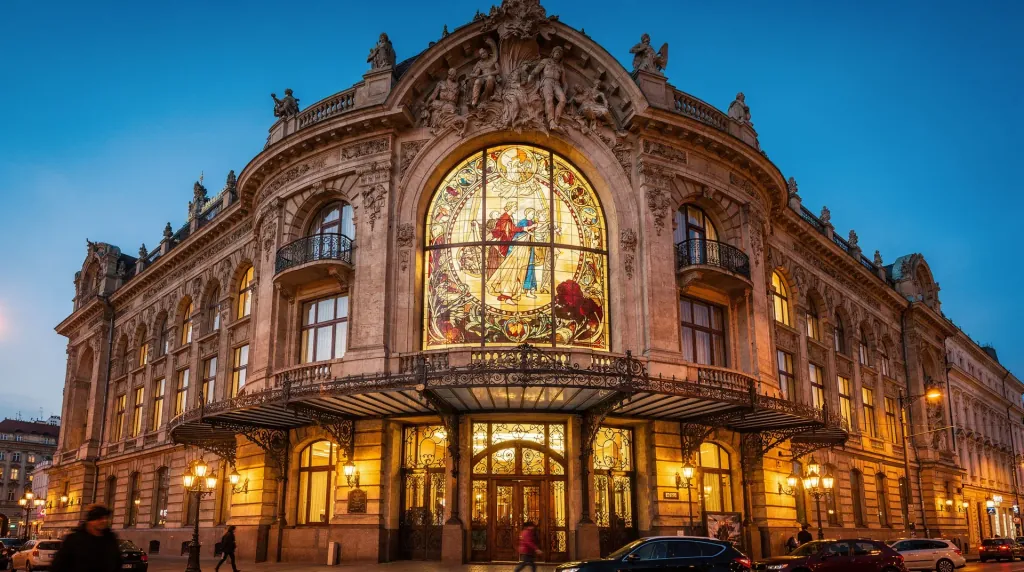
The building’s facade, facing Náměstí Republiky, centres on a mosaic by Karel Špillar titled “Homage to Prague” — a dynamic composition showing allegorical figures representing Czech history and the nation’s aspirations. The twin turrets flanking the entrance and the ornate ironwork of the canopy are often photographed, but take time to look at the individual ceramic and sculptural details around the doorframes. Nothing in the exterior is purely decorative in the generic sense — every element was chosen to reinforce the programme.
The public spaces (free access)
The lobby, the ground-floor café (Kavárna Obecní dům), and the wine bar (Plzeňská restaurace in the basement) are accessible without a ticket and open daily. The café is one of the best-preserved Art Nouveau interiors in Europe — the kind of room where you pay for a coffee partly for the privilege of sitting in it. The basement Plzeňská restaurant, decorated in Czech folk-Baroque style, serves traditional Czech food and is less visited than the café.
The guided tour (paid)
The guided tour — running approximately 50 minutes, in English, French, or German — is the only way to see the rooms that make Municipal House exceptional. These include:
Smetana Hall (Smetanova síň): The main concert hall, seating 1,200, is named for Czech composer Bedřich Smetana. The room has perfect acoustic proportions and is decorated with ceiling paintings, sculpted loges, and an organ that still functions. This is where Czechoslovakia was proclaimed independent in 1918.
Lord Mayor’s Hall (Primátorský sál): Alfons Mucha’s masterwork in the building. He designed every element of the room — the ceiling paintings, the eight panels on the walls depicting Czech virtues and Slavic mythology, the furniture, the chandeliers, the door handles. The room is small (it was a private meeting room for the Lord Mayor) and the density of detail is staggering. This alone justifies the tour price.
Other rooms: Rieger Hall, Palacký Hall, and several smaller salons each decorated by different artists in distinct idioms. Taken together they amount to a survey of Czech decorative arts at the peak of the Art Nouveau period.
Tickets, timings, and price
Lobby, café, and public areas: Free, daily 10:00–19:00.
Guided interior tour (2026 prices):
- Adult: ~€12 / 290 CZK
- Reduced (students, seniors): ~€9 / 220 CZK
- Children under 10: free
- Tours run daily; book online or at the box office inside the building. English tours run multiple times daily in peak season.
- Duration: approximately 50 minutes
Smetana Hall concerts: The Czech Philharmonic, the Prague Symphony Orchestra, and various classical ensembles perform regularly here. Ticket prices vary from around €18 (450 CZK) for a standard concert to €65+ (1600+ CZK) for gala events. The concert season runs September through June; occasional summer concerts in July and August. Book directly via the Municipal House website or via GYG.
Allow 1.5–2 hours for a visit combining the tour with a coffee in the café.
Which tour or ticket to book
For classical concerts in Smetana Hall — one of Prague’s finest concert venues:
Classical concerts at Smetana Hall, Municipal HouseFor an ensemble of soloists performing in the Smetana Hall:
Ensemble of Soloists concert in Smetana HallFor a dedicated Art Nouveau walking tour of Prague including Municipal House and the surrounding district:
Prague Art Nouveau tourFor a private Cubism and Art Nouveau walking tour combining Municipal House with the Black Madonna House and Vyšehrad’s cubist buildings:
Prague private Cubism and Art Nouveau walking tourFor a broader introduction to Prague’s historic centre that includes Náměstí Republiky:
Prague top sights and historic centre introduction tourHow to get there
Metro: Náměstí Republiky (Line B, yellow) — the building is directly in front of you as you exit the metro station. You cannot miss it.
Tram: Multiple tram lines stop at Náměstí Republiky or Masarykovo nádraží, 2 minutes’ walk.
On foot from Old Town Square: Walk east along Celetná — the historic Royal Route — approximately 400 metres. The Powder Gate (Prašná brána) stands next to Municipal House and marks the historic entrance to the Old Town.
Photographer’s note
The exterior mosaic on the facade is best photographed in the morning, when the light falls on it from the east. By afternoon the facade is in shadow and loses much of its colour.
Inside the Lord Mayor’s Hall, photography is permitted on guided tours. The room is small — about 8 by 12 metres — so a wide-angle lens (24mm equivalent or wider) is needed to capture full wall panels. The light in the room is artificial; bring a camera that handles ISO 1600 well.
For the Smetana Hall, concert-goers can photograph from their seats before and after performances. The acoustic proportions of the room make it one of the better-looking concert halls in Europe to photograph, particularly from the upper galleries.
The Art Nouveau programme: who made what in Municipal House
Understanding who was responsible for which part of Municipal House transforms a visit from general admiration to something more engaged. The building was essentially a curated exhibition of Czech artistic talent, organised by medium and space.
Karel Špillar (1871–1928) was responsible for the main facade mosaic “Homage to Prague” and several of the decorative exterior elements. Špillar worked primarily in monumental decorative painting and mosaics; his contribution to Municipal House is the most visible single piece from the street.
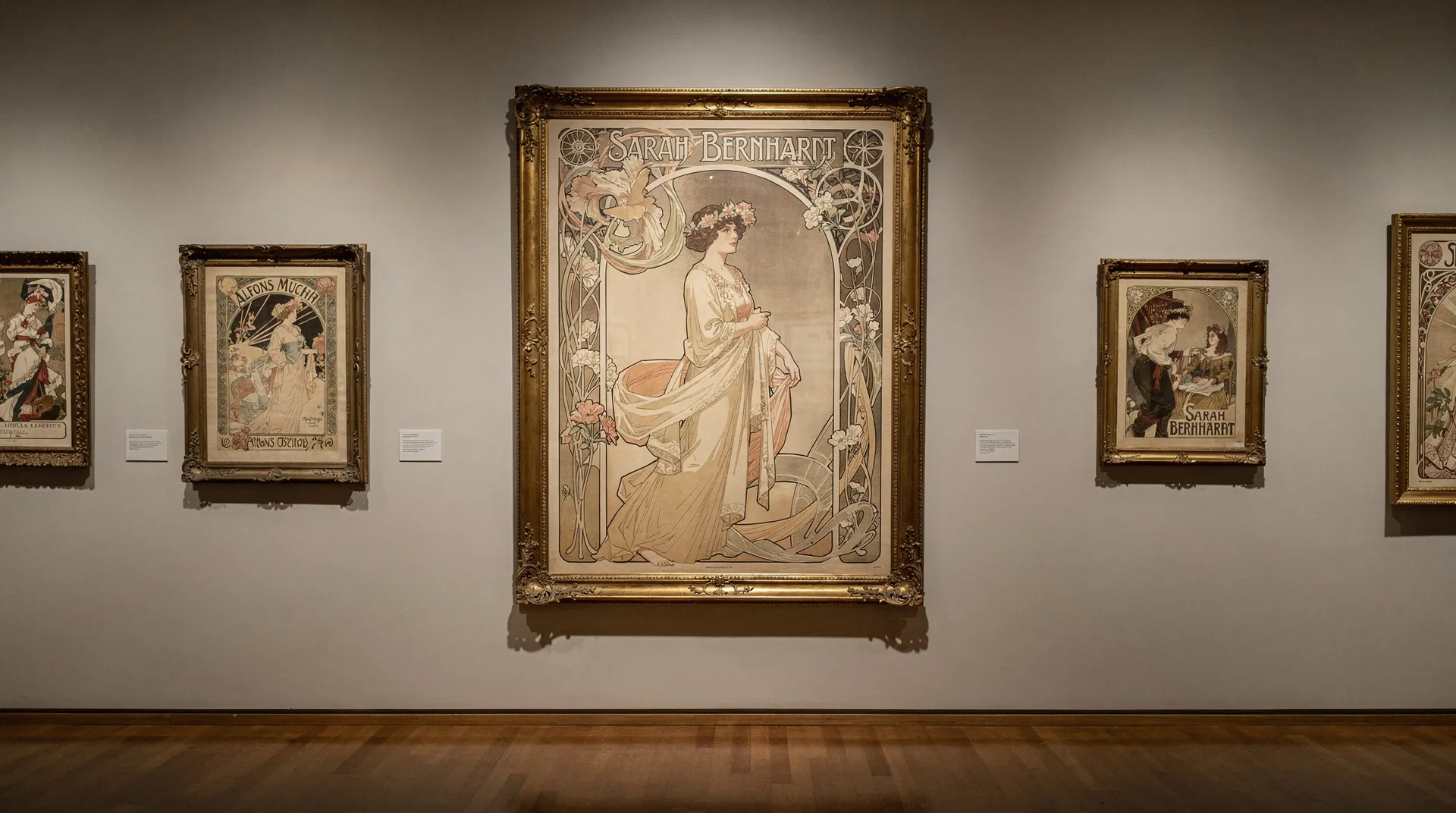
Alfons Mucha (1860–1939) had the Lord Mayor’s Hall — the most prestigious interior commission. He designed every element from the ceiling paintings to the door handles, creating a unified space rather than a decorated room. The eight wall panels, depicting Czech virtues and Slavic myths with the characteristic Art Nouveau sinuous line and face types, are the most immediately recognisable Mucha work in Prague.
Max Švabinský (1873–1962) decorated the Rieger Hall with allegorical paintings of labour and the arts. Švabinský was a slightly different personality from Mucha — more rooted in Czech realism, less in the international Art Nouveau movement — and his rooms have a different tone from the Lord Mayor’s Hall.
František Ženíšek and other artists contributed to various salons. The cumulative effect is of a building where each room represents a different facet of Czech decorative art at the period’s peak, deliberately assembled rather than organically accumulated.
The significance of 28 October 1918
Understanding Smetana Hall as more than a concert venue requires engaging with the date: 28 October 1918. After four years of World War I and centuries of Habsburg rule, the independent Czechoslovak state was proclaimed in this room on that date.
The proclamation wasn’t a single dramatic moment. The day began with negotiations in Vienna and in the streets of Prague simultaneously. Edvard Beneš was in Paris; Tomáš Masaryk was in New York (he was at Carnegie Hall the night before, giving a lecture). The actual declaration in Prague was announced by the Slovak leader Vavro Šrobár and Czech politicians including Alois Rašín, František Soukup, Antonín Švehla, and Jiří Stříbrný — the five-member National Committee. The room where they gathered was Smetana Hall.
The hall was chosen for its scale and its symbolic weight — the most prestigious concert and civic space in the city, opened only six years before. To stand in it today, surrounded by the acoustic isolation of the thick walls and the formal geometry of the 1,200 seats, and know that one of the significant political events of the 20th century occurred in this room, is to understand why guided tours include it.
The Powder Gate (Prašná brána) connection
Municipal House stands directly beside the Powder Gate (Prašná brána), the 15th-century Gothic tower that marked the eastern entrance to the medieval Old Town. The juxtaposition — Gothic tower, Art Nouveau palace — is intentional. The builders of Municipal House placed it on the site of the demolished Royal Court, adjacent to the historic city entrance, as a statement about Czech cultural continuity: the new building standing at the historic threshold, asserting modernity rooted in history.
The Powder Gate has its own ticket and observation platform (approximately €5 / 125 CZK). From the top of the tower, you can look south across Municipal House’s roof and northeast over the Náměstí Republiky streetscape. The combination of both — 45 minutes in Municipal House, 20 minutes up the Powder Gate — is a compact and historically coherent architectural hour.
Municipal House vs Prague’s other guided-tour interiors
Prague has several buildings where the real substance is behind a guided-tour ticket rather than free public access. Deciding which ones justify the time and cost is a common question for visitors planning a first trip.
| Site | What the tour unlocks | Duration | Cost |
|---|---|---|---|
| Municipal House | Smetana Hall, Mucha’s Lord Mayor’s Hall | ~50 min | ~€12 / 290 CZK |
| Mucha Museum | Mucha’s posters and decorative panels (no tour needed) | 45–60 min | ~€11 / 280 CZK |
| Prague Castle interior circuit | St Vitus Cathedral, Old Royal Palace, Golden Lane | 2–3 hrs | Varies by circuit |
Of the three, Municipal House offers the best ratio of time to payoff for a first-time visitor with limited hours: 50 minutes gets you Mucha’s single most ambitious interior and the room where Czechoslovak independence was declared. Pair it with the Mucha Museum, a 5–10 minute walk away, for a coherent half-day rather than trying to squeeze in the full castle circuit on the same day.
Is Municipal House worth it if you’re short on time in Prague?
If you have only a single day in Prague, Municipal House is not the first stop — Old Town Square and Charles Bridge come first. But if you have a second day, or an interest in architecture and 20th-century Czech history, it is one of the best half-morning additions in the city: the free café alone justifies a short detour, and the guided tour is compact enough to fit before lunch.
Frequently asked questions about Municipal House
Is Municipal House worth visiting if you’re not interested in architecture?
The café alone is worth a visit — it’s one of the most beautiful Art Nouveau interiors in the city and costs only the price of a coffee. The guided tour is primarily for those interested in architecture and history. For the 1918 independence angle, any Czech history enthusiast will find Smetana Hall genuinely moving.
How long does the guided tour take?
The standard guided tour runs approximately 50 minutes. Add 30 minutes for the café and exterior photography, and 45 minutes if you walk through the Plzeňská restaurant and basement areas.
Can you visit Municipal House for free?
The lobby, café (Kavárna Obecní dům), and wine bar (Plzeňská restaurace) are all free to enter. The guided tour and concert tickets are paid.
Is Municipal House open year-round?
Yes, daily 10:00–19:00 for the public areas. The concert programme runs September through June with some summer events.
Is there parking near Municipal House?
Street parking on Náměstí Republiky is very limited. The Palladium shopping centre next door has a multi-storey car park; alternatively, parking on Náměstí Republiky itself. Public transport (metro B, Náměstí Republiky) is the practical option.
Are the concerts at Smetana Hall worth the price?
Yes. Smetana Hall has outstanding acoustics and an interior that makes the concert experience genuinely theatrical. Czech orchestras perform regularly here. For €20–40, a concert here is better value than many European concert halls at comparable prices.
Can you visit both Municipal House and the Mucha Museum on the same day?
Yes — the Mucha Museum is about 10 minutes on foot from Municipal House (walking south through Jindřišská). A combined visit is logical and makes the connection between Mucha’s commercial and civic work clearer.
Do I need to book the Municipal House tour in advance?
It’s recommended in peak season (June–September), when English-language slots can sell out by early afternoon. Outside summer, walk-up tickets are often available, but booking online removes the risk.
Is Municipal House suitable for wheelchair users?
The lobby, café, and lift access to the main tour route are generally accessible, but the building is over a century old and some historic rooms have thresholds or steps. Contact obecnidum.cz ahead of your visit if step-free access is essential.
The café and basement restaurant: are they worth it?
The Kavárna Obecní dům (the main-floor café) is one of the three or four best café interiors in Prague. The room — coffered ceiling, carved wooden furniture, a mural programme, brass fixtures — was restored to its 1912 specifications and has the weight of a purpose-built space rather than a heritage re-creation. Coffee quality is adequate (not exceptional by specialty standards); food is standard Central European café fare at above-average prices. The justification for visiting is the room, not the menu. Order a coffee, sit for 20 minutes, and look at the ceiling.
The Plzeňská restaurace in the basement takes a completely different approach: a Czech folk-Baroque interior with lower ceilings, dark wood, and a menu of traditional Czech dishes. This is a functioning restaurant, not primarily a heritage space — the decoration is secondary to the food. It serves svíčková, guláš, and the standard Czech canon at moderate prices (lunch approximately €12–18 / 300–450 CZK per person). Less touristy than the café but also less architecturally significant.
Both spaces require only the price of a meal or drink to access — no admission required, no reservation normally needed for the café (the restaurant may require booking for dinner in peak season).
Practical info at a glance
- Address: Náměstí Republiky 5, 110 00 Praha 1
- Opening hours: Daily 10:00–19:00 (public areas); concerts by programme
- Price: Free (lobby/café); tour ~€12 / 290 CZK; concerts from ~€18
- Nearest metro: Náměstí Republiky (Line B, yellow) — 1 min walk
- Official website: obecnidum.cz