At a glance
| Where | Národní 2, Nové Město, on the Vltava embankment |
| Cost | Around €12–80 (300–2,000 CZK) depending on seat and programme |
| Time needed | 10 minutes for the exterior; a full evening (2.5–3 hrs) for a performance |
| Getting there | Metro B to Národní třída, then 5 minutes on foot toward the river |
| Best time | Book Czech-composer operas (Smetana, Dvořák, Janáček) 3–4 weeks ahead |
Why the National Theatre is more than a pretty facade
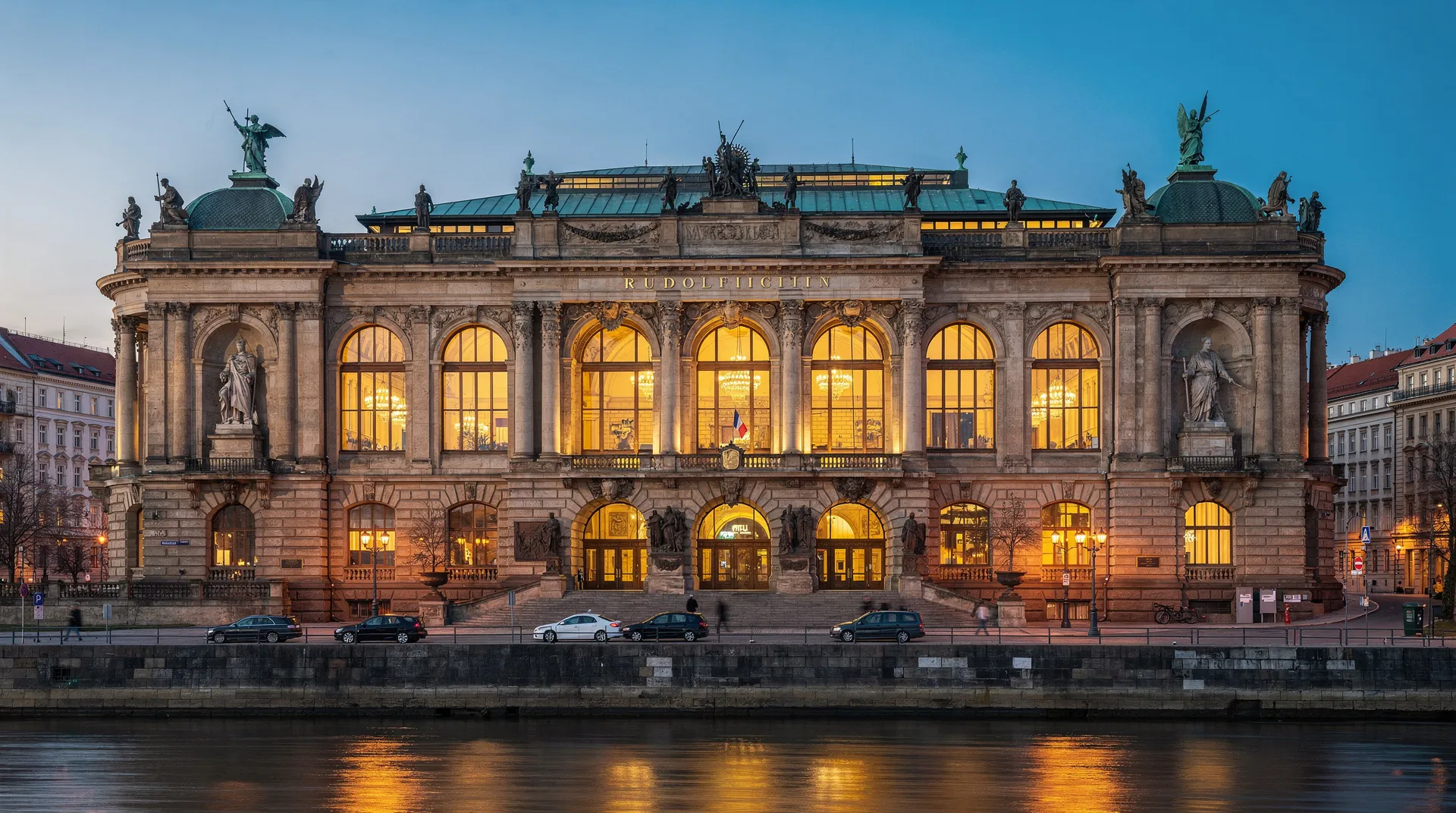
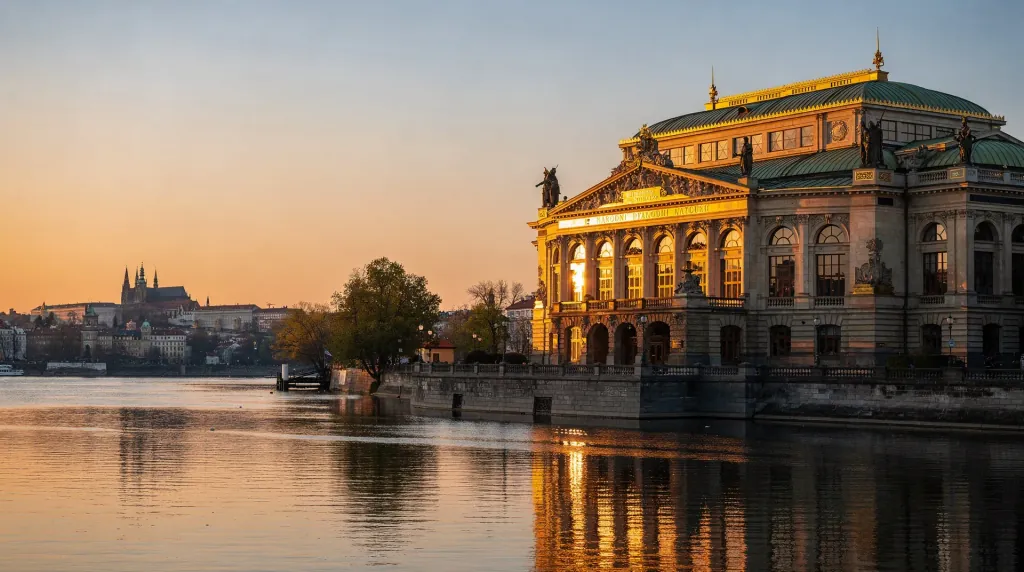
From the Vltava embankment — particularly from the Jiráskův most (Jirásek Bridge) or the Malá Strana bank — the National Theatre presents one of the most composed architectural views in Prague: a Neo-Renaissance building with a gilded roof punctuated by three allegorical sculptural groups, reflected in the river. It is genuinely one of the most beautiful 19th-century theatres in Europe.
But the building is not primarily a visual attraction. Národní divadlo exists to be used: for opera, ballet, and drama, performed by three resident companies that between them present one of the most comprehensive national repertoire programmes on the continent. If you visit Prague and have any interest in opera or classical ballet, an evening here is worth considerable planning.
For those who don’t attend performances, the building is impressive from the outside and worth a 10-minute stop on a walk along the embankment. Guided tours of the interior are available but not widely publicised; check the theatre’s website for current tour schedules.
The story of Národní divadlo
The National Theatre is one of the most potent symbols of Czech national identity — a status it earned before a single performance was staged. In the mid-19th century, Bohemia was part of the Habsburg Empire, Czech language and culture were officially secondary to German, and there was no permanent stage for Czech-language opera or drama in the country. The campaign to build one became a national cause. Funding was raised by public subscription — the phrase “the nation to itself” (Národ sobě) became the building’s motto and is inscribed above the stage.
Construction began in 1868 under architect Josef Zítek. The completed building was inaugurated on 11 June 1881 with a performance of Smetana’s opera Libuše, composed specifically for the occasion. Two months later, on 12 August 1881, the building was almost completely destroyed by fire caused by a spark from a worker on the roof. The devastation was national news.
The reconstruction was funded by a second public subscription, raised in six weeks — a demonstration of the extraordinary symbolic importance the theatre had acquired. The rebuilt theatre, now designed by Zítek’s former student Josef Schulz (who also designed the Rudolfinum), reopened on 18 November 1883 with a second performance of Libuše. The building you see today is essentially the 1883 reconstruction.
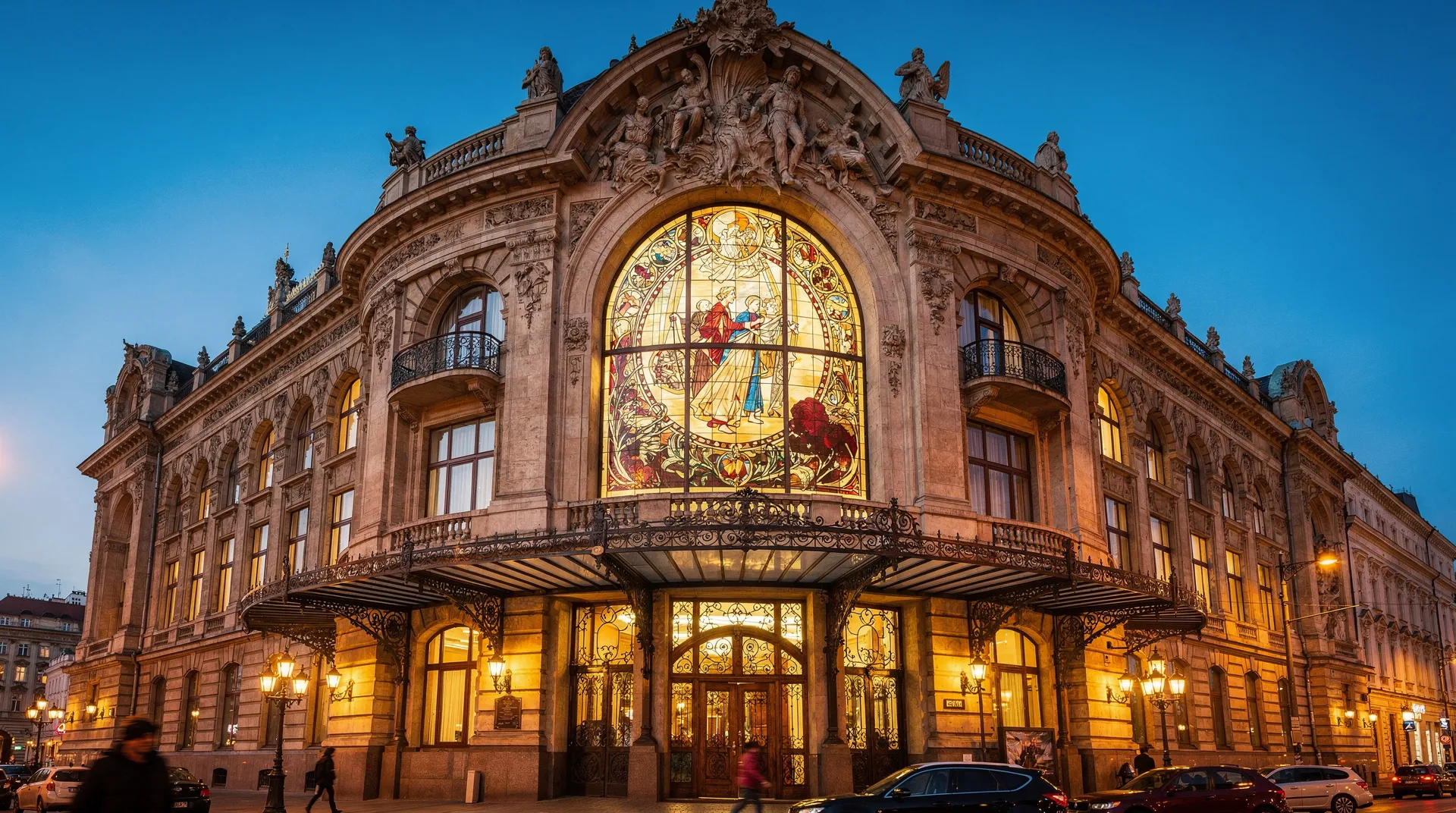
The interior decorative programme — ceiling paintings, curtains, loggias, sculptures — represents the peak of Czech 19th-century painting and sculpture. The artists involved include Mikoláš Aleš, František Ženíšek, Vojtěch Hynais, and Václav Brožík. The main curtain, painted by Vojtěch Hynais, is considered one of the finest theatrical curtains in Europe.
The building was thoroughly renovated between 1977 and 1983 and continues in regular use.
What the National Theatre stages
Three companies operate from the National Theatre building and its associated stages:
Opera company (Opera Národního divadla): Mounts a full season of Czech and international opera, with particular emphasis on Smetana, Dvořák, and Janáček alongside the standard German, Italian, and French repertoire. The company performs in Czech for Czech-language operas and in the original language (with Czech surtitles) for international repertoire.
Ballet company (Balet Národního divadla): One of the major Central European ballet companies. Classical repertoire (Swan Lake, Giselle, The Nutcracker) alongside Czech choreographic works. The company tours internationally and performs at the main stage.
Drama company (Drama Národního divadla): Czech-language theatre, from the national classic repertoire (Čapek, Mrštík) to contemporary Czech and international plays. Primarily of interest to Czech-speaking visitors.
The main stage — the gilded auditorium with three tiers of boxes and the famous painted curtain — is used for large-scale opera and ballet. The Estates Theatre (Stavovské divadlo, where Mozart premiered Don Giovanni in 1787) is also operated by the National Theatre group.
Tickets, timings, and price
Performance tickets (2026 estimates):
- Standing room: ~€12 / 300 CZK
- Side gallery: ~€15–25 / 375–625 CZK
- Upper boxes: ~€20–40 / 500–1,000 CZK
- Stalls and front tiers: ~€35–80 / 875–2,000 CZK
- Premieres and gala events: prices higher
Booking:
- Online: narodni-divadlo.cz (English available)
- Box office: Národní 2, Mon–Fri 10:00–18:00, Sat–Sun 10:00–12:00, and 1 hour before each performance
- GYG for curated concerts and performances
Season: September–June. Summer season is limited; the main building may be dark in July–August.
Book popular operas (Rusalka, The Bartered Bride, Jenůfa, any Dvořák) at least 3–4 weeks ahead. Ballet and less-popular opera titles are often available closer to performance date.
Which tour or ticket to book
For classical concerts in Smetana Hall and the National Theatre district — a useful orientation to Prague’s musical venues:
Classical concerts at Smetana Hall, Municipal HouseFor an ensemble of soloists performing Czech classical repertoire in a Prague concert hall:
Ensemble of Soloists concert, PragueFor an Art Nouveau walking tour that covers the National Theatre and the surrounding Nové Město architectural heritage:
Prague Art Nouveau tourFor a private architectural walking tour combining the National Theatre with Prague’s other Neo-Renaissance and Art Nouveau landmarks:
Prague private Cubism and Art Nouveau walking tourHow to get there
Metro: Národní třída (Line B, yellow) — exit toward the river, then walk 300 metres east along Národní to the theatre entrance. About 5 minutes.
Tram: Multiple lines (2, 18, 22, 23, 93) stop at Národní divadlo on Rašínovo nábřeží — directly in front of the theatre on the river side.
On foot from Old Town Square: Walk south through Staroměstské náměstí and Betlémské náměstí to Národní třída (about 10 minutes), then west toward the river.
Photographer’s note
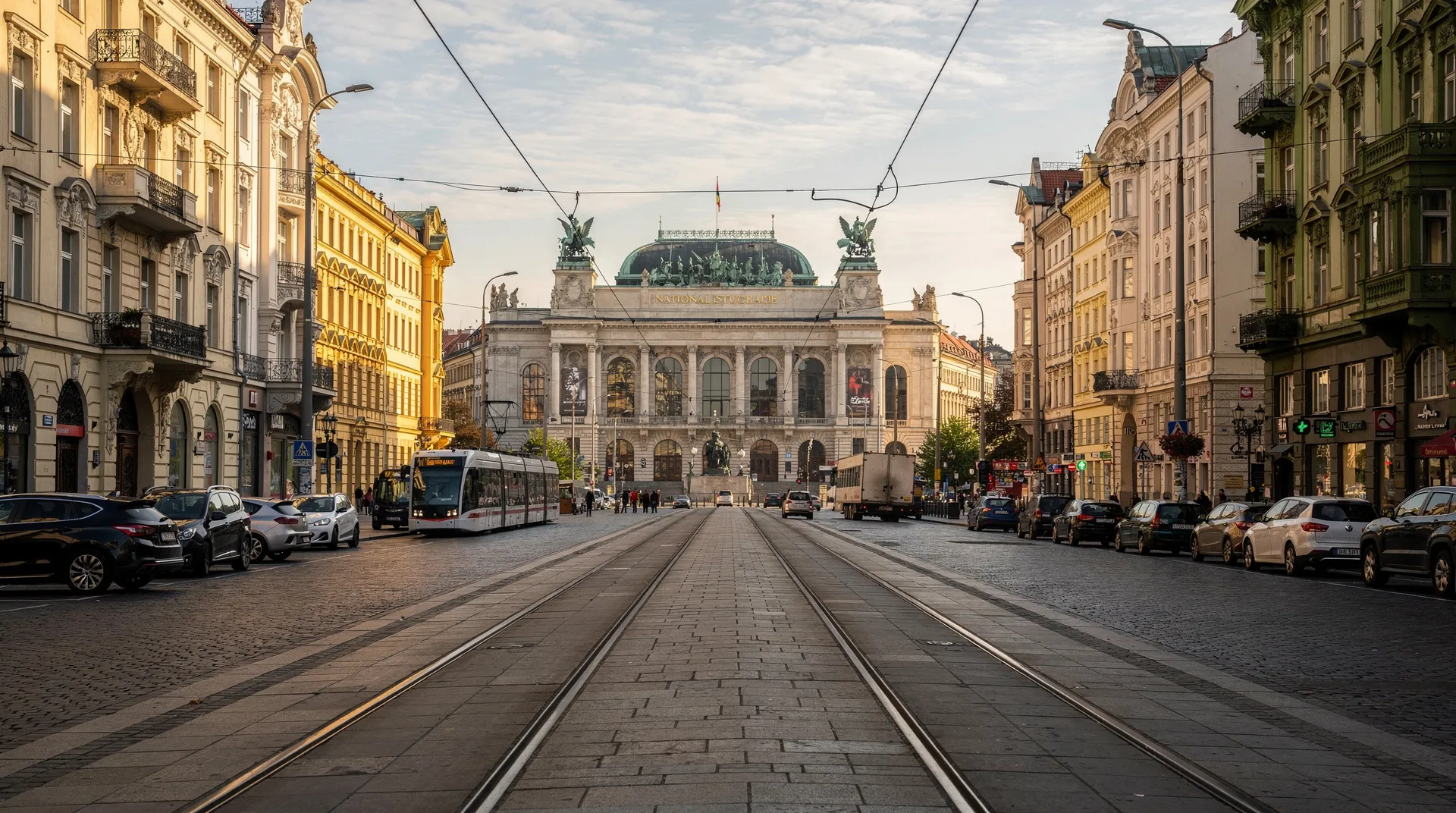
The exterior is best photographed from the Jiráskův most or from the Rašínovo nábřeží embankment, looking north with the river in the foreground. The golden roof catches afternoon and evening light particularly well. The Neo-Renaissance facade facing Národní třída is less photogenic than the river elevation.
For the interior, photograph during intermission — the lobbies, staircases, and bar areas are accessible during breaks and are spectacular. The main auditorium is generally not photographed during performances; the house lights are sometimes raised briefly before the performance begins, creating a brief window.
The National Theatre as cultural institution: what it produces
The Opera company at Národní divadlo maintains a rotating repertoire of approximately 40–50 titles per season, covering Czech opera (Smetana’s Libuše, Prodaná nevěsta, and Dvě vdovy; Dvořák’s Rusalka and Dimitrij; Janáček’s Jenůfa, Kát’a Kabanová, and Věc Makropulos) alongside the standard Italian, German, and French canon.
The Czech operas are the primary reason to choose the National Theatre over other Prague concert venues. Smetana’s Rusalka — in Czech, in a Czech production, at the house where these works premiered — is an experience that carries a cultural resonance unavailable in translation or in a foreign house. Czech audiences know these works from childhood; the National Theatre performances have a particular intensity that reflects that familiarity.
The Ballet company is one of the stronger classical ballet companies in Central Europe, with a repertoire that ranges from the standard Petipa-Tchaikovsky canon (Swan Lake, The Sleeping Beauty, The Nutcracker) through to Balanchine and contemporary Czech choreography. The company has won international recognition for its Dvořák-era Czech ballet productions.
Ticket allocation between Czech and international visitors has been an ongoing discussion at the theatre. The subscription system, used by Prague residents who buy season tickets, absorbs a large proportion of stalls capacity for the most popular productions. Last-minute tickets are sometimes available at the box office; the theatre website’s English-language booking has improved significantly in recent years.
The 1881 fire and the national response
The fire that destroyed the National Theatre two months after its inaugural performance is one of the formative events in Czech cultural history — not because of the damage itself, but because of the response.
On 12 August 1881 a spark from workers building a new zinc roof ignited the stage area. The fire spread rapidly through the wooden interior structures; the auditorium roof collapsed within an hour. The building was gutted. The external walls survived, as did some of the interior structural elements.
The response — a second public subscription campaign that raised the necessary reconstruction funds in six weeks, largely through small donations from across Bohemia and Moravia — became the defining story about Czech cultural identity in the late 19th century. The “nation to itself” phrase, which had been the building’s motto, took on additional meaning: the nation had rebuilt its theatre from its own resources, without Habsburg subsidy, demonstrating collective will rather than aristocratic patronage.
This story is actively present in the building today. The phrase “Národ sobě” (the nation to itself) is inscribed in the auditorium in multiple locations. Guides and programme notes routinely reference the 1881 fire and the six-week subscription. To attend a performance at the National Theatre is to participate, at some remove, in a ritual of national self-assertion that Czechs have been performing since 1883.
Smetana, Dvořák, Janáček: the Czech operatic trinity
Three Czech composers dominate the National Theatre’s operatic identity:
Bedřich Smetana (1824–1884) wrote Libuše specifically for the opening of the National Theatre in 1881, making the connection between the composer and the institution explicit. His operatic output — Prodaná nevěsta (The Bartered Bride), Libuše, Dvě vdovy, Hubička — forms the core of the Czech operatic national canon.
Antonín Dvořák (1841–1904) wrote Rusalka (1901), the most internationally performed Czech opera. Its soprano aria “Song to the Moon” (Měsíčku na nebi hlubokém) is one of the most beautiful pieces in the operatic repertoire. The National Theatre Rusalka productions are considered definitive.
Leoš Janáček (1854–1928) was premiering his operas at the theatre from Jenůfa’s Prague premiere in 1916. Janáček’s musical language — driven by speech rhythms, with abrupt harmonic shifts and orchestral textures that anticipated mid-20th-century modernism — is challenging for some listeners but enormously rewarding. The Prague productions of Kát’a Kabanová and Věc Makropulos are among the finest in the world.
If you can time your visit to coincide with any of these three composers’ operas at the National Theatre, the experience goes well beyond a generic cultural evening.
National Theatre vs Estates Theatre vs Rudolfinum: choosing a Prague classical evening
Prague has several outstanding venues for opera, ballet, and classical concerts, and first-time visitors often aren’t sure which suits their interests.
| Venue | Best for | Duration | Typical price |
|---|---|---|---|
| National Theatre | Czech opera and ballet (Smetana, Dvořák, Janáček) | 2.5–3 hrs | ~€12–80 |
| Estates Theatre | Mozart’s Don Giovanni in its 1787 premiere venue | 2.5–3 hrs | Similar range |
| Rudolfinum | Symphonic concerts (Czech Philharmonic) | ~2 hrs | Varies by programme |
If your priority is opera and ballet with a strong Czech national identity, the National Theatre’s own productions of Rusalka or Prodaná nevěsta are the most authentic choice available anywhere. If you specifically want the Mozart connection, the Estates Theatre — a 10-minute walk from Old Town Square — is unmatched. For purely orchestral programmes, the Rudolfinum is the city’s dedicated concert hall rather than an opera house.
Is an evening at the National Theatre worth it for non-opera fans?
If opera and ballet aren’t normally your thing, the building itself and the surrounding embankment are worth a short daytime visit regardless — the golden roof view from Charles Bridge or the Jiráskův most costs nothing and takes 10 minutes. For a full evening, the ballet programme (Swan Lake, The Nutcracker) tends to be more approachable for newcomers than the Czech-language opera repertoire, since the visual spectacle doesn’t depend on following the libretto.
Frequently asked questions about the National Theatre
How do I book opera tickets at the National Theatre?
Online via narodni-divadlo.cz is the most reliable method and shows full seat availability. The box office at Národní 2 is the alternative for in-person booking. English is available online and at the box office.
What are the best seats in the National Theatre?
For opera and ballet: the stalls (přízemí) in the first 10–12 rows are acoustically and visually excellent. The first tier of boxes (loge) at the front and sides is also very good. Avoid extreme side positions in the upper tiers, which have restricted views of the stage.
Is the National Theatre open for tourism without attending a performance?
Guided tours are occasionally available — check the theatre’s website for current offerings. The building is otherwise only accessible by attending a performance.
Is there a dress code for the National Theatre?
Smart casual is entirely acceptable. Formal dress is not required; many Prague theatregoers dress simply. The only exception is the annual New Year’s gala, where black tie is conventional.
What language are performances in?
Czech for Czech-language operas and plays. International operas are usually performed in the original language (Italian, German, Russian, French) with Czech surtitles above the stage.
Is the National Theatre different from the Estates Theatre?
Yes. Both are operated by the National Theatre group, but the Estates Theatre (Stavovské divadlo, Ovocný trh 1, near Old Town Square) is a separate 18th-century building famous as the site of the world premiere of Mozart’s Don Giovanni in 1787. Both are worth attending.
Is the National Theatre near the Dancing House?
The Dancing House (Tančící dům) is about 800 metres south along the Rašínovo nábřeží embankment — a 10-minute walk. The natural riverbank walk combines both.
Is it worth attending the National Theatre if you don’t understand Czech?
Yes for opera, since surtitles or the visual spectacle carry the experience, and yes for ballet, which needs no language at all. Czech-language drama is the exception — that’s primarily of interest to Czech speakers.
How far in advance should I book National Theatre tickets?
For the most popular Czech operas (Rusalka, The Bartered Bride, Jenůfa), 3–4 weeks ahead is a safe margin, especially in the September–June season. Ballet performances and less prominent opera titles are often available with just a few days’ notice.
The Estates Theatre: Mozart’s Prague connection
For visitors interested in opera history, the Estates Theatre (Stavovské divadlo) is worth mentioning alongside the National Theatre. Both are operated by the Národní divadlo group, but the Estates Theatre has a different historical significance: it is where Wolfgang Amadeus Mozart conducted the world premiere of Don Giovanni on 29 October 1787.
The Estates Theatre (then called the Nostic Theatre, after its founder Count Nostic-Rieneck) was built in 1783 — earlier than the National Theatre and in a Neo-Classical rather than Neo-Renaissance style. The interior, when Mozart conducted, was essentially as you see it today: the horseshoe-shaped auditorium with its tiers of boxes and the gold-and-green decorative scheme is largely original or close to it.
The famous phrase “meine Prager verstehen mich” (my Praguers understand me) refers to Mozart’s experience in Prague: his opera The Marriage of Figaro had been cooler in Vienna than expected, but Prague received it ecstatically. Prague audiences of the 1780s had a genuine appetite for sophisticated musical complexity that was still developing in Vienna. The Don Giovanni commission followed naturally.
The premiere was chaotic: Mozart finished the overture on the morning of the performance, the orchestra sight-read it, and the audience apparently heard more perfection than the musicians felt they had produced. The premiere was a success. The Estates Theatre has performed Don Giovanni almost every season since.
For visitors who can attend a performance there (booking via narodni-divadlo.cz), the Estates is approximately 10 minutes’ walk from the National Theatre, on Ovocný trh just east of Old Town Square.
Practical info at a glance
- Address: Národní 2, 110 00 Praha 1
- Box office: Mon–Fri 10:00–18:00; Sat–Sun 10:00–12:00 and 1h before performances
- Price: ~€12–80 (300–2,000 CZK) depending on seat and programme
- Nearest metro: Národní třída (Line B) — 5 min walk
- Nearest tram: Národní divadlo (lines 2, 18, 22, 23) — at the door
- Official website: narodni-divadlo.cz