Why Vítkov is one of Prague’s most undervisited monuments
At a glance
| Where | Vítkov hill, Žižkov, east of the city centre |
| Cost | Terrace and views free; museum interior around €5 / 120 CZK |
| Time needed | 60–90 minutes for terrace and museum |
| Getting there | Tram 5, 9, or 26 to Tachovské náměstí, then 10 minutes on foot |
| Best time | Weekday mornings for near-solitude; clear days for the panorama |
The Vítkov hill, in Žižkov east of the centre, is the site of one of the most consequential battles in Czech history and one of the most striking monuments in the city. Almost no tourists visit. That combination is unusual enough to justify a closer look.
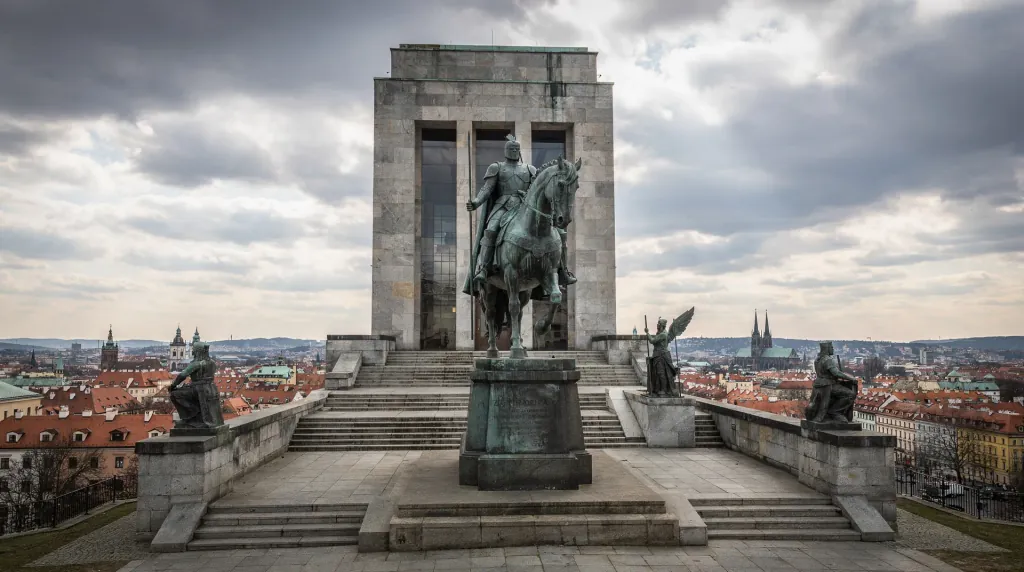
The monument is significant for two overlapping reasons. The primary historical reason is the Battle of Vítkov Hill in 1420, when a Hussite army led by Jan Žižka defeated a crusading force sent by Holy Roman Emperor Sigismund, establishing the Hussite movement’s military credibility and beginning a period of Czech resistance to imperial authority that lasted decades. The equestrian statue of Žižka on the hill’s summit — the largest equestrian bronze in the world, larger than the Statue of Liberty’s figure — commemorates this.
The secondary reason is stranger: the memorial building itself was completed in 1932 as a monument to Czech legionaries and soldiers from World War I. The communist regime then appropriated it as their central mausoleum, placing Klement Gottwald’s embalmed body here in 1953. When Gottwald’s body began to decompose faster than expected (the embalming had not worked as well as the Soviet model), it was cremated. The mausoleum is now a museum of 20th-century Czech history.
The combination of a 15th-century Hussite battlefield, a 1930s nationalist monument, and a failed communist mausoleum, topped by the world’s largest equestrian bronze, is an only-in-Prague sequence.
The Battle of Vítkov Hill and Jan Žižka
Jan Žižka z Trocnova (c. 1360–1424) was a Bohemian military commander who became the military leader of the radical Hussite movement following the martyrdom of Jan Hus in 1415. Žižka was already middle-aged and blind in one eye when he became the Hussite general; he lost his remaining eye during the siege of Rabi in 1421, and continued commanding effectively as a completely blind general — a situation that has fascinated military historians ever since.
On 14 July 1420, Sigismund’s crusading force — assembled from across the Holy Roman Empire — attempted to take the Vítkov hill and cut off the Hussite stronghold in Hradčany. Žižka defended the hill with a small force, deploying his characteristic wagon-fort (Wagenburg) tactics to hold a numerically superior enemy. The crusaders were repulsed. The battle established the military effectiveness of the Hussite forces and changed the political dynamics of the region for the next two decades.
Žižka died in 1424 of plague and requested that his skin be made into a war drum “so that I may still beat the enemy after my death.” Whether this was done is disputed by historians.
What to see at the memorial
The Jan Žižka equestrian statue
The statue, by sculptor Bohumil Kafka (who worked on it from 1913 until his death in 1942; it was cast posthumously and unveiled in 1950), stands at the western end of the memorial terrace. The horse and rider together measure approximately 9 metres high; the total monument with its base is taller. The Guinness World Records lists the bronze casting as the largest equestrian statue in the world. The horse is rendered in a powerful forward-lunging posture; Žižka holds his mace. The details of the armour and the composition are impressive at close range.
The panorama from the terrace
The hilltop terrace offers a west-facing view across central Prague, taking in the Old Town, Hradčany, and the curve of the Vltava. The view is not quite as dramatic as Letná or Petřín — the angle is slightly different — but the combination of the statue in the foreground and the city behind makes for excellent photographs. Completely free; no admission required for the terrace.
The memorial building interior
The memorial building itself (Národní památník na Vítkově) was opened in 1932 and is now managed by the National Museum as a branch museum. The interior contains:
- The Mausoleum (Mauzoleum): The central hall where Klement Gottwald’s body was displayed from 1953 to 1962. The space was redesigned after communism fell; it now serves as a ceremonial hall and event space.
- Permanent exhibition on Czech 20th-century history: Covering the Czechoslovak legions in World War I (the original purpose of the building), the interwar republic, World War II occupation, and the communist period. The exhibition is serious and well-documented, primarily in Czech with some English translation.
- The columbarium: A small room with the urns of Czech national figures, including some who were buried here during the communist period.
Museum hours and prices:
- Tuesday–Sunday 10:00–18:00; closed Monday
- Adult: ~€5 / 120 CZK
- Reduced: ~€3 / 75 CZK
- The terrace and exterior are free and always accessible
How this fits into Prague’s 20th-century history tour
The Vítkov Memorial connects directly with the broader communist history of Prague. The same period of Czech history — 1948–1989 — that produced the Vítkov mausoleum also produced the nuclear bunker tours and the Museum of Communism that most history-focused visitors prioritise. The Vítkov adds an unusual dimension: a communist appropriation of a pre-existing nationalist monument, and the visible awkwardness of that appropriation in the current exhibition.
Which tour to book
For a communism and bunker tour that provides the political context for understanding Vítkov’s communist-era role:
Prague: Communism and Bunker Tour with 70s Canteen LunchFor a communism history and nuclear bunker guided tour:
Prague communism history and nuclear bunker guided tourFor a dedicated World War II and communism history tour:
Prague World War II and communist history tourFor a focused back-to-communism walking tour covering the city’s communist-era landmarks:
Prague 2-hour back to communism walking tourHow to get there
Tram: Tram 5, 9, or 26 to Tachovské náměstí (in Žižkov), then walk north about 10 minutes through Žižkov streets up to the hill. The memorial is visible on the hilltop.
On foot from Florenc (metro B/C): Walk east through Žižkov along Jana Želivského for about 20 minutes. The hill rises at the end of the walk.
Cycling: The memorial is accessible by bicycle via the Žižkov streets. No dedicated cycle path but the roads are manageable.
Photographer’s note
The statue photograph from the front (west-facing terrace, standing in front of the horse) with the Prague skyline behind is the iconic shot. Shoot in the morning when the light falls on the statue’s face and chest from the east; by afternoon the figure is back-lit from this angle.
For the panorama without the statue in frame, move to the south side of the terrace and shoot northwest across the Žižkov rooftops toward the Old Town spires.
The interior mausoleum hall, now empty, is a stark and impressive piece of Stalinist monumental architecture — worth photographing if you’re interested in 20th-century political design.
The Hussite movement and what it means for Czech identity
The Hussite period (roughly 1415–1436) is the formative episode in Czech national mythology, and the Vítkov Memorial is its most imposing monument. Understanding why requires a brief account of what the Hussites were and why the battles of the 1420s became so important.
Jan Hus was a Czech theologian at Charles University who began preaching reform of the Catholic Church around 1400 — criticising indulgences, clerical corruption, and the gap between Church teaching and Church practice. He was summoned to the Council of Constance in 1414 under a guarantee of safe passage, tried for heresy, and burned at the stake on 6 July 1415, despite the guarantee. His death provoked an immediate uprising in Bohemia: the Hussite movement.
The Hussites were not a unified group. The radical wing (the Taborites, based in Tábor in southern Bohemia) wanted a complete reformation of the Church and Czech society. The more moderate wing (the Utraquists, based in Prague) focused on the right to receive communion in both kinds (bread and wine) for laypeople — a practice the Church reserved for priests. Both groups were declared heretics and subject to crusades organised by Holy Roman Emperor Sigismund.
Jan Žižka was the military leader of the Taborite wing. Between 1420 and his death in 1424, he led Hussite forces to a series of remarkable victories against numerically and technologically superior crusading armies. His tactical innovations — the Wagenburg (wagon fortress), the use of cannon, the integration of infantry, artillery, and cavalry — were genuinely new in European warfare.
The symbolic importance of the 1420 Battle of Vítkov Hill is partly military (it was the first significant Hussite victory) and partly locational: the hill is visible from the centre of Prague, and Žižka’s defence of it effectively prevented the crusade from capturing the city. For Czech national mythology, this is the moment when Czech resistance to external authority began.
Klement Gottwald and the failed mausoleum
The communist appropriation of the Vítkov Memorial is a black comedy of preservation technology and political symbolism.
Klement Gottwald (1896–1953) was the communist leader who engineered the 1948 coup that established communist rule in Czechoslovakia. He died on 14 March 1953, nine days after returning from Stalin’s funeral in Moscow, where he had caught pneumonia. His death came at an awkward moment for Czech communism: the Stalin cult was just beginning to crumble, but the personality cult was not yet fully dismantled.
The decision to embalm Gottwald’s body and display it publicly, following the Soviet model with Lenin’s mausoleum, was taken by the Czechoslovak Party leadership. The Vítkov Memorial was redesigned and equipped with a refrigeration system, a laboratory, and a viewing corridor. Gottwald’s embalmed body was put on display in February 1953.
The embalming did not work well. Within months, decomposition became visible despite the refrigeration. Soviet technical advisors were called in. The body was repeatedly treated with chemicals; parts required replacement with wax reconstruction. By the late 1950s, maintaining the illusion of preservation was requiring enormous effort and expense. In 1962 the body was cremated and the ashes interred in the Vítkov Memorial wall — quietly, without publicity.
The hall where Gottwald’s body was displayed is now a ceremonial space with no reference to its former use in the standard visitor experience. The exhibition in adjacent rooms covers this episode with appropriate irony.
The equestrian statue’s scale: comparisons
The Jan Žižka equestrian statue is listed in the Guinness World Records as the largest equestrian bronze statue in the world. Some context for the claim:
The statue measures approximately 9 metres from the top of the rider’s head to the ground; the horse alone is approximately 5 metres at the shoulder. The total weight of the bronze casting is approximately 16.5 tonnes. The statue stands on a granite pedestal that adds approximately 4 metres to the total height.
By comparison: the equestrian statue of Simón Bolívar in Caracas (often cited as a competitor) is approximately 5.5 metres; the equestrian Marcus Aurelius in Rome is approximately 4.2 metres (though it is ancient bronze rather than modern casting). The Statue of Liberty’s figure is 46 metres from foot to torch, but it is not equestrian. The Žižka statue’s distinction is specifically in the equestrian category.
The sculptor Bohumil Kafka began the project in 1913 and worked on it until his death in 1942. The statue was cast posthumously and unveiled in 1950. The gap between design and completion encompasses two world wars, a republic, a Nazi occupation, and the beginning of communist rule — a biographical arc that gives the work an unintended historical resonance.
Frequently asked questions about the Vítkov Memorial
What is the Vítkov Memorial?
The Národní památník na Vítkově is a national memorial complex on Vítkov hill in Žižkov. It combines a 1930s monument to Czech soldiers with the world’s largest equestrian bronze (Jan Žižka) and a museum of Czech 20th-century history. The building served as a communist-era mausoleum from 1953 to 1962.
Is it free to visit the Vítkov Memorial?
The hilltop terrace and exterior are free and always accessible. The museum interior is approximately €5 / 120 CZK for adults.
Who was Jan Žižka?
Hussite military commander (c. 1360–1424), who led Czech forces against crusading armies in the early 15th century. He won several significant battles despite being blind. He is considered a founding hero of the Czech military tradition. His equestrian statue at Vítkov is the world’s largest equestrian bronze.
How do I get to the Vítkov Memorial?
Tram 5, 9, or 26 to Tachovské náměstí in Žižkov, then 10 minutes on foot north toward the hill. No direct metro connection.
Can I combine the Vítkov Memorial with the Žižkov TV Tower?
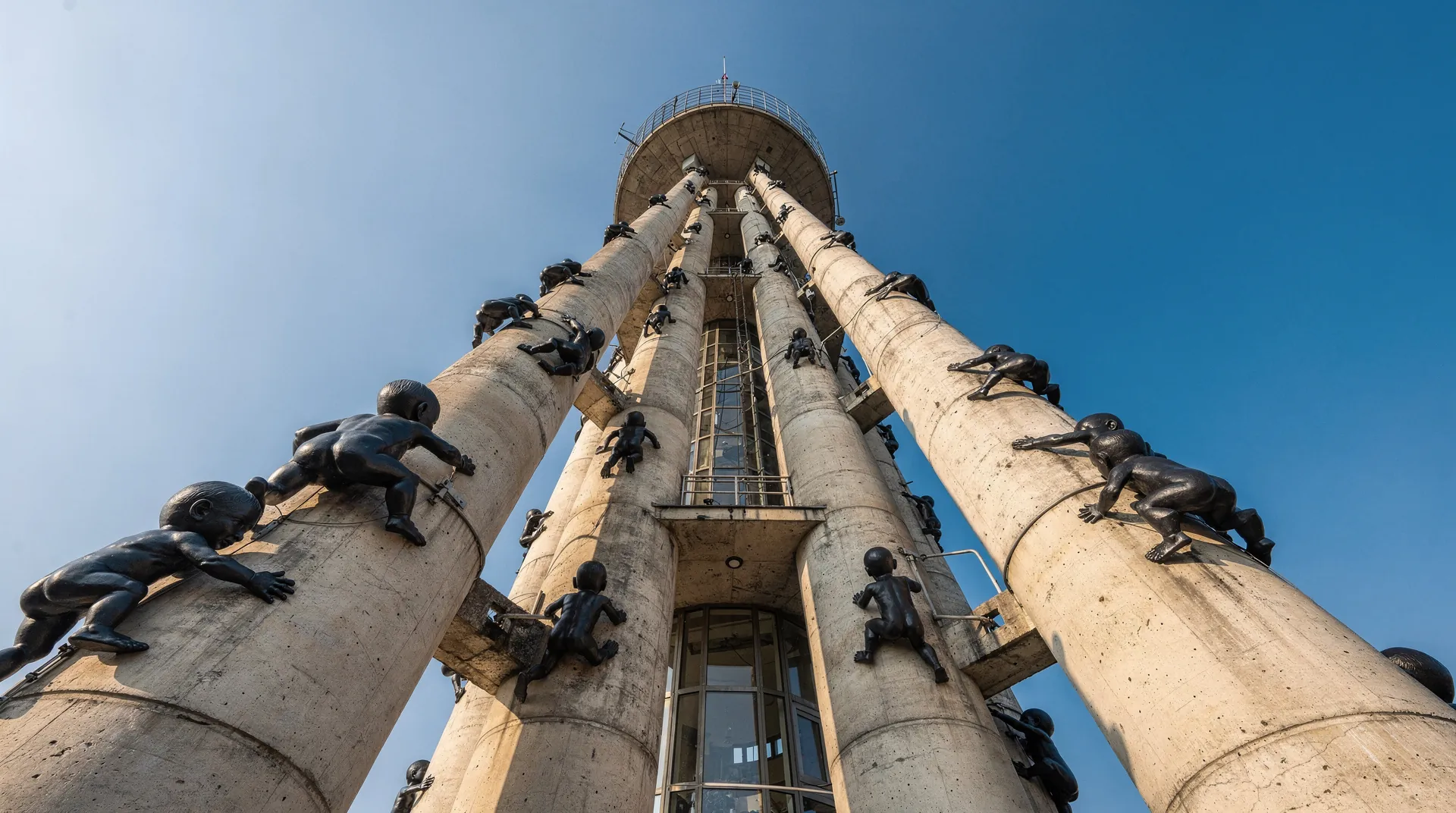
Yes — both are in Žižkov, about 1.5 km apart. A morning at Vítkov followed by the TV Tower observation deck makes a logical Žižkov half-day. Add lunch or a beer at one of the local pubs in between.
Is the Vítkov Memorial crowded?
Almost never. It is one of the least-visited significant monuments in Prague. On a weekday you may be the only non-local visitor.
Is Vítkov worth visiting if I only have two days in Prague?
Probably not — with only two days, prioritise the Old Town, Castle, and Charles Bridge. Vítkov rewards a third day or longer, or a specific interest in Czech history and communist-era monuments.
Is the exhibition inside Vítkov in English?
Partially. Panel text is primarily Czech with some English translation; the core narrative (legions, interwar republic, occupation, communism) is followable, but detailed captions may need a translator app.
Pairing Vítkov with the rest of Prague’s 20th-century history
Vítkov works best as one stop in a wider look at Czech 20th-century history rather than a standalone visit. Travellers who found the Vyšehrad cemetery’s national-revival cemetery moving often respond the same way to the Slavín-style seriousness of the Vítkov exhibition, even though the political registers are very different — one is 19th-century cultural nationalism, the other is a failed communist personality cult. For visitors staying in Vinohrady, Vítkov is a short tram or walk away and pairs naturally with an evening back in the neighbourhood’s restaurant scene.
Anyone building a communism-focused day should also plan around the Žižkov TV Tower, about 1.5km away, and could reasonably compare notes with the Prague vs. Budapest vs. Vienna blog post, which touches on how differently each former Eastern Bloc capital has handled its communist-era monuments. If your interest runs to Hussite and medieval Bohemian history specifically rather than the 20th century, the parallel site to visit is Vyšehrad again — different century, same instinct to build national myth into stone.
The surrounding Žižkov neighbourhood: where to eat and drink
The Vítkov Memorial is at the edge of Žižkov proper — the neighbourhood between Vítkov hill and the TV tower. The pub density here is genuinely the highest in Prague. Practical notes:
U Houdků (Bořivojova 110): One of the surviving old-style Žižkov hospodas. Cheap beer, simple food, entirely local clientele. On Bořivojova, about 10 minutes’ walk from the memorial.
Vinárna Žižkov (Blanická 23, technically Vinohrady but on the border): A neighbourhood wine bar that has been running since the 1990s. Reliable Czech wine list; unpretentious.
Pivovarský klub (Křižíkova 17): A pub specialising in Czech craft beers and hard-to-find regional lagers. One of the original specialist beer bars in Prague, predating the craft beer boom. Near Náměstí Republiky metro.
The Akropolis (Kubelíkova 27): A combination café, bar, music club, and gallery that has been Prague’s alternative culture hub since 1996. The music programme is eclectic and the bar stays open late. Not a tourist venue in the conventional sense; the audience is Prague’s creative community.
For the combination of Vítkov Memorial in the morning and lunch in Žižkov, plan on arriving at the memorial at 10:00 (when it opens), allowing 90 minutes for the exterior and interior, and then walking south through Žižkov’s characterful street grid for lunch.
Understanding the memorial within Czech national mythology
The Vítkov Memorial sits at the intersection of three distinct periods of Czech national mythology, and understanding all three makes the visit considerably richer:
The Hussite period (1415–1436): Jan Žižka and the military defence of the Hussite reformation against imperial crusades. This is the primary historical layer — the narrative of Czech resistance to external religious and political pressure that the memorial was originally designed to honour.
The First Republic (1918–1938): The memorial building was designed and built under the Czechoslovak First Republic, the democratic state established in 1918. The original programme was to commemorate the Czech and Slovak legionaries who fought in World War I — not directly connected to Žižka but in the same tradition of Czech military self-assertion.
The Communist period (1948–1989): The appropriation of the building as a communist mausoleum, the placement of Gottwald’s failing embalmed body, and the subsequent removal. This layer has a darkly comic quality that the current exhibition handles with appropriate irony.
The visitor who engages with all three layers leaves the memorial with a compressed version of Czech history over six centuries — and a specific understanding of how national mythology gets built, amended, and occasionally made absurd by events.
Practical info at a glance
- Address: U Památníku 1900, 130 00 Praha 3 (Žižkov)
- Opening hours: Terrace always open; museum Tue–Sun 10:00–18:00
- Price: Terrace free; museum ~€5 / 120 CZK
- Nearest tram: Tachovské náměstí (trams 5, 9, 26) — 10 min walk
- Nearest metro: Florenc (Lines B and C) — 20 min walk
- Official website: nm.cz/vitkov-memorial (National Museum branch)