At a glance
| Where | Starts at Celetná 34 (Old Town), detours to Vyšehrad, ends at Spálená 4 (New Town) |
| Cost | Free to walk the exteriors; Museum of Czech Cubism around €8 / CZK 200 |
| Time needed | Around 2–2.5 hours, longer with the museum |
| Getting there | Metro Náměstí Republiky (line B) to start; tram 3, 7, or 17 to skip the Vyšehrad climb |
| Best time | Any season; low winter and early-morning summer light sharpens the angular shadows |
The most unlikely architectural anomaly in the world
Cubism was a painting movement. Picasso fragmented the human figure; Braque fractured still-life compositions. It was not supposed to become architecture. Buildings are three-dimensional objects in real space — applying Cubism’s logic of multiple simultaneous viewpoints to a facade risks becoming purely absurd.
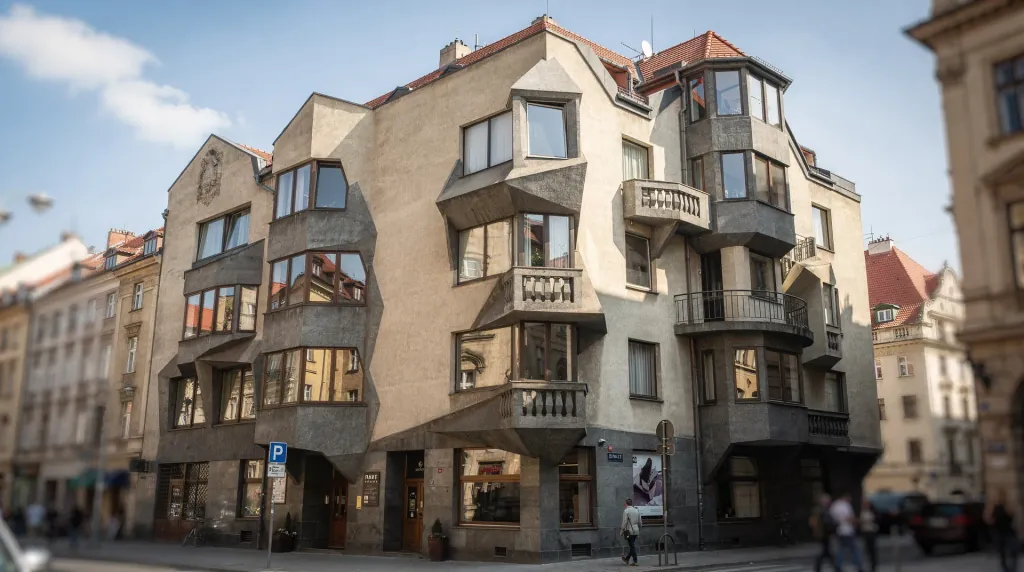
It only happened in one place: Prague. Between roughly 1910 and 1925, a group of Czech architects — Josef Gočár, Pavel Janák, Josef Chochol, Vlastislav Hofman — took Cubist formal principles and applied them to buildings with rigorous seriousness. The diagonal surfaces create dramatic light-and-shadow effects. The angular geometry builds tension into otherwise flat facades. The results are buildings that look like nothing else in architectural history — not Expressionist, not Constructivist, not Baroque: Cubist. Genuinely.
This walk takes approximately 2 hours and covers 6–7 buildings across the Old Town, New Town, and Vyšehrad. The Vyšehrad extension requires a tram; the Old Town–New Town section is walkable in one continuous circuit.
The walk, stop by stop
Stop 1: House at the Black Madonna — Grand Café Orient
Celetná 34, Staré Město | Metro: Náměstí Republiky (line B)
Start here: the defining example and the ground floor contains the Grand Café Orient, the world’s only Cubist cafe. The building was designed by Josef Gočár in 1912. The facade is the place to begin your visual education in Czech Cubism: look at the window surrounds, the pilasters, the cornice line, the way each element is fractured into diagonal planes rather than the smooth curves of Art Nouveau next door (the Powder Gate is visible at the end of the street).
Inside, the Grand Café Orient was restored in 2005 to its original specification — Cubist-designed furniture, light fittings, and woodwork that Gočár designed himself. The furniture is not a reproduction; the patterns come from original drawings. A coffee here is also a visit to the Museum of Czech Cubism (the Czech Museum of Fine Arts occupies the upper floors with a permanent Cubist design collection, entry €8 / CZK 200). The museum is strongly recommended for context before the walk.
Allow 30–45 minutes.
Stop 2: Diamant Building approach — Vodičkova 35
Vodičkova 35, Nové Město | Near Wenceslas Square
Walk south from Celetná toward Wenceslas Square. On Vodičkova, the Diamant Building (1913, Matěj Blecha) shows Cubism in transition — the facade has angular elements applied to what is otherwise a conventional commercial building of the period. Not the purest example, but a useful demonstration of how the style spread into mainstream construction.
Allow 5–10 minutes en route.
Stop 3: Church of the Most Sacred Heart of Our Lord, Vinohrady
Náměstí Jiřího z Poděbrad, Vinohrady | Metro: Jiřího z Poděbrad (line A)
A detour east to Vinohrady is rewarded by Josip Plečnik’s 1932 church — not strictly Cubist but in direct dialogue with it, designed with a monumental clock tower that looks like an abstract Cubist sculpture embedded in the facade. Plečnik was the Slovenian architect who was Josef Gočár’s contemporary at the Vienna school. The church is the largest on this walk and the most austere.
Allow 15 minutes.
Stop 4: Apartment buildings on Rašínovo nábřeží (Vyšehrad)
Rašínovo nábřeží 6-10, Nové Město | Tram: Palackého náměstí
Continue south along the embankment to the Vyšehrad area. Josef Chochol designed three adjacent apartment buildings on Rašínovo nábřeží (nos. 6, 8, and 10) between 1913 and 1914 — the most concentrated group of Cubist residential buildings anywhere in the world. The facade of no. 10 is the textbook Cubist composition: every element — window surrounds, balcony railings, cornices, entrance portal — is redesigned as a system of angular planes. From the Vltava embankment, the buildings create a dramatic angular skyline against the Vyšehrad cliffs above.
Allow 20 minutes.
Stop 5: Kovařovicova Villa
Libušina 3, Vyšehrad | Walking distance from rašínovo nábřeží
A short walk uphill into the Vyšehrad residential area brings you to the Kovařovicova Villa (1912, Josef Chochol) — the finest Cubist private house in Prague. A single-family villa on a corner plot, its garden fence, gate, and all external details are as rigorously Cubist as the building itself. It is a private residence; view from the street only.
Allow 10 minutes.
Stop 6: Triple House — Neklanova Street
Neklanova 30/32/36, Vyšehrad
Two streets below the villa, on Neklanova, Chochol designed a terrace of three connected apartment buildings (1913–1914) whose unified facade is the most dramatic Cubist street composition in existence. Stand at the corner of Neklanova and Vnislavova to get the full perspective: a continuous facade of angular bays, corbelled cornices, and fractured surface that catches the afternoon sun from the Vyšehrad cliff.
Allow 10 minutes.
Stop 7: Diamond House (Dům diamant)
Spálená 4, Nové Město | Metro: Národní třída (line B)
Return to the New Town to end the walk at the Diamond House (1913, Matěj Blecha) — a commercial building on Spálená Street whose facade treatments and entrance portal demonstrate Rondocubism, the final evolution of Czech Cubist architecture. Rondocubism (mid-1920s) softened the hard angles slightly, incorporating semicircular elements into the Cubist vocabulary. It was Czech Cubism’s answer to the French Art Deco movement and the last gasp before modernism ended the whole experiment.
Allow 10 minutes.
Fit for more
The Czech Museum of Fine Arts at the House of the Black Madonna (top of this walk) has a permanent collection of Czech Cubist furniture, ceramics, and painting that provides essential context. Entry €8 (CZK 200). Allow 45–60 minutes.
Cubism versus Prague’s other architectural walks
Cubist Prague is easy to confuse with the city’s other signature styles because the same neighbourhoods overlap. Here is how the angular Cubist stops compare to the two walks most people pair it with:
| Walk | Period | Character | Best paired with |
|---|---|---|---|
| Cubist Prague (this walk) | 1910–1925 | Angular planes, diagonal facades, unique to Prague | Art Nouveau walk — curved forms right next door |
| Art Nouveau walk | 1895–1912 | Flowing lines, floral motifs, Mucha-era decoration | Cubist Prague, since both start near Celetná |
| Gothic Prague | 1230–1500 | Pointed arches, ribbed vaults, medieval mass | Neither — different neighbourhoods and pace |
If you only have time for one architectural theme, Cubism is the more unusual choice — Gothic and Art Nouveau exist in dozens of European cities, but nowhere else built Cubist buildings.
Where Cubism sits in the wider city
The Vyšehrad half of this walk overlaps with the Vyšehrad neighbourhood, worth extending into if the Chochol buildings hook you — the fortress views over the Vltava are a short uphill walk from Neklanova Street. The Old Town half sits inside Staré Město, a five-minute walk from Old Town Square and the Astronomical Clock, so it’s easy to combine this walk with the more conventional sightseeing circuit rather than treating it as a separate day. For getting between the two halves, Prague’s metro system is faster than walking the full 5 km in one go if time is tight.
Practical info
- Start: Grand Café Orient, Celetná 34, Metro: Náměstí Republiky (line B)
- End: Diamond House, Spálená 4, Metro: Národní třída (line B)
- Duration: 2–2.5 hours including Vyšehrad detour
- Distance: approximately 5 km (3 miles)
- Indoor vs outdoor: mostly outdoor; Grand Café Orient is indoor (free to enter as a cafe); Czech Museum of Fine Arts costs entry
- Season: excellent year-round; the angular facades create dramatic shadow patterns in low winter light and early morning summer light
- Accessibility: the embankment route is flat and accessible; the Vyšehrad detour involves a steep uphill section (Libušina street); tram 3, 7, or 17 avoids the climb
Questions about Czech Cubist architecture
Why did Cubism only happen in Prague?
Czech architects in the early 1900s were studying in Vienna under Otto Wagner and his students and were simultaneously aware of the Paris Cubist painting movement. Josef Gočár and Pavel Janák developed a theoretical argument that three-dimensional forms in architecture could embody Cubist principles — the work of multiple planes, angular force, implied motion. Vienna and Berlin architects saw Cubism as purely pictorial; Prague’s architects saw it as structural principle. The movement lasted from roughly 1910–1925 before Modernism absorbed it.
How many Cubist buildings survive in Prague?
Approximately 30–40 buildings with significant Cubist characteristics survive in Prague, predominantly in the Old Town, New Town, and Vyšehrad. The major Chochol buildings on Rašínovo nábřeží and Neklanova Street are all intact and in good condition.
What is Rondocubism?
Rondocubism (also called National Style) is the post-World War I Czech evolution of Cubism, incorporating semicircular (rond = round in Czech/French hybrid terminology) elements and more decorative surface treatment. It was a nationalistic architectural movement — Czech architects wanted a distinctively Czech style after independence in 1918. The Diamond House and the Legiobank on Na Příkopě are major examples.
Can I go inside the Cubist buildings?
The Grand Café Orient is a working cafe (enter freely). The Czech Museum of Fine Arts is ticketed. The Chochol apartment buildings and villa are private residences — view from street only. The Diamant building has commercial tenants on the ground floor.
Is there a Cubist museum in Prague?
The Czech Museum of Fine Arts, housed in the House at the Black Madonna (Celetná 34), has a permanent collection dedicated to Czech Cubist art, architecture, and design. It is the only museum in the world entirely devoted to Cubism applied to three-dimensional objects and spaces.
Is the Cubist walk suitable for kids?
It works best for older children and teenagers with some patience for architecture, since the appeal is mostly visual and historical rather than interactive. Younger children tend to get more out of the Old Town Square area, where the Astronomical Clock show gives them something to watch on the hour.
How does Cubist Prague compare to Gothic Prague as a first walk?
They cover different eras and different neighbourhoods, so neither replaces the other. If forced to choose one, first-time visitors usually get more immediate reward from Gothic Prague — St. Vitus Cathedral and Charles Bridge are must-sees regardless — and save the Cubist walk for a second or third day when the city’s mainstream sights are already covered.
Go deeper
Prague: private Cubism and Art Nouveau walking tour — a specialist private guide covering both architectural movements with expert architectural commentary.
Prague Art Nouveau tour — the complementary walk; covers the Art Nouveau buildings that stand beside and behind the Cubist ones.