At a glance
| Where | Starts at Museum of Communism (Na Příkopě), ends at Letná Park plinth |
| Cost | Museum of Communism around €14 / 355 CZK; Žižkov Tower around €13 / 330 CZK; rest free |
| Time needed | Around 3–3.5 hours with the museum, 2 hours without |
| Getting there | Metro Náměstí Republiky or Můstek (lines A/B) to start |
| Best time | Year-round; autumn light suits the Letná plinth especially well |
Forty-one years that changed everything and left scars
Czechoslovakia came under Communist rule in February 1948 — the so-called Victorious February, when the Communist Party staged a coup within a coalition government. The period that followed, until the Velvet Revolution of November 1989, was 41 years of single-party rule, surveillance, censorship, collectivisation, and periodic political violence.
The physical traces are everywhere in Prague if you know where to look. Some are monumental absences — the empty Letná plinth where the world’s largest Stalin statue stood until 1962. Some are embedded in the architecture — the grotesque Žižkov Television Tower, built in the 1980s partly to block Radio Free Europe signals. Some are institutional — the Museum of Communism, housed with deliberate irony in a building that now contains a McDonald’s and a casino. And some are still being reckoned with: mass graves, rehabilitations, ongoing archival work.
This walk does not treat the Communist period as entertainment. It treats it as recent, complex, formative history — the context for why Prague looks the way it does and why Praguers feel the way they feel about politics.
The walk, stop by stop
Stop 1: Museum of Communism
Na Příkopě 10, Nové Město | Metro: Náměstí Republiky or Můstek (lines A+B)
Begin with the museum. The Museum of Communism opened in 2001, founded by American entrepreneur Glenn Spicker and Czech historian Jan Kaplan. Its location — above a McDonald’s and next to a casino in a 19th-century Baroque palace on the city’s main commercial street — is either grimly ironic or perfectly intentional, depending on your perspective.
The permanent exhibition covers the full arc of the Communist period: the 1948 coup, the Stalinist show trials of the 1950s (the Milada Horáková trial, in which she was executed), the 1968 Prague Spring and Soviet invasion, the Charter 77 dissident movement, and the 1989 Velvet Revolution. The exhibition uses original objects, photographs, and reconstructed environments — a Communist-era school classroom, an interrogation room — to convey daily life rather than just political narrative. Admission: €14 (CZK 355). Allow 60–90 minutes.
Stop 2: Wenceslas Square — the site of 1969
Václavské náměstí, Nové Město | Metro: Muzeum (lines A+C)
Walk from the museum five minutes to Wenceslas Square. The square is the epicentre of modern Czech political history. On 16 January 1969, student Jan Palach set himself on fire here in protest against the Soviet occupation following the 1968 invasion. He died three days later. A memorial plaque near the National Museum upper end of the square marks the approximate spot. Another student, Jan Zajíc, did the same a month later.
The square was also the site of the great demonstration of November 1989 (covered in the Velvet Revolution walk). In Communist Prague, Wenceslas Square’s commercial function continued — the department stores operated, the trams ran — but the political implications of the space were permanently charged.
Allow 15–20 minutes.
Stop 3: Národní třída (Národní 17) — the November 17 memorial
Národní 16, Nové Město | Metro: Národní třída (line B)
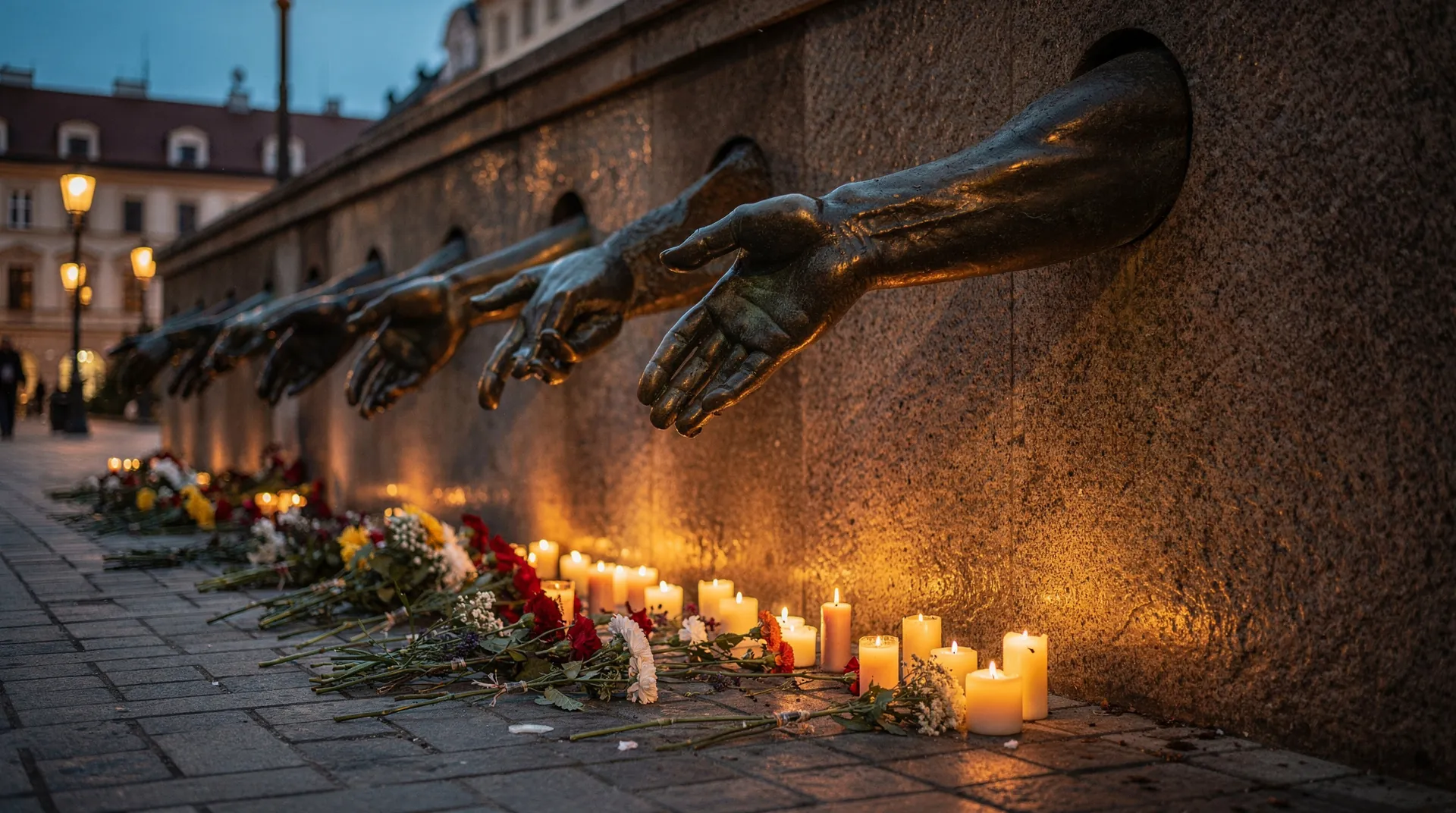
Walk west to Národní Street. In the passage at no. 16, a row of bronze hands reaching out from the wall marks the spot where riot police attacked student demonstrators on 17 November 1989 — the event that triggered the Velvet Revolution. The memorial is simple and physical: cast bronze limbs emerging from the stone wall, reaching outward as if appealing to passers-by. Many Praguers leave flowers here.
Allow 10 minutes.
Stop 4: Former State Security (StB) headquarters
Bartolomějská 4, Staré Město | Metro: Národní třída (line B)
Two streets north of Národní, the building at Bartolomějská 4 is one of Prague’s most important and least-visited sites. It was the headquarters of the Státní bezpečnost (StB) — the Czechoslovak secret police — until 1989. It subsequently became a police station and then briefly housed a hotel (with great publicity: former interrogation cells as guest rooms). The building is now back in administrative use. There is no public museum access, but standing outside it and knowing its function is an act of historical confrontation.
Allow 10 minutes exterior.
Stop 5: Žižkov Television Tower
Mahlerovy sady 1, Žižkov | Metro: Jiřího z Poděbrad (line A) + 15-min walk, or tram 5/9/26
The Žižkov Television Tower is the most controversial building in Prague’s skyline. Built between 1985 and 1992, it was designed by architect Václav Aulický in a form that critics called brutally imposing — 216 metres of reinforced concrete legs supporting a central tower, visible from anywhere in the city. Its original construction was partly motivated by the desire to interfere with foreign radio broadcasts (Radio Free Europe was based in Munich until 1994).
The Czech-German artist David Černý added ten giant crawling baby sculptures to the tower’s legs in 2000 — figures with camera lenses for faces, crawling upward. They are now inseparable from the tower’s identity. An observation platform at 93 metres has a restaurant and cafe; the views over Prague are excellent. Entry: €13 (CZK 330).
Allow 45 minutes including transit.
Stop 6: Vítkov Memorial
U Památníku, Žižkov | Metro: Florenc (lines B+C) + 15-min walk
The Vítkov Memorial is a grim architectural relic of the Communist period. Completed in 1950 on a hill above Žižkov, it was intended as a monument to the 1420 Hussite victory in the Battle of Vítkov Hill and became, under the Communists, a mausoleum for Klement Gottwald — the first Communist president of Czechoslovakia, who died in 1953. Gottwald’s embalmed body was displayed here until 1962, when it began to decompose and was cremated. The building now contains a permanent exhibition on 20th-century Czech history. The equestrian statue of Jan Žižka at the entrance is one of the largest bronze equestrian statues in the world.
Allow 30 minutes.
Stop 7: Letná Park — the empty plinth
Letenská pláň, Holešovice | Tram: Čechův most
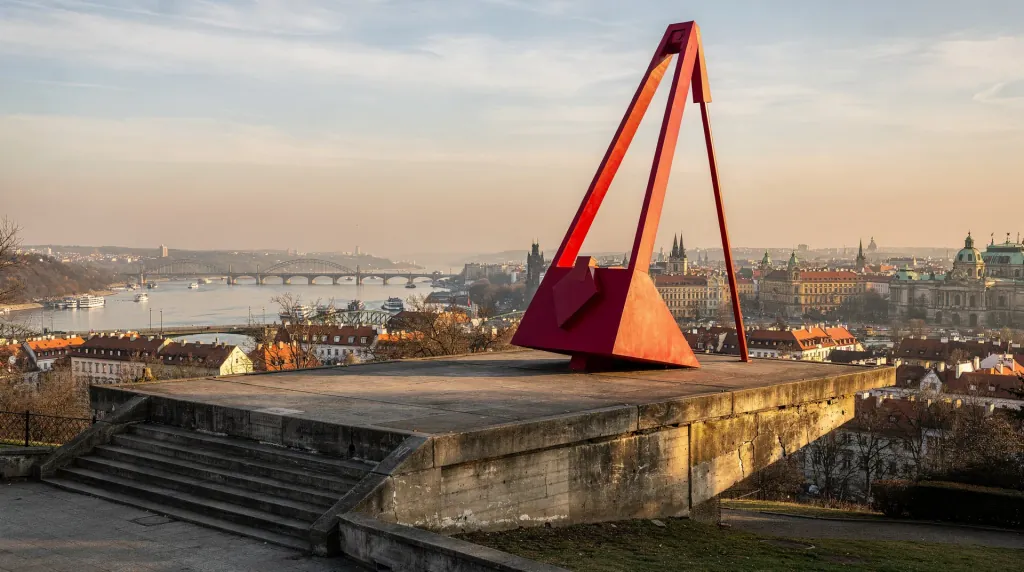
The walk ends at Letná Park’s famous empty plinth. Between 1955 and 1962, the largest monument to Josef Stalin in the world stood here — 14,000 tonnes of granite, 30 metres tall, depicting Stalin leading a procession of Czech and Soviet workers. It was dynamited in 1962 after Khrushchev’s de-Stalinisation programme made it embarrassing. The enormous granite pedestal remains — too large to remove — and stands empty, looking out over Prague.
David Černý installed a giant red metronome here in 1991 — it still ticks, a post-Communist commentary on time. The plinth and the metronome have become the defining image of Prague’s relationship with its Communist past: the absence is the monument.
Allow 20 minutes. Enjoy the view over the city from the park terrace.
Fit for more
The nuclear bunker tour (under Parukářka Park in Žižkov, or the city centre bunker) is a 2-hour guided experience through an actual Cold War-era nuclear shelter maintained in operating condition. GYG has this listed separately; it is strongly recommended as a complement to this walk.
Practical info
- Start: Museum of Communism, Na Příkopě 10, Metro: Náměstí Republiky (line B) or Můstek (A+B)
- End: Letná Park plinth, tram back to centre: Čechův most (trams 1, 8, 25, 26)
- Duration: 3–3.5 hours with museum, 2 hours without
- Distance: approximately 7 km (4.5 miles) including Žižkov detour
- Indoor vs outdoor: Museum of Communism and Žižkov Tower observation are indoor/ticketed; the rest is outdoor
- Season: year-round; the Letná plinth and park terrace are particularly striking in autumn (October–November)
- Accessibility: Wenceslas Square and Národní are flat and fully accessible; Vítkov and Letná involve uphill walks (alternative: tram/taxi to each)
Questions about Communist-era Prague
How did everyday life differ under Communism in Czechoslovakia?
Housing was state-allocated, employment was effectively guaranteed (and compulsory), private enterprise was abolished, and the media was state-controlled. The consumption of Western media — music, film, literature — was restricted and monitored. Travel abroad required official permission. The 1950s Stalinist period included show trials and executions; the 1960s saw a cultural relaxation (the Prague Spring); the 1970s–1980s normalization period returned to repression after the 1968 Soviet invasion.
What was the Prague Spring of 1968?
The Prague Spring was a period of political liberalisation under Communist Party leader Alexander Dubček, beginning in January 1968. Dubček’s programme of “socialism with a human face” included freedom of the press, rehabilitation of political prisoners, and decentralisation of power. It ended on 21 August 1968 when Soviet-led Warsaw Pact forces invaded Czechoslovakia. The occupation lasted until 1991.
Who was Jan Palach?
Jan Palach was a 20-year-old Czech student who set himself on fire on Wenceslas Square on 16 January 1969 to protest the passivity of Czechoslovak society following the Soviet invasion. He died on 19 January. He became a symbol of individual resistance to totalitarianism; his funeral attracted 150,000 people to the streets of Prague. A national holiday marks his death.
What happened to the Museum of Communism building under the regime?
The palace at Na Příkopě 10 was used by Communist-era state agencies. The building’s post-1989 transformation — a museum to Communism in a palace that now shares a building with McDonald’s and a casino — is a condensed summary of Prague’s chaotic post-Communist capitalism.
Can I visit the nuclear bunker?
Yes, through guided tours (GYG has listings for the Communism and Nuclear Bunker tour). The bunker under the city centre and the larger shelter under Parukářka Park both run guided visits. The experience is genuine — maintained Cold War infrastructure — not a reconstruction.
How this walk relates to the other history walks
This route focuses on the physical infrastructure of the regime — the museum, the secret police headquarters, the tower, the plinth. For the specific week of events that ended Communist rule, the dedicated Velvet Revolution sites walk covers Národní třída and the other 1989 locations in more depth than the single stop here allows. If your interest runs earlier, to the pre-war and wartime period, the Jewish heritage walk and a day trip to Terezín cover the Nazi occupation years this walk doesn’t touch.
| Walk | Focus | Best for |
|---|---|---|
| Communist-era Prague (this walk) | 1948–1989 infrastructure and monuments | First-time visitors wanting the full arc of the regime |
| Velvet Revolution sites | The 1989 transition itself | Visitors specifically interested in the revolution’s week |
| Jewish heritage | Pre-war Jewish Prague and the Holocaust | Visitors prioritising 1930s–40s history over Cold War history |
How does this walk compare to just visiting the Museum of Communism alone?
The museum gives you the narrative and artefacts; the walk gives you the physical geography — seeing the actual Wenceslas Square pavement, the actual StB building, the actual empty plinth makes the history tangible in a way a single museum visit doesn’t. If you only have an hour, the museum alone is the higher-value single stop; if you have three, the full walk adds a dimension the museum can’t.
Go deeper
Prague: Communism history and nuclear bunker guided tour — extends this walk with access to an actual Cold War bunker.
Prague: 2-hour back to Communism walking tour — a specialist guided walk covering the political and physical legacy of the regime.